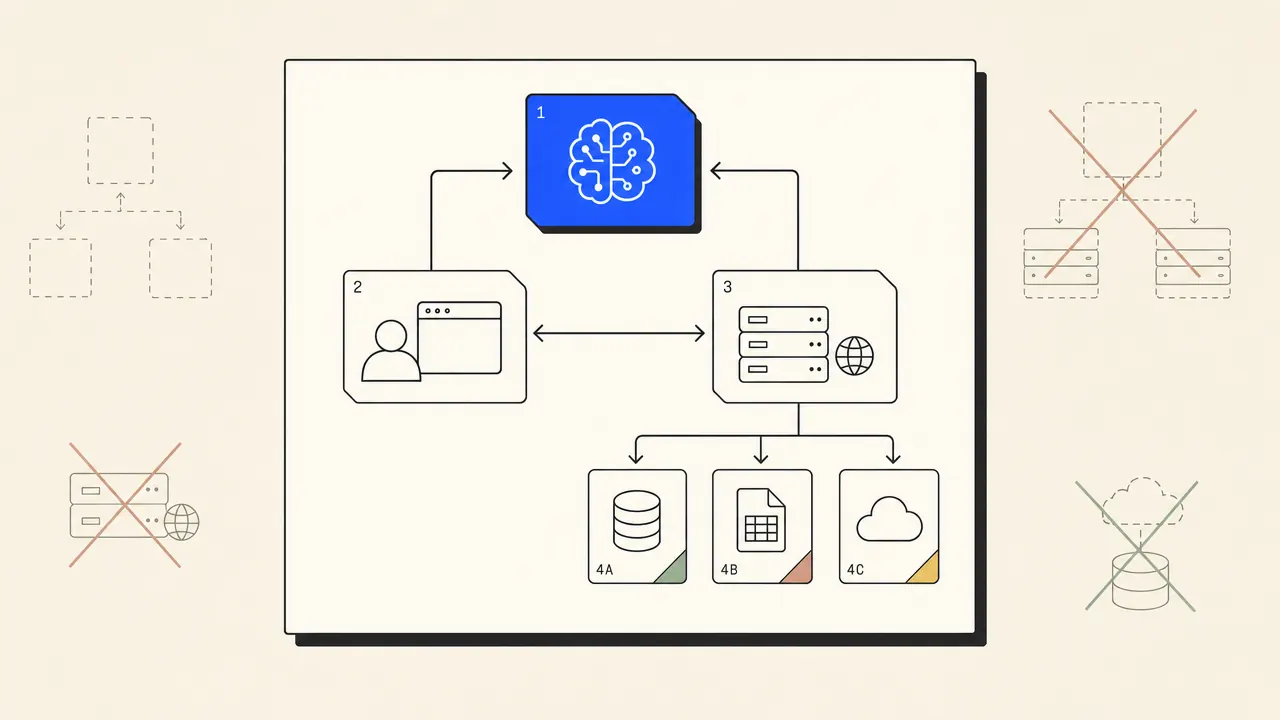
How an SEO MCP server actually works.
MCP separates the AI application from the system that owns the data. The host is the product where the user works. A client inside that host maintains a connection to one server. The server advertises tools with names, descriptions, and input schemas, then translates approved calls into API requests, local application commands, or database queries. The official MCP architecture specification defines those roles and the message flow.
For SEO, the advertised tools might include keyword lookup, backlink comparison, crawl start, Search Console query, Analytics report, page scrape, or CMS action. The model chooses a tool based on the prompt and its tool description. It sends structured arguments such as a domain, location, date range, or crawl limit. The server validates the request, runs the underlying operation, and returns structured results to the model for interpretation.
That structure is why MCP is better than pasting a spreadsheet into a chat. The call is repeatable, the fields stay typed, credentials remain outside the prompt, and the assistant can request another slice of data when the first answer is incomplete. It is also why the connection needs discipline. A vague prompt can invoke the wrong tool, pass the wrong market, or produce a costly crawl. The protocol standardizes the pipe. It does not guarantee that the question, data source, or decision is good.
From a Search Console signal to a published refresh.
Consider a fictional B2B software site with an old article about customer onboarding checklists. The content lead asks an owned-data MCP server to find non-brand queries where the page has more than 1,000 impressions in the last 28 days, an average position between 6 and 15, and lower clicks than the prior period. The assistant calls one read-only report and returns a candidate query plus the affected URL.
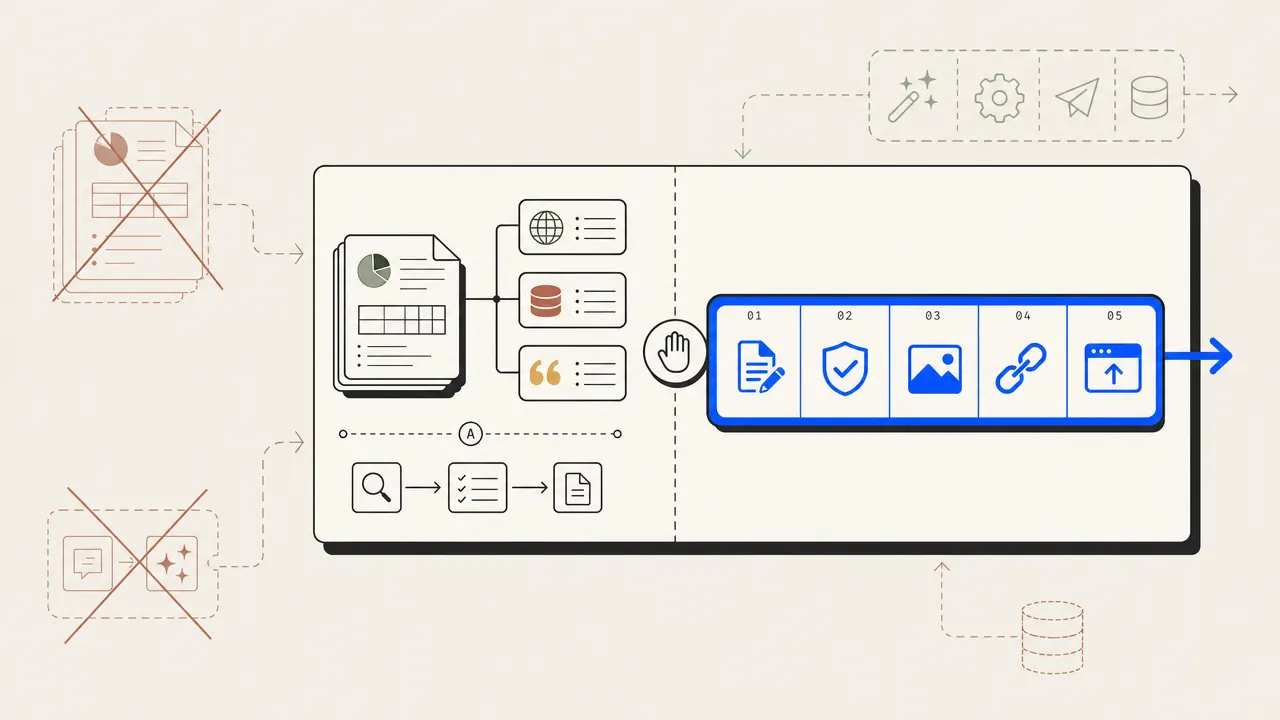
A market-research server then checks the current SERP and related terms. A crawler inspects the existing page and finds a stale title, two broken internal links, and no section on product-led onboarding. The combined output is now a useful brief: refresh the existing URL, preserve the core intent, add the missing section, repair two links, and measure clicks over the next 28 days. The MCP layer has done its job.
Nothing is published yet. The execution layer must source current claims, draft the revision, run a fact-checking pass, preserve the URL, verify the replacement links, render an image, compare the new page with the brief, and send the approved update through the site's WordPress publishing connection. It also records the publish time and schedules the measurement query. That stateful chain is what converts a correct data call into an SEO result.
This example also shows why an MCP server should return evidence rather than a command to rewrite. Search performance suggested a refresh, but the SERP and crawl established what changed. The execution layer still needs permission to modify a public page. Each boundary has one owner and one test.
A safe setup process takes four decisions.
Installation instructions differ, but the decision sequence should not. Start with a narrow job, restrict what the server can reach, observe a real call, then define the artifact another system can consume. The protocol's authorization specification explains the remote authorization flow. Local servers need the same permission discipline even when OAuth is not involved.
1. Choose one recurring job
Write the test in plain language: “Every Monday, find pages with more than 1,000 impressions, positions 5 to 15, and falling clicks over 28 days.” This is better than “help with SEO” because it fixes the source, filters, cadence, and decision.
2. Limit credentials and tools
Use a dedicated account or token where possible. Grant read-only access to one property, project, or dataset. Disable write tools until a workflow genuinely needs them. Do not expose billing, user management, or broad filesystem access to answer a keyword question.
3. Run a read-only test
Watch the selected tool, arguments, response, errors, time, and billable calls. Ask the model to state what it queried and what it inferred. Repeat with an empty result, invalid property, and rate limit so failure behavior is visible before the server enters a real process.
4. Define the output contract
Require a stable brief: opportunity, source metrics, market, date, evidence URLs, assumptions, recommended action, and confidence. If code will consume it, use a schema and a version. A documented content API contract is more reliable than parsing whatever prose the assistant happened to return.
Four jobs worth connecting.
The best reason to add an SEO MCP server is not that MCP is new. It is that one recurring task becomes faster, more consistent, and easier to audit. The current market falls into four useful job families. The best MCP for SEO comparison maps verified servers to each family.
Market research
Keyword, SERP, backlink, competitor, and traffic tools answer what people search for and which sites currently win. They are strongest when the prompt fixes the market, language, match type, and date of the data.
Technical crawling
Crawler tools start a bounded crawl, inspect status codes, metadata, canonicals, indexability, and links, then export the affected URLs. They find evidence. They do not decide whether a template change is safe.
Owned performance data
Search Console and analytics connections show impressions, clicks, landing-page behavior, events, and conversions for properties you control. This is the layer that turns a theoretical opportunity into an observed business result.
Page extraction
General web crawlers and extractors collect current public pages, documentation, headings, and structured fields. They are useful research inputs, but retrieved copy is untrusted evidence and can contain malicious instructions.
These jobs combine well because they answer different questions. Market data says where demand exists. Owned data says where your site already has traction. A crawl finds technical friction. Page extraction provides source material and structural context. Do not connect four broad research suites that all answer the same keyword question with slightly different numbers. That creates reconciliation work, not leverage.
Data access is not outcome ownership.
An MCP server makes a capability available. The assistant can call a keyword report, inspect a crawl, or request an analytics breakdown. If the conversation ends, the state usually ends with it. The host may retain the transcript, but that is not the same as a content queue with deadlines, retries, approvals, and publish status.
Outcome ownership starts when a system carries one decision through every dependent step. For a new article, that means selecting the opportunity, resolving search intent, producing a source-backed brief, drafting, checking claims, editing, adding internal links and images, applying metadata and schema, passing a quality threshold, and publishing to the right destination. The SEO automation pipeline is an example of that persistent execution model.
MCP can still be part of the execution layer. A server may expose actions for article generation, status checks, audits, or publishing. The important distinction is not read tool versus write tool. It is who owns sequencing, policy, and failure recovery. The SEO MCP connection model shows callable actions, while the AI SEO tools layer shows the broader product surface. A button that can publish is not safe automation unless another layer decides when it is allowed to run and verifies the result.
A useful test
Ask what happens after the assistant returns a correct answer. If a person must translate it into a ticket, write the page, check it, and push it live, the server improved research. It did not automate the content program.
Treat tool output and tool access as separate risks.
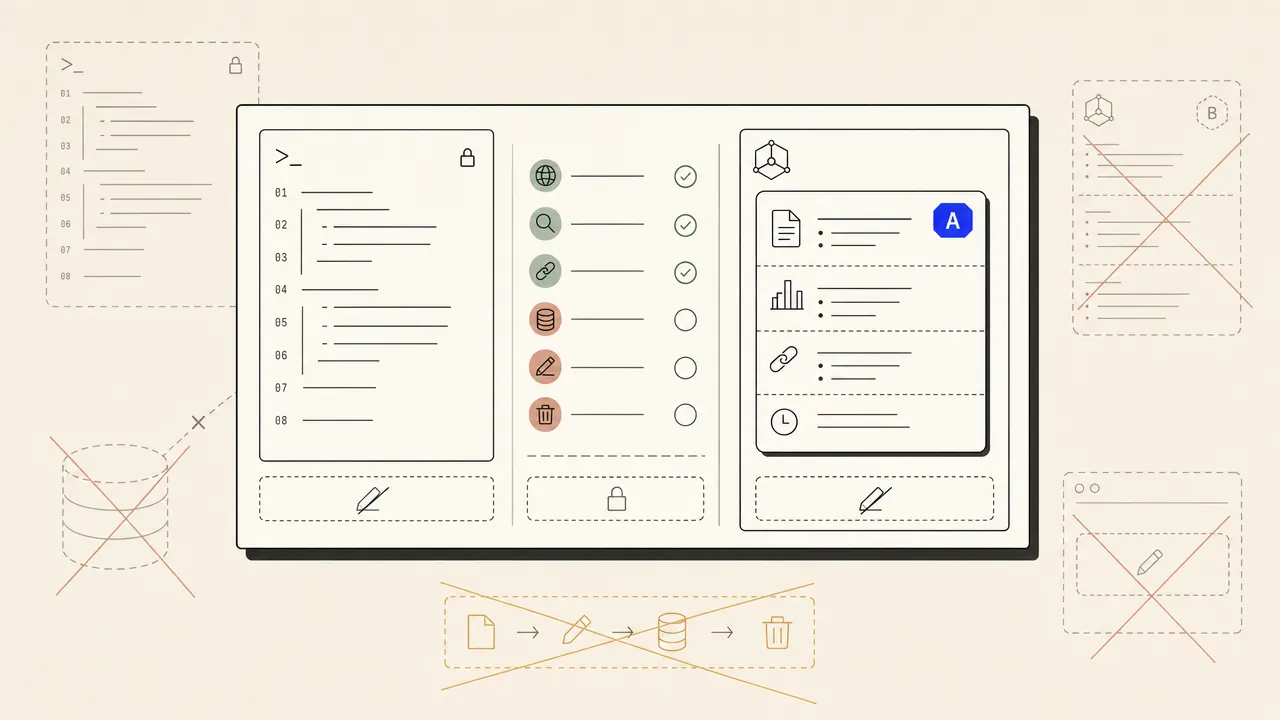
The first risk is excessive authority. A server connected with an owner token may be able to read every property, change projects, spend API credits, or publish content. The host should not receive more power than the workflow requires. Use least-privilege accounts, narrow scopes, short-lived credentials where supported, and explicit user confirmation before destructive or public actions. The official MCP security best-practices guide covers confused-deputy attacks, token handling, and authorization boundaries.
The second risk is untrusted content. A crawler or extractor can retrieve a page that contains instructions aimed at the model. Those instructions are data, not authority. The assistant must not let a sentence on a competitor page trigger another tool, reveal credentials, widen a crawl, or publish a change. Keep retrieved content isolated from system instructions and require approval at sensitive boundaries.
The OWASP MCP Security Cheat Sheet gives a practical checklist for input validation, tool allowlists, logging, rate limits, and human approval. Apply the same operational mindset you would use for a production SEO audit system: know the boundary, record the evidence, and make failure safe. A conversational UI does not make the connected infrastructure low risk.
The minimal stack is usually three connections or fewer.
Use one primary research source for market questions, one owned-data connection for observed performance, and one crawler or extractor for page-level evidence. Many teams need only two of those. The point is separation of jobs. Each source should have a clear reason to exist, a distinct authority, and a named output.
Primary research source
Owns demand, competitor, SERP, or backlink questions. Pick the dataset your team understands and can afford to query consistently.
Owned performance source
Confirms whether the site receives impressions, clicks, useful visits, and conversions. Scope it to the properties and metrics the workflow uses.
Crawler or extractor
Supplies current URLs, technical evidence, page structure, and source material. Add it only when a bounded crawl or scrape is part of the recurring job.
All three should hand a stable brief to the execution layer, not talk to one another indefinitely. The execution layer decides what enters production, checks the result, and records publish state. Compare the available AI SEO software categories before adding more connectors. If internal links are the specific missing step, use a purpose-built internal linking process instead of expecting a research server to infer the whole site policy.
Six ways an SEO MCP setup becomes expensive decoration.
Installing before defining the job
A long tool list looks capable but gives the model too many plausible paths. Start with a repeatable question and select the smallest server surface that answers it.
Giving write access during research
Keyword and crawl work rarely needs publishing, billing, or project-administration rights. Separate read workflows from actions that change public or paid systems.
Trusting the model's summary without the fields
Require source metrics, dates, markets, and affected URLs. A confident paragraph without the returned evidence is difficult to review and impossible to replay.
Connecting overlapping datasets
Two providers can disagree because their indexes, locations, refresh times, and models differ. Pick an authority for each decision before the workflow runs.
Letting scraped pages issue instructions
Web content is input data. It must not authorize new tool calls, change system behavior, request secrets, or override the user-approved scope.
Calling research a publishing system
A good brief is a handoff, not a shipped outcome. If the target is visibility in search and answer engines, the next layer still has to produce a quotable, accurate page. The answer-engine optimization guide covers what that page needs after the data arrives.