The 10 best LLM SEO tools in 2026.
A language model runs four steps before it names anyone: fetch the page, keep it, retrieve it, cite it. The ten tools below are ranked by which of those steps they touch rather than in a straight best to worst line, with real August 2026 prices and one honest flaw each. Six of them measure the last step. One works on the step that changes it.
Which LLM SEO tool should you pick?
Pick by pipeline layer. Supply, meaning the pages a model can reuse: TheSEOAgent at $99/mo flat, one fact-checked article a day. Access: Scrunch AI, free audit first, $300/mo after. Demand: AlsoAsked, free credits then $12/mo, and Semrush prompt research if you already pay for the suite. Citation: Otterly.AI from $29/mo for founders, Peec AI for marketing teams, Rankscale from about 20 euros for ten models, Profound for enterprise, Ahrefs Brand Radar from $398/mo per index. Free baseline: HubSpot AI Search Grader. Only the supply layer changes the number the others report.
The SEO Agent writes pages large language models can reuse: a direct answer, sourced statistics and consistent naming, published to your site every day. Enter your site to start.
Free trial · Cancel in one clickThe shortlist, scannable in ten seconds.
- 01The SEO AgentBest for supply
- 02Scrunch AIBest for page access
- 03AlsoAskedBest demand research
- 04ProfoundBest enterprise tracker
- 05Peec AIBest for marketing teams
- 06Otterly.AIBest budget tracker
- 07RankscaleBest model coverage on a budget
- 08Ahrefs Brand RadarBest suite add-on (Ahrefs)
- 09Semrush AI VisibilityBest suite add-on (Semrush)
- 10HubSpot AI Search GraderBest free starting point
How we picked these ten.
Search for LLM SEO tools and you get ten dashboards that all answer the same question: is the model saying our name. Useful once, not ten times. So we ranked this list by the pipeline a model actually runs. Access is whether a crawler can read your page. Supply is whether a page worth quoting exists. Demand is what people ask assistants in the first place. Citation is the scoreboard at the end. Read the layer tag above each entry as the real ordering key; inside a layer, the order is team fit and price. The mechanics of each layer are broken down on our LLM SEO explainer.
The editorial position, stated plainly because we have a stake in it: we build the tool at number one, and it is there because supply is the only layer where doing something changes the outcome. The research backs the emphasis rather than the ranking. The Princeton GEO benchmark measured quotations, statistics, and cited sources as the strongest visibility levers, and a 768,000-citation study found comparison-shaped content taking up to 70% of AI citations. Both point the same way: what you publish decides what gets quoted. Every price on this page was read off the vendor's own pricing page in August 2026, and the vendors that hide pricing behind a call are labelled as such. No affiliate links, no sponsored slots, and no outbound links to the tools listed: the screenshots are the proof. For a different cut of the same market, see our ranked list of GEO tools or the AEO tools list.

The SEO Agent
Producing the pages a model can actually pull from.
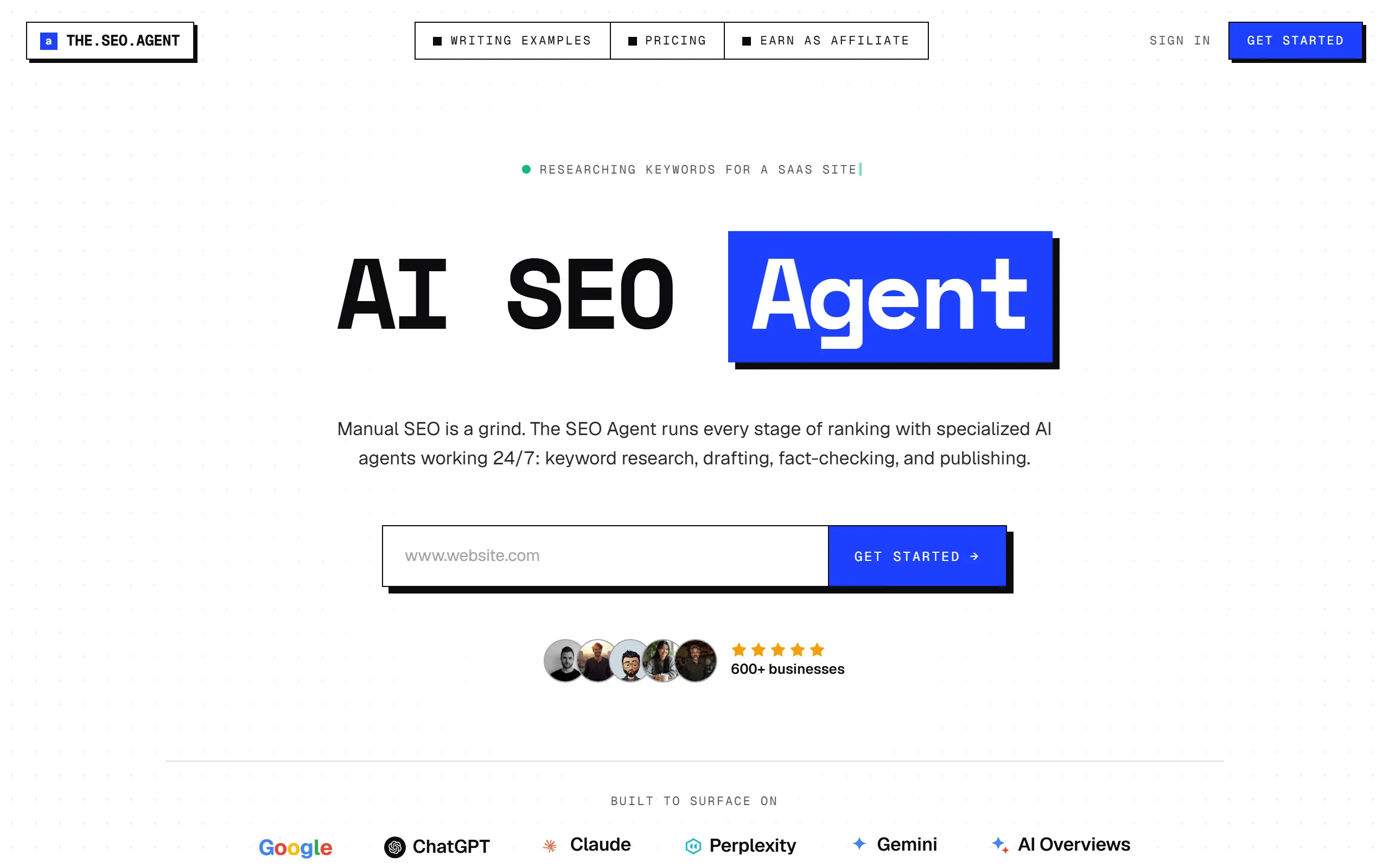
$99/mo flat, one site. Writes one fact-checked article a day: a direct answer in the first 50 words, a named source on every statistic, consistent entity naming, FAQ and article schema, published natively to WordPress, Webflow, Shopify, Wix, or Ghost. Free trial, one-click cancel.
A language model can only reuse text that exists, is fetchable, and reads as a source. Nine of the ten tools on this page work on the second and third of those. This one works on the first, which is the only part with a marginal cost attached when a human does it.
Our LLM SEO page documents the levers it applies per article: a standalone answer block near the top, a source URL forced onto every statistic the draft states, one entity name used the same way throughout, and schema on the page before it ships. Those are the properties that decide whether a retrieval step returns your paragraph or somebody else's. The cadence matters as much as the shape: thirty pages a month at $99 flat is a corpus, and one page a quarter is not.
No citation dashboard of its own. Pair it with a tracker from the bottom half of this list once there are pages worth measuring.
Scrunch AI
Finding out what an AI crawler actually retrieves from your site.
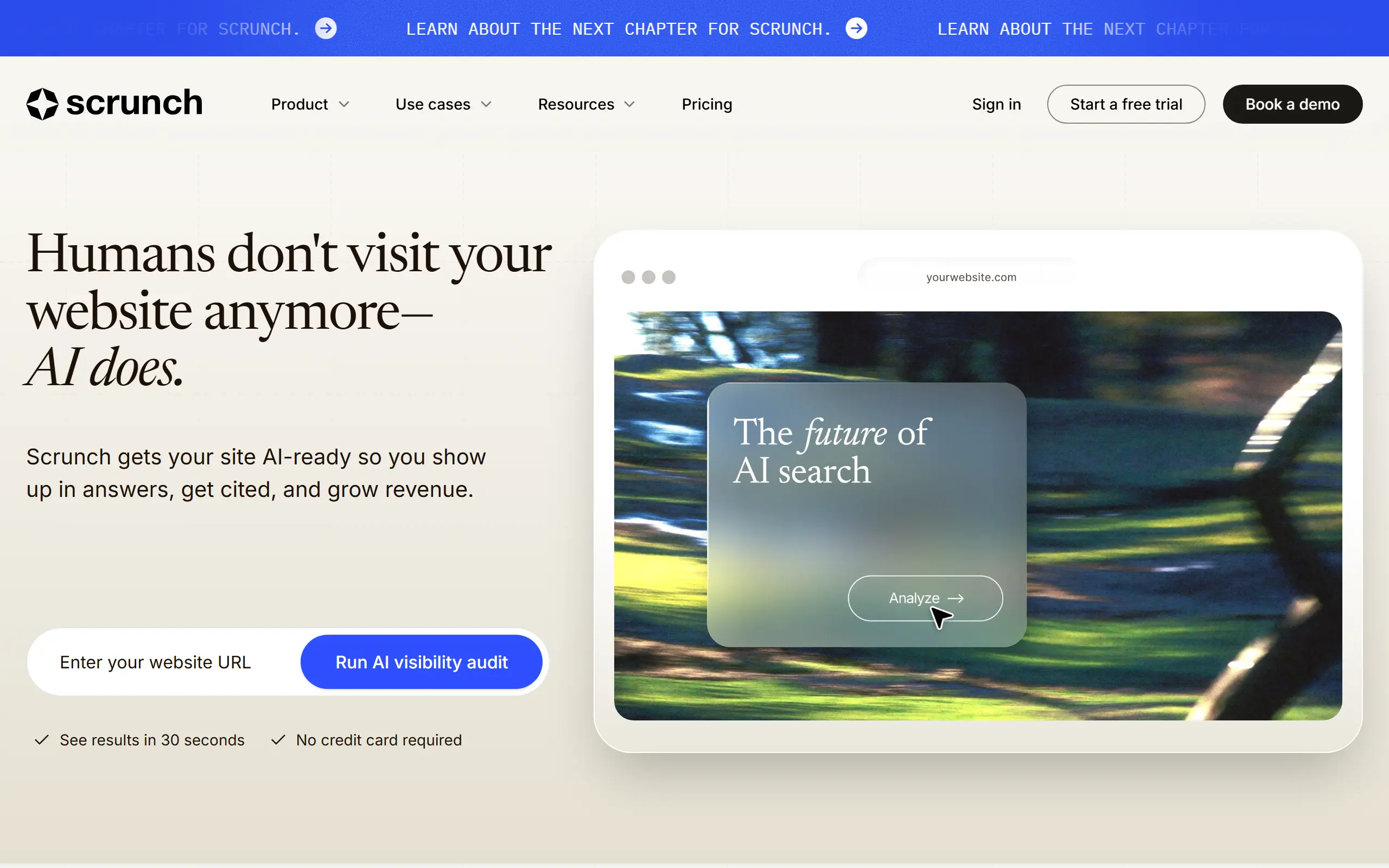
Starter $300/mo month-to-month ($250 annual), Growth $500/mo ($417 annual), Enterprise on quote. Free AI visibility audit from the homepage. Monitors how assistants fetch, read, describe, and cite your pages.
Before a model can prefer your page it has to be able to read it. Scrunch works that layer: what an assistant retrieves when it fetches your URLs, whether the answer is in the HTML or arrives only after client-side rendering, and where the models are describing your product wrongly because the page never said it plainly. The free audit on the homepage is a worthwhile ten-minute diagnostic before you spend anything anywhere on this list.
The paid product is priced for companies defending a brand rather than growing a blog. At $300 a month it costs three times a daily publishing cadence, so the sane order is: run the free audit, fix what it surfaces on the templates, build coverage, then buy the platform if there is still a narrative worth monitoring. Access problems are usually a handful of template fixes, not a subscription.
Entry tier is $300/mo, and most of the diagnostic value front-loads into the free audit.
AlsoAsked
Mapping the question space before you write a single page.
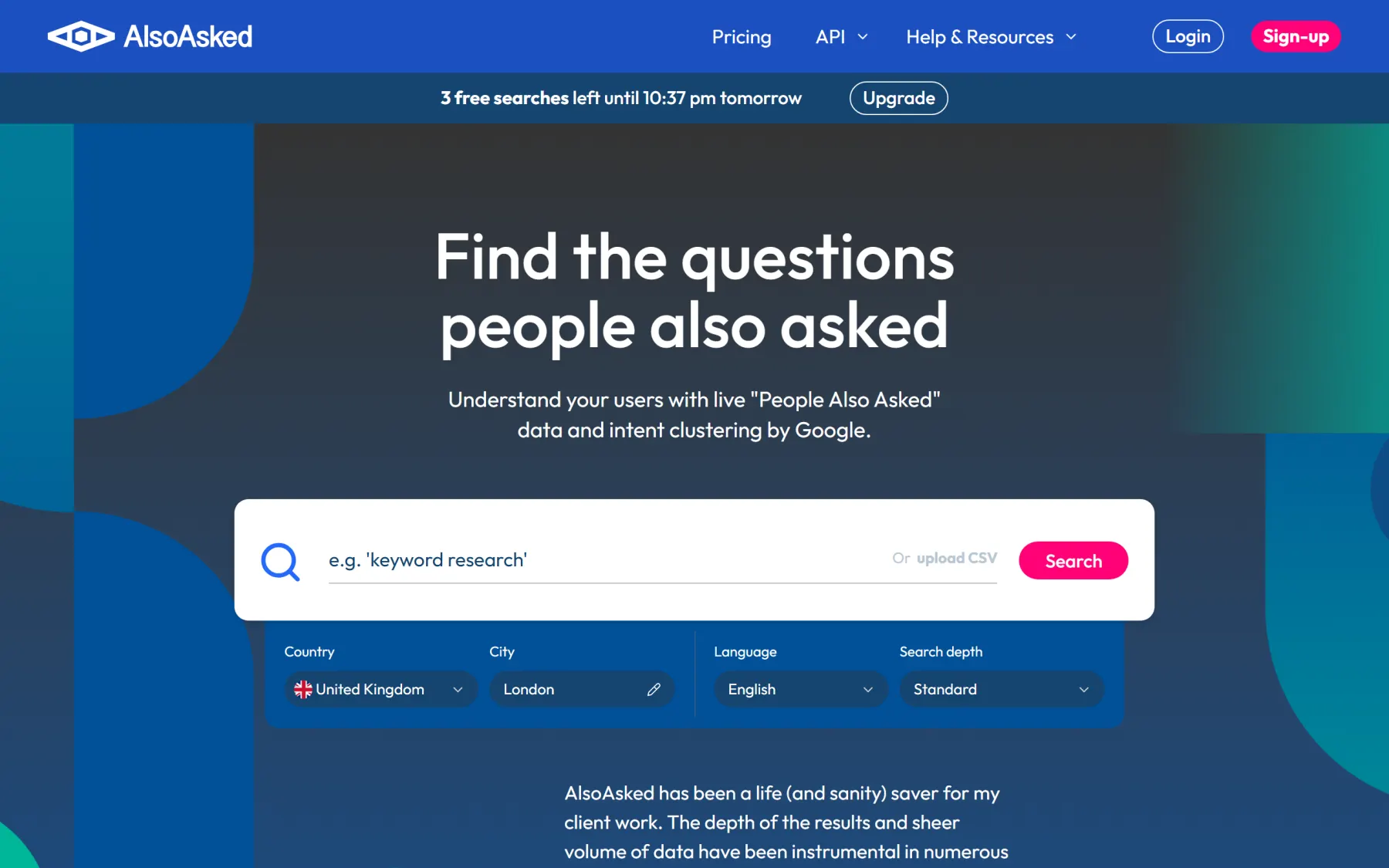
Free credits without an account. Paid from $12/mo (100 credits), $23/mo (300), $47/mo (1,000). Renders live People Also Ask trees by country, city, and language, with intent clustering and CSV export.
Assistants get asked questions, not keywords, and AlsoAsked is still the cleanest way to see the real shape of one. Enter a seed and it draws the question tree several levels deep: what people ask, what follows once they ask it, and what follows that. As a proxy for the prompt space in your category it is imperfect and it is also the cheapest one available.
It is deliberately narrow: no scoring, no editor, no tracking, and credits burn quickly on broad seeds. The export is an input, not a deliverable: paste it into a chat assistant and group it with the clustering prompt in our guide on how to use ChatGPT for SEO. The tree tells you which twenty questions deserve a page, and something still has to write those twenty pages, which is the handoff an automated content pipeline exists to absorb.
Research only. No output, no tracking, and credits disappear fast on broad seeds.

Profound
Enterprise teams that need the deepest answer-engine dataset.
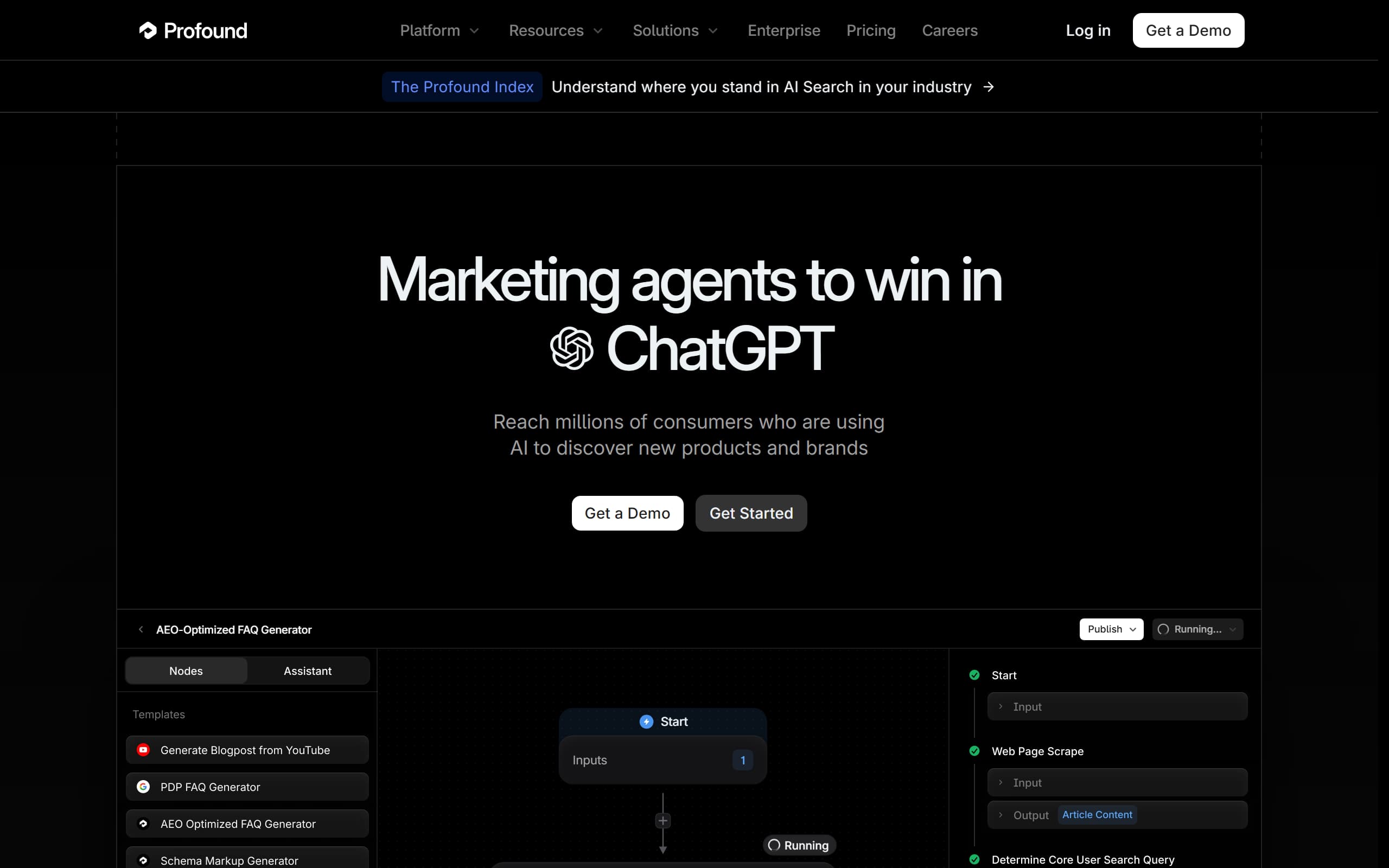
Demo-gated enterprise pricing. Large prompt panels across ChatGPT, Perplexity, and AI Overviews, with share-of-voice trends, per-page citation attribution, and analytics on traffic from AI agents.
Profound is the name most enterprise shortlists open with and the depth is real: wide prompt panels, competitor share of voice over time, and attribution down to the page that earned the citation. It has also moved earliest into the surfaces that arrive next, including shopping answers and traffic that comes from agents rather than people.
The posture is the trade-off. Pricing sits behind a demo call and reviewers place it at the top of the category range. Pointed at a thin site it will report a flat line accurately and expensively, which is the sequencing argument we make in full on the AI search optimization page.
Demo-gated enterprise pricing. Overkill until you publish at volume.
Peec AI
Marketing teams that want daily tracking without a sales call.
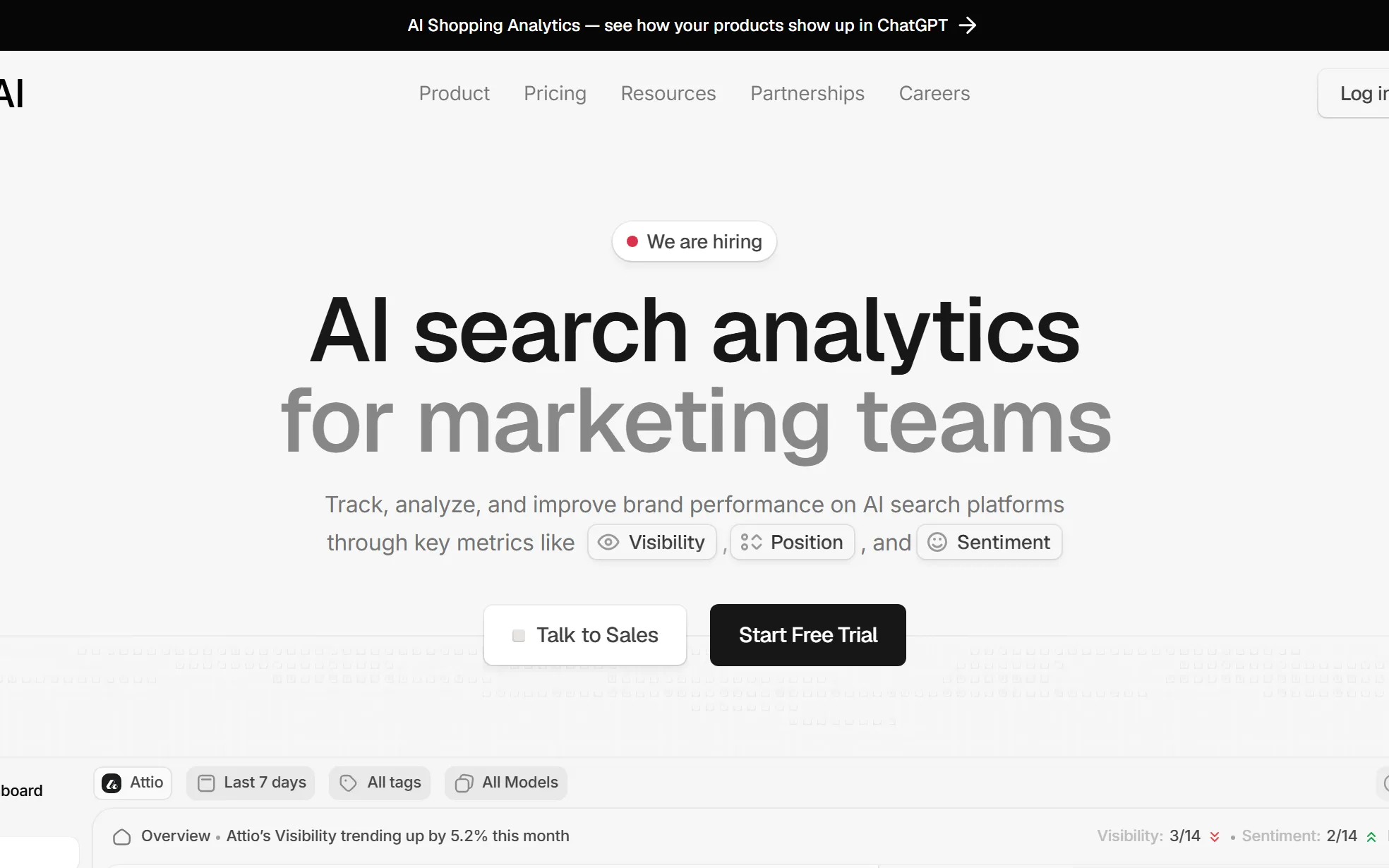
Self-serve signup, four tiers from Starter to Enterprise with numbers surfacing once you are in the app. Tracks visibility, position, and sentiment across the major assistants, plus the source domains those assistants keep citing in your category.
Peec is the default mid-market pick because it answers the three questions a marketing lead asks in a weekly review: are we appearing, where in the answer, and in what tone. The source analysis is the underrated half. Seeing which domains a model leans on in your category tells you what shape of page wins before you commission one.
Like every tracker it reports and does not act, so it is at its best pointed at a site that publishes on a cadence and has something to move. We rank the measurement field on its own terms in our AI visibility tools roundup if that is the only layer you are shopping for.
Pricing is not published on the marketing site. Monitoring only, no content layer.
Otterly.AI
Founders who want a monthly pulse check for the price of a lunch.
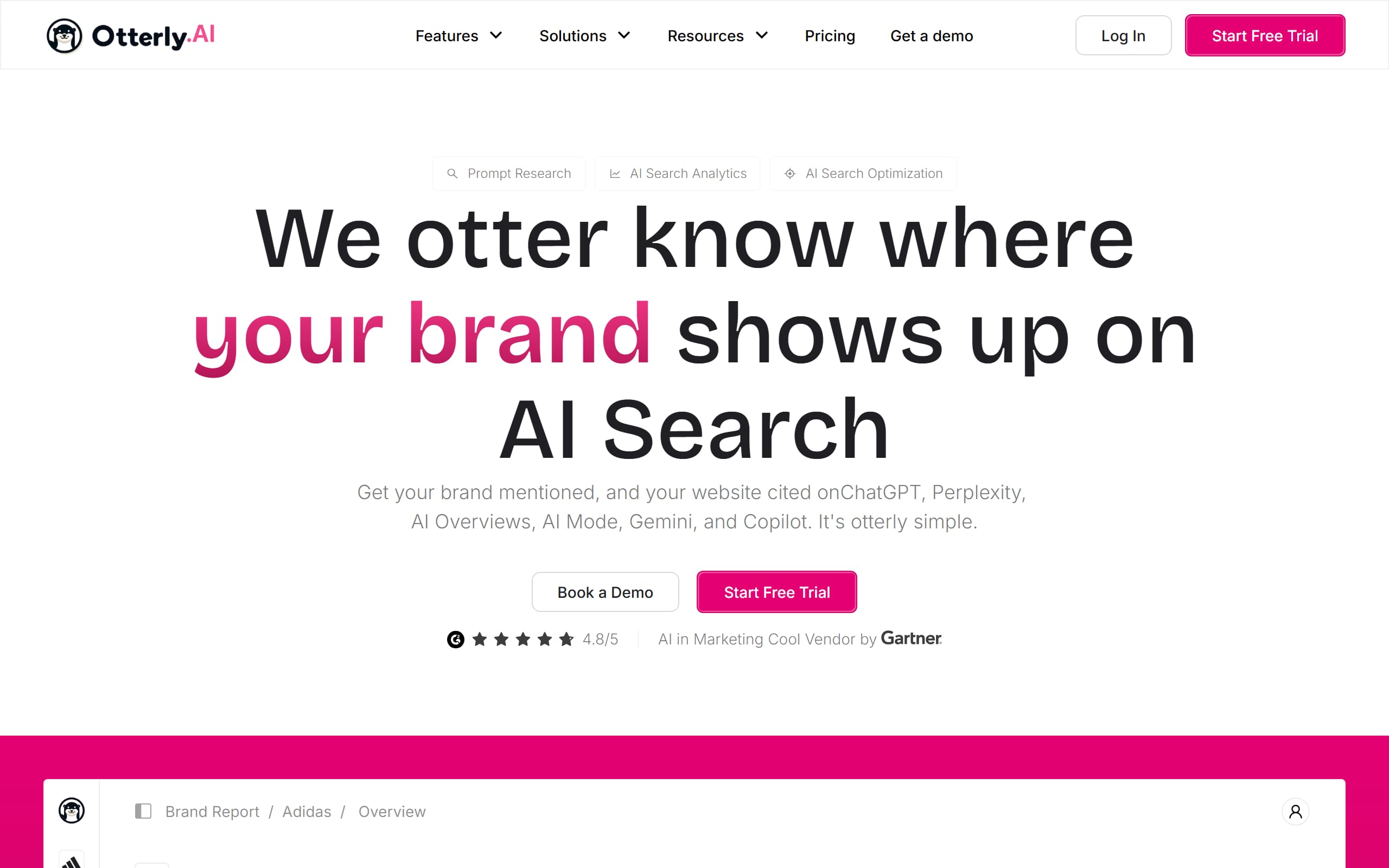
Lite $29/mo for 15 tracked prompts, Standard $189/mo for 100, Premium $489/mo for 400. Seven-day trial with no card. Gemini and Google AI Mode are paid add-ons on top.
The cheapest credible way into citation tracking. Register the prompts you care about and it reports how often your brand and your links show up in the answers, across a wider engine list than several tools at five times the price. For a founder who wants a number once a month rather than a war room, the $29 tier genuinely covers it.
The prompt model is also the ceiling: fifteen prompts means you track the questions you thought of, not the question space. That makes it a good second purchase. Map demand first, publish against it, then point Otterly at the prompts that carry revenue. The answer engine optimization guide walks the mapping step end to end.
Fifteen prompts on the entry tier, and two major engines are paid add-ons. Reporting only.
Rankscale
Small teams and agencies that want every model covered per dollar.
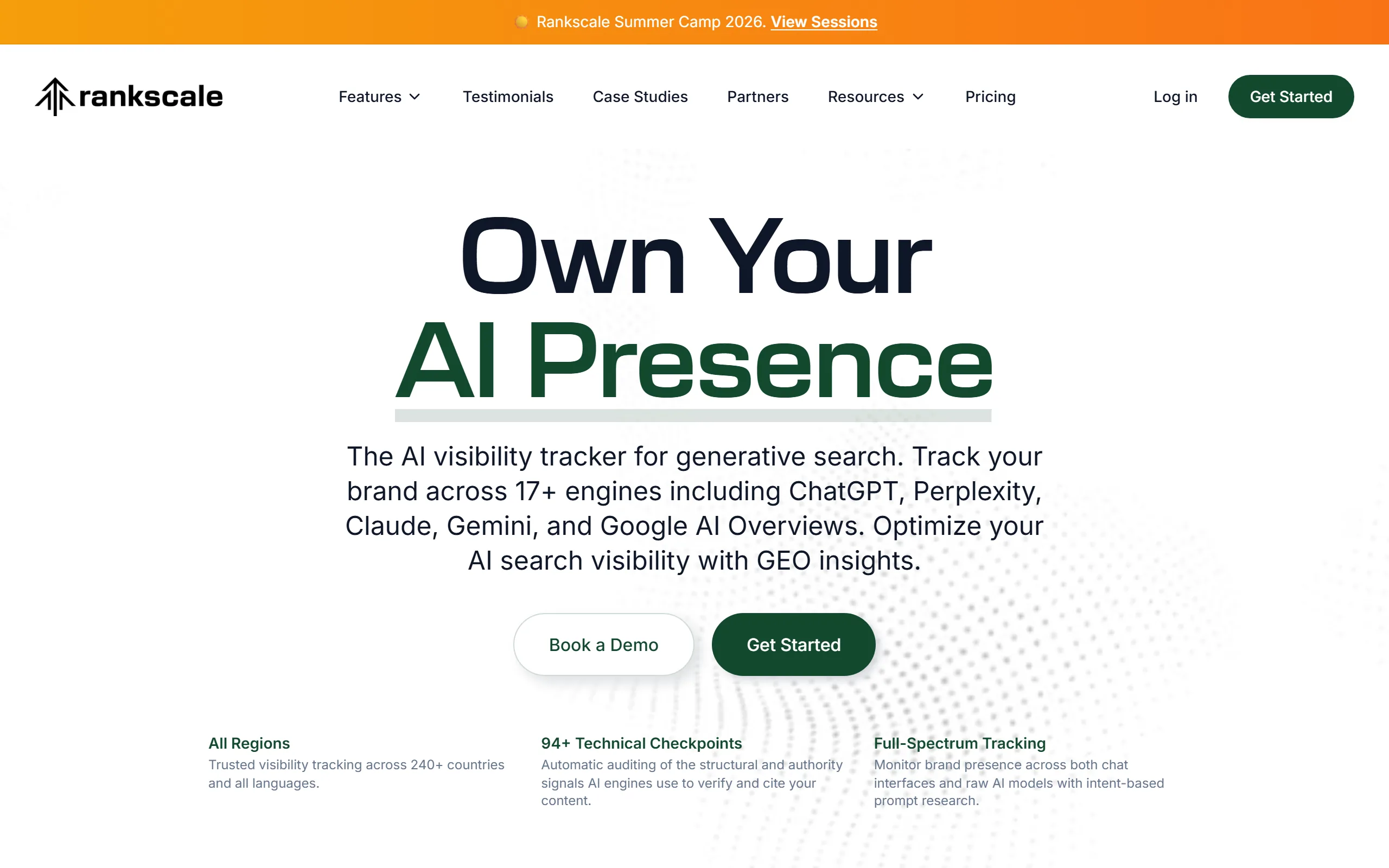
From about 20 euros a month, credit based, 15% off annual, credits roll over. Names ten engines on every plan including ChatGPT, Perplexity, Gemini, Claude, Copilot, Grok, DeepSeek, and Mistral. Pro is about 99 euros. Ships an on-page audit alongside the tracking.
Rankscale sells coverage: ten named models on the cheapest plan, including the ones most trackers quietly skip, starting below the price of a streaming subscription. The audit is the part that matters here, because it scores whether a page carries the structural signals a retrieval step rewards: heading shape, schema, a direct answer near the top.
It is a young product and the seams show. Audit scores can move between runs on an unchanged page, and agencies report gaps in the export tooling. Read the audit as a checklist rather than a metric, and fix what it flags at template level the same way you would treat sitewide structure work like internal linking.
Audit scores wobble between runs. Credit pricing needs watching at agency volume.

Ahrefs Brand Radar
Teams already paying for Ahrefs who want AI answers in the same login.
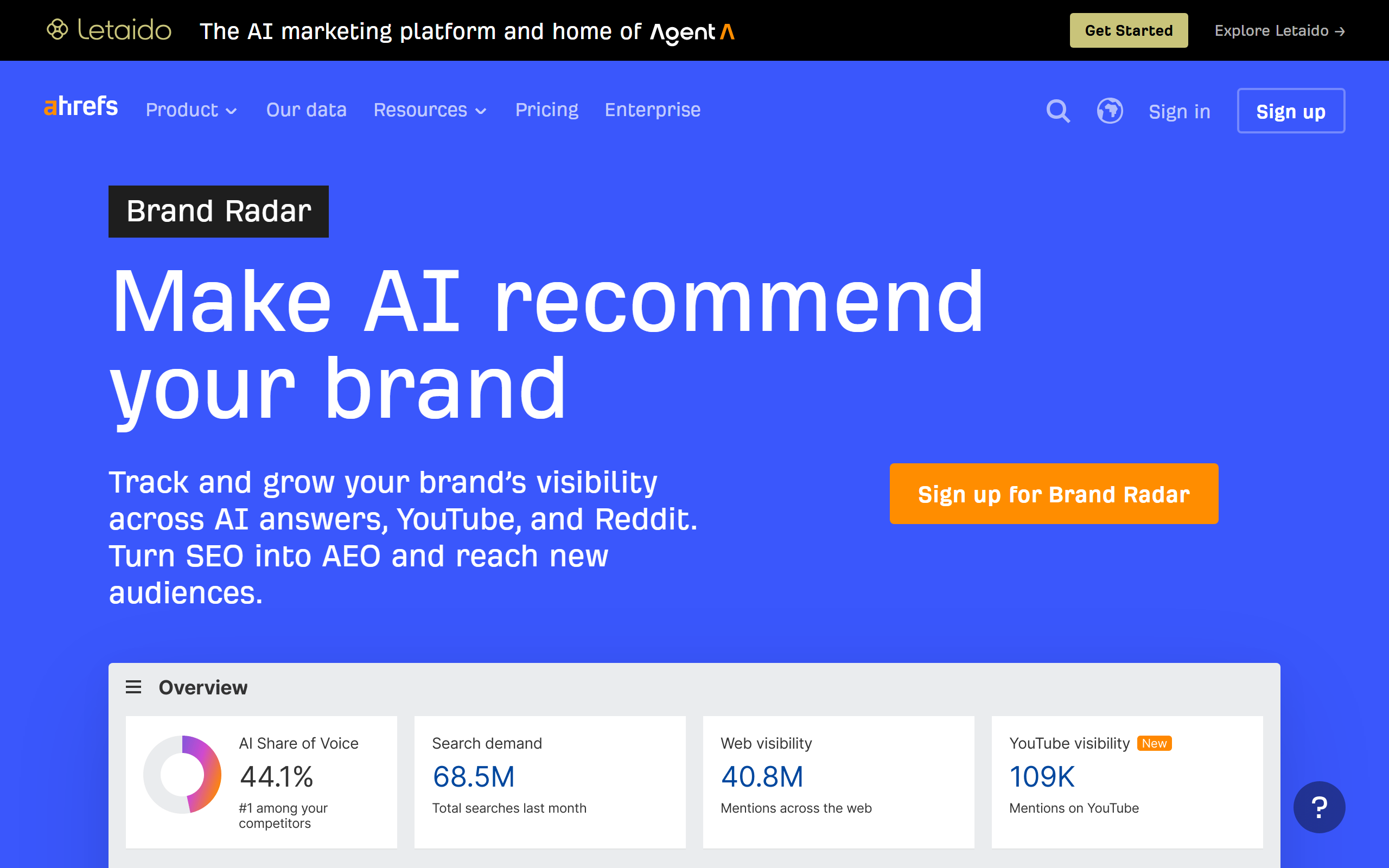
Add-on from $398/mo per engine index, on top of a base Ahrefs plan. Tracks AI answers alongside YouTube, TikTok, and Reddit mentions, on the crawler infrastructure Ahrefs already runs.
Brand Radar bolts answer tracking onto an index Ahrefs already maintains, with the largest indexed-prompt claim in the category and a 2026 expansion into video and forum citation tracking. If your team lives in Ahrefs, the integration story is genuine: one workspace trends both classic rankings and how often a model repeats your name.
Two cautions. Full coverage means paying per engine index, which independent reviews price at roughly double the category average once assembled, and one published accuracy test found it undercounting mentions against manual checks. Spot-check it before letting it steer strategy, and remember that a suite add-on measures the same thing a $29 tool measures.
Costs stack per engine index on top of the base plan. Third-party tests have flagged undercounting.
Semrush AI Visibility
Semrush shops adding model tracking to an existing workflow.
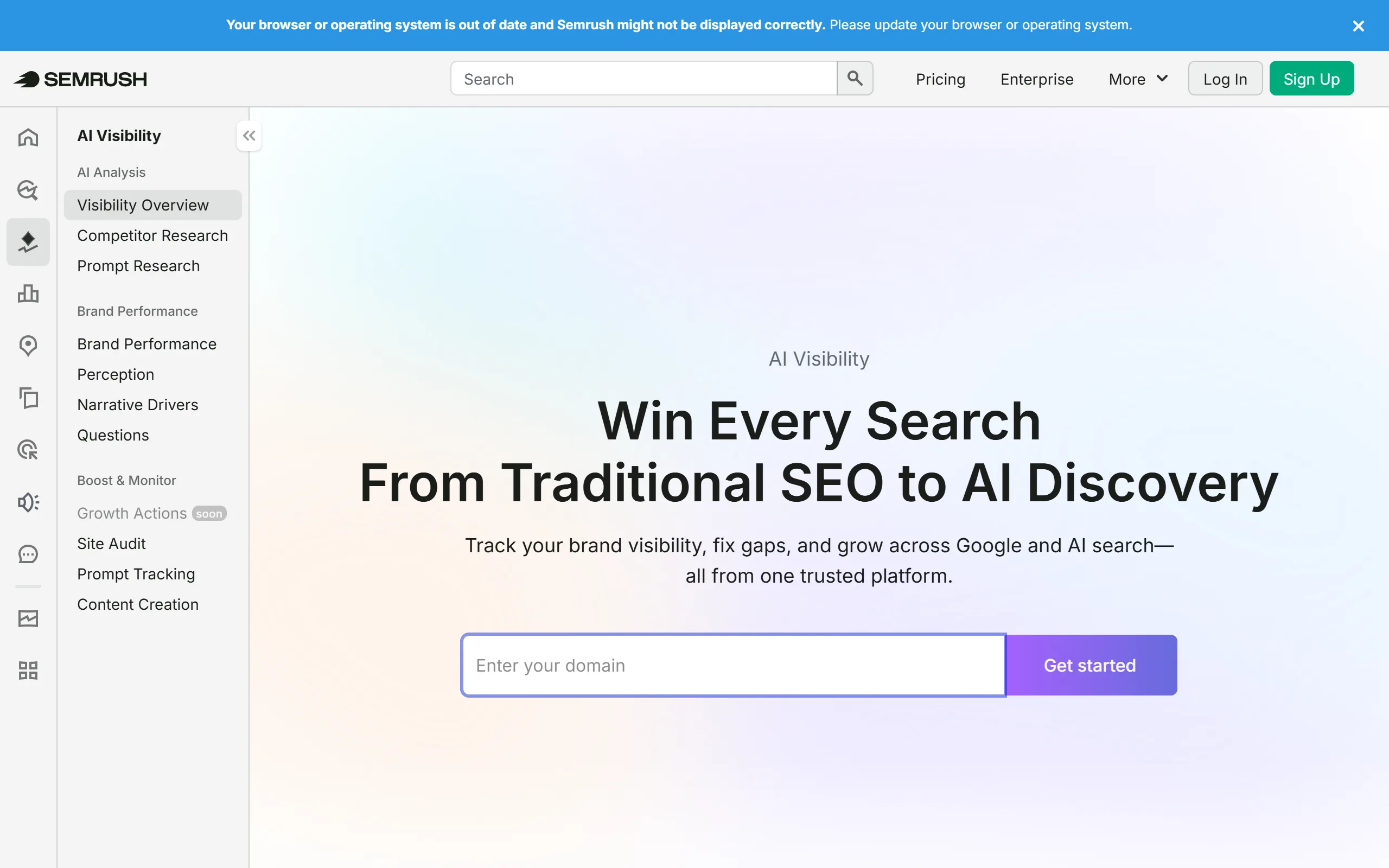
Toolkit on a Semrush subscription. Visibility overview, competitor research, prompt research, brand perception reports, and an AI-focused site audit in the same workspace as the keyword tools.
Semrush folded its AI toolkit into a full visibility product. Prompt research is the part worth the login: it shows what people ask assistants in your category, which is the demand layer most trackers skip entirely. The visibility overview and perception reports then cover the citation layer at suite depth.
Per-engine depth trails the specialists above and the recommendations lean generic. Treat it as a convenient thermometer rather than a strategy, the same way we treat every suite add-on in the AI SEO tools roundup. It earns its place here for prompt research, not for tracking.
Shallower per-engine data than the specialists, and only sensible if you already pay for Semrush.
HubSpot AI Search Grader
A zero-cost baseline before you buy anything else on this list.
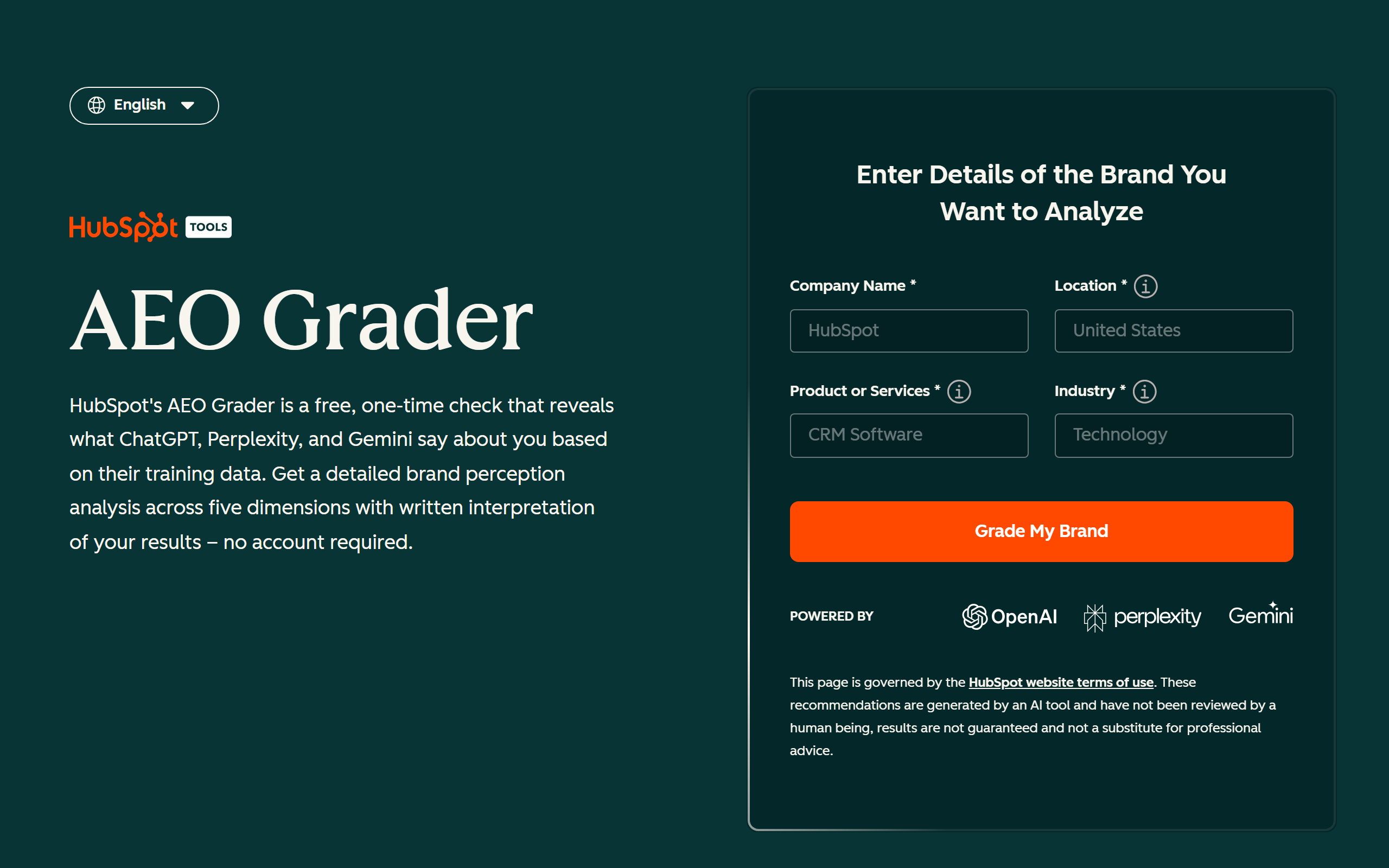
Free, no account required. One-time brand perception check across ChatGPT, Perplexity, and Gemini, scored on five dimensions with a written interpretation.
The honest free tier of the category. Enter your brand, product, and industry and it reports how the major models currently describe you, scored across five dimensions. In a market built on demo calls, a tool that returns something useful without a signup form is worth naming.
Know its shape: it reads what the models were trained on rather than what they retrieve live, and it is a single grade with no trend line. Use it to work out whether your problem is measurement or supply. In our experience it is nearly always supply, which is a publishing problem wearing a measurement costume.
Training-data snapshot, not live retrieval. One grade, no trend, no alerting.
Buy the layers in order, not all at once.
The expensive mistake in this category is buying the citation layer first. A team signs up for a tracker, watches a flat line for a quarter, and concludes that AI search does not work for them. The line was flat because there was nothing to retrieve. Models reuse pages that exist, load without a rendering step, answer one question near the top, and name their sources. Build that layer first, either by hand with the checklist in our step-by-step AEO playbook or on a cadence with our AI SEO agent. Then add one tracker and watch a line that can move.
The same ordering holds across the wider stack, which we argue at length in the SEO automation tools roundup: instrumentation earns its cost only once production exists. If you are still deciding which questions deserve a page, the topic idea generator is a free place to start. The numbers behind the shift to assistant traffic sit on our AI SEO statistics page, with linked sources, and optimizing content for large language models is what the agent does on every article it ships.
Ten tools, four layers, one gap.
| FEATURE | THE SEO AGENT | SCRUNCH AI | ALSOASKED | PROFOUND | PEEC AI | OTTERLY.AI | RANKSCALE | AHREFS BRAND RADAR | SEMRUSH AI VISIBILITY | HUBSPOT AI SEARCH GRADER |
|---|---|---|---|---|---|---|---|---|---|---|
| Pipeline layer | Supply | Access | Demand | Citation | Citation | Citation | Citation plus audit | Citation | Demand plus citation | Citation |
| Entry price | $99/mo flat | $300/mo | Free, then $12/mo | Demo-gated | Self-serve, in-app | $29/mo | ~20 euros/mo | $398/mo add-on | Suite add-on | Free |
| Self-serve signup | ||||||||||
| Writes the page | ||||||||||
| Publishes to your CMS | ||||||||||
| Tracks citations | One-off grade | |||||||||
| Free tier | Free trial | Free audit | 7-day trial |
What is an LLM SEO tool?
An LLM SEO tool helps large language models find, read, and reuse your pages when someone asks them a question. The category splits four ways along the pipeline a model runs: access (can a crawler read the page at all), supply (does a citable page exist), demand (what people actually ask assistants), and citation (whether you get named in the answer). Most roundups only cover citation, which is the layer you can measure and the one you cannot change directly.
How did you rank these ten?
By pipeline layer, not best to worst. Supply first, then access, then demand, then the six citation trackers, ordered inside each layer by team fit and price. One editorial position shapes the top: supply is the only layer where an action changes the outcome, so the tool that produces pages ranks first. We build that tool and we say so plainly. Every price was read off the vendor pricing page in August 2026.
What is the best LLM for SEO work?
For writing, the frontier reasoning models beat the cheap ones on structure and on refusing to invent statistics, which matters more than prose quality when a fact-checker is going to verify every number. For being cited, you do not choose: ChatGPT, Perplexity, Gemini, Claude, and Copilot each retrieve differently, and Rankscale is the cheapest way to see all ten at once. Optimising for one assistant is a bad bet. The on-page properties that win are the same across them.
Are LLM SEO tools different from GEO and AEO tools?
The labels are used interchangeably by vendors and the tool sets overlap heavily. AEO came from the featured-snippet era, GEO comes from a 2023 academic paper, and LLM SEO is the plainest description of the same job. We keep three separate roundups because each ranks the field on a different axis: this one on the pipeline layers, the GEO roundup on monitor versus produce, and the AEO roundup on the question-to-answer path.
What is the cheapest way to start with LLM SEO?
Zero dollars gets you a real diagnosis. Run the HubSpot AI Search Grader for a baseline, run the free Scrunch audit to see what a crawler retrieves, and use AlsoAsked free credits to map the question tree for your top three topics. That is the access, demand, and citation layers checked for nothing. The first dollar after that belongs in supply, because the other three layers only report on what supply produced.
Do I need a tool at all, or can I do LLM SEO by hand?
The on-page behaviour is doable by hand: answer the question in the first 50 words, cite every statistic to a named source, use one consistent name for each entity, add FAQ schema, keep pages current, and make sure the answer is in the HTML rather than rendered by JavaScript. If you publish two pages a month, a checklist is enough. Past roughly one page a week the manual version stops being the cheap option.
Is this list sponsored?
No. No affiliate links, no paid placements, and no outbound links to the tools listed: the screenshots are the proof instead. We rank our own product first and label it plainly, which is a bias you should weigh. Everything else is checkable, and every price is dated so you can tell when it goes stale.
Can any tool guarantee that ChatGPT mentions my brand?
No. Nobody sells placement in organic AI answers; models pick sources through retrieval and trust. What the research supports is narrower and more useful: pages carrying quotations, statistics, and cited sources measurably lift generative-engine visibility, and comparison-shaped pages earn an outsized share of AI citations. Tools help you execute and verify. They cannot buy the citation.
Related guides + features.
LLM SEO
What large language models actually retrieve, and how the agent ships pages built to be reused: direct answers, sourced statistics, consistent entity naming.
/features/llm-seo →PILLAR · AI SEARCHAI search optimization
Quotable answers, cited statistics, entity naming, and schema baked into every article the agent writes, so AI engines have a source to cite.
/features/ai-search-optimization →LISTICLEBest GEO tools
The GEO field ranked honestly: which trackers are worth paying for, which tier fits which team, and the one tool that produces citable content instead of measuring it.
/blog/best-geo-tools →Publish the pages the models pull from.
Connect your CMS and the agent ships a fact-checked article every day: a direct answer up top, statistics with named sources, schema in place, entity names kept consistent. Free trial first, $99 a month after, cancel in one click.
FREE TRIAL · CANCEL IN ONE CLICK