SaaS SEO software that ships published articles, not dashboards.
SaaS founders do not need another analytics seat. TheSEOAgent validates search demand, produces cited drafts, checks every claim against its sources, and publishes finished articles to your CMS. The result is an editorial and programmatic content system built to compound qualified signups.
FREE TRIAL · CANCEL IN ONE CLICK
What is SaaS SEO software?
SaaS SEO software is a system that turns validated search demand into articles built to attract and convert software buyers. TheSEOAgent checks keywords against live data, drafts with citations, checks every claim against its sources, then publishes the output to your CMS. The wedge is execution, not another dashboard or consulting handoff: $99/mo flat.
Add another dashboard to the stack.
Traditional SaaS SEO platforms are useful for research and reporting, but they leave execution with the founder, content hire, or consultant. You still turn scores into briefs, drafts, reviews, and published pages.
- Keyword exports wait in a spreadsheet
- Editorial ownership stays with your team
- Fact-checking happens late or not at all
- CMS formatting becomes another handoff
- Software fees sit beside writer and consultant costs
Runs the operating loop.
You set the product, buyer, and editorial guardrails. TheSEOAgent turns them into a repeatable publishing queue where each article moves through keyword validation, cited drafting, a claim check, and native CMS publishing.
- Search demand validated before drafting
- Claims checked against their sources
- Unbacked claims are softened or cut
- Approved articles publish in CMS format
- One flat software bill covers the pipeline
Four controls between a keyword and a published SaaS article.
Ground every page in demand your SaaS can win.
A content calendar should not start with a brainstorm. The agent checks monthly demand, ranking difficulty, search intent, and the current result set before a brief enters production, so low-value topics stay out of the queue and each page gets a specific acquisition job. For product-led clusters, the same data can feed a programmatic SEO system without turning every variation into a thin template, and founders can pressure-test an angle first with the free SEO title generator.

Protect B2B trust before a claim reaches buyers.
SaaS pages make claims about workflows, costs, integrations, and outcomes, and a loose number can damage trust with an informed buyer faster than a weak headline. The agent runs a separate AI fact-check pass, adds credible citations where support exists, and rewrites claims that cannot be supported: evidence that survives procurement review and gives sales teams a page they can send without caveats. The broader AI SEO software overview covers the category-level workflow, and the AI fact-checker workflow breaks down the verification controls. Comparing this with a B2B SEO agency proposal instead? The retainer and the flat fee are set side by side there. If the pitch came from a SaaS SEO agency, that page prices the same output against a SaaS-specialist retainer.

Cut unbacked claims before they dilute the domain.
High publishing volume is only useful when each page holds up. Every claim is checked against the sources saved during research, the ones they do not back are softened or cut, and an article with a fact problem it could not fix waits for your review instead of reaching the CMS because a calendar slot is due. The full SEO automation loop shows where the check sits in the pipeline, while the SEO automation software guide separates execution systems from dashboards and writing tools. You scale the queue without lowering the definition of ready. Running the same bar across a book of client accounts instead of one product? That is SEO software built for agencies, with a separate project and queue per client site. Pre-revenue teams weighing this against a first marketing hire should start with SEO for startups instead.

Finish in the CMS, not in another export queue.
An article is not shipped when a draft tab says complete. The agent sends the finished page to WordPress, Webflow, Shopify, or Ghost with structure, metadata, images, tags, and schema ready for the connected site, and a webhook covers other CMS workflows. Marketing sites designed in Framer import through a plugin instead, which Framer SEO walks through. That removes the copy, paste, reformat, and schedule loop that turns a daily content plan into founder admin. The $99 flat plan covers the publishing pipeline without a per-article meter, and the main SEO agent overview shows the broader operating model behind that endpoint. If you report this pipeline out to stakeholders or clients every month, the automated SEO reporting guide covers the assembly side.
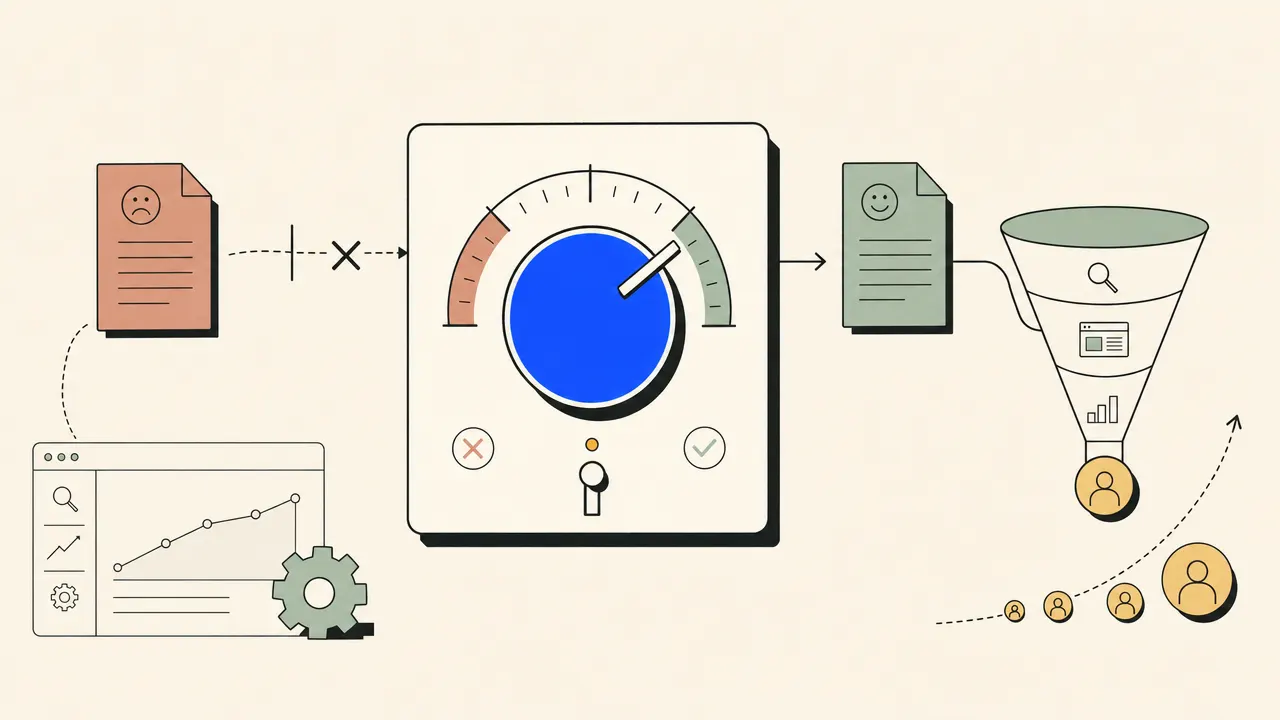
Four stages. One queue. Published output.
Set the product, market, jobs to be done, conversion path, existing pages, and topics to avoid. The agent uses those constraints to keep the queue tied to product demand instead of generic traffic.
The agent checks live keyword data, search intent, competing result types, and overlap with current coverage. Weak or irrelevant terms stay out. Approved opportunities become briefs with one clear acquisition job.
Each brief becomes a structured article. An AI fact-check pass checks every claim against the sources saved during research and softens or cuts what they do not back. An article with a fact problem it could not fix waits for your review.
Approved articles publish natively to the connected CMS with metadata, internal-link instructions, images, and schema. The queue keeps moving, so editorial pages and scalable use-case clusters can compound qualified signup opportunities over time.
Execution software beside dashboards and consultants.
| FEATURE | THE AGENT | EVERYONE ELSE |
|---|---|---|
| Primary job | Turns approved demand into published articles | Dashboards analyze; consultants advise or deliver |
| Keyword research | Live data applied inside each brief | Dashboards expose data; consultants interpret it |
| Drafting | Cited drafts inside the same pipeline | Varies by platform or consulting scope |
| Quality control | Claim check before CMS publish | Scores, manual review, or scoped editorial QA |
| CMS delivery | Native publish after the check | Exports, integrations, or consultant-managed publish |
| Cost model | $99/mo flat | Software seats, usage tiers, or retainers |
Q.01What is SaaS SEO software?+
SaaS SEO software turns search demand into content that attracts and converts software buyers. It can cover research, planning, drafting, optimization, publishing, or reporting. TheSEOAgent is built around execution: validated keywords, cited drafts, a claim check, and native CMS publishing in one pipeline.
Q.02How is this different from a SaaS SEO analytics platform?+
An analytics platform helps your team inspect keywords, competitors, backlinks, and rankings. Those are useful inputs, but someone still has to turn them into published pages. TheSEOAgent takes the execution role after strategy and guardrails are set. It does not pretend reporting dashboards are useless or replace every specialist research workflow.
Q.03How is this page different from the AI SEO software page?+
The AI SEO software page explains the broader product category and the full AI-assisted workflow. This page is for SaaS buyers. It focuses on product-led keyword selection, B2B claim accuracy, editorial and programmatic page types, CMS delivery, and content that supports qualified signups.
Q.04Can it run editorial and programmatic SaaS content together?+
Yes. Editorial pages can cover high-context comparisons, use cases, integrations, and guides. Programmatic pages can cover repeatable long-tail patterns when each page has distinct value. Both use the same keyword validation, fact-check pass, and publishing path.
Q.05How does the fact-check pass protect B2B trust?+
It checks defensible claims against credible sources, adds citations where support exists, and rewrites claims that cannot be supported. That reduces the chance that a technical buyer, procurement reviewer, or sales prospect finds an invented statistic or unsupported product claim on the page.
Q.06Which CMS platforms can it publish to?+
WordPress, Webflow, Shopify, and Ghost have native publishing paths. A webhook covers other CMS workflows. Finished articles can include their structure, metadata, images, tags, FAQ schema, and article schema when the destination supports them.
Q.07What does SaaS SEO software cost?+
The plan is $99 per month flat, with a free trial. There is no per-article meter or separate seat charge for the core pipeline. Cancellation is one click in the app.
Q.08What does the paid SaaS SEO pipeline do after setup?+
It maintains the keyword queue, produces cited drafts, checks every claim against its sources, and publishes the articles to the connected CMS. You set the product context and guardrails, then review the shipped output and acquisition results instead of managing every production handoff.
Related guides + features.
SEO automation
The full pipeline: research, drafting with every claim checked against its sources, and native publish. Where these tools stop, the agent ships the page.
/features/seo-automation →PILLAR · PROGRAMMATIC SEOProgrammatic SEO
Topical clusters at scale without hiring writers or wiring page templates by hand.
/features/programmatic-seo →PRICINGSimple pricing
$1 for a 3-day trial if eligible, then $99 per month. No per-keyword meter. Cancel in the app.
/pricing →Put the SaaS content queue into production.
Start with a free trial. Connect the CMS, define the SaaS buyer, and watch the first cited article move through the claim check into the publishing queue. Keep it only if the output is useful.
FREE TRIAL · CANCEL IN ONE CLICK