The 10 best ChatGPT SEO tools in 2026.
Two completely different products get sold under this keyword. Seven of the ten below put ChatGPT to work on SEO labour: prompts, briefs, drafts, bulk page edits, finished articles. The other three treat ChatGPT as a place you need to show up and measure whether it names you. Buying from the wrong half is the expensive mistake here. Real August 2026 prices, one honest flaw each.
Which ChatGPT SEO tool should you pick?
Decide which job you are buying first. To put ChatGPT to work: The SEO Agent at $99/mo flat for fact-checked articles published to your CMS, ChatGPT itself from free for everything you can do by hand, AIPRM from around $10/mo for a shared prompt library, Frase at $49/mo for SERP-grounded briefs, Surfer at $49/mo for grading a draft, Screaming Frog free to 500 URLs for running one prompt across a whole site, and Semrush ContentShake AI if the suite is already in your stack. To find out whether ChatGPT names you: HubSpot AI Search Grader free, Otterly.AI from $29/mo, Profound for enterprise. Buy a worker before you buy a tracker.
Most ChatGPT SEO tools stop at a draft. The SEO Agent picks the keyword, writes a cited article and publishes it to your CMS every day. Enter your site to start.
Free trial · Cancel in one clickThe shortlist, scannable in ten seconds.
- 01The SEO AgentBest for finished output
- 02ChatGPTBest free starting point
- 03AIPRMBest prompt library
- 04FraseBest for briefs
- 05Surfer SEOBest draft grader
- 06Screaming Frog SEO SpiderMost underrated pick
- 07Semrush ContentShake AIBest suite option
- 08ProfoundBest enterprise tracker
- 09Otterly.AIBest budget tracker
- 10HubSpot AI Search GraderBest free check
How we picked these ten.
Search this term and you get two incompatible lists stapled together. One half is writing software with a model behind it. The other half is dashboards that watch assistant answers for your brand name. They solve opposite problems, and the reason people buy the wrong one is that both categories describe themselves with the same four words. So we split the page down that line and labelled every entry with its role. Read the role tag above each entry as the real ordering key. Inside a role, the order is team fit and price. If you want the drafting side of the market ranked on its own terms, our AI SEO tools overview covers it, and the LLM SEO tools roundup cuts the measurement side along the retrieval pipeline instead.
Worker-side tools run first because the channel is still small in absolute terms and completely dependent on what you publish. Assistants send about 1% of website traffic, most of it from ChatGPT, and independent clickstream analysis put ChatGPT referrals at 0.32% of traffic in May 2026, up from 0.23% a month earlier. Growing fast, still a rounding error next to organic search, and entirely downstream of whether a page worth quoting exists. Buy the thing that produces pages, then buy the thing that measures them. The editorial position, stated plainly because we have a stake in it: we build the tool at number one. Every price on this page came off the vendor's own pricing page in August 2026, vendors who hide pricing behind a call are labelled as such, and there are no affiliate links, no sponsored slots, and no outbound links to the tools listed. For adjacent cuts of the same market, see the AEO tools list or the SEO automation roundup.

The SEO Agent
Turning the drafting job into something that runs without you.
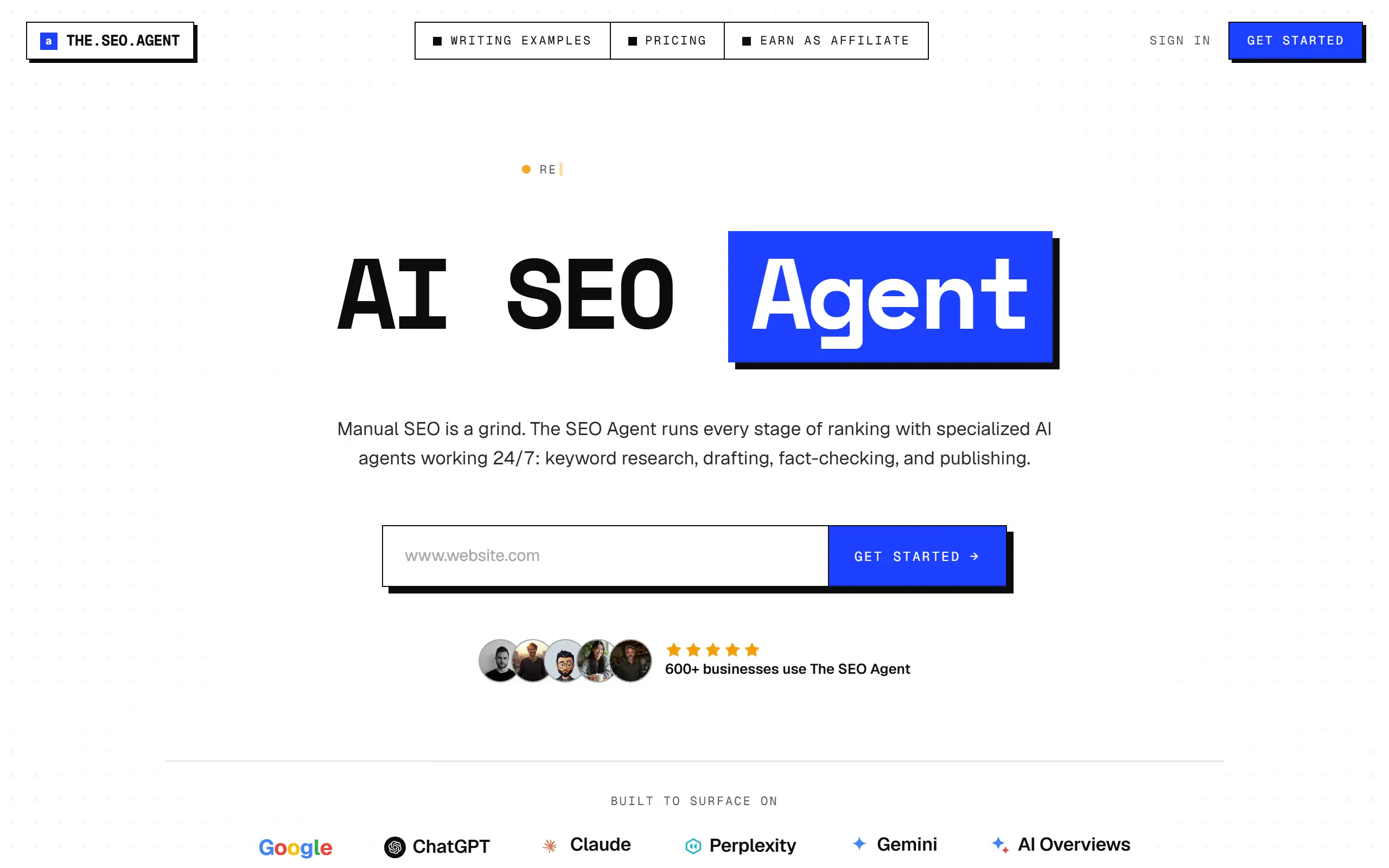
$99/mo flat, one site. Ships one fact-checked article a day: keyword picked from live search data, every statistic tied to a named source, a direct answer in the opening lines, FAQ and article schema attached, published straight into WordPress, Webflow, Shopify, Wix, or Ghost. Free trial, one-click cancel.
Every other worker-side tool on this page hands you a draft and stops. The gap between a draft and a published page is where the month actually goes: fact-checking the numbers, fixing the structure, adding schema, finding an image, pasting it into the CMS, doing it again tomorrow. That is the part we automated, and it is the reason this sits at number one on our own list, which you should weigh accordingly.
The difference from a chat window is the checks that run before anything ships. A fact-checking pass forces a real source URL onto every statistic in the draft, and a quality gate refuses to publish anything that fails it rather than handing you a confident-sounding page with an invented number in paragraph four. Keyword selection comes from live search data instead of the model guessing what people search for, which is the single most common failure mode when a founder briefs a chat window directly.
Cadence is the other half. Thirty pages a month at $99 flat is a body of coverage that a search engine and an assistant can both draw from. Three pages a quarter, however well written, is not. If you want the mechanics of the pipeline rather than the pitch, the SEO automation breakdown walks each stage end to end.
One site per subscription, and it is a pipeline rather than an editor. If you want to sit inside the draft and rewrite every line, a document tool suits you better.
ChatGPT
Anyone who has not yet proven they need a paid SEO tool at all.
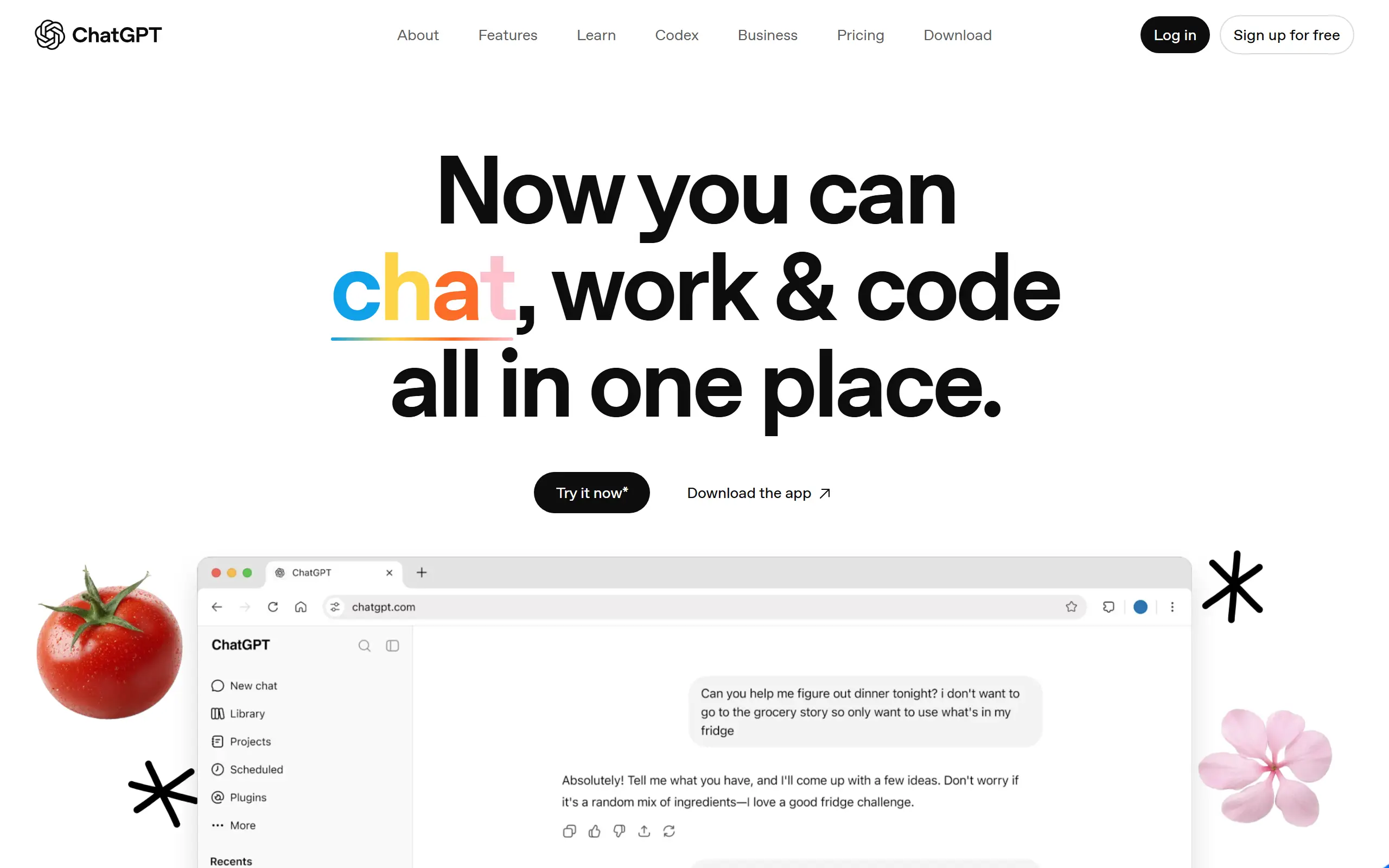
Free tier with usage limits. Go $8/mo, Plus $20/mo, Pro $200/mo, Business $25 per user monthly. Web browsing, deep research, file upload, custom instructions, and a project workspace on the paid tiers.
Most of the tools underneath this one are a wrapper around a model you can already reach for $20. Before spending anything, spend two weeks in the raw product: cluster your keywords by intent, draft outlines, rewrite title tags, write schema markup by hand, pull a competitor page apart section by section, starting from the copy-paste ChatGPT SEO prompts in our how-to guide. Roughly half the people who buy an SEO writing subscription would have been fine with a saved prompt and a browsing session. Which model to pick inside ChatGPT for drafts is covered in our guide to choosing a ChatGPT model for writing.
Where it breaks is predictable and worth knowing before you rely on it. It does not know search volume, so it will happily send you at a keyword nobody types. It invents statistics and citations under pressure, which is fatal in a niche where accuracy is the product. Every session starts from nothing unless you rebuild the context. And because everyone drafts from the same model, the output converges: the same headings, the same five subheads, the same tone. That sameness is exactly what a headline tool or a real brief exists to break.
No search volume, no ranking data, no memory of your site, and it will fabricate a statistic rather than say it does not know.
AIPRM
Getting a repeatable SEO prompt without writing one from scratch.
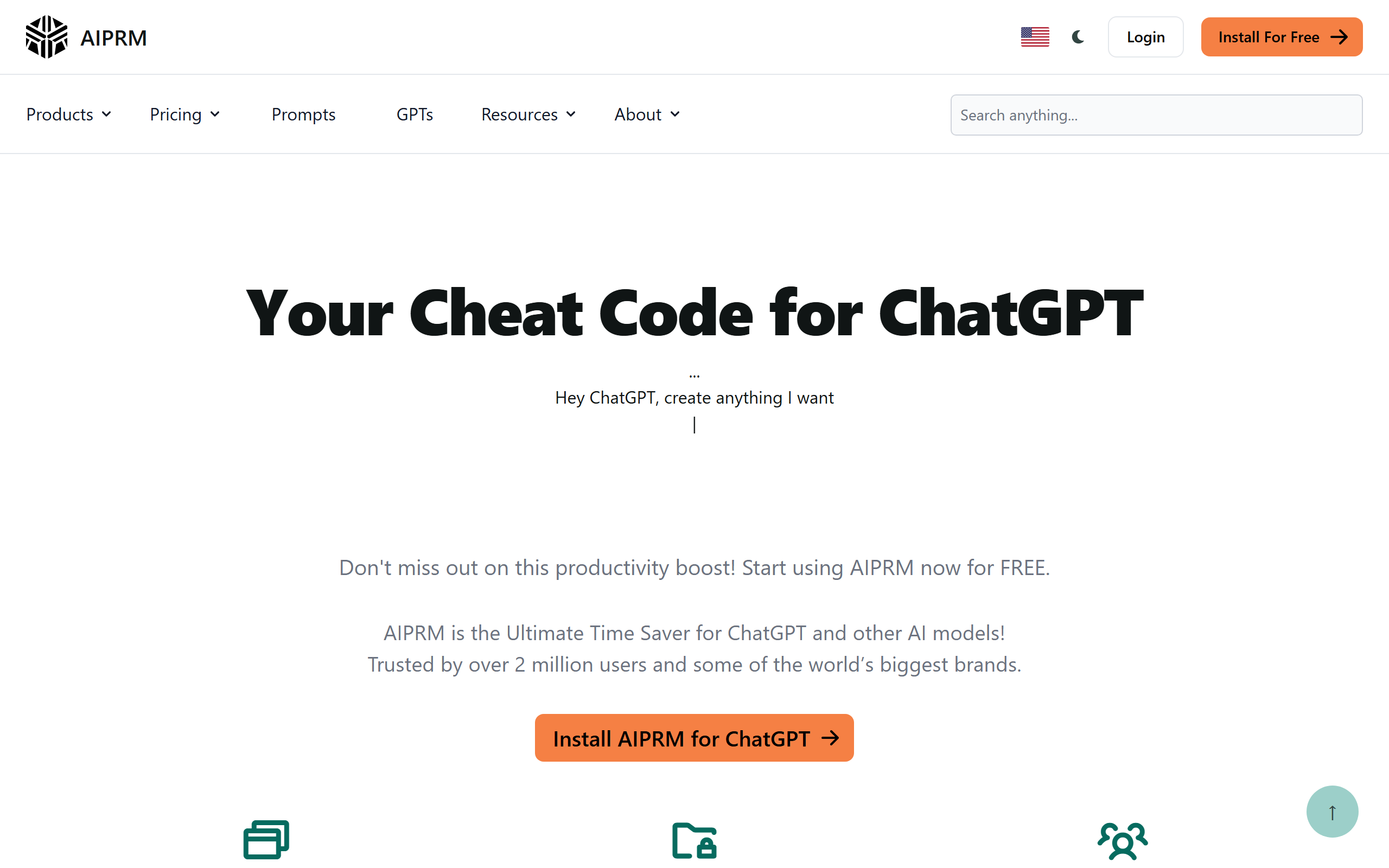
Browser extension that injects a searchable prompt library into the ChatGPT interface. Free tier with community prompts. Solo paid plans run from roughly $10/mo for Plus up to about $33/mo for Pro, with team pricing above that. Prompts cover keyword clustering, outlines, meta tags, and schema.
AIPRM solves a small, real problem: most people write bad prompts, and rewriting a good one from memory every morning is a tax. It drops a library of community-published SEO prompts directly into the chat interface, so a keyword-cluster prompt or an outline prompt is two clicks instead of two paragraphs of typing. For an agency where five people need to produce comparable output, the shared prompt list is the actual value.
Be clear-eyed about the ceiling. The library is user-generated, so quality swings hard, and the top-voted SEO prompts are heavily gamed toward output that looks thorough rather than output that ranks. A prompt cannot give the model search volume it does not have, and it cannot stop a fabricated statistic. Treat it as ergonomics, not as an SEO tool. If you want the same speed on the small mechanical jobs without an extension, our free meta description generator does one of them properly.
Community prompts vary wildly in quality, and it changes how you talk to the model, not what the model knows.

Frase
Writers who want the model briefed on what already ranks.
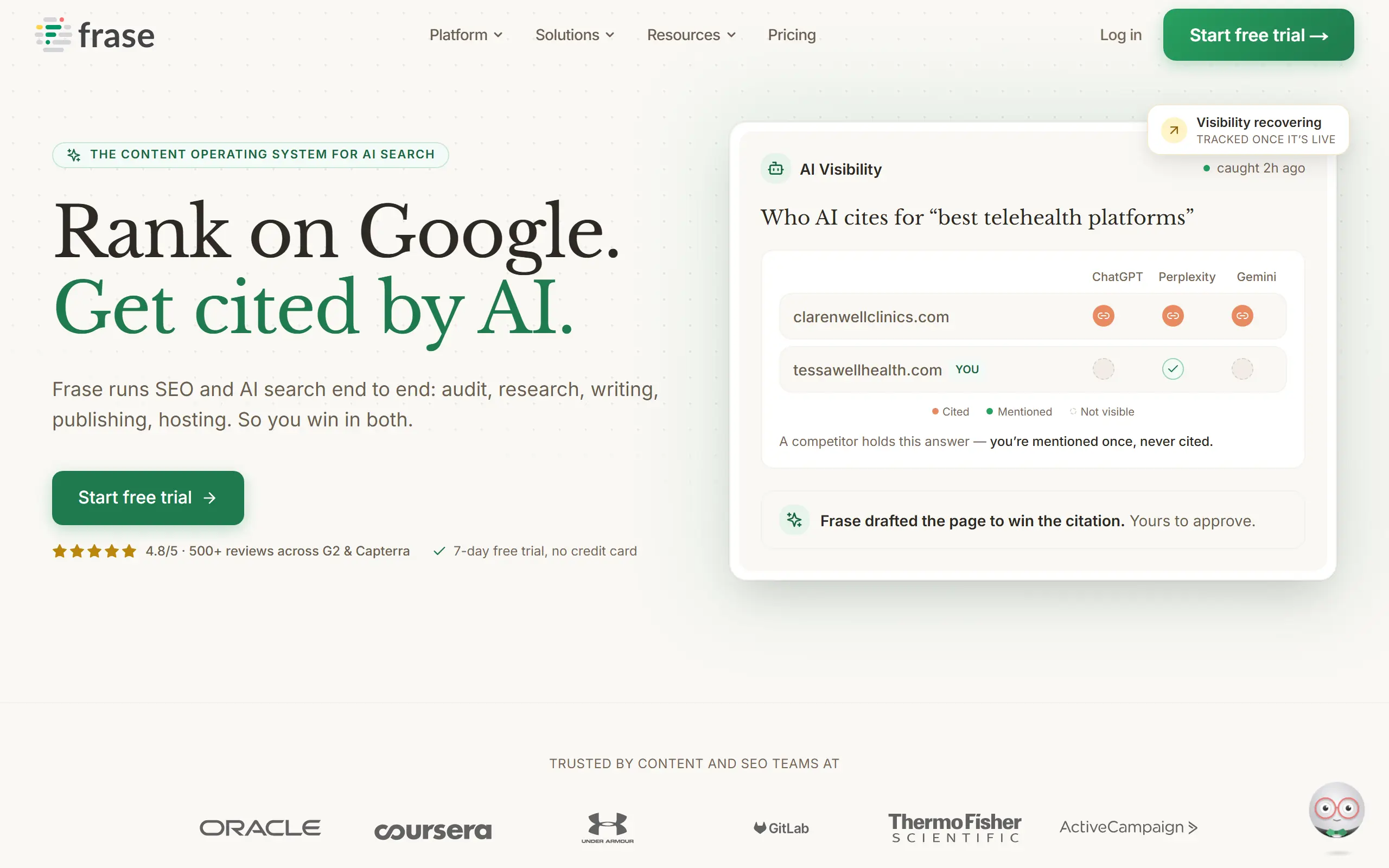
Starter $49/mo for 10 articles and 50 audit pages, Professional $129/mo for 40 articles and 250 audit pages, Scale $299/mo for 100 articles. Seven-day free trial with no card. Pulls the top-ranking results for a query and builds the brief and outline from them.
The single biggest upgrade over a bare chat window is grounding: instead of asking a model what it thinks belongs in an article, Frase reads the pages currently ranking for that query and builds the outline from what they actually cover. Topic gaps, heading structure, question coverage, and word count all come from the live results rather than from the model's priors. Hand that brief to any writer, human or otherwise, and the output improves immediately.
The article limits are the thing to check against your plan. Ten articles a month at $49 is roughly $5 a brief, which is fine for a considered publishing schedule and expensive if you are trying to build coverage across a category. The optimizer also nudges toward term density, an idea that has aged badly since search engines started reading meaning rather than counting words. Use the brief, ignore the score. We break the plans and the editor down in our Frase review. For a wider read on where the brief-and-optimize category sits, the AI SEO tools roundup ranks the field on shipped output.
Per-article limits bite quickly, and the density scoring encourages writing for a number rather than a reader.
Surfer SEO
Grading a ChatGPT draft against the pages it has to beat.

Discovery $49/mo for 120 documents, Standard $99/mo for 360 documents with 25 tracked prompts refreshed weekly (ChatGPT only), Pro $182/mo for 50 prompts refreshed daily across ChatGPT, Perplexity, Gemini, and Google, Peace of Mind $299/mo for unlimited documents and 100 prompts.
Surfer is the tool most people already use to check a draft before it goes live, and it is the clearest example on this page of a product straddling both sides of the split. The content editor grades a draft against the top-ranking pages for the query, which is worker side. The prompt tracking added to the paid tiers watches whether assistants mention your brand, which is channel side. Notably, the $99 tier tracks ChatGPT only; multi-model coverage starts at $182.
The grading is genuinely useful as a structural checklist and genuinely misleading as a target. Chasing a score to 90 produces pages that read like they were assembled to hit a score, because they were. Take the coverage gaps it flags, ignore the number. The tier math and the editor get a longer read in our Surfer SEO review. And be careful about the bundling: prompt tracking inside a writing tool is convenient, but it is the same measurement that a dedicated tracker does at a third of the price, which we work through in the AI visibility tools comparison.
Optimising to the score degrades the writing, and ChatGPT-only prompt tracking on the $99 tier is a thin version of the feature.
Screaming Frog SEO Spider
Running one prompt against every page on a site at once.
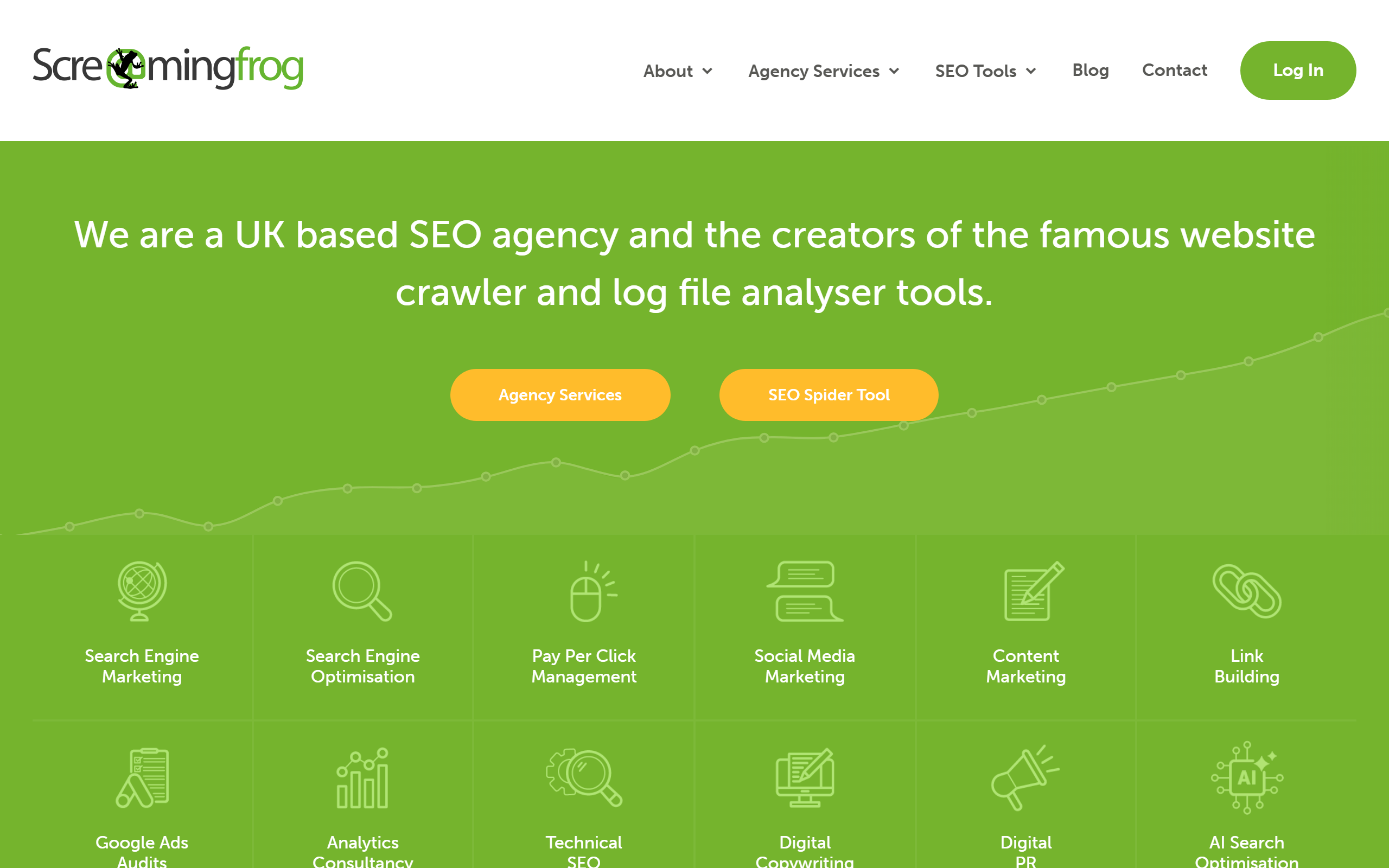
Free up to 500 URLs, GBP 199 per year for the full licence. The custom JavaScript feature calls a language model API for every URL in a crawl, so a single prompt can classify intent, draft alt text, or write meta descriptions across thousands of pages in one pass.
The pick nobody expects on a list like this, and the one that saves the most hours. A crawler is not usually thought of as a ChatGPT SEO tool, but the custom JavaScript feature turns it into the only sane way to run a prompt at site scale. Point it at a crawl and you can classify search intent for every URL, generate a first-pass meta description for every page missing one, draft alt text for every unlabelled image, or flag pages whose content no longer matches their title. That is a week of manual work returned as a CSV.
Two conditions. You supply your own model API key, so the calls are metered separately from the licence and a careless crawl across ten thousand URLs costs real money. And the output is a first pass, not a publishable one: bulk-generated descriptions still need a human eye before they go live. It pairs naturally with structural work you would do across a whole site anyway, like the internal link mapping pass most sites have never run.
Desktop software with a real learning curve, metered model calls on top of the licence, and everything it produces is a draft.
Semrush ContentShake AI
Teams already paying for Semrush who want drafting in the same login.
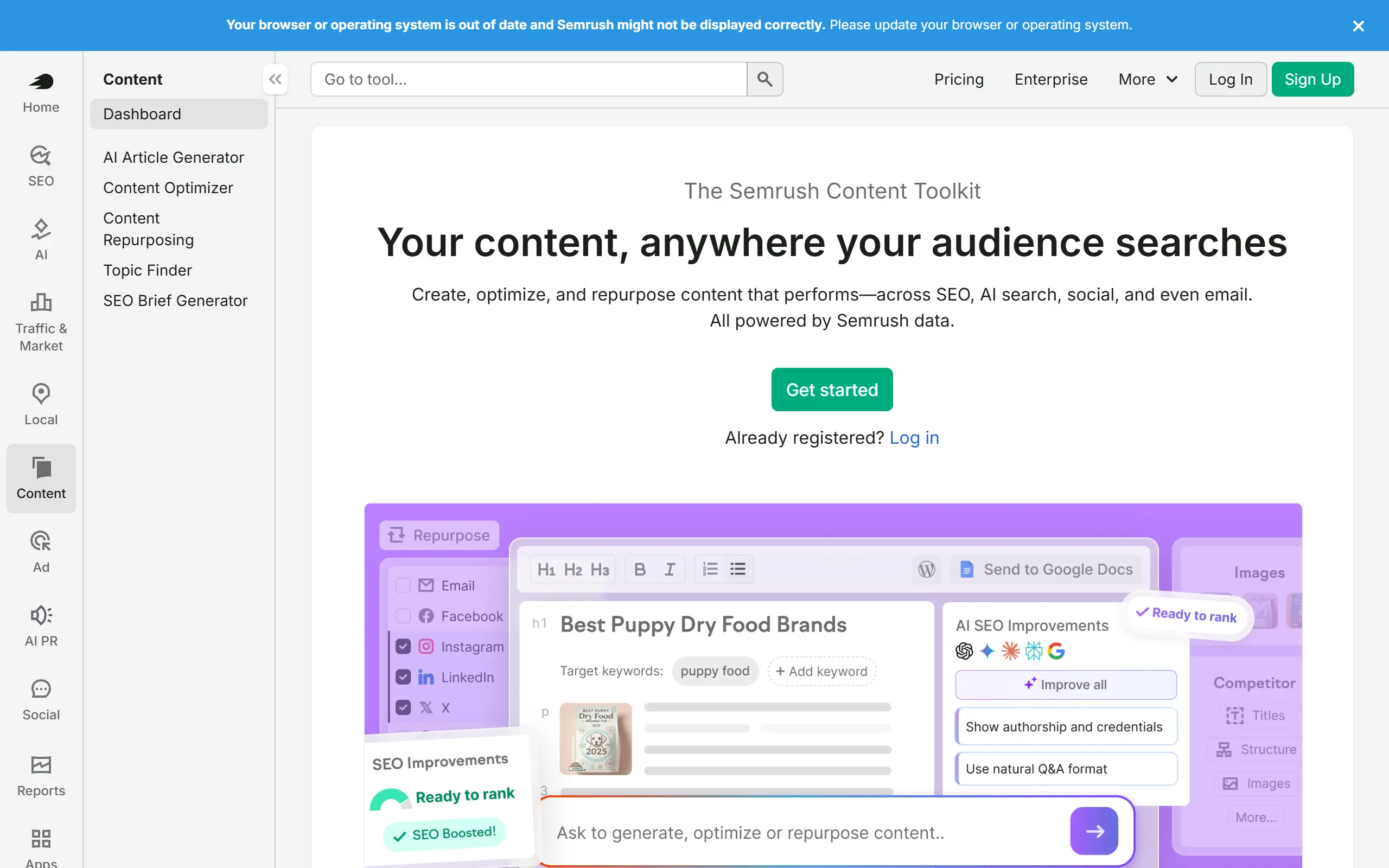
Sold as a separate paid add-on rather than bundled into a base Semrush subscription, with a free trial and a small monthly article allowance before top-up packs. Now sits inside the wider Content Toolkit alongside an article generator, a content optimizer, a topic finder, and a brief generator.
The argument for it is the data underneath. Drafts are generated against Semrush's own keyword and competitor index rather than against whatever the model recalls, which removes the worst failure of a bare chat window: writing confidently at a keyword with no demand behind it. Topic suggestions come from what your competitors rank for, and the finished draft can push to WordPress without a copy-paste step.
The pricing shape is the catch. It is an add-on, so you are paying for it on top of a subscription that already costs more than most tools on this page, and the included article allowance is small enough that a real publishing schedule means buying packs. Output quality lands where every suite writer lands: competent, structured, and generic enough that it needs an editor. If the suite is already in your stack the convenience is real. If it is not, this is an expensive way in. The same add-on maths applies to the writer-plus-tracker bundles, which is what Writesonic priced tier by tier works through.
An add-on on top of an already expensive subscription, with a low included article allowance and generic drafts.

Profound
Enterprise teams that need the deepest ChatGPT answer dataset.
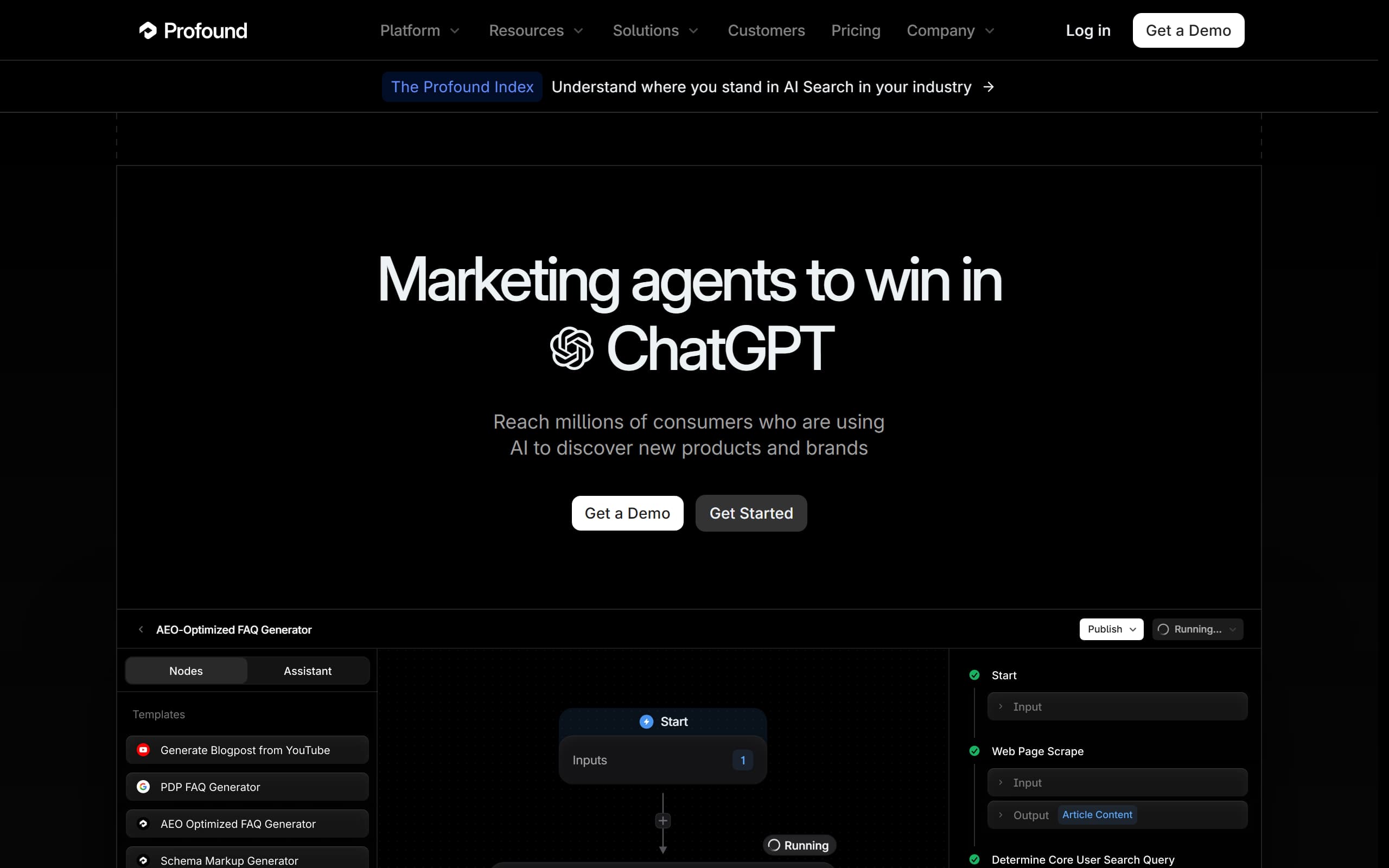
Demo-gated enterprise pricing. Large prompt panels across ChatGPT, Perplexity, and AI Overviews, with share-of-voice trends over time, citation attribution down to the page that earned the mention, and analytics on traffic arriving from agents rather than people.
If the question is which pages of yours ChatGPT is actually quoting, and you have a budget approval process, this is the deepest answer available. Wide prompt panels, competitor share of voice trended over months, and attribution that names the specific URL behind a citation. It has also moved earliest into the surfaces that arrive next, including shopping answers and traffic that comes from agents rather than browsers.
The posture is the trade-off, and it is the same trade-off every channel-side tool on this page carries. Pricing sits behind a sales call, and pointed at a thin site it will report a flat line accurately and expensively. Measurement is worth buying once there is something to measure, which is the sequencing argument in full on our AI search optimization page.
No public pricing, a sales call to get started, and nothing it reports changes unless you publish.
Otterly.AI
Founders who want a monthly pulse check without a sales call.
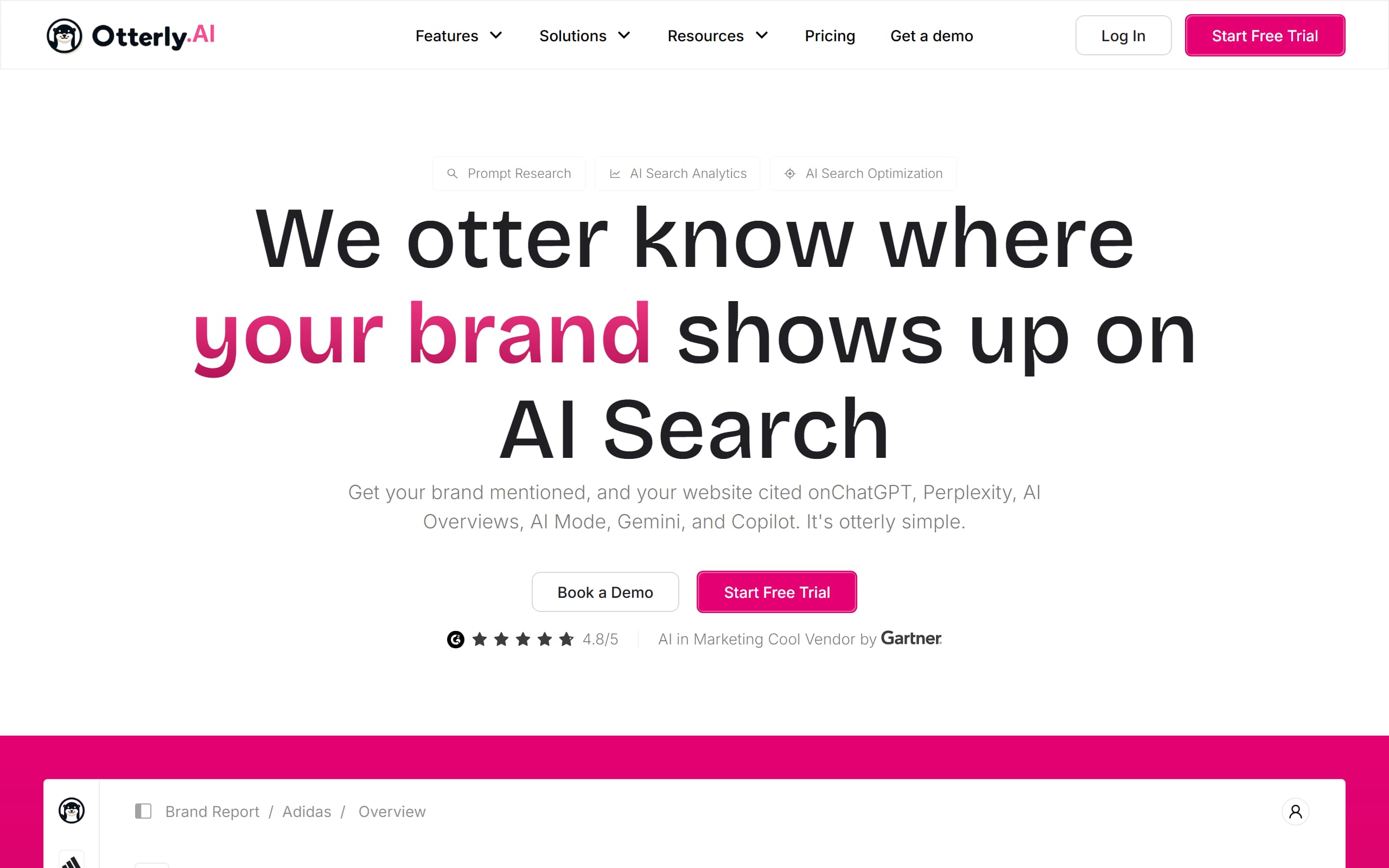
Lite $29/mo for 15 tracked prompts, Standard $189/mo for 100, Premium $489/mo for 400. Seven-day trial with no card required. Reports how often your brand and your links appear in assistant answers. Gemini and Google AI Mode are paid add-ons on top.
The cheapest credible way to answer the question this whole channel-side category exists for. Register the prompts your buyers actually type, and it reports how often ChatGPT names you and links you across them. For a founder who wants a number once a month rather than a war room and a weekly report, the $29 tier genuinely covers it.
The prompt count is also the ceiling. Fifteen prompts means you track the fifteen questions you thought of, not the question space your category actually spans, so it confirms a hypothesis rather than finding one. That makes it a good second purchase rather than a first: map the questions, publish against them, then point it at the prompts that carry revenue. The answer engine optimization guide covers the mapping step in detail, and our GEO tools buyer's guide ranks Otterly against the rest of the monitoring market.
Fifteen prompts on the entry tier, two major engines behind paid add-ons, and reporting only.
HubSpot AI Search Grader
A zero-cost baseline before you buy anything else on this list.
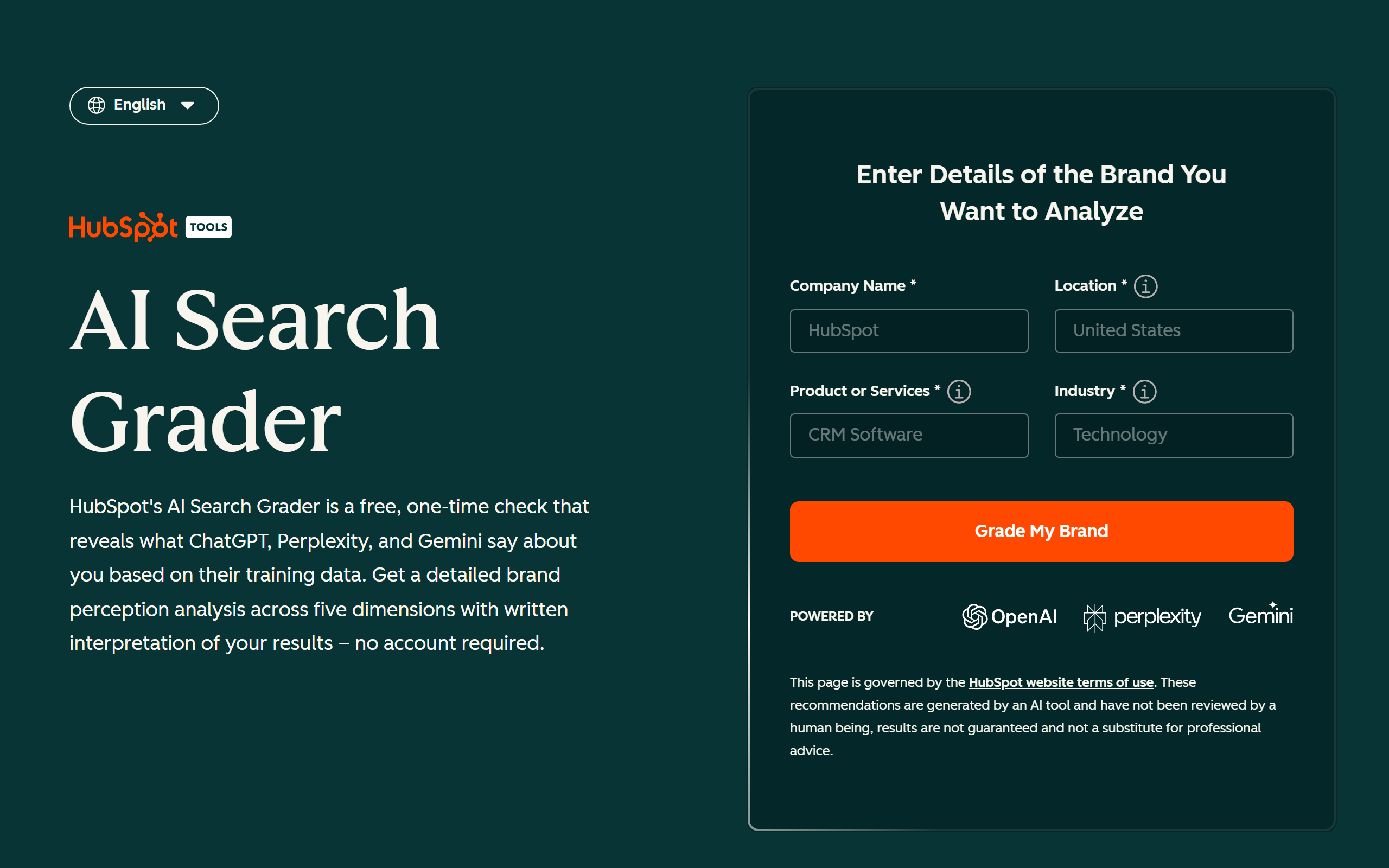
Free, no account required. Enter a brand, product, and industry and it returns a one-time brand perception check across ChatGPT, Perplexity, and Gemini, scored on five dimensions with a written interpretation of the result.
In a category where most products open with a demo call, a tool that returns something useful from a form with no signup deserves naming. It tells you how the major assistants currently describe your company, which is often more revealing than a share-of-voice number: brands routinely discover the models have them positioned in a category they left two years ago.
Know its shape before you act on it. It reads what the models absorbed during training rather than what they retrieve live, and it returns a single grade with no trend line and no alerting. Use it to work out whether your problem is measurement or supply. In our experience it is nearly always supply, which is a publishing problem wearing a measurement costume, and it is the whole argument behind our generative engine optimization agent.
A training-data snapshot rather than live retrieval, one grade, no trend, and no way to track it over time.
How to actually use ChatGPT for SEO.
None of the tools above matter if the process around them is wrong. This is the sequence that separates a page worth publishing from a page that reads like every other draft produced from the same model on the same day. It works in a bare chat window, and it is the same order of operations our AI SEO agent runs automatically on every article it ships.
- STEP 01
Find the question, not the keyword
Do not ask a model what people search for, because it does not know. Pull the questions from live search data, from your own Search Console queries, and from the people-also-ask trees around your topic. Feed that list into the chat window as the input rather than asking it to invent one.
- STEP 02
Brief it against what already ranks
Paste the top three ranking pages into the prompt and ask for what they all cover, what none of them cover, and which of those gaps you can fill credibly. The gap list is the article. Skipping this step is why so much AI content reads like a slightly worse copy of result number one.
- STEP 03
Draft in sections, never in one shot
One prompt per section, each with the brief and the section brief attached. Long single-shot drafts drift, repeat themselves, and lose the structure by the third heading. Section drafting also lets you kill a weak section without regenerating the whole page.
- STEP 04
Verify every number before it ships
This is the non-negotiable step. Take each statistic in the draft and find the named source that supports it. Anything that cannot be sourced comes out. A single invented figure discovered by a reader costs more credibility than the whole article earns.
- STEP 05
Add the parts a chat window will not
Schema markup, a direct answer block in the opening lines, internal links to your related pages, a real image, correct heading hierarchy, and a publication date. These are the parts that decide whether the page is retrievable, and they are the parts a draft never arrives with.
- STEP 06
Publish on a schedule you can hold
One good page a week beats twelve in a burst and then silence for a quarter. Coverage compounds and gaps do not. Pick a cadence you can sustain by hand, or hand the cadence to something that runs whether or not you have the evening free.
Steps four and five are where hand-run processes quietly fail, because they are the boring ones and nobody notices when you skip them until a reader does. If you publish inside WordPress, the WordPress walkthrough applies the same sequence with the CMS specifics attached. If you are still working out which questions deserve a page, the free blog topic generator is a reasonable place to start, and the AI SEO statistics page keeps the numbers behind the assistant shift current.
Ten tools, two jobs, one honest split.
| FEATURE | THE SEO AGENT | CHATGPT | AIPRM | FRASE | SURFER SEO | SCREAMING FROG SEO SPIDER | SEMRUSH CONTENTSHAKE AI | PROFOUND | OTTERLY.AI | HUBSPOT AI SEARCH GRADER |
|---|---|---|---|---|---|---|---|---|---|---|
| Role | Worker | Worker | Worker | Worker | Worker plus channel | Worker | Worker | Channel | Channel | Channel |
| Entry price | $99/mo flat | Free, then $8/mo | Free, then ~$10/mo | $49/mo | $49/mo | Free to 500 URLs | Paid add-on | Demo-gated | $29/mo | Free |
| Self-serve signup | ||||||||||
| Uses live search data | ||||||||||
| Checks facts before publish | ||||||||||
| Publishes to your CMS | ||||||||||
| Tracks ChatGPT mentions | One-off grade | |||||||||
| Free tier or trial | Free trial | 7-day trial | Free trial | 7-day trial |
What are ChatGPT SEO tools?
The label covers two different products that get sold under one keyword. The first group uses ChatGPT as a worker: prompt libraries, brief builders, draft graders, crawlers that call a model across every page, and pipelines that write and publish. The second group treats ChatGPT as a channel and measures whether it names your brand in answers. Buying from the wrong group is the most common and most expensive mistake in this category, because a tracker cannot produce a page and a writer cannot tell you whether you are being cited.
How did you rank these ten?
By role first, then by fit inside each role. Seven worker-side tools run before three channel-side trackers, because measurement only earns its cost once something exists to measure. Inside each group the order is team fit and price, not a straight quality line. One editorial position shapes the top: we build the tool at number one and we say so plainly rather than burying it at number four to look neutral. Every price was read off the vendor pricing page in August 2026.
Can I just use ChatGPT for SEO without paying for a tool?
For a while, yes, and most people should try before subscribing to anything. Keyword clustering, outline drafting, title rewrites, schema markup, and competitor teardowns all work in a $20 chat window. Three limits decide when it stops being enough: it has no search volume data so it cannot tell you what people actually type, it fabricates statistics under pressure, and it restarts from zero every session. Past roughly one published page a week, rebuilding that context by hand costs more than a tool does.
Does ChatGPT-written content rank on Google?
Google has been explicit that AI-generated content is not penalised for being AI-generated, and that it rewards helpful, reliable, people-first content regardless of how it was produced. The failure mode is not the model, it is the process: unchecked drafts carry invented statistics, mirror whatever the top three results already said, and cover a keyword nobody searches for. Ground the draft in live search data, verify every number against a named source, and add something the ranking pages do not have.
What is ChatGPT SEO optimization, and how is it different from normal SEO?
It is the same job with one extra objective: being reusable by a model rather than only clickable by a human. In practice that means answering the question directly in the first 50 words, attributing every statistic to a named source, using one consistent name for each entity across your whole site, adding FAQ and article schema, keeping publication dates current, and making sure the answer is present in the HTML rather than rendered by JavaScript after load. None of it conflicts with ranking on Google. It is a stricter version of the same discipline.
Which tool tracks whether ChatGPT mentions my brand?
Three on this list do it directly. HubSpot AI Search Grader is free and gives you a one-time baseline with no account. Otterly.AI starts at $29/mo for 15 tracked prompts and is the cheapest ongoing tracker worth running. Profound is the enterprise option with the deepest dataset and demo-gated pricing. Surfer bundles ChatGPT-only prompt tracking into its $99 tier if you already write there. Start with the free one before paying for any of the others.
Is this list sponsored?
No. No affiliate links, no paid placements, and no outbound links to the tools listed: the screenshots are the proof instead. We rank our own product first and label it plainly, which is a bias you should weigh when reading the rest. Every other claim is checkable, and every price is dated so you can see when it goes stale.
Can any tool guarantee ChatGPT recommends my product?
No, and treat any vendor who implies otherwise as a warning. Nobody sells placement in organic assistant answers; models choose sources through retrieval and accumulated trust. What is supportable is narrower: pages that answer a question directly, cite named sources, and carry clean structure get retrieved and reused more often than pages that do not. Tools help you execute that and verify it. They cannot buy the mention.
Related guides + features.
AI SEO tools
Keyword research, briefs, drafting, and a check on every claim, run by an agent instead of a dashboard you operate by hand.
/features/ai-seo-tools →LISTICLEBest AI SEO tools
The AI SEO field ranked for teams that want shipped articles, not another dashboard.
/blog/best-ai-seo-tools →PILLAR · AI SEARCHAI search optimization
Quotable answers, cited statistics, entity naming, and schema baked into every article the agent writes, so AI engines have a source to cite.
/features/ai-search-optimization →Skip the chat window. Ship the article.
Connect your CMS and the agent runs the whole sequence every day: a keyword picked from live search data, a draft written to a brief, every statistic checked against a named source, schema attached, published without you opening a tab. Free trial first, $99 a month after, cancel in one click.
FREE TRIAL · CANCEL IN ONE CLICK