MarketMuse review: pricing, verdict, and who it fits.
The most useful fact about MarketMuse in 2026 is on its pricing page, and it is a thing that is missing. Four tiers are listed. Not one of them shows a price. That single change tells you more about who the product is now sold to than any feature list does, and it is where this review starts.
Is MarketMuse worth it in 2026?
MarketMuse is worth it if your problem is deciding what to write on a site big enough that the answer is not obvious, and you can justify a quoted enterprise price. Its topic inventory, cluster analysis, and briefs are the most rigorous planning layer in the category. It is the wrong buy if pages are not getting published, because the deliverable is a brief, not an article. Paid briefs are capped at 5, 10, or 20 a month by tier, nothing verifies a claim, nothing publishes, and since Siteimprove completed the acquisition in October 2024 every paid tier is a demo booking rather than a listed price.
1. What MarketMuse is in 2026.
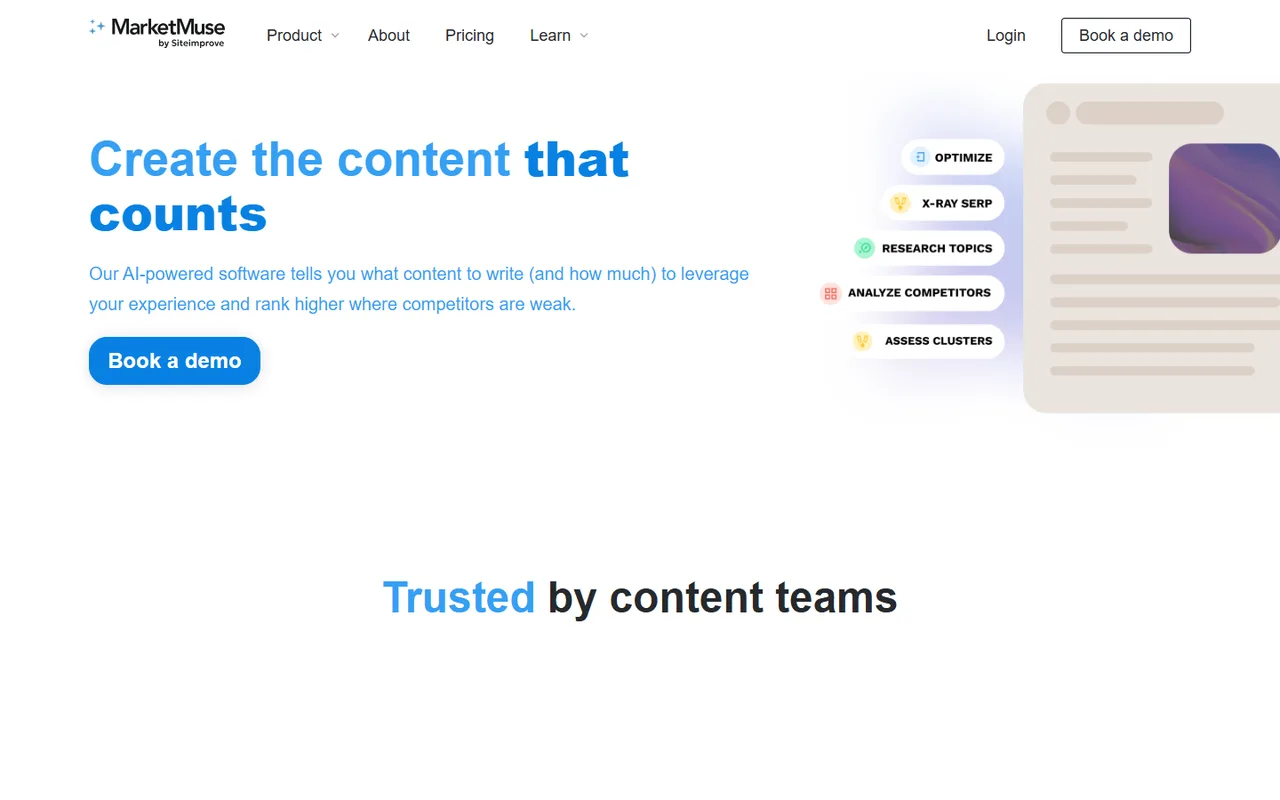
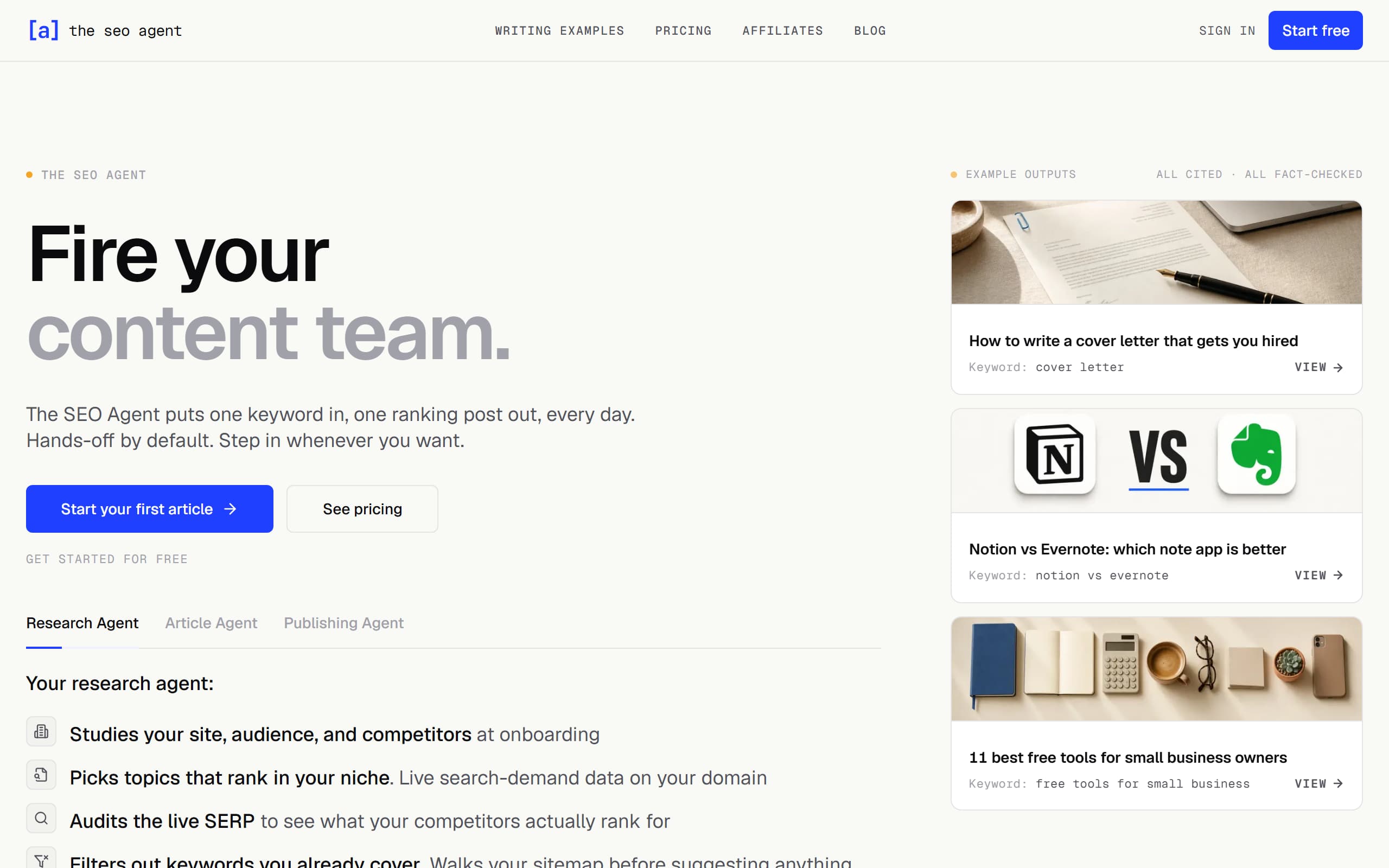
MarketMuse is a content intelligence platform: it models the topics your site covers, scores that inventory against competitors, and turns the gaps into clusters, plans, and briefs. TheSEOAgent is an AI SEO tool at the other end of the same job: keyword validation, citations, internal links, a quality gate, and native CMS publish in one path.
The pitch has not really changed since 2013. The site says its software tells you what content to write and how much of it, so you can rank where competitors are weak. The modules on the homepage are the same ones long-time users know: Optimize, X-Ray SERP, Research Topics, Analyze Competitors, Assess Clusters, plus content planning and the brief generator. Customers are quoted reporting 4x to 10x more traffic on optimized pieces.
What changed is who owns it. The wordmark now reads MarketMuse by Siteimprove. Siteimprove announced the acquisition on 8 October 2024 and closed it on 31 October 2024, folding a content strategy product into a platform better known for accessibility, analytics, and enterprise SEO governance. Everything else in this review follows from that: the buyer it is sold to is now a procurement committee, not a solo marketer. If you want the wider map of the category first, the AI SEO tools roundup covers who does planning, who does drafting, and who does neither.
2. MarketMuse pricing, tier by tier.
Here is the honest version, checked 2026-09-13. The pricing page lists Free, Optimize, Research, and Strategy, describes the limits of each in detail, and attaches a dollar figure to none of them. Every paid tier has a demo booking where the price should be. A free trial link sits at the foot of the page.
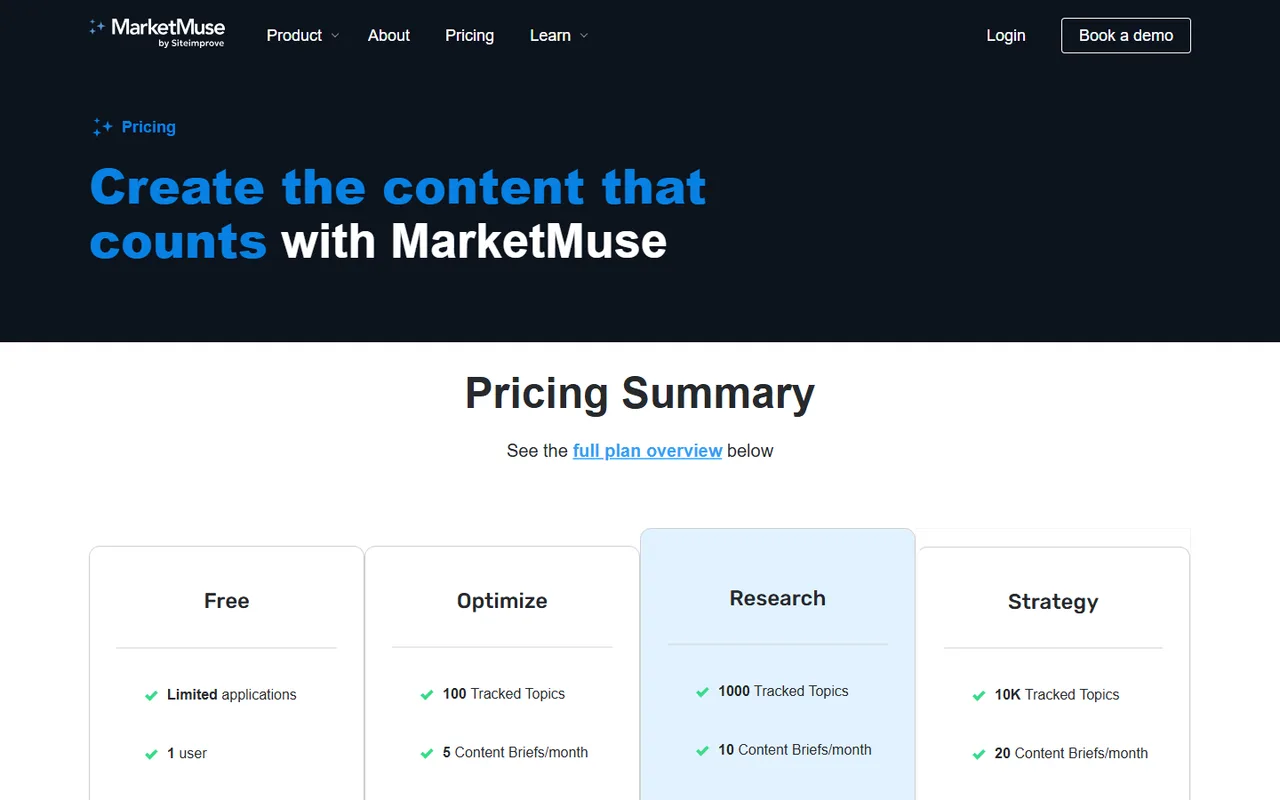
- FreeNo price listed
1 user, 10 queries a month, no tracked topics, no content briefs, no strategy documents, limited applications. A look at the interface rather than a trial of the thing you would be buying.
- OptimizeNo price listed, demo only
1 user, 100 queries a month, 100 tracked topics, 5 content briefs a month, 1 strategy document a month, 1 site inventory. The single-seat tier, and 5 briefs a month is the number to sit with.
- ResearchNo price listed, demo only
3 users, unlimited queries, 1,000 tracked topics, 10 content briefs a month, 3 strategy documents a month, 1 site inventory. The first tier where the topic inventory covers a real content site.
- StrategyNo price listed, demo only
5 users, unlimited queries, 10,000 tracked topics, 20 content briefs a month, 5 strategy documents a month, 1 site inventory, and access to all 9 brief types. This is the agency and enterprise tier.
Be careful with the numbers you will find elsewhere. Several pricing-tracker sites still publish MarketMuse figures, they are scraped from different archive snapshots, and they disagree: Optimize turns up quoted anywhere from about $99 to $149 a month, and the top self-serve tier anywhere from about $499 to $1,499. None of those is confirmed by the live site today, so do not budget against them. Ask for the quote, and ask what it does at renewal.
The other way to read a hidden price is as a signal about fit. Tools priced for self-serve publish the number because the buyer decides in an afternoon. Tools priced per account hide it because the number moves with the account. Our own flat monthly plan is published for the first reason, and it includes the writing and the publishing rather than the plan for them.
3. Where MarketMuse wins.
Set the pricing aside. The research layer is genuinely strong, and it is stronger than most of the tools that outrank it on review sites.
- Topic authority, not keyword lists. The site inventory scores what your domain has actually earned the right to rank for. That reframes planning from a spreadsheet of volumes into a question about where you are already credible, which is the correct question.
- Cluster analysis that holds up. Up to 10,000 tracked topics on Strategy, grouped into clusters with coverage gaps marked. On a 2,000-page site this is work a human analyst takes weeks to do and does less consistently.
- Briefs a writer can actually use. Nine brief types on the top tier, built from the topic model rather than from scraping the current top ten. A brief that says what to cover beats one that says which competitor to imitate.
- Evidence for the budget meeting. Strategy documents exist to be shown to someone who approves spend. If you have to defend a content plan quarterly, that output has real internal value.

If nobody at your company can currently answer what should we write next without guessing, this is a defensible purchase. It answers that question better than the alternatives, including the brief-first tools covered in the comparison of research and brief tools. Just be clear that answering it and acting on it are two purchases.
4. Is MarketMuse good for SEO?
For the planning half, yes, and it always has been. For the part where rankings actually move, which is pages going live, it does not participate.

- Five briefs is not a program. On the entry paid tier you get 5 content briefs a month, 10 on Research, 20 on Strategy. A cadence that moves rankings looks more like a page a day, so on any tier the plan outruns what the plan covers.
- Nothing writes the page. The brief is the deliverable. Every hour of drafting, editing, and formatting is still yours, which is the cost line that made you look at software in the first place. That is the whole difference between a planner and hands-off publishing.
- No fact checking. Nothing attaches a source or verifies a claim, so the expensive half of reviewing any AI-assisted draft stays with your team. It is the job our citation pass exists to do before anything ships.
- One site inventory on every tier. Free through Strategy, it is a single site inventory. Agencies running client portfolios should get that limit in writing before signing, because it is the constraint most likely to bite after month two.
- Clusters do not link themselves. The product identifies the cluster. Someone still has to build the internal links that make a cluster behave like one, which is what an automatic internal linker does as pages publish.
This is the split our automation-tool rankings weigh heaviest: how much of the loop closes without a person picking up the recommendation and doing the work by hand?
5. MarketMuse vs TheSEOAgent.
The clean split: MarketMuse works out what the site should cover and hands back a brief. TheSEOAgent researches, writes, checks, links, and publishes on a cadence. Same goal, opposite end of the loop, and the prices are visible on one side only.
| FEATURE | MARKETMUSE | THESEOAGENT |
|---|---|---|
| Best fit | Content leads planning a quarter of writer time on a large site | Founders and teams who want published pages without staffing the writing |
| Product shape | Topic modelling, cluster analysis, and briefs | End-to-end pipeline from keyword to live post |
| Topic authority mapping | Site inventory scored against competitors, up to 10,000 tracked topics | Site coverage check that skips keywords you already rank for |
| Who writes the page | Your writers, from the brief | The pipeline drafts it, you review it |
| Fact checking | Not part of the product | Citation-backed pass before the draft can clear the gate |
| Volume limits | 5, 10, or 20 briefs a month depending on tier | A daily cadence you set, on one flat plan |
| Publishing | None. The brief is the deliverable | Native publish to WordPress, Webflow, Shopify, Ghost, and Wix |
| Price visibility | No figures on the pricing page, every paid tier is a demo booking | $99 a month flat, published, cancel in one click |
6. The decision matrix.
Two cards, one question each. Answer honestly about what happens to a brief after it lands in the shared drive.
- You have writers and the hard part is telling them what to write.
- The site is big enough that topic gaps are not obvious by eye.
- You defend a content plan to someone who approves budget.
- A quoted enterprise price is normal procurement for you.
- Nobody on the team is going to write the drafts.
- You want citations and internal links handled.
- You want weak drafts blocked, not scored or briefed.
- You want the price before the sales call.
Comparing verdicts across the category rather than picking today? The Surfer SEO verdict covers the on-page optimizer side, the Frase verdict covers brief-first research at a single-article altitude, and the Writesonic verdict covers the AI-search visibility trackers.
7. Is MarketMuse worth it?
As content intelligence for an in-house team that already publishes, yes, assuming the quote is proportionate to how much writer time it redirects. As the thing that fixes a content program, no, because it does not touch the step where programs actually fail.

The failure mode is specific and common. A year in, the strategy documents are excellent, the cluster map is accurate, and forty briefs sit unwritten because nobody had the hours. The plan was never the constraint. If that is a description of your last twelve months, an AI SEO agent that drafts, checks, links, and publishes is the purchase that changes what ships.
Running both is reasonable for a mid-size team with real writers: plan with one, produce with the other. If your site runs on WordPress, the shortest path from a brief to a live page is publishing straight into WordPress on a schedule, and for large templated page sets the cheaper answer is usually generating the pages programmatically rather than briefing each one.
8. How to test it before you buy.
The Free tier gives you 10 queries and no tracked topics, so it cannot answer the buying question on its own. Use the demo and the trial deliberately:
- Ask for the price in the first five minutes of the demo, plus the renewal terms and what an extra site inventory costs.
- Run your own domain through the topic inventory and check whether the gaps it finds are ones your team had not already named.
- Take one brief and hand it to a writer cold. Time how long the finished page takes end to end.
- Multiply that time by the brief allowance on the tier you would buy. That is your real monthly cost, software plus hours.
- Count pages published in the trial window, not briefs generated. They are not the same metric and only one of them ranks.
To run the same test on the production side, the free trial covers keyword validation through to CMS publish with no sales call in the middle, and the head-to-head against Outrank shows that test against the closest autopilot product.
Is MarketMuse worth it in 2026?
It is worth it if your bottleneck is deciding what to write and proving the decision to someone else, and if the quote you get back clears your budget. It is not worth it if the bottleneck is that nothing gets published. MarketMuse produces briefs, clusters, and strategy documents. Somebody on your side still writes every page.
How much does MarketMuse cost?
Checked 2026-09-13: the pricing page lists four tiers (Free, Optimize, Research, Strategy) and no dollar figures at all. Every paid tier routes to a demo booking. Third-party trackers still publish numbers scraped from older snapshots, and they contradict each other, with Optimize quoted anywhere from about 99 to 149 USD a month and the top self-serve tier from about 499 to 1,499. Treat all of those as stale. The only real number is the one on your quote.
Is MarketMuse good for SEO?
It is good at the planning half. Topic modelling, content clusters, competitive gap analysis, and briefs built from an inventory of your own site are real SEO work, done more rigorously than most tools attempt. It does nothing about the production half. No fact checking, no publishing, and the brief allowance on the entry paid tier is 5 a month.
What is MarketMuse best for?
Deciding what to write next on a large site, with evidence. The topic inventory plus cluster analysis tells you which subjects you already have authority in and which ground is uncovered, which is the question an in-house content lead has to answer before allocating a quarter of writer time.
What is the main weakness of MarketMuse?
The gap between a brief and a live page. Strategy documents and briefs are the output, and the whole cost of turning them into published, fact-checked, internally linked pages stays with you. The hidden pricing is the second weakness: you cannot size the purchase without a sales call, which prices out exactly the small teams who would benefit from the planning.
Did Siteimprove buy MarketMuse?
Yes. Siteimprove announced the acquisition on 8 October 2024 and completed it on 31 October 2024. The wordmark on the site now reads MarketMuse by Siteimprove, and the enterprise motion that came with it is the most plausible reason self-serve prices left the pricing page.
Does MarketMuse have a free plan?
Yes, a Free tier with 1 user and 10 queries a month, no tracked topics, no content briefs, and no strategy documents. It is enough to see the interface and run a couple of topic queries. It is not enough to evaluate the product, because the tracked-topic inventory is the part worth evaluating.
Is MarketMuse or Frase better?
Different altitudes. Frase works at the level of one article: pull the SERP, build the brief, optimize the draft. MarketMuse works at the level of the whole site: what does this domain have authority in, where are the gaps, what should the next twenty pages be. A single writer usually gets more from Frase. A content lead planning a quarter gets more from MarketMuse.
How is TheSEOAgent different from MarketMuse?
MarketMuse tells you what to write. TheSEOAgent writes it and publishes it: live keyword validation picks the target, drafting attaches citations, a quality gate refuses weak drafts, internal links are added, and the finished article publishes to WordPress, Webflow, Shopify, Ghost, or Wix. One flat plan at 99 USD a month, listed publicly, cancel in one click.
Should I switch from MarketMuse to TheSEOAgent?
Switch if your plan is already longer than your publishing capacity, which is the usual failure state after a year of briefs. Stay if you have writers and the hard part is genuinely deciding what they work on. Running both is coherent: plan with one, produce with the other, and check after a quarter which one the published pages actually came from.
Related guides + features.
SEO automation
The full pipeline: research, fact-checked drafting, a quality gate, and native publish. Where these tools stop, the agent ships the page.
/features/seo-automation →LISTICLEBest AI SEO tools
The AI SEO field ranked for teams that want shipped articles, not another dashboard.
/blog/best-ai-seo-tools →PRICINGSimple pricing
$99 flat per month after a free trial. No per-keyword meter, and cancellation is one click in the app.
/pricing →