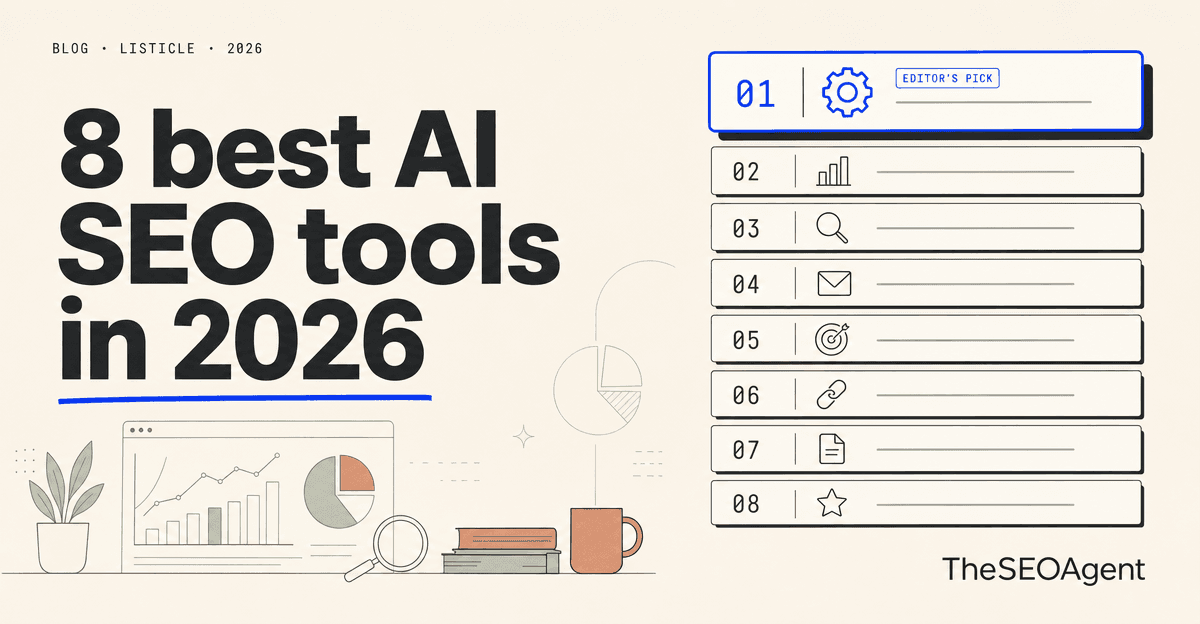
8 best AI SEO tools in 2026, ranked by what they actually ship.
Eight tools worth a 2026 subscription, scored on the five things that decide whether an AI SEO tool actually moves rankings: data source, fact-checking, quality gate, CMS publishing, and price. Honest pros and cons on every entry, no affiliate links, no sponsored placements.
Want one tool that runs the whole thing? The SEO Agent researches keywords, writes cited articles and publishes them to your site daily. Enter your site to start.
Free trial · Cancel in one clickHow we picked these eight.
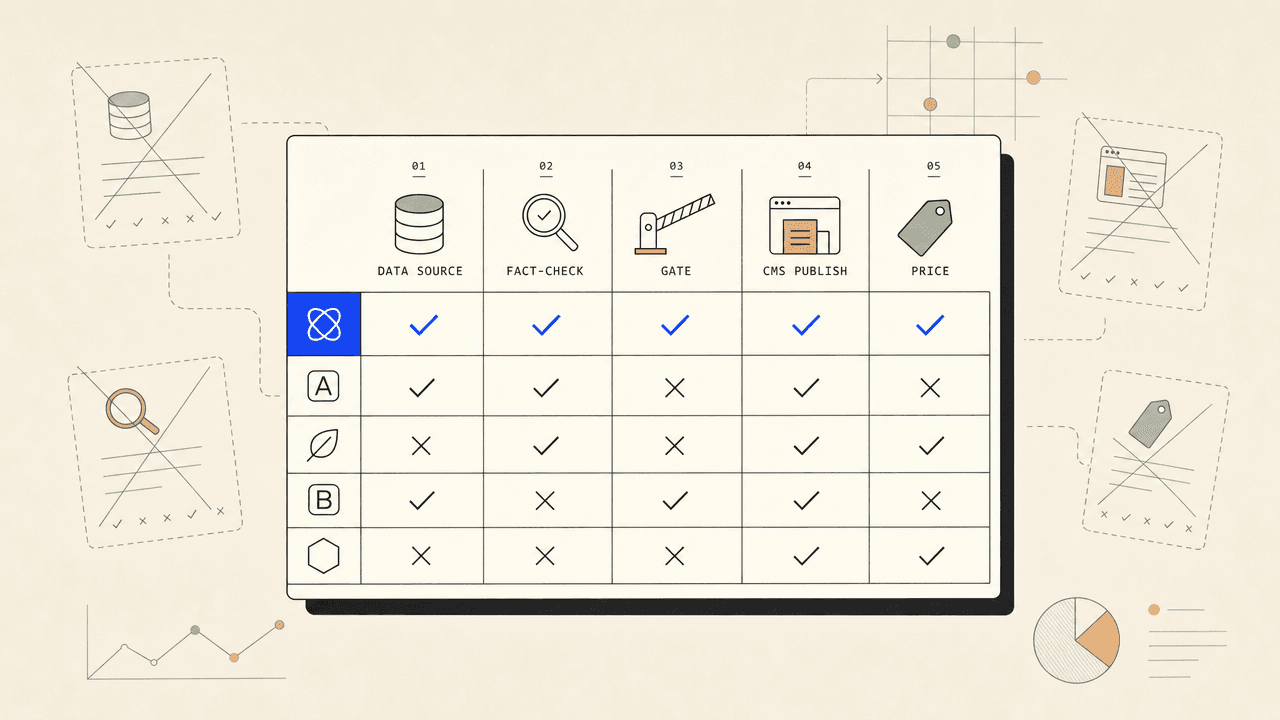
An AI SEO tool earns a slot on this list when it covers a real slice of the content loop and ships work that survives the live SERP. We scored each candidate on five dimensions: data source (live data or internal estimates), fact-checking (citations or hallucinations), quality gating (publish-time refuse or ship-everything), CMS publishing (native or copy-paste), and total cost to run a 30-articles-a-month program. Most tools win on one or two dimensions and fall short on the others, which is why the ranking ends up mostly inverse to how many slices each tool tries to own.
The list is ranked, not thematic. TheSEOAgent sits at #1 because the tool we built is the only one on this list that owns all five dimensions in a single program for one subscription. The other seven entries are ranked by category depth and value-per-dollar within their slice. There are no affiliate links and no sponsored placements; if you want to know how we approach SEO content honestly, the story page is the longer version. Pricing on our end is flat at $99 a month, broken down on the pricing page. If you are buying these tools to resell the output to clients rather than run your own site, the same field ranked for agencies is in our roundup of white label SEO platforms.
TheSEOAgent
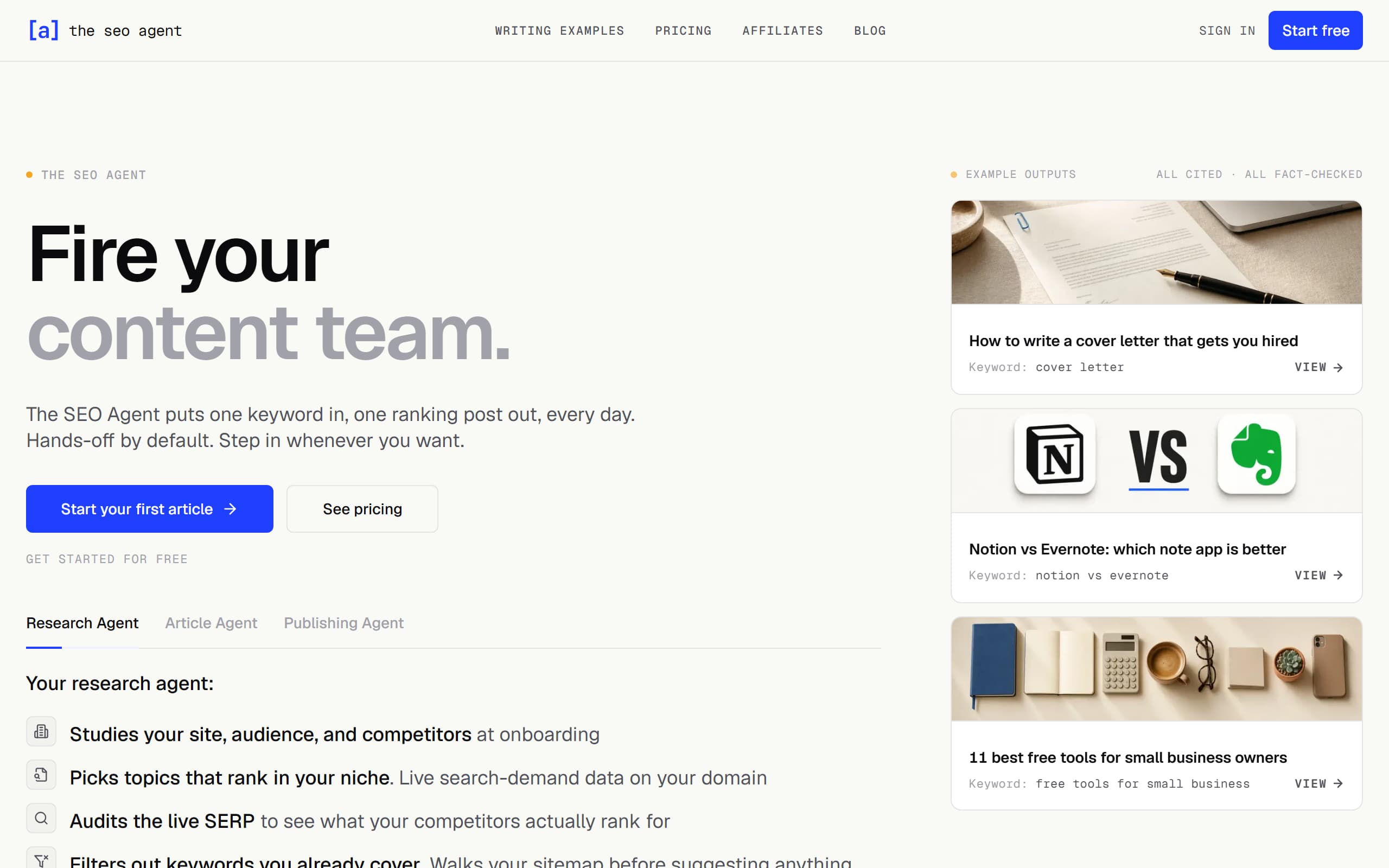
The only AI SEO tool on this list that owns the entire content loop in one program. Live keyword research, fact-checked drafting with citations, a quality gate that refuses bad drafts, and native publish to WordPress, Webflow, Shopify, and Ghost. $99 a month flat, with a free trial. Built for founders and content teams who want a daily publishing program without managing a five-tool stack.
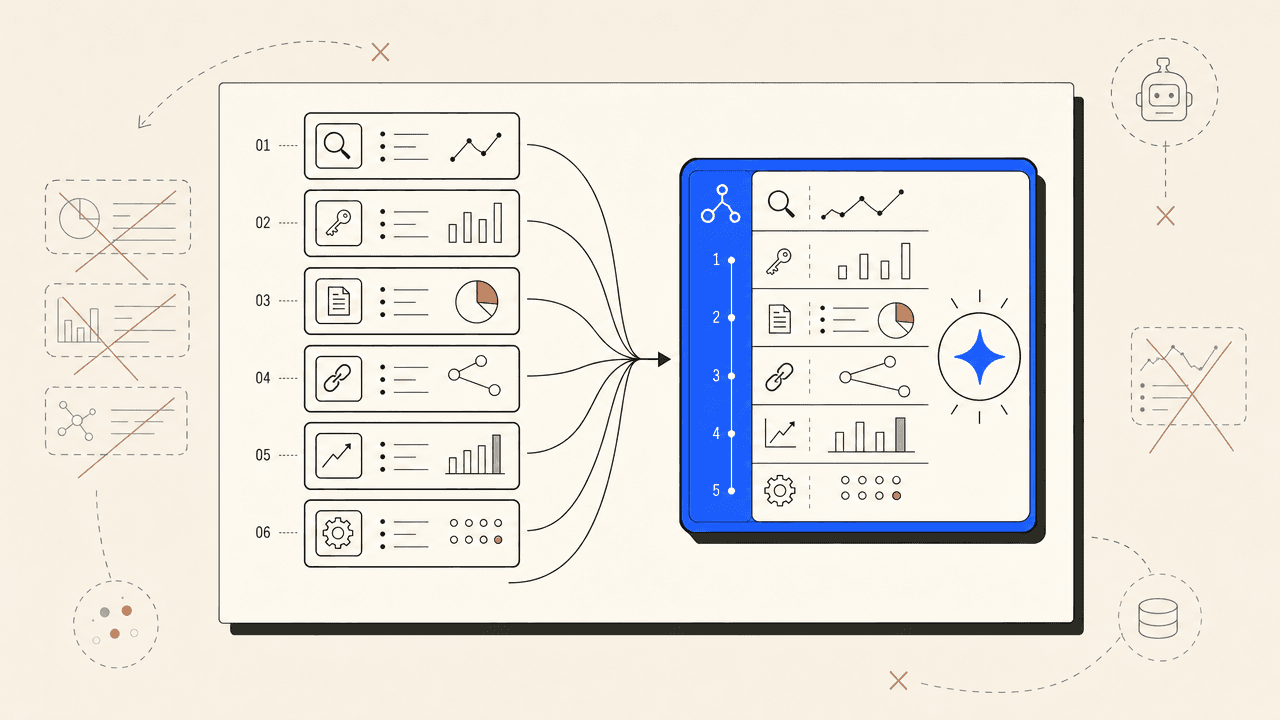
The pitch is structural, not feature-led. Most AI SEO tools own one slice of the workflow (optimization, briefs, drafting, or publishing) and leave the rest to glue code. TheSEOAgent runs the full pipeline as a single program. The keyword data is real (live, not estimated), the draft cites its sources, the gate refuses output that scores below threshold, and the finished article ships native to the CMS with images and schema. The full architecture is on the SEO automation page if you want the longer version.
Pricing is flat at $99 per month, no per-article meter and no token surcharge. The first three days are a free trial so you can see articles ship before committing. The agent architecture, why one program beats a stack of specialists, is laid out on the dedicated SEO automation page. Most SEO case study examples skip the pages that gained impressions and no clicks. Ours does not: four months of our own Search Console data, matched windows and impression traps included.
- Live keyword data on every brief, never internal estimates
- Fact-check pass with citations on every defensible claim
- Quality gate refuses to publish below threshold
- Native publish to WordPress, Webflow, Shopify, Ghost
- No Notion or Framer integration yet (webhook works as a fallback)
- Younger than Surfer or Frase, smaller third-party app marketplace
Surfer SEO
The category-defining content optimization tool. Surfer reverse-engineers the top-ranking pages for a target keyword and tells you what to add to your draft to match: word count, NLP terms, headings, image count. The AI-generated content add-on bolts a drafting layer on top, though the optimization score is what most teams actually pay for.
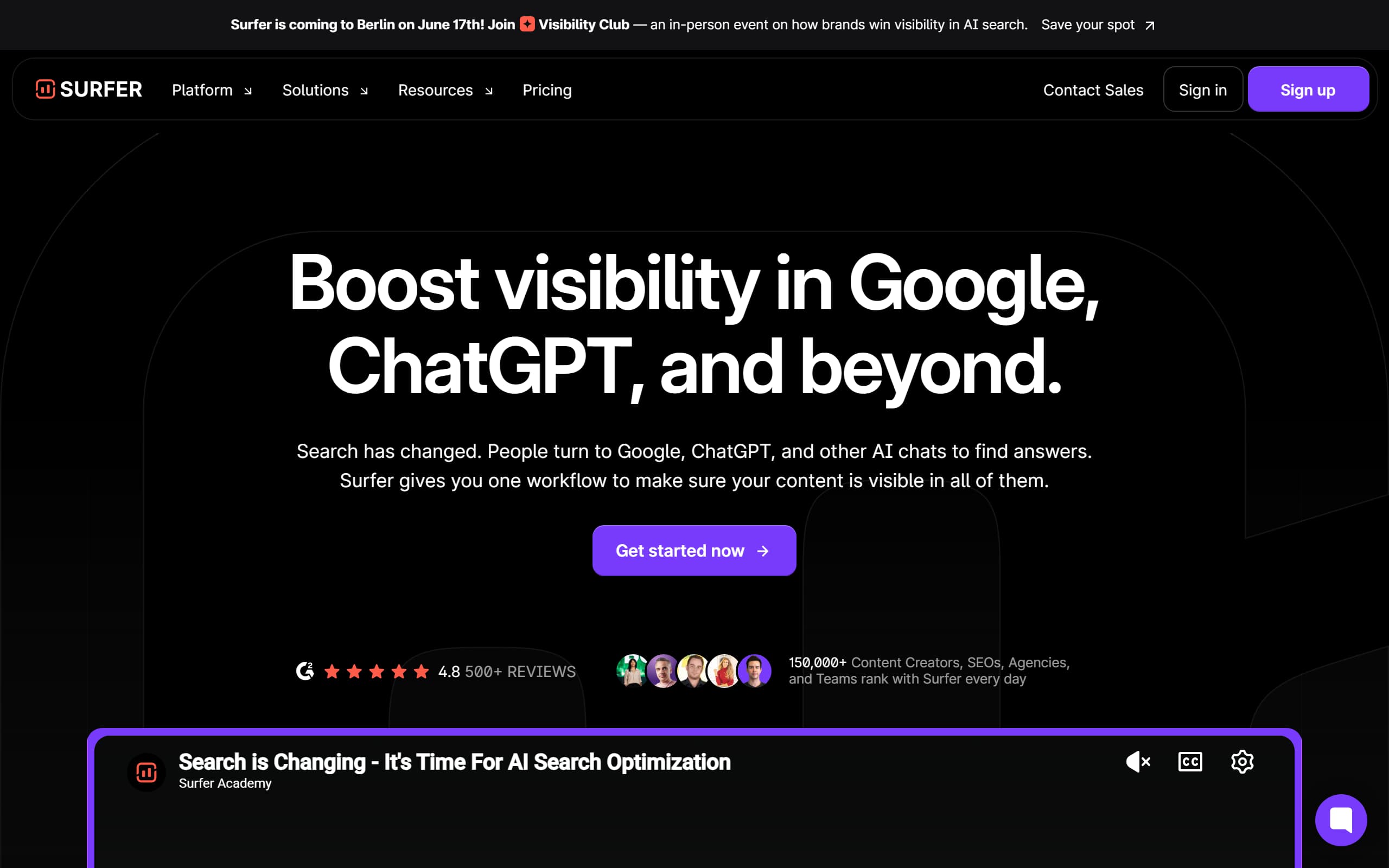
Surfer is the right pick when your bottleneck is on-page optimization and you already have a writing team. The Content Editor scores your draft against the live SERP and surfaces a ranked list of NLP terms to add, headings to mirror, and structural changes that match the shape of the pages currently winning. It is the most refined optimization scorer on the market and the Chrome extension lets editors work directly inside Google Docs or WordPress without a copy-paste round trip.
Where it leaves you on the hook is the rest of the pipeline. Keyword research, fact-checking, quality gating, and CMS publish are separate tools, separate subscriptions, separate dashboards. For teams running a daily publishing program that gets compounded into programmatic SEO sweeps, that stack adds up. Our Surfer SEO review works through the current tiers and what each one actually buys.
- Best-in-class content score that maps to SERP-winning shape
- NLP term suggestions are dense and well-ranked
- Healthy Chrome extension for in-editor optimization
- Optimization is one slice; you still need brief, draft, and publish tools
- AI content add-on is priced separately and drafts are middling
Frase
Frase turned the SERP-driven content brief into a paid product. Paste a target keyword and it returns a structured brief: top-ranking outlines merged, common subheadings, NLP themes, FAQ questions pulled from People Also Ask. The AI writer drafts from the brief; the optimization scorer rates the result.
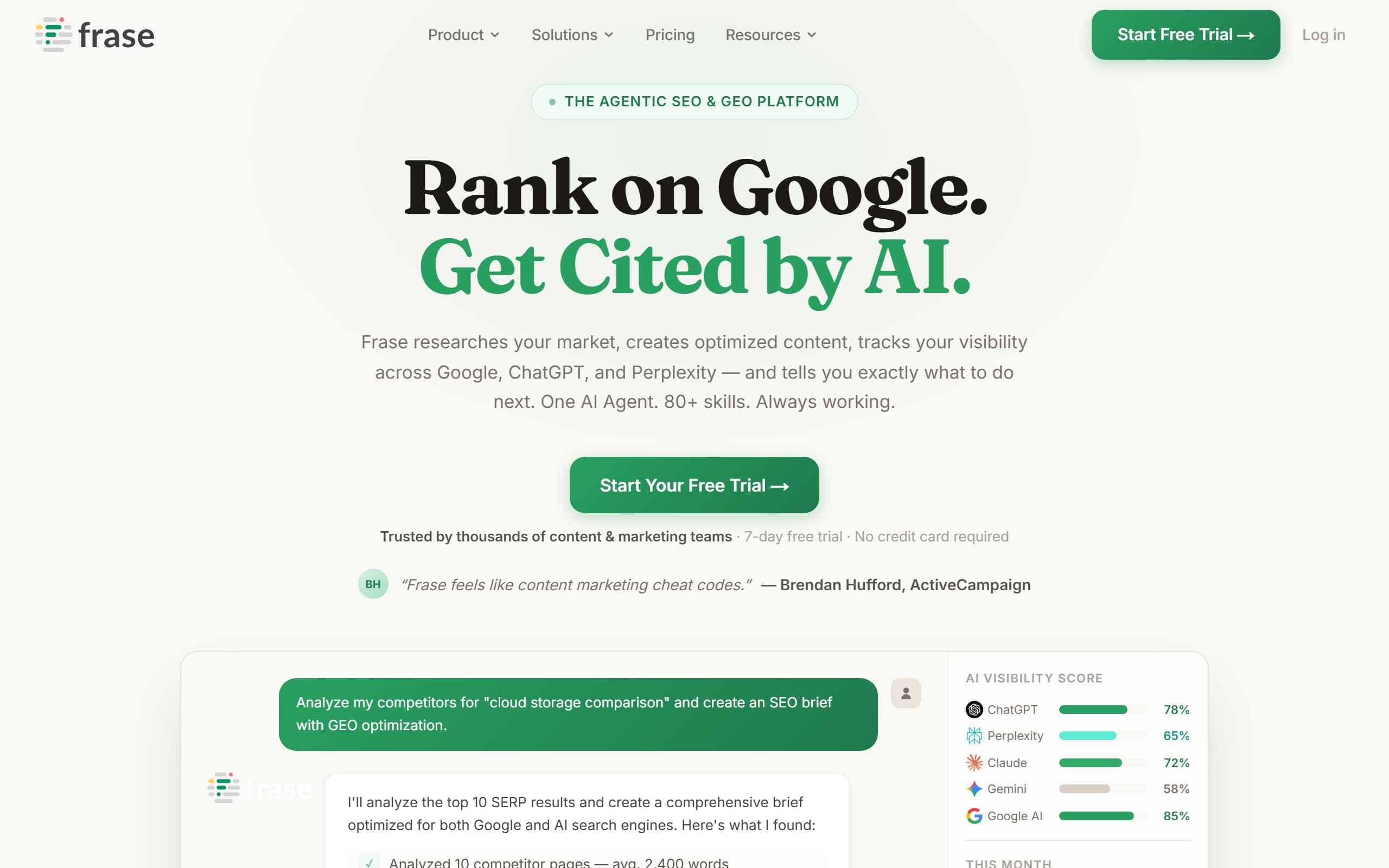
Frase is the right pick when the bottleneck is brief generation and your writers are strong enough to draft from a structured outline. The brief layer is the differentiator: merged competitor outlines, NLP themes, and People Also Ask questions are pre-pulled so the writer starts with a complete map of what the page should cover. Many content teams use Frase as a brief layer and then write outside it.
The AI drafting layer is the weaker half. Output reads competent but generic and almost always needs an editorial pass before publish. There is no fact-check step and no CMS publish, so the workflow still depends on the rest of the stack. Compared to the citation-enforcing fact-check pass we run on every claim, Frase drafts feel more like a starting outline than a shippable article. The full verdict, tier by tier, is in our Frase review.
- Briefs are dense and SERP-grounded, not generated from thin air
- Cheaper than Surfer for similar optimization scoring
- AI writer is acceptable for first drafts
- Drafts need a heavy editorial pass
- No native CMS publish; output is markdown or copy-paste
MarketMuse
The most academically rigorous content intelligence tool in the category. MarketMuse builds a topical authority model for your domain, scores every page against it, and tells you which clusters you own vs which ones you have to build. Priced for enterprise content teams; overkill for a solo founder.
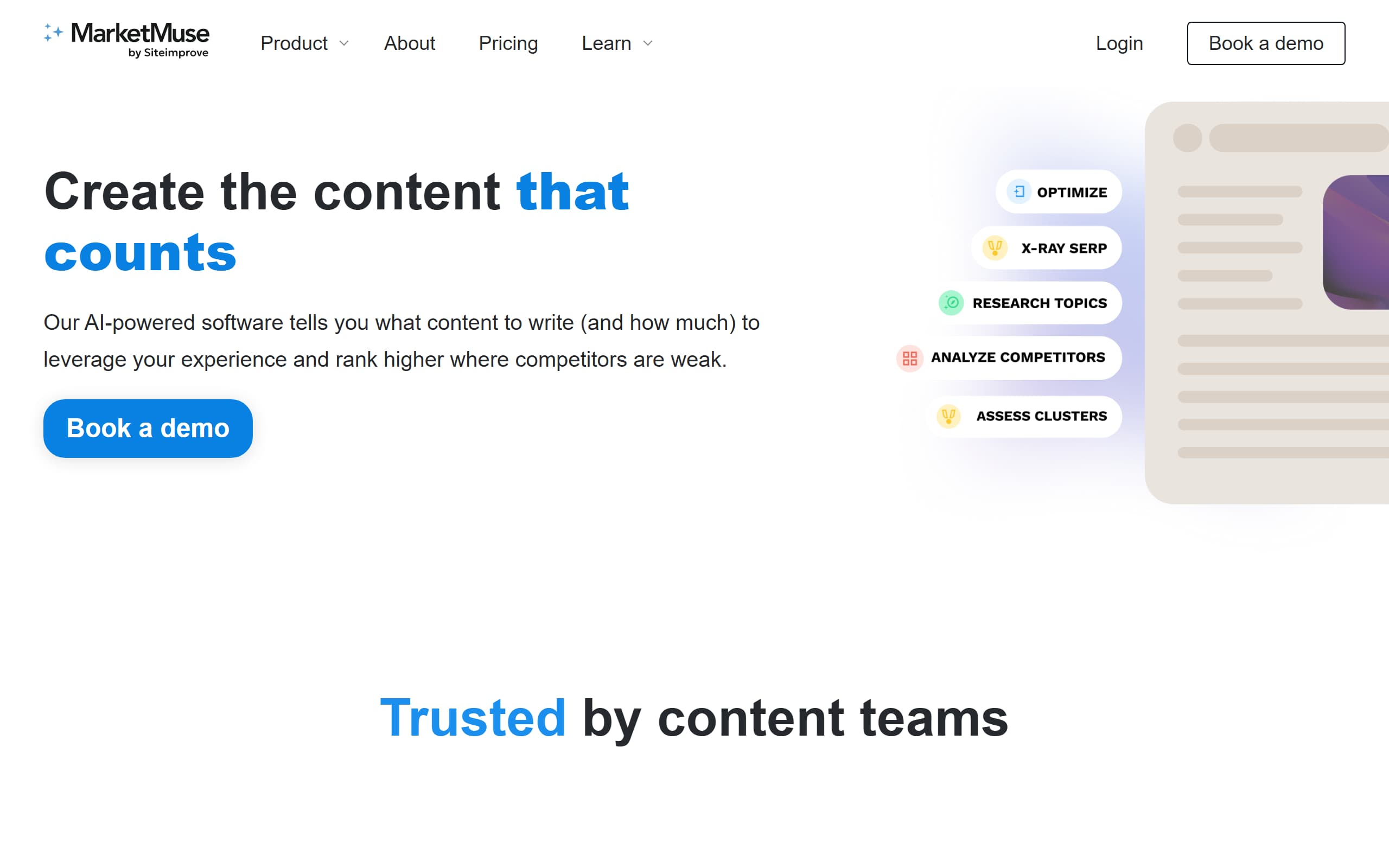
MarketMuse earns its slot for two things: the topical authority model and the inventory feature. The authority model maps your entire site against a topic graph and identifies where you have cluster ownership versus where the SERP is unclaimed. The inventory pass audits every URL and scores each one against an ideal version, surfacing pages that should be updated, expanded, merged, or pruned. For a team running a multi-thousand-page program, this is the most defensible way to plan what to write next.
The cost structure is the friction. Pricing starts well above seven thousand dollars a year and assumes a content-ops team can absorb the dashboard. For solo founders and small content teams running a daily publishing cadence, the same topical-coverage question is better answered by the site-coverage pass we run on every brief, which surfaces gaps in seconds rather than days.
- Topical authority model is the most rigorous in the category
- Cluster-level reporting saves enterprise content ops time
- Inventory feature audits an entire domain in one pass
- Pricing starts north of $7k a year, hard ROI for under-10-person teams
- Learning curve is steep; the dashboard rewards content-strategy fluency
Clearscope
Premium content optimization tool aimed at editorial teams. Clearscope is the smallest, sharpest set of features on this list: paste a target keyword, get a term-coverage brief and a content grade that maps to SERP performance. Used by The Atlantic, HubSpot, and Adobe; priced accordingly.

Clearscope is what editorial teams reach for when Surfer feels noisy. The product does one thing (score draft quality against a target keyword) and does it with restraint. Term recommendations are tightly curated rather than enumerated, the letter-grade score is legible to non-SEO editors, and there is no AI drafting layer to ignore. It is the opposite of a feature-creep product and the editorial teams that pay for it tend to stay. Our full Clearscope review walks the $189 entry tier and what it does not cover.
What you do not get is anything else: no keyword research, no brief generation, no drafting, no fact-check, no CMS publish. The cost stacks. For founders evaluating an all-in-one alternative, the longer breakdown is on the dedicated SEO automation page.
- Cleanest scorer UI in the category, designed for working editors
- Term recommendations are tightly curated rather than spammed
- Reliable, fast, no AI-feature creep
- Pricing starts around $189 a month, no free tier
- Optimization only; you still need every other layer of the stack
NeuronWriter
The most-recommended SEO tool on indie SaaS Reddit threads for one reason: it does most of what Surfer does for a fraction of the price. NeuronWriter pulls SERP competitors, generates briefs, scores drafts against term coverage, and includes a usable AI drafting layer in the base price. Not as polished as the premium tools, but the gap is smaller than the price gap.
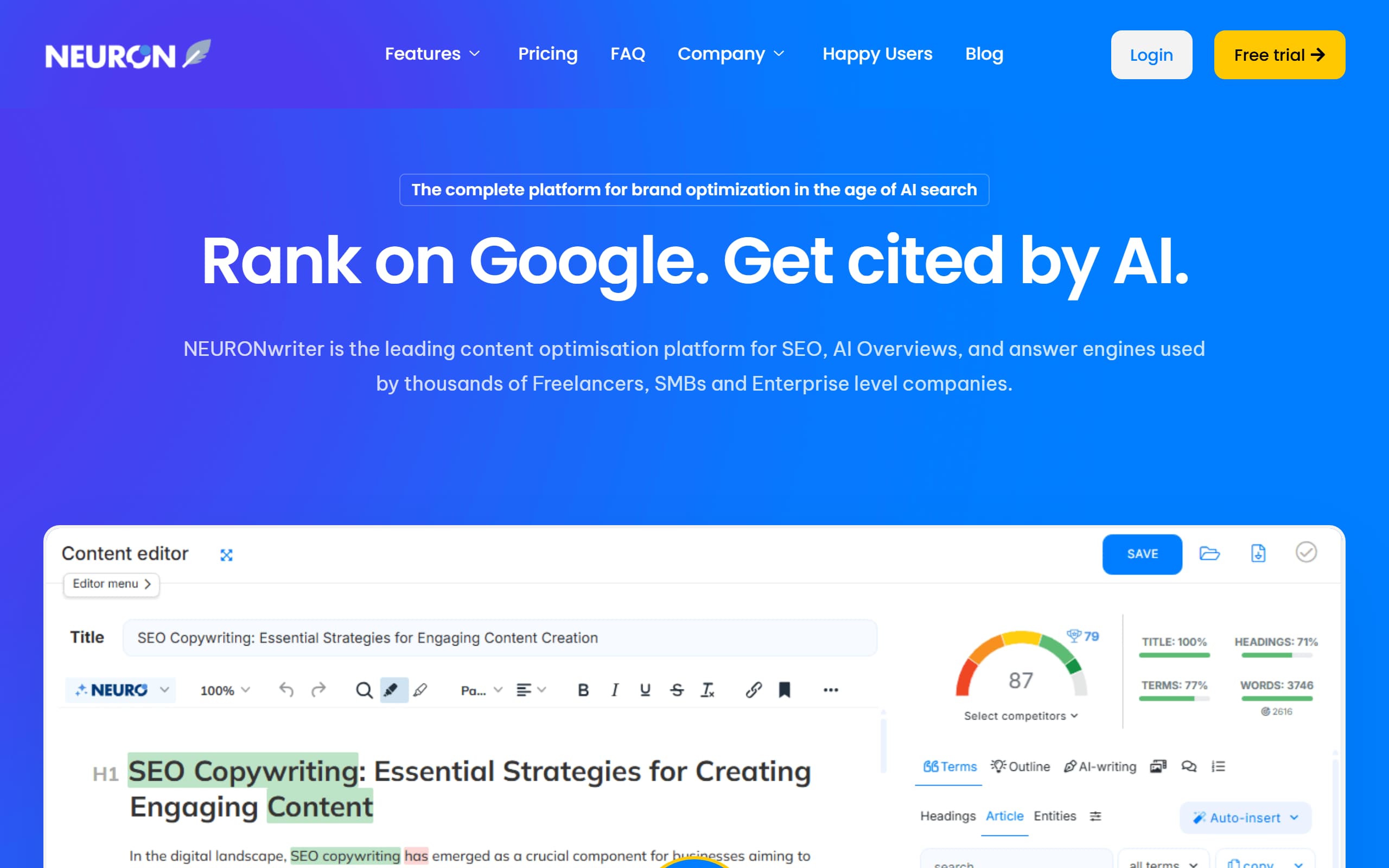
NeuronWriter is the right pick for budget-constrained teams that want most of the premium functionality in one tool. The SERP analyzer pulls top-ranking competitors and merges their structure into a brief, the AI writer drafts from that brief, and the content scorer rates term coverage against the live SERP. None of the individual pieces are best-in-category, but bundled together at a fifth of Clearscope's price, the value proposition is clear.
The compromises show up downstream. There is no fact-check step, so AI hallucinations slip through, and there is no native CMS publish, so the workflow ends in markdown. For founders graduating from NeuronWriter to a real publishing program, the natural upgrade path is into the single $99-a-month TheSEOAgent plan that covers every downstream step.
- Plans start under $25 a month with a lifetime deal sometimes available
- Bundles optimization + brief generation + AI drafting in one tool
- Active development cadence, frequent feature shipments
- UI feels dated next to Surfer and Clearscope
- No fact-check pass and no native CMS publish
Outrank.so
The other autopilot SEO content tool in the category. Outrank generates and publishes SEO articles to your CMS on a schedule with minimal human input. Cheaper than us on the entry tier; quality and editorial controls are the open question. Direct comparison on the dedicated /vs page.
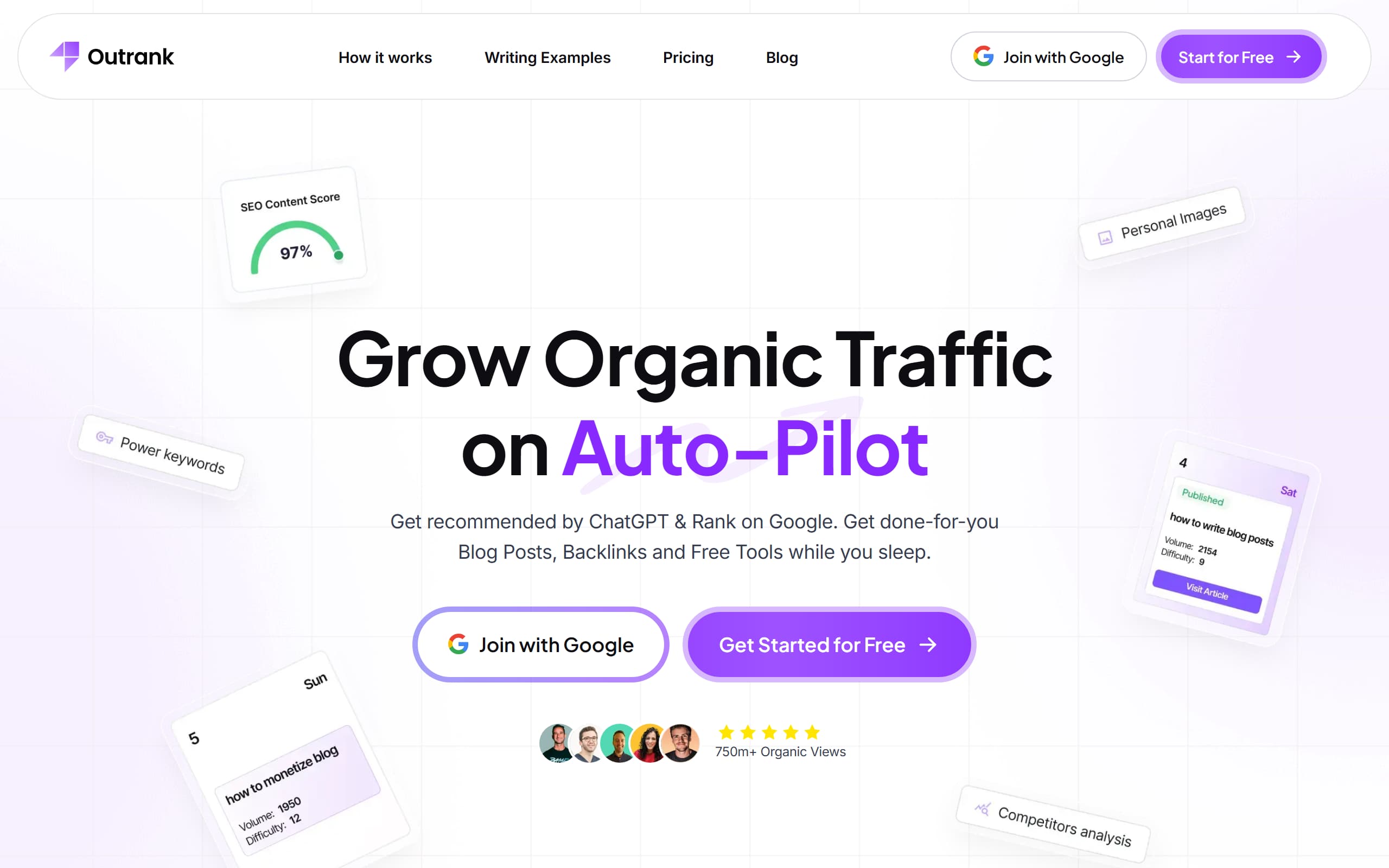
Outrank is the closest structural peer to TheSEOAgent: an autopilot SEO content tool that drafts and publishes to a connected CMS without a human in each step. The architecture is similar, the categories of work are similar, and the value proposition (a daily publishing program without managing the stack) is shared. The differences live in the editorial guardrails: real keyword data versus internal estimates, a published gate score versus an unreviewed pass, and a documented cancellation flow versus a friction-y one.
The longer side-by-side, including the explicit feature comparison and pricing breakdown, is on the TheSEOAgent vs Outrank page. For teams already on Outrank evaluating a switch, that comparison is the right starting point. If you are also considering AI article writers rather than autopilot SEO platforms, use our Byword AI review and RightBlogger review as the adjacent shortlist checks, plus the Writesonic review if the shortlist includes a writer that has repositioned around AI visibility.
- True autopilot loop similar to ours
- Lower entry tier for low-volume publishing
- No public quality dashboard, harder to audit gate output
- Cancellation friction has been a recurring complaint
AlsoAsked
Single-purpose tool that maps the People Also Ask tree for any keyword. Not a full AI SEO tool by itself, but every brief and every FAQ section on every other tool gets better when you feed AlsoAsked output into it. The cheapest, sharpest research utility on this list.
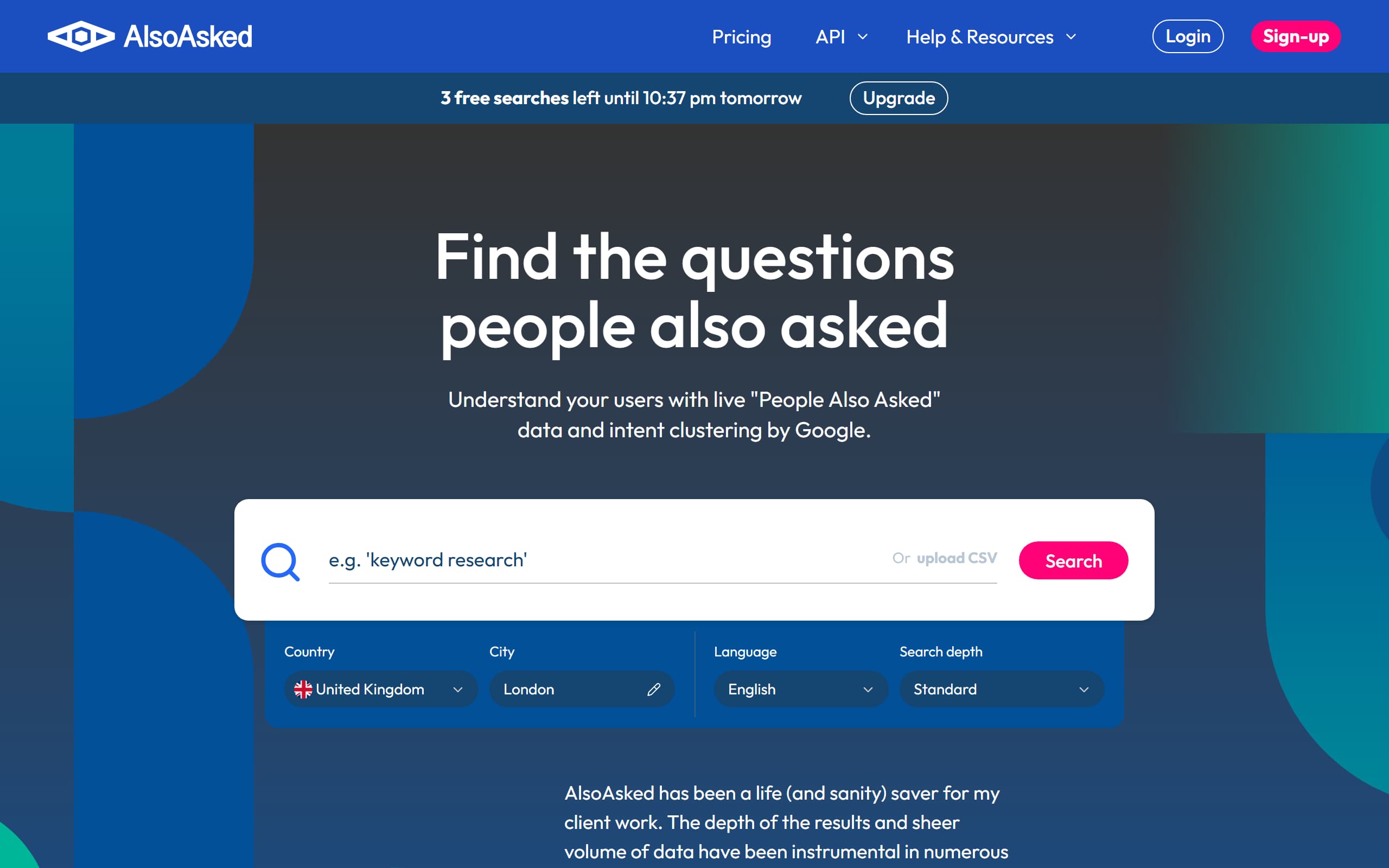
AlsoAsked earns its slot for one reason: the People Also Ask tree visualization is the best in the category and the question data it surfaces makes every brief tighter. Pasted into a brief generator or a FAQ section, AlsoAsked output gives the long-tail question coverage that the premium SEO tools either undercover or charge extra for. The free tier handles one-off research; paid plans scale into project-level workflows.
The honest framing: this is a research utility, not an AI SEO tool. It belongs on a list like this because every other tool on the list works better with AlsoAsked output as input. Our own pipeline pulls equivalent question data automatically when it mines your site for keyword opportunities, so the same coverage lands inside the brief without a manual paste.
- Best PAA-tree visualization in the category
- Free tier is genuinely useful for one-off research
- Cheap paid plans scale with project count
- Single purpose; not a content workflow tool
- No drafting, no scoring, no publishing
- Why we built TheSEOAgent as one program instead of a stack
- TheSEOAgent vs Outrank: the autopilot SEO content comparison
- SEO automation: the longer version of the pillar story
- Autoblogging.ai review for the narrow article-generator comparison
- ChatGPT SEO tools scored on what they automate end to end
- Daily rank trackers you can run without a subscription
- AI copywriting tools, the general-purpose writers this list leaves out
- MarketMuse review with the enterprise pricing written down
What makes a tool an AI SEO tool versus a regular SEO tool?
It uses AI somewhere in the content workflow. That could be brief generation, SERP analysis, term suggestions, draft writing, fact-checking, optimization scoring, or auto-publishing. Most tools cover one or two; TheSEOAgent at #1 is the only one that covers all of them in a single pipeline.
Are these ranked by quality or by category?
Mostly by overall quality and value, with the category tag on each entry surfacing what each one is actually best at. TheSEOAgent ranks #1 for owning the whole loop end-to-end; the others rank by depth of their slice and price-to-value.
Why not include ChatGPT or Claude as AI SEO tools?
They are general-purpose LLMs, not SEO products. Both are good for ad-hoc drafting, but neither does keyword research, SERP analysis, optimization scoring, fact-checking against the live web, or CMS publishing. The tools on this list wrap an LLM inside a content workflow; the LLMs by themselves do not.
How often is this list updated?
When tools ship meaningfully new features, raise prices, or get acquired. Last updated 2026-05-21. We do not run "yearly refresh" timestamps that pretend the list was reviewed when it was not.
Is this sponsored or affiliate?
No. None of the tools on this list pay for placement and there are no affiliate links. TheSEOAgent ranks #1 because it is our product and we built it to cover what every other tool here leaves on the table.
What's the cheapest tool on this list that actually works?
NeuronWriter at under $25 a month is the most defensible budget pick. AlsoAsked has a free tier for research. TheSEOAgent at $99 a month is the cheapest option that covers the whole loop end-to-end (one bill versus stacking three or four budget tools).
What about Outrank.so, SEOBot, or other autopilot tools?
Outrank is included at #7 as the closest structural peer to TheSEOAgent. Other autopilot tools like SEOBot and BabyLoveGrowth.ai sit in the same category; for a side-by-side with Outrank specifically, see /blog/theseoagent-vs-outrank. For autobloggers as a category, see our /blog/babylovegrowth-vs-outrank comparison.
Why should I pick TheSEOAgent over assembling my own stack?
One subscription, one program, one bill, one source of truth for everything that shipped. The stack approach (Surfer + Frase + Clearscope + an AI writer + a CMS plugin) runs about $400-600 a month and still requires manual glue between steps. TheSEOAgent is $99 a month flat with the glue removed. Free trial; cancel in one click if it isn't earning.
Related guides + features.
AI SEO tools
Keyword research, briefs, drafting, and a quality gate run by an agent instead of a dashboard you operate by hand.
/features/ai-seo-tools →PILLAR · SEO AUTOMATIONSEO automation
The full pipeline: research, fact-checked drafting, a quality gate, and native publish. Where these tools stop, the agent ships the page.
/features/seo-automation →LISTICLEBest SEO automation tools
The category ranked on workflow depth, from keyword validation through to native CMS publishing.
/blog/best-seo-automation-tools →One subscription. Whole loop. Free trial.
Three days for a dollar. Connect your CMS, point it at a keyword list, watch articles ship native. Cancel in one click if it isn't earning.
FREE TRIAL · CANCEL IN ONE CLICK