Programmatic SEO that ships finished pages, not duplicates.
Generate hundreds of long-tail variants from one brief. Each page gets live keyword data, a SERP-grounded draft, a fact-check pass, and a quality gate. The volume comes from automation, the variation comes from real data per page.
FREE TRIAL · CANCEL IN ONE CLICK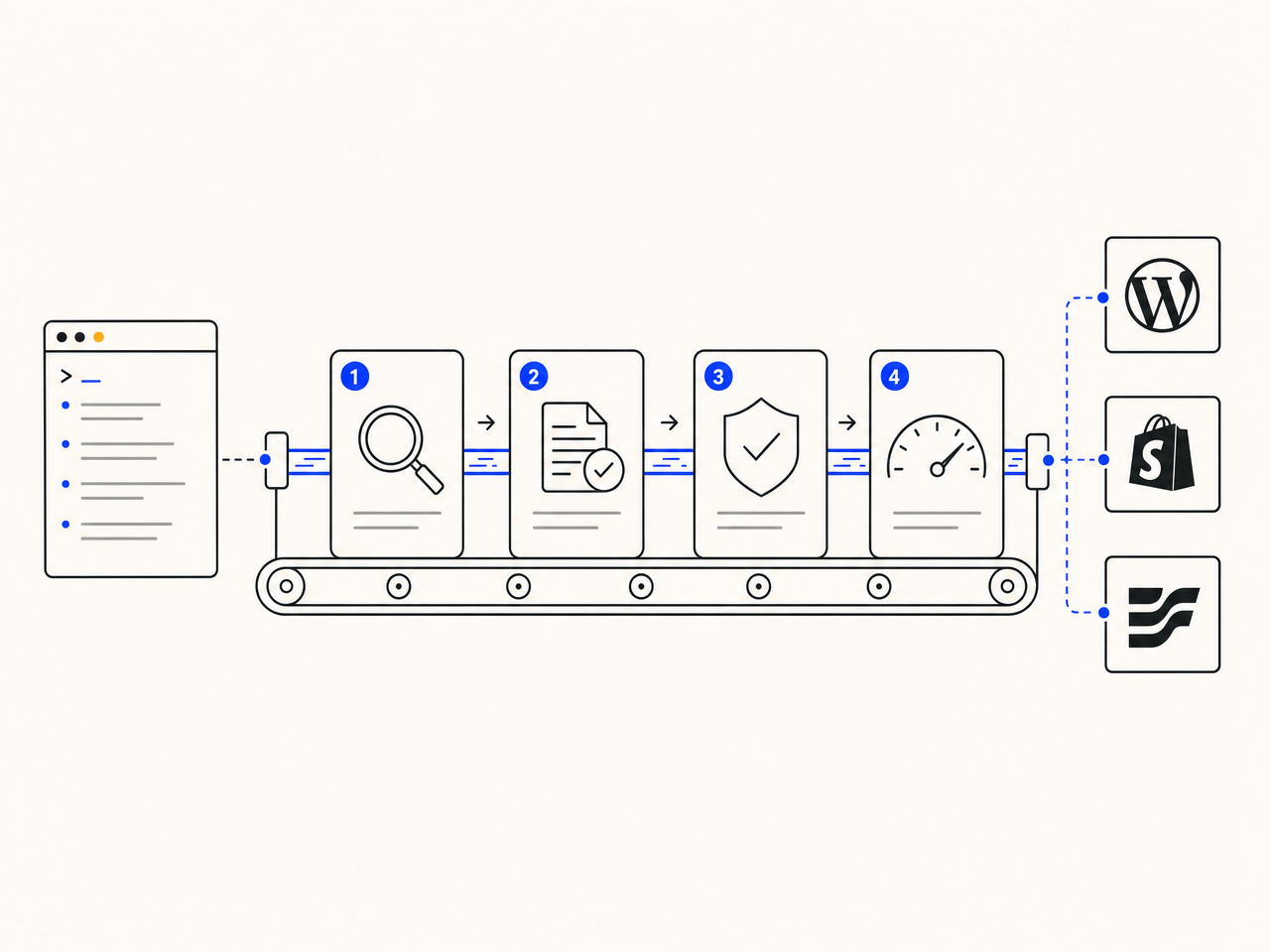
What is programmatic SEO?
Programmatic SEO is generating hundreds or thousands of pages from one template and a structured data source, each page targeting a long-tail keyword variant. The standard stack is a Webflow CMS template plus a CSV, which floods Google with near-duplicates and gets most of the pages de-indexed. TheSEOAgent runs each variant as a real article: live keyword research per variant, per-variant SERP-grounded draft, per-page fact-check, per-page quality gate, then native CMS publish. $99 a month, flat, no per-page meter.
Spin up 500 near-duplicate pages and pray.
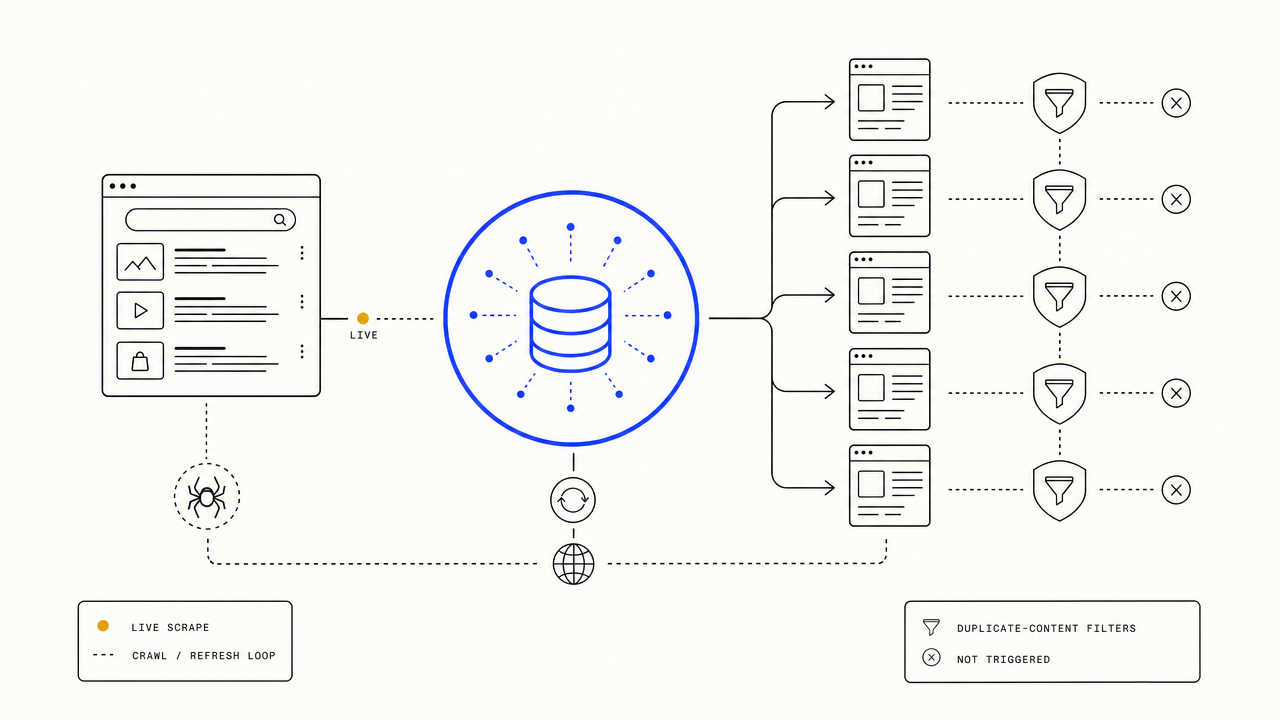
The standard stack is a spreadsheet of variables piped into a Webflow CMS template. Every page reads almost the same. Google merges them, ranks one, and de-indexes the rest. The work was real; the result is one ranking page out of 500.
- No real keyword data per variant, just placeholder fields
- No fact-check, so generated stats hallucinate at scale
- No quality gate, so weak variants ship alongside good ones
- Manual publish through CSV import, schema bolted on after
- No way to spot a low performer until traffic data shows up months later
Generates each variant as a real article, not a row in a spreadsheet.
Every long-tail variant gets the same treatment a single hand-written article would: live keyword research for that exact variant, a draft grounded in SERP data, a fact-check pass, a quality gate. The volume comes from automation, not from gluing a CSV to a template. We covered the pipeline that does this on the SEO Automation page.
- Live keyword data for every variant, never reused or invented
- Per-variant SERP scrape grounds the draft in what actually ranks
- Per-page fact-check appends citations or rewrites the claim
- Per-page quality gate. Variants below threshold regenerate, never ship
- Native CMS publish with structured data on every page
Four differences between scaled output and scaled garbage.
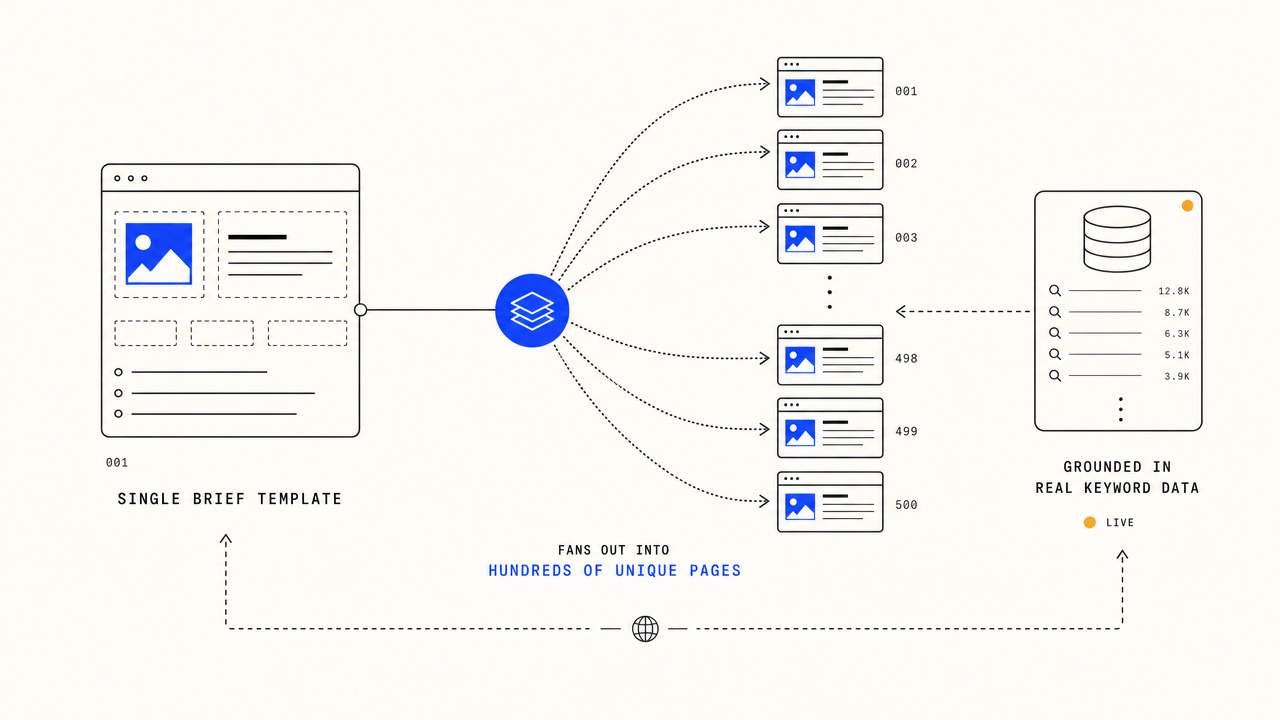
Live keyword data for every page, not invented numbers.
A spreadsheet with 500 rows looks like 500 keywords. Most of those rows have zero search volume. Our pipeline pulls live volume, difficulty, and CPC for every variant before drafting starts. Variants with no real demand get dropped before they cost you a draft, an image generation, or an indexed page slot. Same data layer the full SEO automation pipeline runs on every single article. Volume is the easy half. The measured half, what 61 new pages did to our own search traffic, is published with both matched Search Console windows intact.
Hallucinated stats die one page at a time, before publish.
Programmatic stacks scale hallucinations because they generate at volume without a verifier. Every variant we publish runs through an AI fact checker that cross-references each claim against the live web. Citations get appended, unverifiable sentences get rewritten. The 500-page launch ships with citations on every defensible claim, not with 500 different invented statistics, which is the dimension where our approach beats most AI SEO competitors.
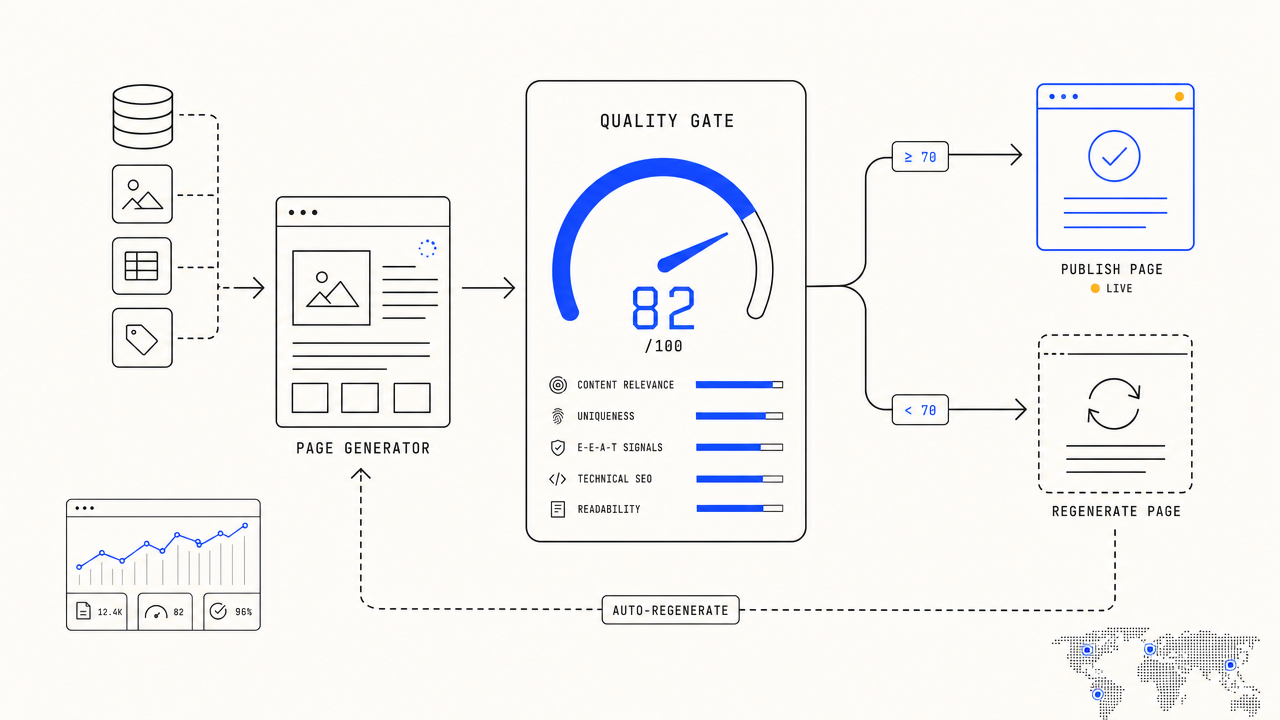
Weak variants regenerate, never ship.
A scoring model reviews every drafted variant on accuracy, originality, keyword density, reading level, link strategy, and structure. Below threshold, the variant goes back through draft. Above threshold, it ships. The same gate that the end-to-end content pipeline applies to every single article runs across every programmatic variant too. No human review required; no embarrassing thin variants on your site.
Variants land in your CMS with full structured data attached.
WordPress (custom plugin), Webflow, Shopify, Ghost. The publish stage attaches FAQ schema, article schema, featured image, slug, internal links to sibling variants, per-page SEO title tags and meta descriptions on every variant. No CSV import dance, no schema bolted on later. Pricing is $99 a month flat, no per-page meter.
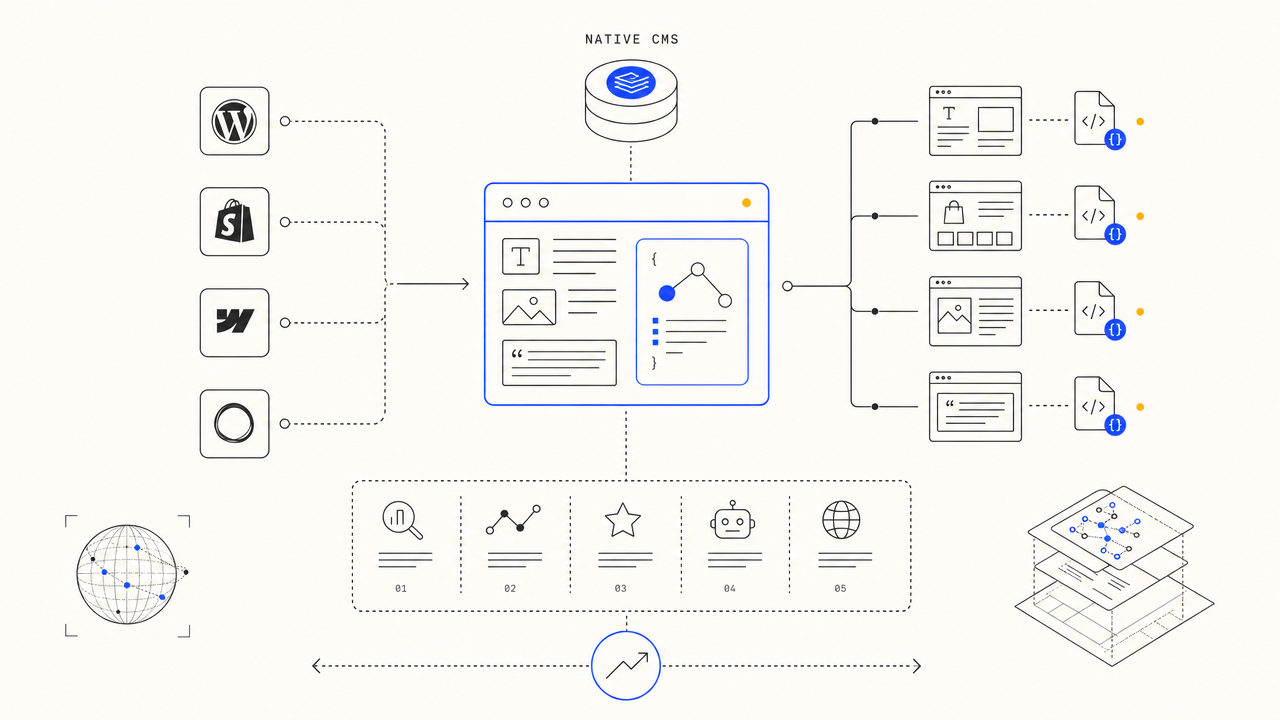
Four stages. Per variant. No human required.
One brief describes the page shape. Variants come from a structured source: keyword list, location list, product catalogue, or live keyword expansion.
For every variant, the agent pulls live volume + difficulty + SERP. If a variant has no real demand, it gets dropped before drafting starts.
Per-page draft, citations on every claim, quality scoring. Variants below threshold loop back through draft. No bad variants ship.
Each variant lands in your CMS with structured data, internal links to siblings, and full SEO meta. Weekly rank check on every page that shipped.
The honest one-screen comparison.
| FEATURE | THE AGENT | EVERYONE ELSE |
|---|---|---|
| Keyword data per variant | Live volume + difficulty + SERP per page | Placeholder fields, no real demand check |
| Fact-check per page | ||
| Per-page quality gate | ||
| CMS publish | Native: WordPress, Webflow, Shopify, Ghost | CSV import, schema bolted on after |
| Internal-link weave between variants | Auto-generated sibling links per page | Manual or none |
| Pricing | $99/mo flat, no per-page meter | Tiered or per-page surcharge |
Q.01What is programmatic SEO actually?+
Programmatic SEO is generating hundreds or thousands of pages from one template plus a structured data source, each page targeting a long-tail keyword variant. Done well, it captures search demand at scales no human team could write to. Done badly, it floods Google with near-duplicate pages that get merged or de-indexed. The pipeline you use decides which one happens.
Q.02How is this different from a Webflow CMS template plus a CSV?+
A CMS template renders the same page shape with different field values. Each generated page reads almost identically; Google merges them and ranks one. Our pipeline runs each variant as a real article: per-variant keyword research, per-variant SERP-grounded draft, per-variant fact-check, per-variant quality gate. The volume comes from automation, the variation comes from real data per page.
Q.03Will the pages get hit by duplicate-content penalties?+
Not in the way that a CSV-template stack does. Each page is drafted from a separate live SERP scrape, fact-checked separately, and gated separately. The pages share a brief but not their content. Google treats them as distinct articles because they are distinct articles.
Q.04What kinds of programmatic motions does this work for?+
City-list pages (e.g. "best <thing> in <city>"), product-list pages (e.g. "<feature> apps for <vertical>"), comparison grids (e.g. "<tool> vs <tool>"), and long-tail keyword expansions. If the variant axis is a real list of things people search for, the pipeline scales to it. If the axis is invented (made-up locations, fake categories), the agent will refuse the variants without real search volume before drafting.
Q.05How much does it cost to publish 500 pages?+
$99 per month flat. One plan, no per-page meter, no token surcharge. Generate as many variants as the keyword pool supports. The first 3 days are a free trial so you can verify variant quality before committing.
Q.06How fast does it actually publish 500 variants?+
About 3 minutes per variant including research, draft, fact-check, gate, and CMS publish. The full pipeline runs in parallel where it can. A 500-variant batch typically lands inside 36-48 hours, well below the time it takes Google to crawl and index that many new URLs.
Q.07Can I keep humans in the loop for programmatic batches?+
Yes. Every batch can require human approval before drafting starts (you preview the keyword list and per-variant briefs first), and the gate flags edge-of-threshold variants for optional review. Most operators run programmatic batches on auto-approve once the first few hundred variants score consistently above gate threshold.
Q.08How does this compare to the full SEO Automation feature?+
Programmatic SEO is the same pipeline applied at variant scale rather than article scale. The full SEO Automation feature covers a single high-effort article a day; this feature covers many lower-effort but still gated variants. Same fact-check, same gate, same CMS publish, same dashboard.
Related guides + features.
SEO automation
The full pipeline: research, fact-checked drafting, a quality gate, and native publish. Where these tools stop, the agent ships the page.
/features/seo-automation →PILLAR · AI SEO TOOLSAI SEO tools
Keyword research, briefs, drafting, and a quality gate run by an agent instead of a dashboard you operate by hand.
/features/ai-seo-tools →PRICINGSimple pricing
$1 for a 3-day trial if eligible, then $99 per month. No per-keyword meter. Cancel in the app.
/pricing →Watch 500 long-tail pages ship to your CMS this week.
Three days for a dollar. Connect your CMS, hand the agent a variant axis, watch each page get its own keyword research, fact-check, and gate before publish. Cancel in one click if it isn't working.
FREE TRIAL · CANCEL IN ONE CLICK