Outranking review: pricing, verdict, and who it fits.
Two things make this product hard to buy, and neither of them is the software. The first is the name: Outranking at outranking.io is a completely different company from Outrank.so, and half the reviews online have them mixed up. The second is the pricing page, which is where this review has to start.
Is Outranking worth it in 2026?
Outranking is worth it if you have a writer who works one document at a time and you want the brief, the outline, and the on-page score in the same editor. It is the wrong buy if pages are not shipping, because the base plans meter you at 4, 15, or 30 SEO documents a month, first drafts sit behind a separate AI credits add-on starting at $49, and keyword clustering sits behind a $79 Strategist add-on. Checked 2026-09-17 the pricing page renders Starter at $1,500 a month for four documents, a figure no pricing tracker or user report corroborates, so confirm the real number at checkout before you buy anything.
1. What Outranking is, and what it is not.
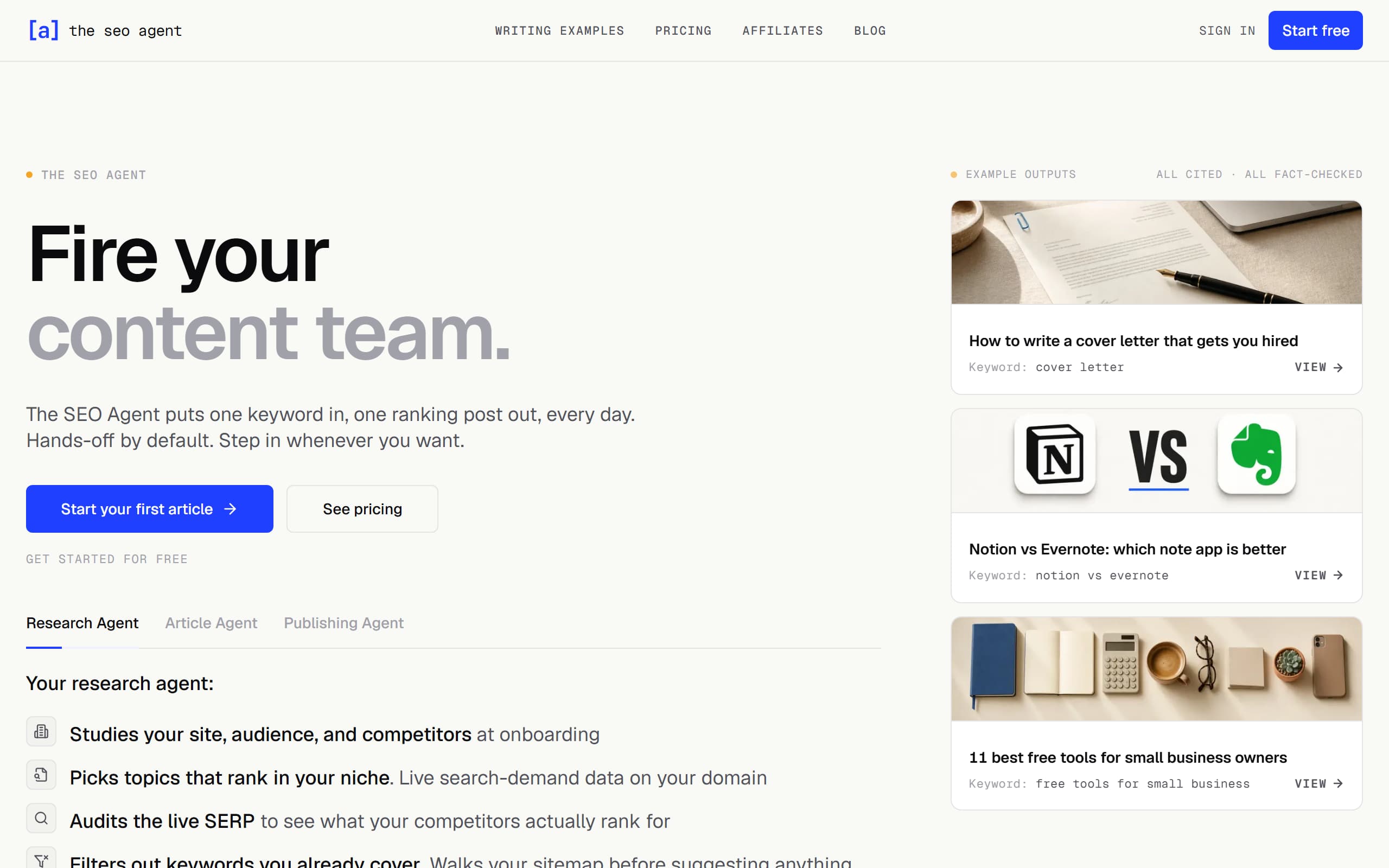
Outranking is an SEO content editor: brief, outline, live on-page score, and AI drafting in one document. TheSEOAgent is an AI SEO tool at the other end of the same job, running keyword validation, citations, a quality gate, internal links, and native CMS publish without a person in the editor.
Start with the name, because it costs buyers real money. Outranking is outranking.io, operated by Outranking LLC. Outrank.so is a different company selling a different thing: an autopilot publisher that researches, writes, and posts to your CMS on a schedule with nobody in the loop. Review sites, comparison posts, and pricing aggregators mix the two up routinely. If autopilot publishing is what you are shopping for, the head-to-head against Outrank is the page you actually want, and the list of Outrank alternatives covers the rest of that category.
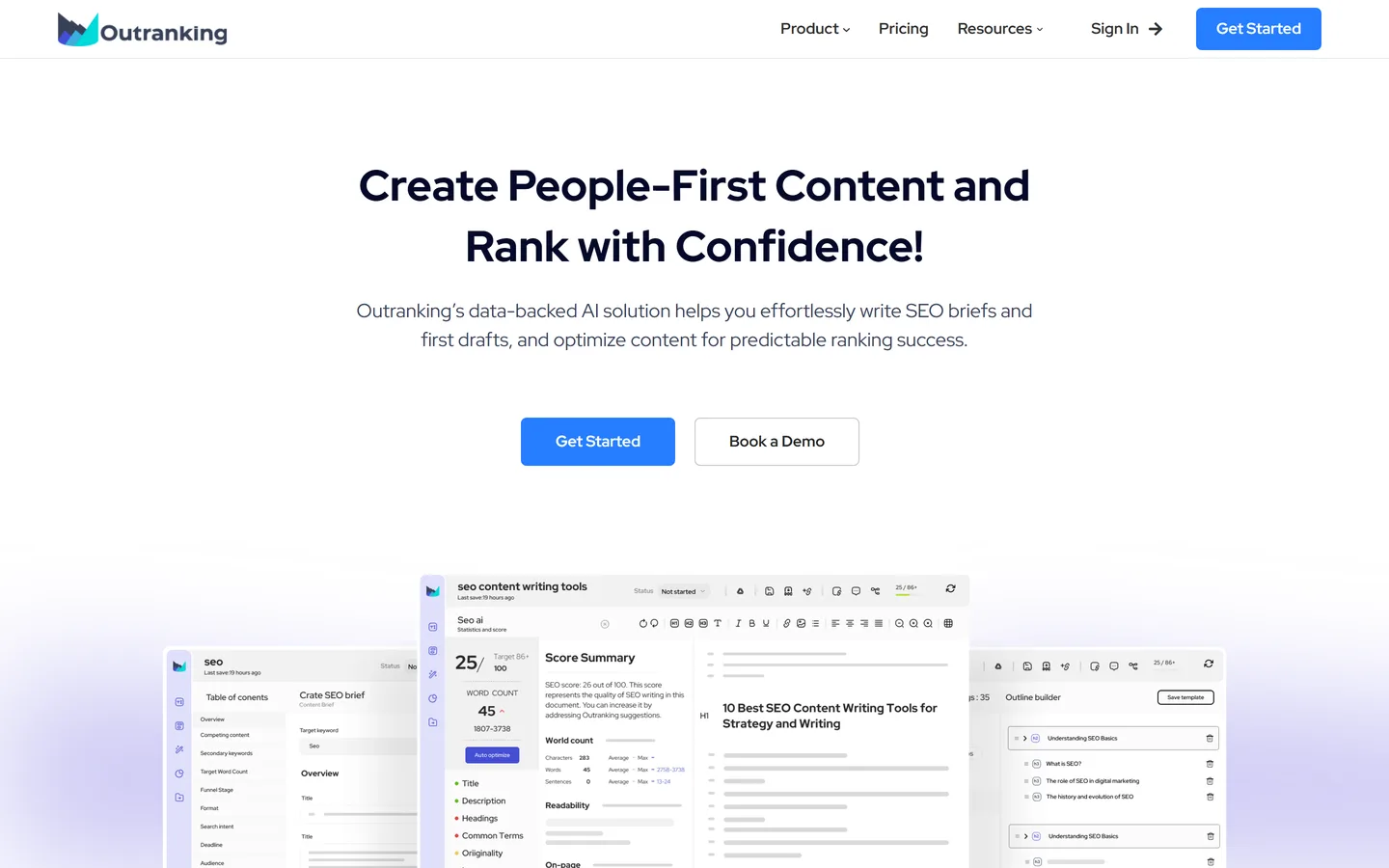
Outranking itself is a 2022-generation content optimizer that kept growing. The homepage headline is Create People-First Content and Rank with Confidence, and the modules underneath it are the ones a long-time user would recognize: a real-time SEO content checker scoring against more than ten on-page factors, an SEO writing assistant with brand style guides, keyword prioritization and clustering, content briefs and planning, a plagiarism checker, content workflows, and automatic internal linking. It still names Google NLP and GPT-4 as the stack behind it, which tells you when the positioning was written.
The footer claims more than 12,000 users and the testimonial wall is heavy with agency and in-house editors. The product is real and the app is live. What has aged is the packaging, and that is section two.
2. Outranking pricing, tier by tier.
First, find it. The pricing page is at /pricing-plan/, not /pricing, and the whole marketing site is client-rendered, so a lot of the third-party pages quoting Outranking prices are reading old snapshots rather than the live page. Here is what the live page showed on 2026-09-17.
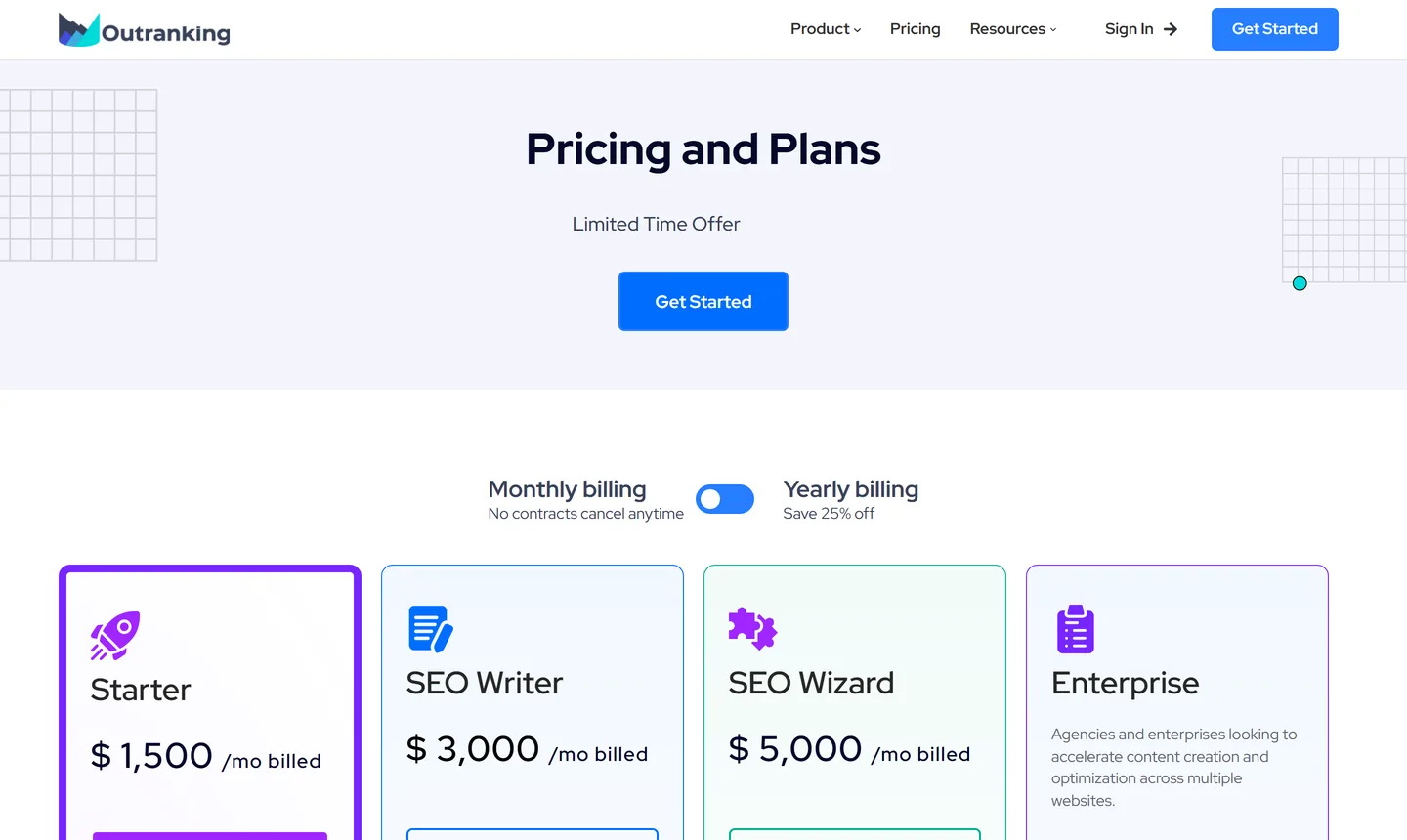
The structure is clear and it is the useful part: every paid tier is metered in SEO documents per month, and the seat count climbs with the tier.
- Starter4 SEO documents a month
AI assisted optimization, content briefs, integrations, and AI first drafts carrying an asterisk. Four documents is one page a week, which is a trial cadence rather than a content program. The yearly toggle bumps it to 5.
- SEO Writer15 SEO documents a month, 2 users
Everything in Starter plus automatic optimization, unlimited AI and SEO drafts, and automatic internal linking. This is the first tier where the internal linking feature the homepage leads with is actually included.
- SEO Wizard30 SEO documents a month, 3 users
The same feature set as SEO Writer with double the documents and a third seat. Thirty documents a month is roughly a page a day, which is the first allowance that matches a real publishing cadence.
- EnterpriseSchedule a meeting
Account manager, training, invoicing, and a customized package, aimed at agencies and enterprises running multiple websites. No listed price, as you would expect at this tier.
Now the figures, and this is where the page stops being usable. On the monthly toggle it renders Starter at $1,500 a month, SEO Writer at $3,000, and SEO Wizard at $5,000. Flip to yearly and it reprices them consistently 25 percent lower at $1,125, $2,250, and $3,750, and bumps Starter from 4 documents to 5. A consistent scaling across three cards and both toggles is not a typo on one card. Meanwhile the pricing trackers quote Outranking anywhere from about $19 to about $219 a month, contradict each other, and match neither the live page nor one another. The only defensible position is that the public page cannot be used to size this purchase. Get the number from the checkout in the app before you enter a card.
The second half of the cost is the add-on ladder, and it matters more than the headline tier.
- AI creditsFrom $49, and from $79
The $49 pack is described as 8 to 10 AI drafts and the $79 pack as 16 to 18. The pricing FAQ is explicit that first drafts and the advanced AI functions need this add-on, not the base plan.
- Strategist$79 one time
Keyword discovery and clustering, plus the content inventory and planner, both carry a footnote requiring Strategist. That is the keyword-selection half of SEO sold beside the plan rather than inside it.
Read the pricing FAQ and the shape gets explicit. Plans come with what it calls fundamental AI functions: title generation, outlines, auto-optimization. First drafts and the advanced functions need the AI characters add-on, bought from the dashboard. Keyword discovery, clustering, and the content inventory each carry an asterisk pointing at Strategist. So the two things most buyers think they are purchasing, drafts and keyword strategy, are both priced beside the plan. Our own flat monthly plan exists because that arithmetic is exhausting to do in a trial window.
3. Where Outranking wins.
Set the packaging aside. The editor is good, and it is good at a specific thing: taking one keyword you have already decided to target and getting a structured, well-covered document out of it.
- Scoring you can work against. A live score across more than ten on-page factors, with auto-optimization for missing terms, gives a writer a target that moves while they type. That feedback loop is why this class of tool sold in the first place.
- Concepts pulled from live results. The feature users single out is Concepts: research pulled from what currently ranks and offered as material for the draft, rather than the model inventing supporting detail from nothing.
- Briefs and outlines in one place. Title generation, outline building, and the brief live in the same document as the draft, so an editor is not stitching three tools together to start a page.
- Workflow for a team of humans. Task management, seats on the higher tiers, and style guides are built for a content desk where several people touch a page. That is a real problem and most AI writers ignore it.

If you have writers and the complaint is that their drafts are thin or badly structured, this is a defensible purchase at the right price. The category context is in our AI SEO tools roundup, which separates the tools that help a person write from the ones that replace the writing step.
4. Is Outranking good for SEO?
For the on-page half, genuinely yes. For the parts that decide whether the page ranks at all, it participates less than the homepage implies, and the metering is the reason.

- Four documents is not a program. On the entry tier you get 4 SEO documents a month, 15 on the middle tier, 30 at the top. Rankings move on cadence, and only the $5,000-rendered top tier reaches roughly a page a day.
- Keyword choice costs extra. Clustering and the content inventory sit behind Strategist. Target selection is the highest-leverage decision in the whole workflow, and it is the one thing the base plan does not include.
- Plagiarism checking is not fact checking. Knowing a sentence is original tells you nothing about whether it is true. No source is attached and no claim is verified, which is the expensive half of reviewing any AI draft. That is the job our citation pass exists to do before anything ships.
- Nothing refuses a weak draft. The score is advisory. A writer can publish a 40 and the tool will let them, which means quality still depends entirely on editorial discipline rather than on a gate that can say no.
- Internal linking is tier-gated. Automatic interlinking is one of the loudest homepage features and it starts on the middle tier. If the cluster work is why you are buying, price from there, and compare it against what an automatic internal linker does as pages publish.
This is the split our automation-tool rankings weigh heaviest: how much of the loop closes without a person picking up the recommendation and doing the work by hand?
5. Outranking vs TheSEOAgent.
The clean split: Outranking makes the person in the editor better and meters how many documents they may touch. TheSEOAgent removes the person from the editor and meters nothing but the daily cadence you choose.
| FEATURE | OUTRANKING | THESEOAGENT |
|---|---|---|
| Best fit | Writers and editors optimizing one document at a time | Founders and teams who want published pages without staffing the writing |
| Product shape | Brief builder, on-page optimizer, and AI drafting in one editor | End-to-end pipeline from keyword to live post |
| On-page scoring | Real-time score across more than ten on-page factors, auto-optimize for missing terms | Structure and coverage checked at the gate, not surfaced as a live dial |
| Keyword selection | Clustering and content inventory require the Strategist add-on | Live keyword validation before anything is planned, included |
| First drafts | Behind the AI credits add-on, metered in packs | Included, drafted on every scheduled run |
| Fact checking | Plagiarism checking, no citation pass | Citation-backed pass before a draft can clear the gate |
| Volume limits | 4, 15, or 30 SEO documents a month by tier | A daily cadence you set, on one flat plan |
| Publishing | Integrations and workflows, the document is the deliverable | Native publish to WordPress, Webflow, Shopify, Ghost, and Wix |
| Price visibility | Figures on the page that no tracker or user report corroborates | $99 a month flat, published, cancel in one click |
6. The decision matrix.
Two cards, one question each. Answer honestly about who opens the editor on Monday morning.
- You have writers and they live in a document editor.
- You already know which keywords you are targeting.
- A live on-page score is what your team works against.
- Ten to thirty pages a month is the real ceiling anyway.
- Nobody on the team is going to open the editor.
- You want the keyword chosen for you from live data.
- You want citations and internal links handled by default.
- You want one published price with no add-on ladder.
Comparing verdicts across the category rather than deciding today? The Surfer SEO verdict covers the pure on-page optimizer, the Frase verdict covers brief-first research, and the MarketMuse verdict covers site-level planning. Outranking sits between all three, which is both its pitch and its pricing problem.
7. Is Outranking worth it?
As an editor for a team that already writes, yes, provided the price you are quoted at checkout is proportionate to the writer hours it saves and you have added the add-ons into that number. As the thing that fixes a stalled content program, no, because the document meter caps exactly the throughput you were trying to buy.

The failure mode is specific. Six months in, the four or fifteen documents get used in the first ten days of every month, the AI credits run out before the drafts do, the Strategist add-on gets bought to answer the keyword question, and the total is no longer the number that won the comparison spreadsheet. The product did not fail. The metering did. If that is a description of your last two quarters, an AI SEO agent that researches, drafts, checks, links, and publishes on one flat plan is the purchase that changes what ships.
Running both is reasonable for a mid-size team: optimize the ten pages a human genuinely owns, automate the rest. If your site runs on WordPress, the shortest path from a target to a live page is publishing straight into WordPress on a schedule, and for a hands-off cadence with no editor in the loop at all, the autoblogging page explains what that actually looks like.
8. How to test it before you buy.
Given the state of the pricing page, the test has to start with the bill, not the features:
- Get to the checkout in the app and screenshot the real monthly figure before you evaluate anything else.
- Add the AI credits pack and the Strategist add-on to that figure. That total is the number to compare, not the tier price.
- Run three keywords from the same cluster all the way to a finished draft and count how many documents and credits it consumed.
- Count unsupported claims, weak sources, and missing internal links in each draft, then time the cleanup.
- Multiply that cleanup time by the document allowance on the tier you would buy. Software plus hours is your real monthly cost.
To run the same test on the automated side, the free trial covers keyword validation through to CMS publish with no add-ons to price and no document meter, and the auto blogging software comparison ranks that category by what actually reaches a live page.
- Surfer SEO review for the on-page optimizer it competes with most directly
- Frase review for the brief-first workflow at the same altitude
- MarketMuse review for the site-level planning comparison
- AI SEO software that writes and publishes rather than scoring
- SEO automation with keyword validation and a quality gate
Is Outranking worth it in 2026?
It is worth it if your bottleneck is producing better-structured drafts and higher on-page scores, and you are prepared to price the base plan plus the add-ons together rather than separately. It is not worth it if the bottleneck is that pages are not getting published. The base plans meter SEO documents, first drafts sit behind a separate AI credits add-on, and keyword clustering sits behind another one.
How much does Outranking cost?
Checked 2026-09-17: the pricing page lists Starter, SEO Writer, SEO Wizard, and Enterprise, metered at 4, 15, and 30 SEO documents a month. The monthly toggle renders those first three at $1,500, $3,000, and $5,000 a month, and the yearly toggle reprices them 25 percent lower at $1,125, $2,250, and $3,750. Third-party pricing trackers publish figures from about $19 to about $219 a month, contradict each other, and match neither. Treat every number you find second hand as unverified and get the figure from the checkout before you commit.
Is Outranking the same as Outrank.so?
No. Outranking is outranking.io, run by Outranking LLC, and it is a brief, optimization, and AI writing platform. Outrank.so is a separate autopilot publisher that researches and posts articles to your CMS on a schedule. The names are one character apart, the products are not alike, and review sites confuse them constantly. If you are comparing autopilot publishers, the Outrank comparison is the page you want, not this one.
What is Outranking best for?
Turning a known keyword into a well-structured, on-page-optimized document. The content brief, the outline builder, the real-time SEO score, and the concepts pulled from live SERP data are the strongest parts, and they are aimed at a writer or editor who is already sitting in the editor working on one page at a time.
Is Outranking good for SEO?
For the on-page half, yes. Real-time scoring across more than ten on-page factors, automatic optimization for missing terms, and structured outlines are legitimate SEO work. For the parts that decide whether a page ranks at all, which are target selection, source quality, and actually publishing on a cadence, it participates much less, and the document allowance caps how many pages a month it can touch.
What is the main weakness of Outranking?
The add-on ladder. The pricing FAQ says the plans include fundamental AI functions like title generation, outlines, and auto-optimization, and that first drafts need the separate AI characters add-on. Keyword discovery, clustering, and the content inventory both carry an asterisk requiring the Strategist add-on at $79 one time. The plan you compare on price is not the plan that does the job you are buying it for.
Why does the Outranking pricing page show such high numbers?
That is the honest problem with it. Checked 2026-09-17, the monthly toggle renders Starter at $1,500 a month for 4 SEO documents, which is not a number any pricing tracker, review, or user report corroborates. The yearly toggle scales it consistently by 25 percent, so it is not a one-off typo on a single card. Whatever the intended figures are, you cannot size the purchase from that page, so treat the dashboard checkout as the only source of truth.
How is TheSEOAgent different from Outranking?
Outranking helps a person write one better page. TheSEOAgent runs the loop without the person: keyword research against live search data picks the target, drafting attaches citations, a quality gate refuses weak drafts, internal links are added, and the article publishes to WordPress, Webflow, Shopify, Ghost, or Wix. One flat plan at $99 a month, published, with no add-on ladder and one-click cancellation.
Should I switch from Outranking to TheSEOAgent?
Switch if the drafts are good and the calendar is still empty, which is the usual state after a year of optimizing one document at a time. Stay if you have writers who live in the editor and the real value you get is the on-page score moving before they hit publish. Running both is coherent for a team with real writers: optimize the pages a human owns, automate the rest.
Is Outranking better than Surfer SEO or Frase?
They overlap heavily, and Outranking puts a comparison against Surfer and Clearscope on its own pricing page. Surfer is the strongest pure on-page optimizer. Frase is the strongest brief-first research workflow. Outranking stretches furthest toward first drafts and workflow management, which is also where its add-on pricing bites hardest. Pick on which half of the job you are actually short on.