See how readable your writing is, sentence by sentence.
Paste a paragraph or a whole article. Get Flesch Reading Ease + Flesch-Kincaid Grade Level for the whole text, plus the top 5 hardest sentences flagged so you know what to rewrite. Computed in your browser, no sign-in.
Paste text on the left. Grade level + per-sentence breakdown will appear here.
What does this reading-level checker do differently?
Most free reading-level tools give you one number and stop, which is useless without knowing which sentences are dragging the average up. This one runs the standard Flesch Reading Ease and Flesch-Kincaid Grade formulas on the whole text AND on every sentence, then sorts and surfaces the top 5 hardest with TOO HARD / TIGHT / OK pills so your rewrite list writes itself. Pairs well with our keyword density checker for an editorial regression check before publishing. The same readability check runs as one rule inside our paid pipeline's quality gate at SEO Automation. Built by an automated AI SEO agent.
Paste a paragraph, a section, or a whole article (up to 20,000 chars).
Tokenize, count syllables (heuristic), compute Flesch Reading Ease + Flesch-Kincaid Grade per sentence and overall.
Grade level + ease + words/sentence at a glance, plus the top 5 hardest sentences flagged so you know what to rewrite.
Four things that make this different from the average reading-level tool.
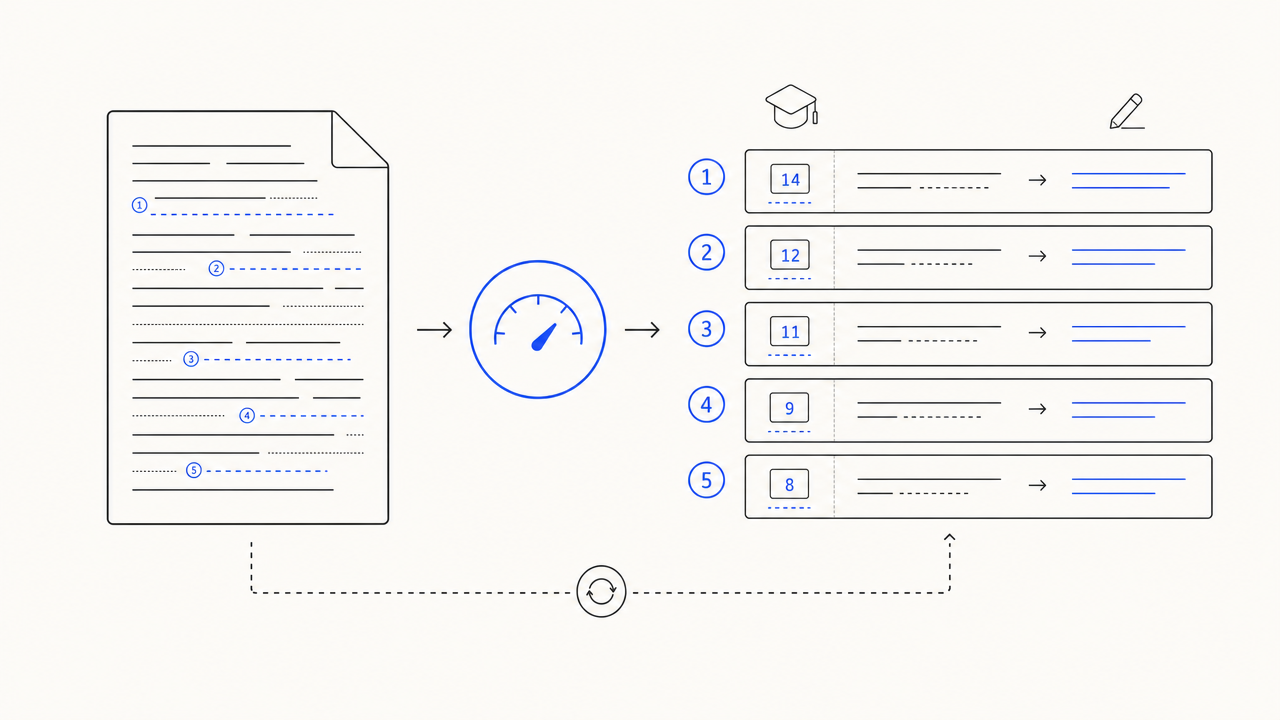
Surfaces the 5 hardest sentences. Not a binary number.
Most reading-level tools give you a grade and stop. That is useless without knowing WHICH sentences are dragging the average up. We sort every sentence by Flesch-Kincaid grade level and surface the worst 5 with TOO HARD / TIGHT / OK pills, so the rewrite list writes itself.
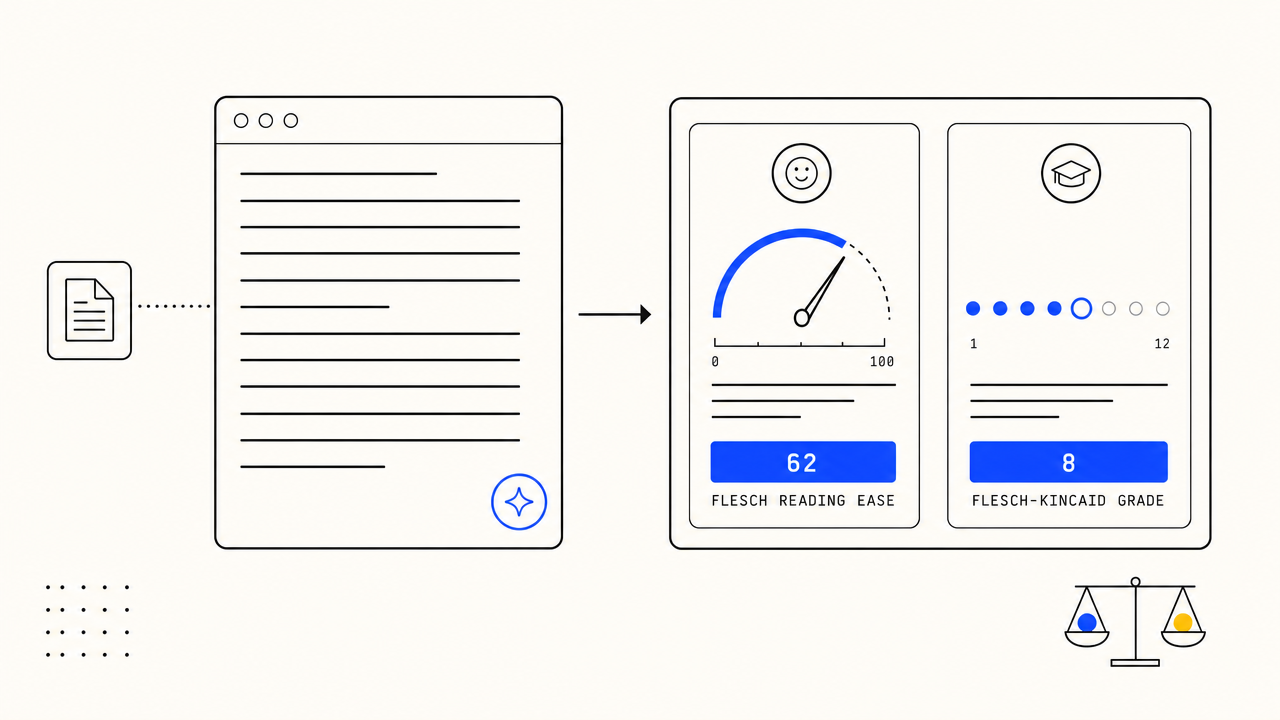
Reading Ease and Grade Level. They measure different things.
Flesch Reading Ease (0-100, higher = easier, 60-70 is plain English) measures sentence and word complexity. Flesch-Kincaid Grade (years of education needed) maps to US school grade level. Most tools show one. Both together tell you both how dense it reads AND who can read it.
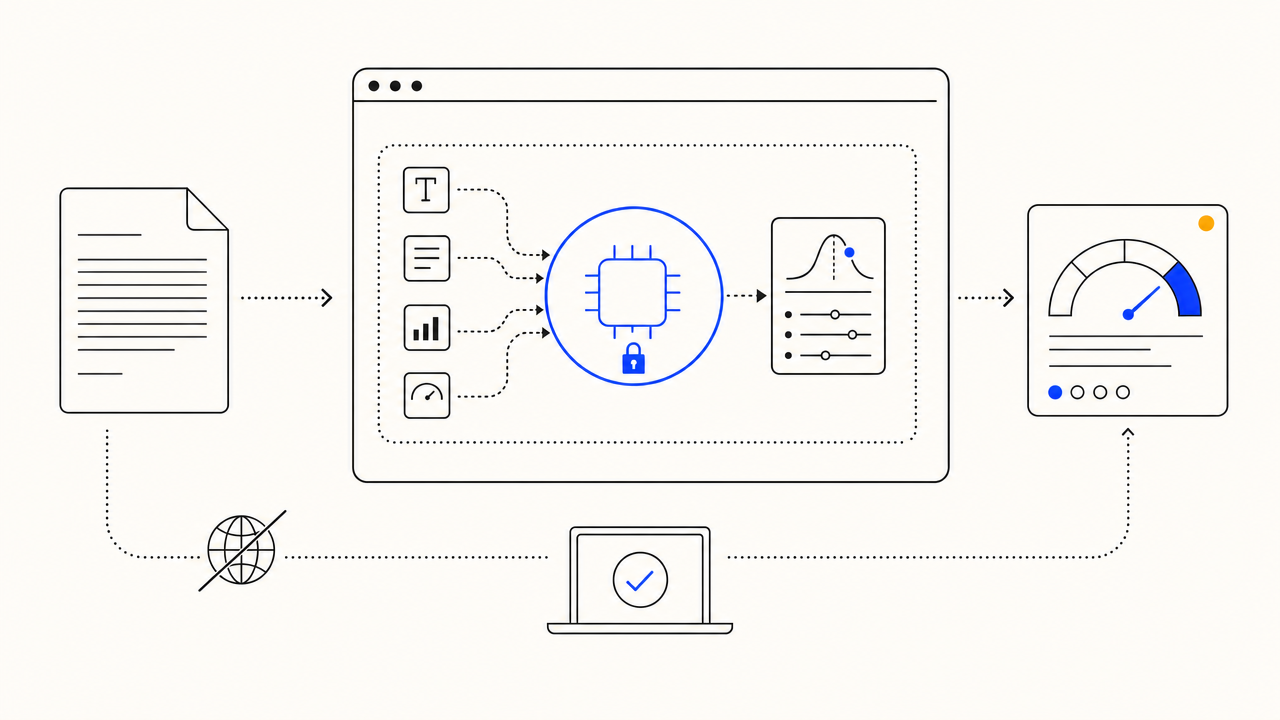
Zero round-trip. Your text never leaves your machine.
Reading-level math is deterministic. There is no LLM call needed. We tokenize, count syllables (Liang-style heuristic), apply the standard Flesch and FK formulas, all in the browser. No tracking on what you paste. Same approach as our slug generator: if it can be a regex, it should not be an API call.
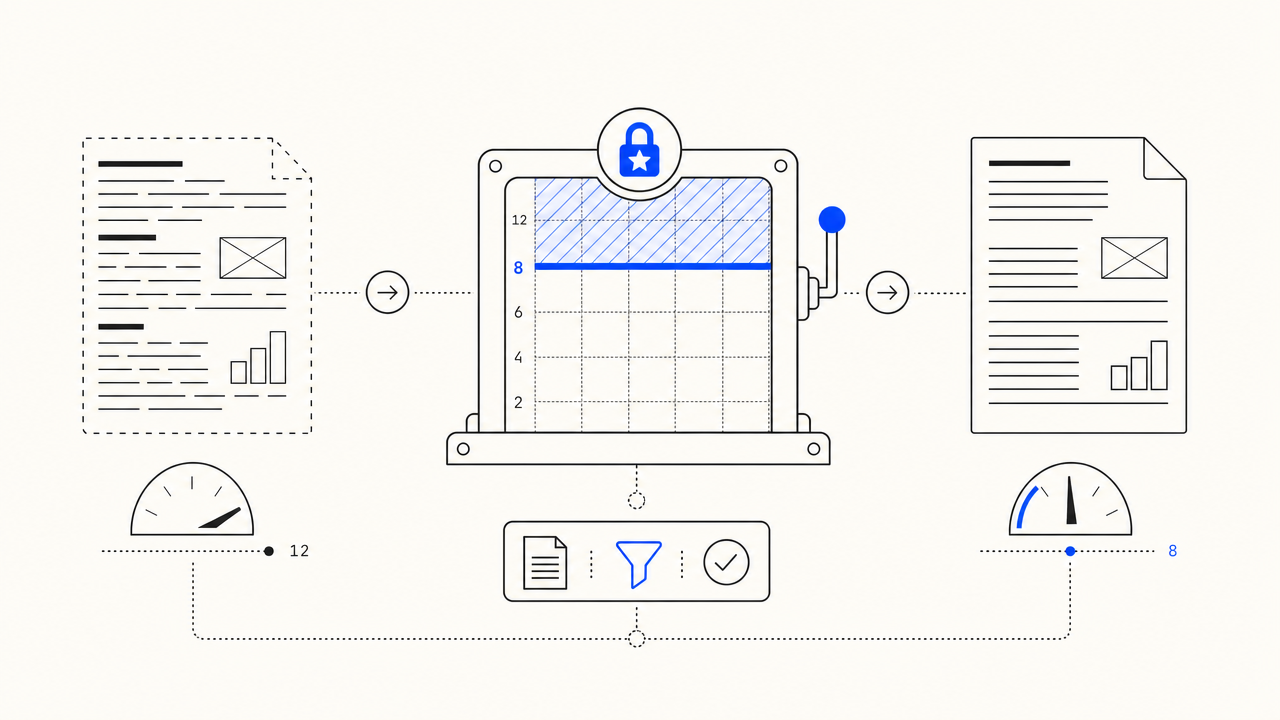
The agent enforces a grade ceiling on every article it publishes.
This widget is the readability check from the paid pipeline's quality gate, surfaced as a standalone tool. The full pipeline goes further: keyword research, fact-checked drafting, internal-link resolution, image generation, gating, CMS publishing, all on a daily cadence at $99 a month flat.
Three steps, computed locally.
Anything from a sentence to a 20,000-character article.
Tokenize, count syllables (heuristic), apply Flesch + Flesch-Kincaid formulas per sentence and overall.
Three top-line scores plus the top 5 hardest sentences with grade-level pills.
Meta description generator
LIVEFive descriptions, each pixel-measured against Google’s 920px cutoff.
Slug generator
LIVEThree URL slug variants from any title. Computed in your browser.
Headline generator
LIVE12 headlines across 6 patterns. Pairs with reading-level for tone calibration.
Everything we get asked about the reading-level checker.
Missing something? Ask us directly.
Q.01What grade level should I aim for?+
For general web content, 7-9 (middle school) reads as natural for the broadest audience. For B2B / technical content, 10-12 (high school) is fine. Anything past 14 starts losing readers, even ones who could technically follow it. The instinct that your content needs to "sound smart" usually backfires.
Q.02How does the syllable counter work?+
A heuristic adapted from the Liang algorithm: lowercase the word, strip trailing silent e, count vowel groups (consecutive aeiouy as one syllable), treat trailing y as a vowel. Not perfect (it will miscount obscure proper nouns and some compound words) but accurate enough that the per-sentence ranking is reliable.
Q.03What is the difference between Flesch Reading Ease and Flesch-Kincaid Grade?+
They use the same inputs (sentence length and word complexity) but emit different numbers. Reading Ease is 0-100 where higher is easier, and 60-70 is plain English. Grade Level is years of US schooling needed to read the text. They correlate but are not redundant. Ease tells you how dense, Grade tells you who can read it.
Q.04Is this the same as Hemingway?+
Hemingway uses a different scoring algorithm and color-codes adverbs and passive voice in addition to grade level. Our tool focuses on the math (Flesch + FK) and surfaces the hardest sentences without imposing a writing style. Use both if you want. They show different things.
Q.05Why does the Reading Ease sometimes go negative?+
The formula is unbounded. Extremely long sentences with high syllable density (think dense academic writing) can push it below zero. Below 30 is "very difficult"; negative scores mean the text reads as effectively unreadable for most audiences. If you see a negative score, your sentences are too long.
Q.06Does this tool need sign-in?+
No. Reading-level math is deterministic and runs in your browser. Nothing is sent to a server, so there is nothing to authenticate against.
Q.07How accurate is sentence detection?+
Splitting on punctuation followed by whitespace and a capital letter handles most prose. Abbreviations ("Dr.", "e.g.", "i.e.") will occasionally cause a false sentence break, which slightly inflates the sentence count and lowers the grade. For most content the noise is under 5% and does not change which sentences land in the "top 5 hardest" view.
Q.08What does the paid pipeline add over this widget?+
Reading-level checking is one rule in the paid pipeline's quality gate, which also runs fact-checking, citation density, internal-link resolution, AI-detection scoring, and brand-voice consistency. The free widget is the readability rule on its own. The paid agent runs the full gate on every article it publishes.
The agent enforces a readability ceiling on every article it publishes.
The paid pipeline runs reading-level scoring plus fact-checking, internal links, brand voice consistency, AI-detection inside its quality gate. Daily cadence. Try it free.