The 10 best AI visibility tools in 2026.
AI visibility tools measure how often ChatGPT, Perplexity, Gemini, and Google AI Overviews mention your brand. Entry prices in this category run from free to roughly $3,000 a month for the same nominal job, so the ranking below is by the team each tool fits, not by a single score. Ten tools, real entry prices, one honest flaw each, and a closing note on the thing no tracker can fix.
Once you can see where AI answers skip your brand, the fix is more answerable pages. The SEO Agent writes and publishes one a day for your site, with sources. Enter your site to start.
Free trial · Cancel in one clickThe shortlist, scannable in ten seconds.
- 01ProfoundBest overall, enterprise
- 02Peec AIBest for marketing teams
- 03Otterly.AIBest budget tracker
- 04RankscaleBest engine coverage on a budget
- 05Scrunch AIBest for the crawler side
- 06AthenaHQBest action-oriented platform
- 07EvertuneBest for brand measurement
- 08Semrush AI VisibilityBest suite add-on
- 09HubSpot AI Search GraderBest free starting point
- 10The SEO AgentNot a tracker, the input side
How we picked these ten.
Almost every tool here does the same nominal thing: fire a panel of prompts at the major assistants on a schedule and score whether you appeared. What separates them is how many engines they reach, how many prompts you get per tier, whether they explain the gap or just report it, and how hard they make it to find out the price. So the order runs by fit rather than by a made-up composite score: enterprise depth, then self-serve mid-market, then budget, then three specialists that answer a question the generalists do not, then the free grader.
Two editorial positions worth stating up front. First, absolute visibility scores are close to meaningless across vendors: the models are non-deterministic and retrain without notice, so trend lines and competitor gaps are the only readings worth acting on. Second, monitoring is not a strategy. The Princeton GEO benchmark measured quotations, statistics, and cited sources as the strongest visibility levers, and a 768,000-citation study found comparison-shaped content earning up to 70% of AI citations. Both point at what you publish, which is why the tenth entry on this list writes pages instead of charting them. It is our product, we ranked it last rather than first, and the disclosure sits inside its own section. No affiliate links and no sponsored placements. If you want the same field ranked on the produce-versus-monitor axis instead, that is our best GEO tools comparison, and the retrieval-side cut is our LLM SEO tools roundup. If Google's AI Overviews block is the only surface you report on, the narrower cut is our list of Google-only AI Overviews trackers.

Profound
Enterprise teams that need the deepest answer-engine dataset.
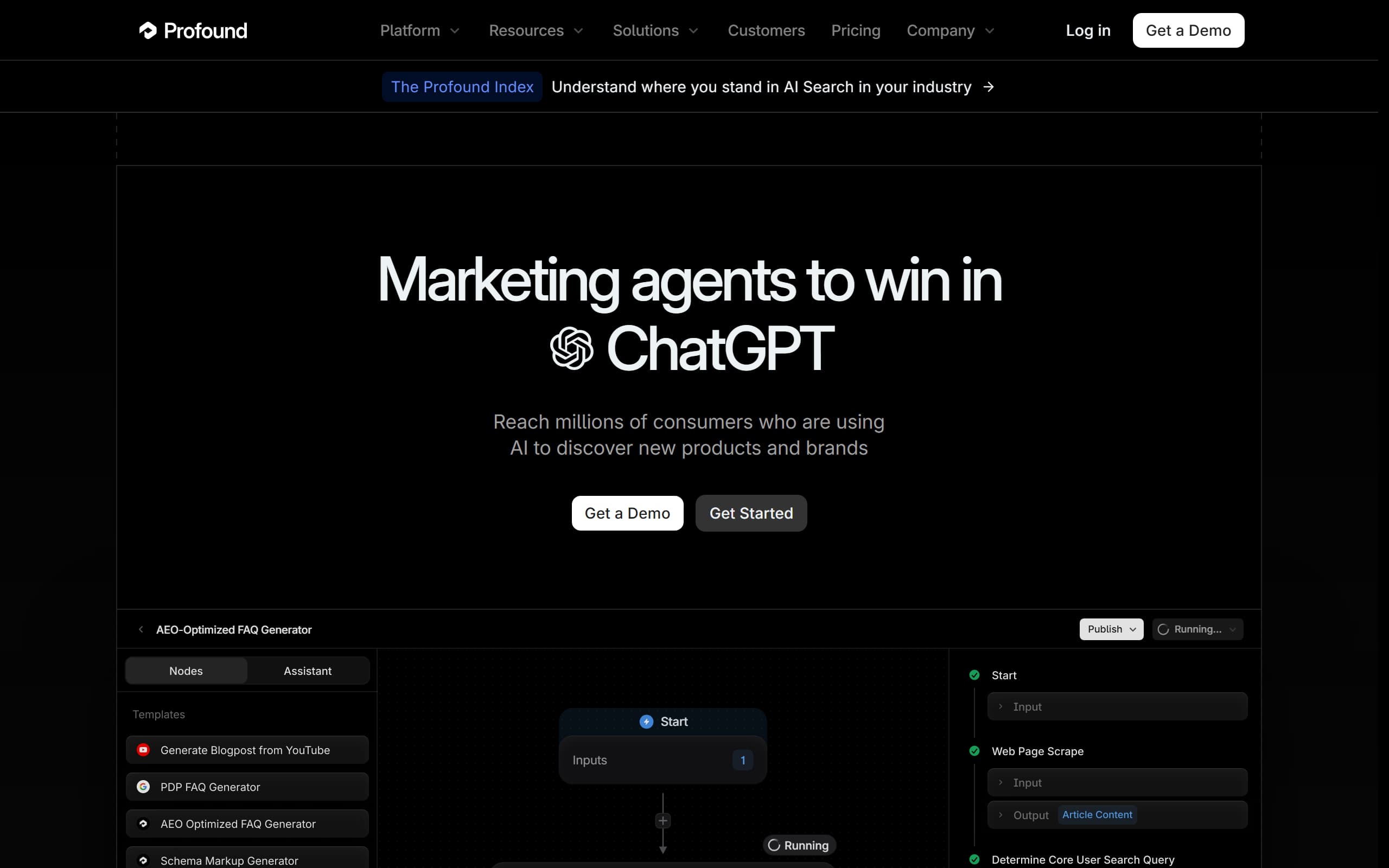
Demo-gated enterprise pricing. Tracks brand presence across ChatGPT, Perplexity, Google AI Overviews and more, with agent-traffic analytics and shopping-answer modules.
Profound is the name most enterprise shortlists open with, and the depth is the reason. It runs large prompt panels against the major assistants rather than sampling a handful, trends your share of voice against named competitors, breaks out which of your pages earn the citations, and has pushed earliest into the adjacent surfaces: shopping answers, and logs of AI agents crawling your site directly.
The cost of that depth is the enterprise posture. Pricing sits behind a demo call, and reviewers consistently place it at the top of the category range. If your site has thin topical coverage, the dashboard will faithfully report a flat line for two quarters. The first dollar in that situation belongs in citable coverage, not in a sharper instrument for measuring its absence.
Demo-gated enterprise pricing. Overkill below a few thousand indexed pages.
Peec AI
Marketing teams that want daily tracking without a sales call.
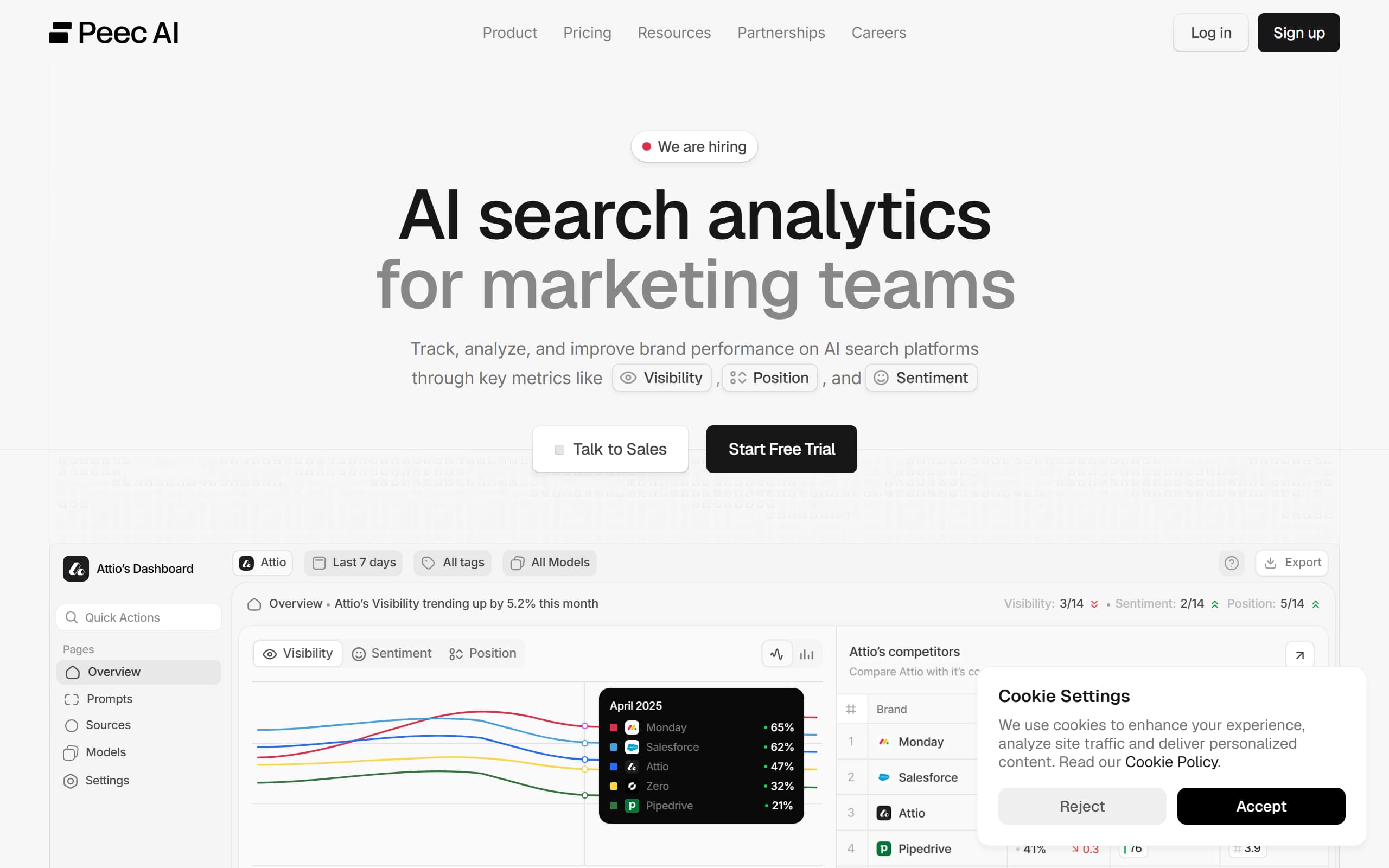
Self-serve, from around 90 euros a month. Visibility, position, and sentiment tracking across the major AI search platforms, with competitor benchmarks and source analysis.
Peec AI has become the default mid-market pick, and it earns it by being boring in the right places. Three metrics that a marketing lead can actually act on (visibility, position, sentiment), clean competitor benchmarking, and a source report that shows which domains the engines keep quoting in your category. The last one is the sleeper feature: it tells you who to out-publish.
Like every tracker on this list, it reports the scoreboard and leaves the scoring to you. Teams that pair it with a steady stream of question-answering pages, the kind an automated SEO pipeline ships daily, watch the line respond within a quarter. Teams that only watch it do not.
Prompt quotas scale with price. No content or remediation layer.
Otterly.AI
Solo founders and small teams starting to track AI mentions.
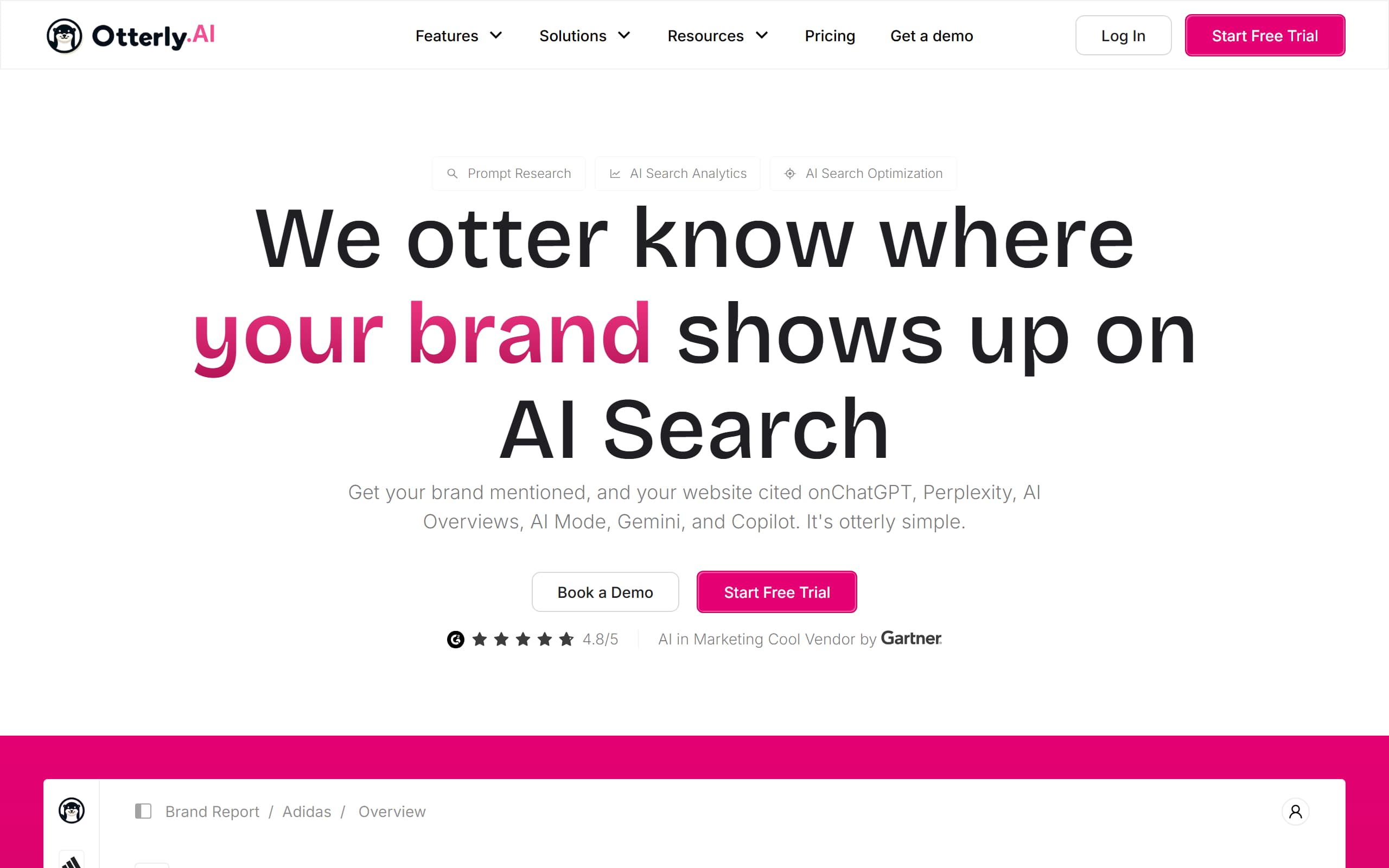
From $29/mo. Monitors brand mentions and link citations across ChatGPT, Perplexity, Google AI Overviews, AI Mode, Gemini, and Copilot. Named a Gartner Cool Vendor in 2025.
Otterly.AI is the cheapest credible entry into the category. You register the prompts you care about, and it reports how often your brand and your links appear in the answers, across a wider engine list than several tools at triple the price. For a founder who wants a monthly pulse check rather than a war room, $29 covers it.
The prompt-based model is also the ceiling. You track the prompts you thought to register, which means your blind spots stay blind. Map the question space first (the method is written up in our AEO playbook), then point Otterly at the prompts attached to revenue.
Small prompt quotas on entry tiers. You only see the prompts you thought to add.
Rankscale
Startups and agencies that want the widest engine list per dollar.
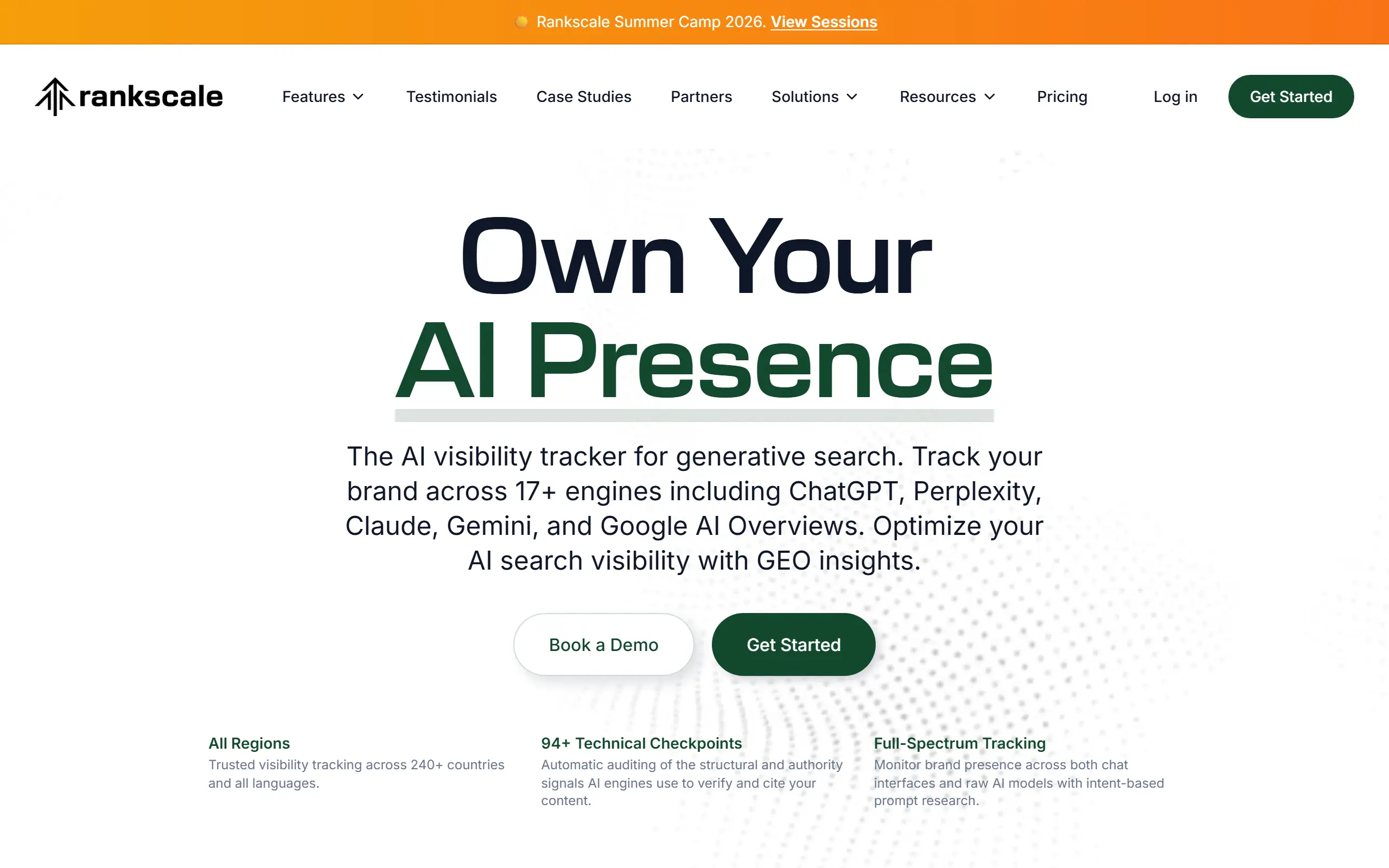
From about $22/mo (20 euros), credit-based. Tracks 17 or more engines including ChatGPT, Perplexity, Claude, Gemini, Grok, and DeepSeek, plus a technical GEO site audit.
Rankscale competes on breadth. Seventeen-plus engines, including the ones most trackers skip entirely (Claude, Grok, DeepSeek, Mistral), at a price that starts near a streaming subscription. It also runs a technical audit that scores whether your pages carry the structural signals engines use to verify and reuse content, which is a genuinely useful second job for a monitoring tool to do.
It is a young product and the seams show. Audit scores can move between runs on an unchanged page, and agencies report gaps in the export tooling. Treat the audit as a direction, not a grade, and cross-check anything it flags with a free technical crawl before you rewrite a page on its say-so.
Audit scores wobble run to run. Credit pricing needs watching at agency scale.

Scrunch AI
Teams whose problem is how AI crawlers read the site, not just the score.
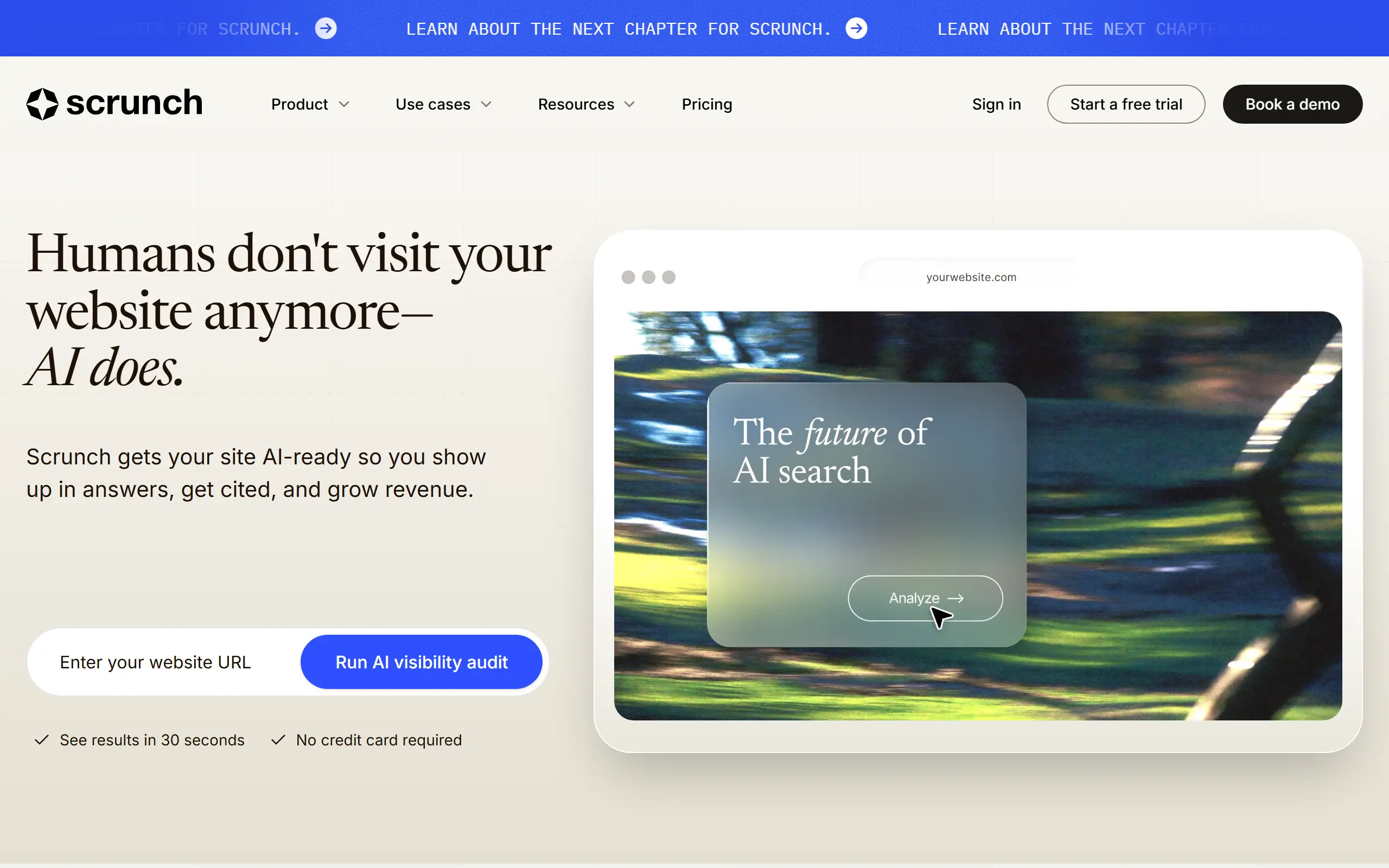
Free instant AI visibility audit, paid plans quoted per site. Focuses on making a site machine-readable for AI crawlers and agents, alongside answer monitoring.
Scrunch comes at visibility from an angle the pure trackers ignore: what an AI crawler actually retrieves when it hits your site. Its framing is that humans are no longer the primary visitor, and its tooling follows from that, checking how pages render to non-browser agents, where content is trapped behind client-side rendering, and which of your URLs the assistants can and cannot reach.
That makes it the right pick for one specific failure mode: a site with real content that AI engines cannot parse. Single-page apps, JavaScript-gated docs, and headless builds hit this constantly. If your pages render fine as static HTML, most of the value collapses back into ordinary tracking, and cheaper tools do that. The free audit is worth running either way to find out which situation you are in.
Paid pricing is quote-based. Overlaps heavily with plain trackers once your pages render server-side.
AthenaHQ
Growth teams that want tracking and recommended actions in one place.
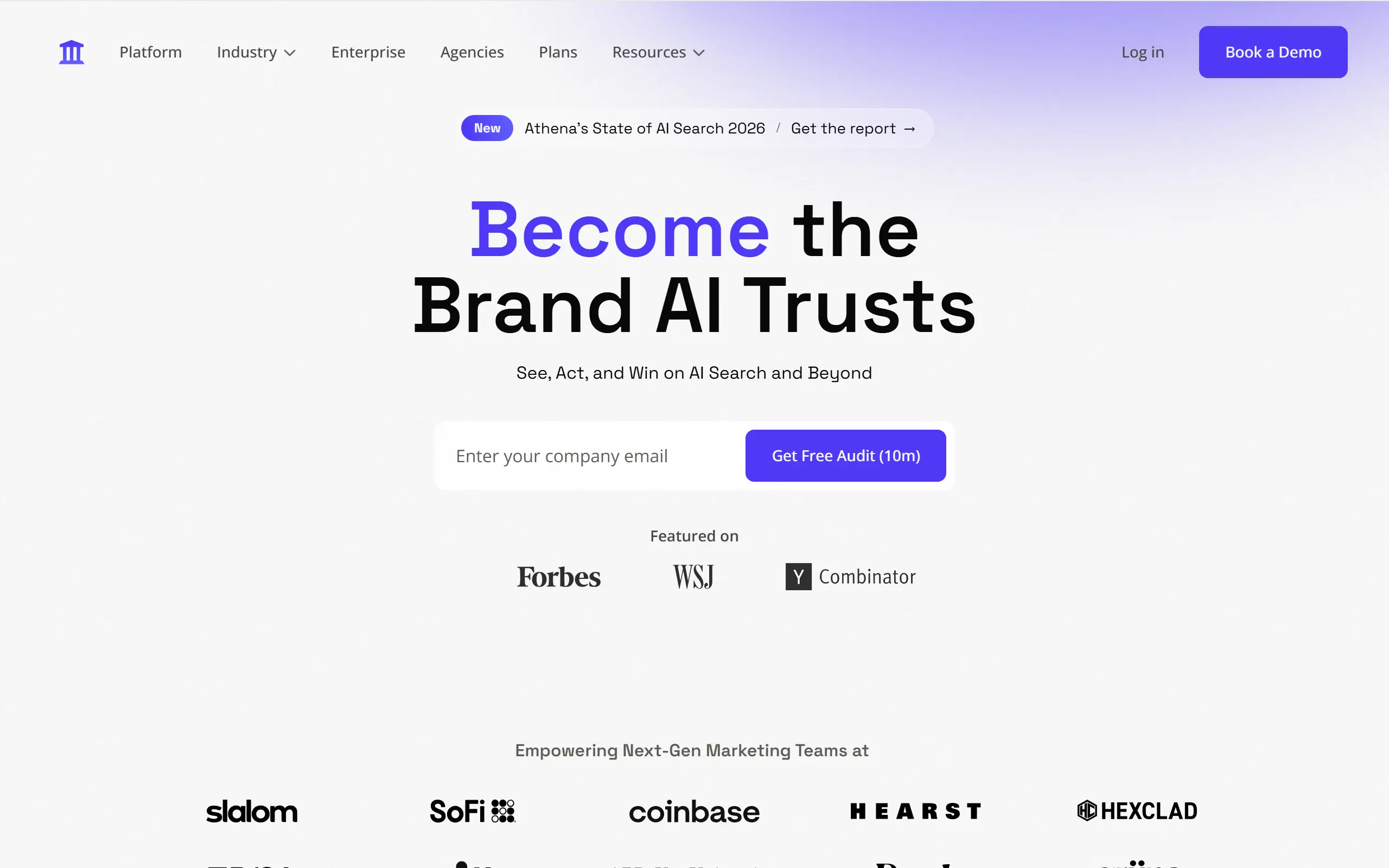
Self-serve plans plus enterprise tiers, with a free 10-minute audit at signup. Y Combinator backed, with Coinbase, SoFi, and Hearst on the customer wall.
AthenaHQ is the most opinionated of the self-serve platforms. Rather than shipping a dashboard and wishing you luck, it pushes toward a see, act, win loop: measure how the models describe your brand, surface the specific gaps driving the deficit, then recommend the pages and mentions that would close them. For a small growth team with no dedicated SEO hire, that opinionation is worth more than another chart.
Verify the recommendations before you build a quarter around them. Every platform in this category is inferring cause from correlation across a moving model landscape, and the suggested fixes tend to be generic where your category is specific. The action list is a starting brief, and it still needs someone to write and ship the pages, which is where most teams stall out. Our AI SEO tools roundup covers what fills that execution gap.
Recommendations skew generic. You still have to produce everything it suggests.
Evertune
Brand teams measuring model-level perception, not page-level citations.
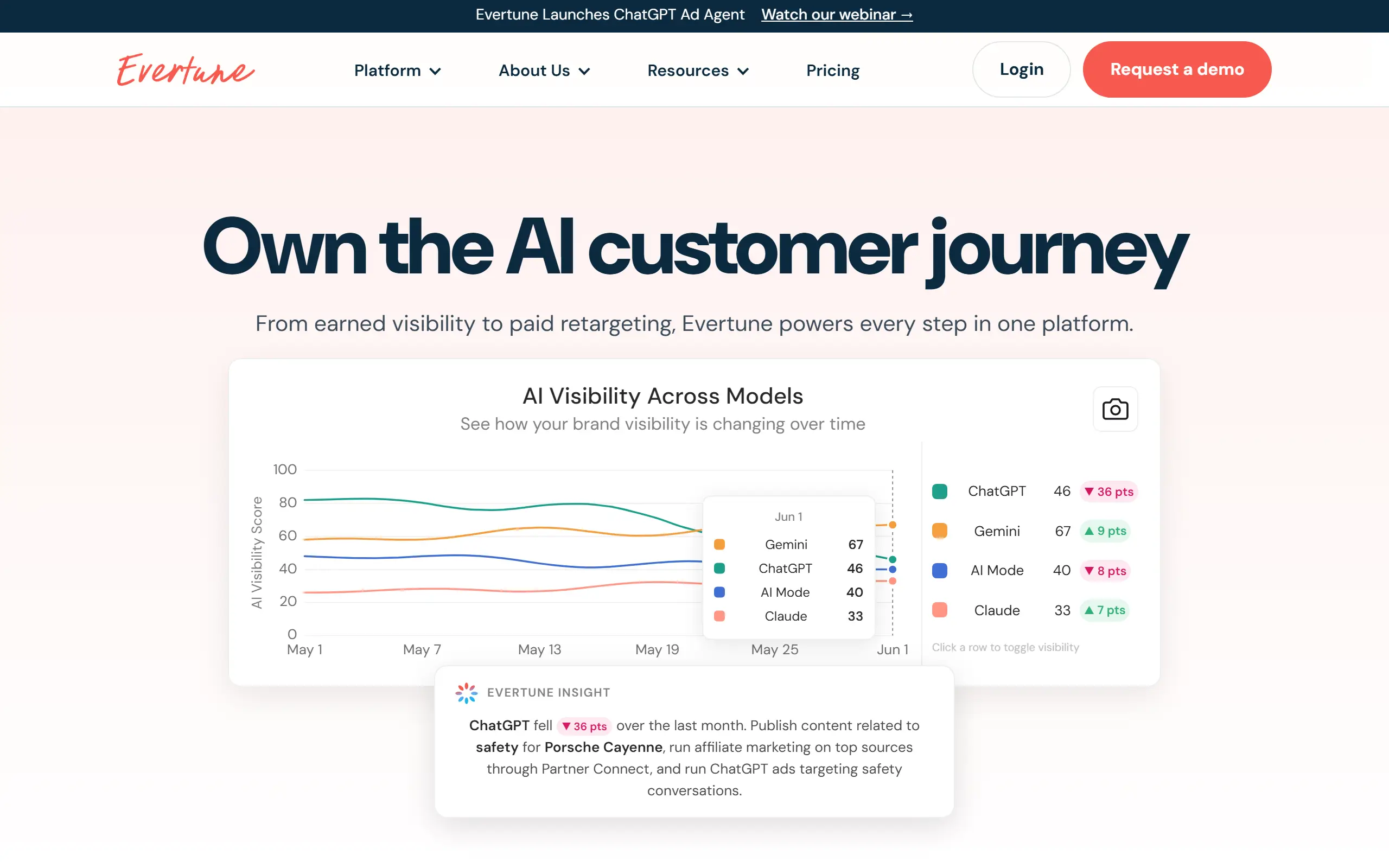
Enterprise contracts, reported to start around $3,000 a month. Scores brand visibility model by model (ChatGPT, Gemini, AI Mode, Claude) and now runs paid placement alongside earned.
Evertune is the outlier here, and worth understanding even if you never buy it. Most trackers ask which of your URLs got cited. Evertune asks what the model believes about your brand, sampling model outputs at scale to score how each one positions you against competitors, then trending that score as models retrain. For a brand team, that is a different and often more useful question than a citation count.
It has also moved first into paid placement inside assistants, which is where this whole category is heading. The price puts it out of reach for anyone below enterprise, and the model-perception metric is harder to tie to pipeline than a citation you can click. We track the market-level numbers behind that shift on our AI search adoption numbers.
Enterprise-only pricing. Model perception is harder to tie to revenue than citations.
Semrush AI Visibility
Semrush shops adding AI tracking to an existing workflow.
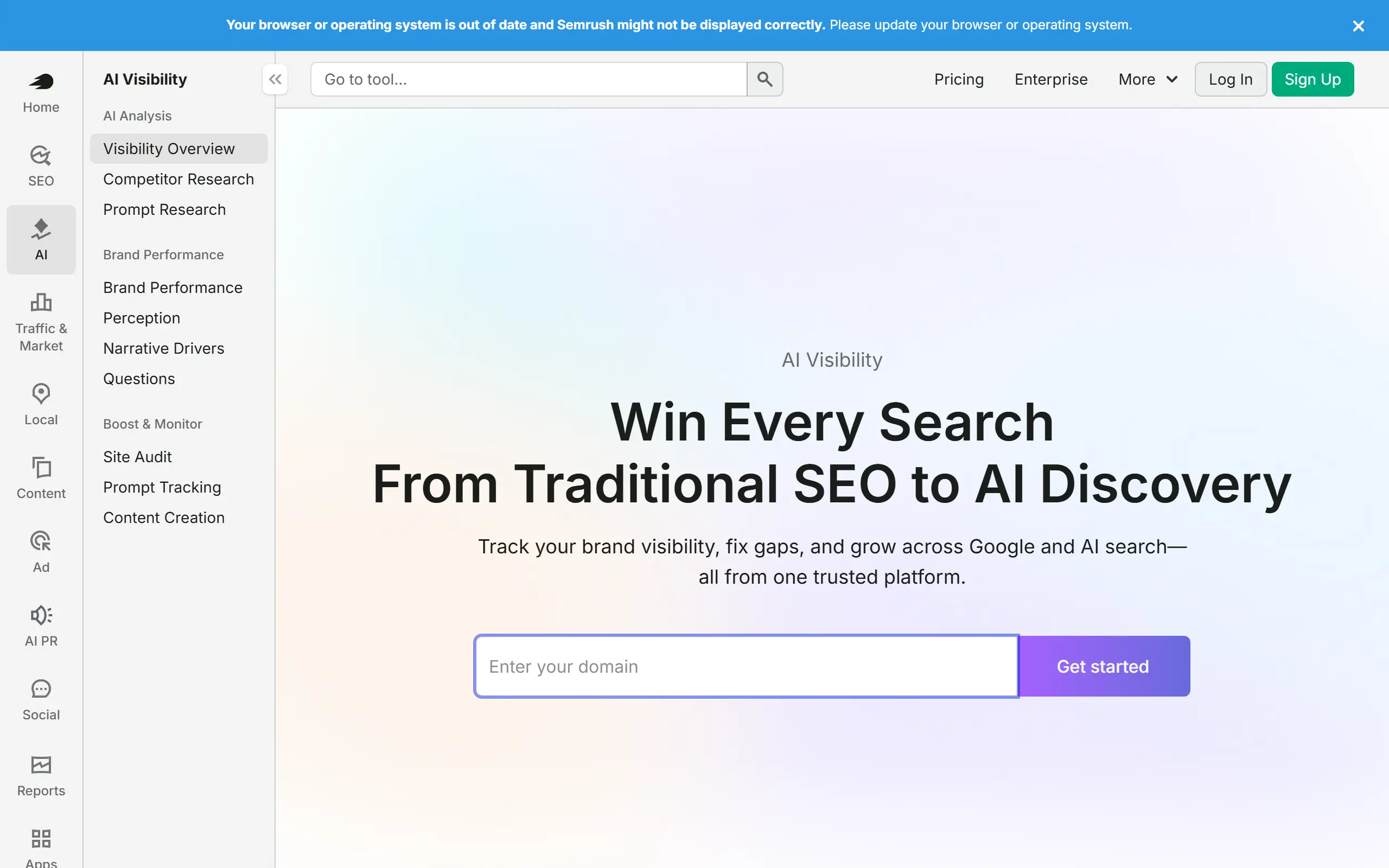
Toolkit on a Semrush subscription. Visibility overview, competitor research, prompt research, brand perception, narrative drivers, prompt tracking, and an AI-focused site audit.
Semrush folded its AI experiments into a full AI Visibility toolkit, and the module list is the most complete of any suite add-on: prompt research shows what people ask assistants in your category, visibility overview trends how often you appear, and perception reports summarise how the models describe you. If your team already lives in Semrush, this is the lowest-friction way to get a baseline this week.
Per-engine depth still trails the specialists above, and the recommendations lean generic in the way suite recommendations always do. Treat it the way we treat every bundled module in the wider AI SEO tool stack: a convenient thermometer that came free with the thing you were already paying for, not a strategy. Writesonic sells the same bundle logic from the other direction, an AI writer that added tracking, and what its visibility tiers cost is worth checking before you pay for two overlapping bundles.
Shallower per-engine data than specialists. Only makes sense if you already pay for Semrush.

HubSpot AI Search Grader
A free first look at how AI models describe your brand.
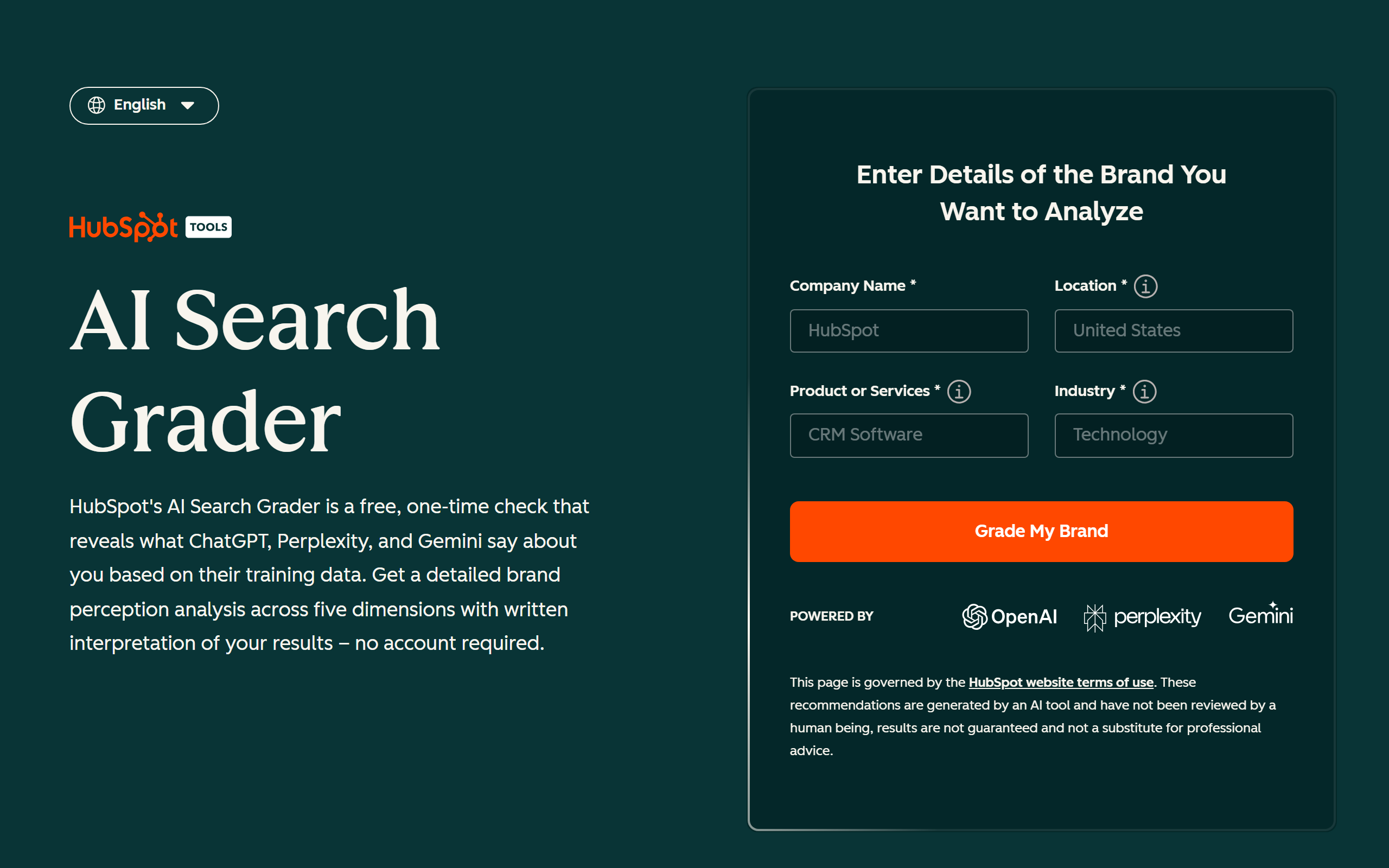
Free, no account required. One-time brand-perception check across the major assistants, scored across several dimensions with a written interpretation.
The honest free tier of the category. Enter your brand, product, and industry, and the grader reports how the major models currently perceive you, with prose you can paste straight into a strategy doc. In a category built on demo calls, a no-signup tool that answers the where do we stand question in two minutes is genuinely rare.
Know its limits before you quote it in a board deck. It reads the models rather than live retrieval, and it is a single grade with no trend line, so it cannot tell you whether last quarter's publishing worked. Use it to start the conversation, then decide whether the gap it shows is a measurement problem or, far more often, a missing-content problem.
One-time grade, no tracking. Reads model perception rather than live citations.
The SEO Agent
Fixing the number the other nine tools measure.
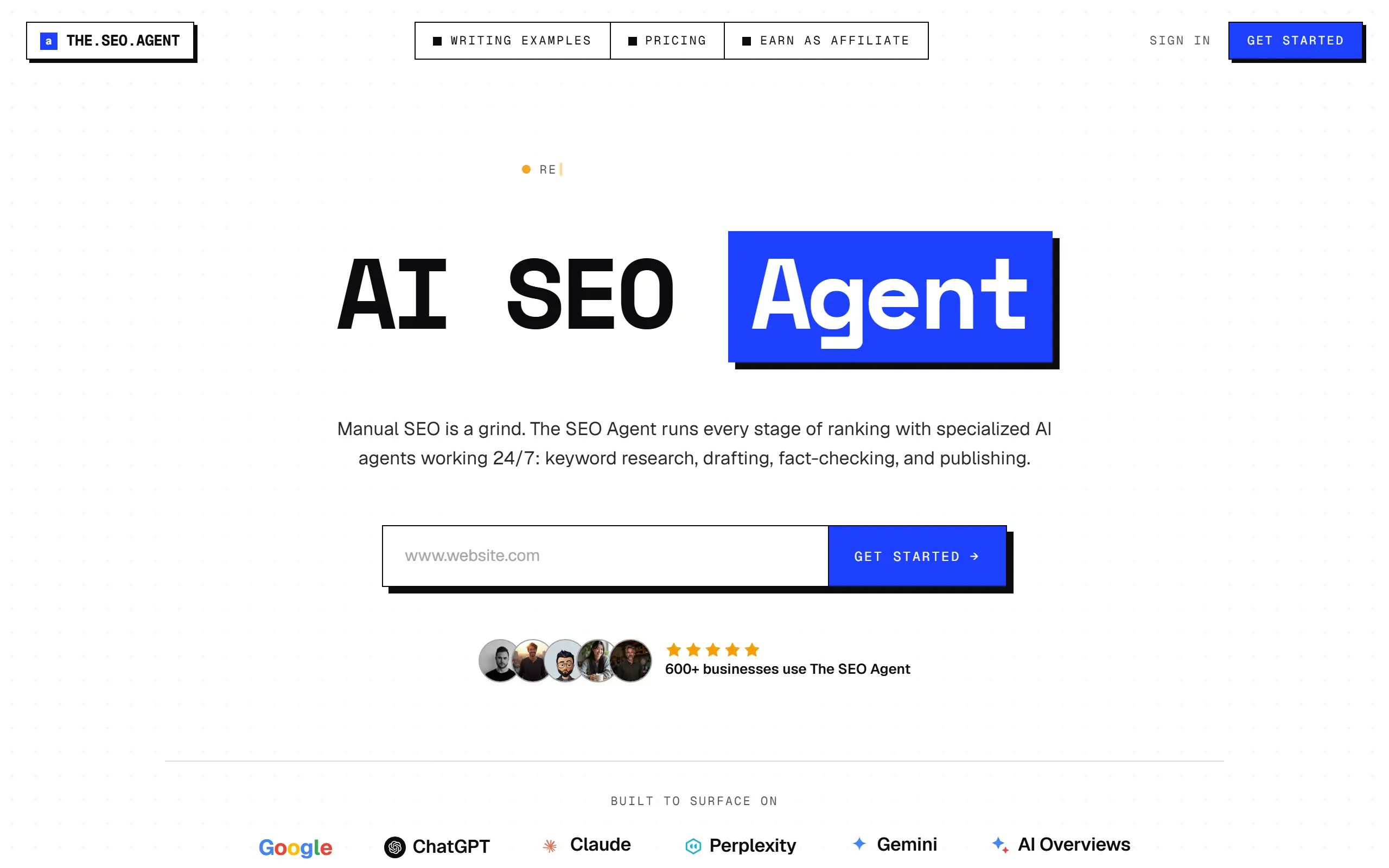
$99/mo flat. Writes and publishes one fact-checked article a day with a quotable answer block, cited statistics, FAQ schema, and native CMS publish. Free trial, cancel in one click.
Listed last and listed honestly: this is our product, and it is not an AI visibility tracker. It has no dashboard of assistant mentions and it will not tell you your share of voice. It belongs on this page for the reason every tool above eventually tells its customers in a QBR, which is that the number they are measuring only moves when new citable pages exist.
The GEO agent runs that production half end to end: it researches the questions buyers actually ask against live keyword data, drafts a page that opens with a directly quotable answer, forces a source onto every defensible claim, applies FAQ and article schema, and publishes natively to WordPress, Webflow, Shopify, or Ghost. Those are the levers with measured effect sizes rather than the ones that sound plausible, at $99 a month flat with no per-keyword meter.
No visibility dashboard. Pair it with a tracker from this list once coverage exists.
The order of operations most teams get backwards.
The common path is a tracker subscription in January, three months of flat dashboards, and a conclusion in April that AI search does not work for this category. The causality runs the other way. Engines cite pages that exist: pages that answer a question directly, carry statistics with named sources, name entities consistently, and stay fresh. A tracker cannot conjure any of that. It can only tell you, accurately and expensively, that it is missing.
So sequence it. Build the coverage first, by hand using the checklist in our step-by-step answer engine optimization guide, or on autopilot with our AI SEO agent. Then buy a tracker from this list and watch a line that can actually move. The same sequencing argument applies to the rest of the stack: instrumentation earns its cost only after production exists, which is the through-line in our AI search optimization pipeline and the reason we built an answer engine optimization agent before we ever built a dashboard.
Ten tools, one shared blind spot.
| FEATURE | PROFOUND | PEEC AI | OTTERLY.AI | RANKSCALE | SCRUNCH AI | ATHENAHQ | EVERTUNE | SEMRUSH AI VISIBILITY | HUBSPOT AI SEARCH GRADER | THE SEO AGENT |
|---|---|---|---|---|---|---|---|---|---|---|
| Primary job | Deep answer tracking | Daily visibility metrics | Prompt monitoring | Widest engine list | Crawler readability | Track plus recommend | Model perception | Suite add-on tracking | One-off brand grade | Publishes the content |
| Entry price | Demo-gated | ~90 euros/mo | $29/mo | ~$22/mo | Free audit, quoted plans | Self-serve plus enterprise | ~$3,000/mo | Semrush plan add-on | Free | $99/mo flat |
| Self-serve signup | ||||||||||
| Tells you what to publish | Citation gaps | Source analysis | Audit findings | Technical fixes | Action list | Prompt research | Picks the topic itself | |||
| Writes and publishes it |
What is an AI visibility tool?
An AI visibility tool measures how often and how favourably your brand appears in answers from ChatGPT, Perplexity, Google AI Overviews, Gemini, Claude, and Copilot. Most work by running a panel of registered prompts against those assistants on a schedule, then scoring your presence, your position within the answer, and the sentiment of the description. The category is also sold as AI search visibility, AI brand visibility, GEO, and AEO tooling. They are the same thing under different labels.
How did you rank these ten?
By the team each one fits rather than a single overall score, because a $29 prompt tracker and a $3,000 brand-analytics platform are not competing for the same buyer. Order runs enterprise depth first (Profound), then self-serve mid-market (Peec AI), budget (Otterly, Rankscale), the specialists (Scrunch for crawler readability, AthenaHQ for recommended actions, Evertune for model perception), the suite add-on, the free grader, and finally our own product, which is not a tracker at all. Every price and feature line was checked against the live product page in August 2026.
Which AI visibility tool is best for a small team?
Otterly.AI at $29 a month is the cheapest credible option and covers six engines. Rankscale from about $22 a month covers seventeen or more if breadth matters more than polish. Both are self-serve with no sales call. If you want to spend nothing first, the HubSpot AI Search Grader gives you a free one-time read on how the models currently describe you, which is usually enough to decide whether the problem is measurement or content.
Do AI visibility tools actually agree with each other?
Not closely. Each tool samples a different prompt set against models that are non-deterministic and retrained without notice, so two trackers pointed at the same brand in the same week routinely disagree on absolute numbers. Published accuracy tests have found undercounting in several products. Pick one tool, treat its absolute score as arbitrary, and read the trend line and the competitor gap instead. Switching vendors resets your baseline.
Is this list sponsored?
No. There are no affiliate links, no paid placements, and no outbound links to the tools listed. We build the tenth entry and we say so in plain text in its section rather than burying the disclosure. The screenshots are captured directly from each product homepage so you can see what you would be signing up for.
What about Conductor, Ahrefs Brand Radar, Goodie, or Knowatoa?
All real tools in the same space. Ahrefs Brand Radar and Conductor are covered in our GEO tools roundup, which ranks the field on a different axis, so we kept them off this page rather than repeat the same nine names twice. Goodie pairs monitoring with content production at a reported $399 and up. Knowatoa is a credible budget tracker that overlaps heavily with Otterly. Ten entries covering every budget tier without duplicates was the constraint.
Can any tool guarantee my brand shows up in ChatGPT?
No, and be suspicious of anyone implying otherwise. Nobody sells placement in organic AI answers. The engines pick sources by retrieval and trust signals. What the research supports is that content carrying quotations, statistics, and cited sources measurably lifts generative-engine visibility, and that comparison-shaped content earns a disproportionate share of AI citations. Tools help you execute and verify. They cannot buy the citation.
Do I need a visibility tracker and a content tool, or just one?
If your site already publishes consistently, a tracker earns its cost immediately by showing which questions you win and where competitors beat you. If it does not, a tracker will report a flat line for two quarters and you will conclude AI search does not work for you, which is the wrong conclusion. Build coverage first, then instrument it. Most serious teams end up running one of each, and the production half is the one that compounds.
Related guides + features.
AI search optimization
Quotable answers, cited statistics, entity naming, and schema baked into every article the agent writes, so AI engines have a source to cite.
/features/ai-search-optimization →LISTICLEBest GEO tools
The GEO field ranked honestly: which trackers are worth paying for, which tier fits which team, and the one tool that produces citable content instead of measuring it.
/blog/best-geo-tools →GUIDE · AEOAnswer engine optimization
How ChatGPT, Perplexity, and AI Overviews pick their sources, the on-page levers with measured effect sizes, and a worked example.
/blog/answer-engine-optimization →Publish the pages the engines cite.
Connect your CMS and the agent ships a fact-checked, citation-ready article every day: quotable answers, sourced statistics, schema in place. Free trial first, $99 a month after, cancel in one click.
FREE TRIAL · CANCEL IN ONE CLICK