The 10 best Shopify SEO apps in 2026.
The App Store sells five different products under one label: on-page coaching, autopilot fixes, image and speed work, bulk metadata, and schema. The ten below are grouped by which of those jobs they actually do, with September 2026 prices, review counts read off each listing, and one honest limit each.
Which Shopify SEO app should a store install?
Buy by job. Hands-off technical cleanup: Booster AI SEO, free tier or $39/mo, 4.8 across 5,475 reviews. Best free plan: Avada, 100 image optimizations and 20 audits at $0. Widest coverage in one app: SearchPie at $39/mo. Images and page speed only: TinyIMG at $14/mo. On-page coaching while you write: Yoast at $19/mo. Bulk metadata on a big catalogue: Smart SEO at $14.99/mo. Schema errors only: Schema Plus at $10.99/mo. Most stores need one technical app plus something that writes the articles, which no App Store app does. That second half is TheSEOAgent at $99/mo per store.
The SEO Agent writes blog posts that bring search traffic to your store and publishes them straight to Shopify, one a day. Enter your store to start.
Free trial · Cancel in one clickThe shortlist, scannable in ten seconds.
- 01The SEO AgentBest for the content the apps leave empty
- 02Yoast SEOBest on-page coaching for people who write
- 03Booster AI SEO + AEO OptimizerBest hands-off technical cleanup
- 04Avada AI SEO Image OptimizerBest free tier in the category
- 05SearchPie: SEO, Speed & SchemaBest all-in-one technical coverage
- 06Tiny SEO Speed Image OptimizerBest for image weight and page speed
- 07Smart SEO AI & Image OptimizerBest cheap bulk metadata
- 08StoreSEO SEO & Image OptimizerBest for small catalogues done properly
- 09Schema PlusBest single-job schema app
- 10Plug in SEOBest for learning what is broken and why
How we picked these ten.
Search the App Store for SEO and you get four hundred listings whose descriptions are close to interchangeable. They are not interchangeable. An image compressor, a schema generator, an on-page analyser, and a scan-and-fix autopilot are four different purchases, and most merchants install three of them without noticing they bought the same feature twice. So the ordering key on this page is the job, marked on every entry: the content, the on-page coaching, the autopilot, the images and speed, the metadata, the schema, the audit. Work out which job is actually open on your store and the shortlist collapses from ten to one or two.
The editorial position, stated because we have a stake in it: we sit at number one and we are not an App Store app, which is a strange thing to put at the top of a list of apps. It is there because the job it does is the one nine of these ten leave untouched. Every technical app makes the pages you already have correct. None of them creates a page that did not exist, and a Shopify store competes for research and comparison queries it has no page for. We lose the App Store row in the table below, along with image compression and broken-link repair, and those are real losses rather than diplomatic ones. The product side of that argument is on our Shopify blog automation page, and the managed version sits with our Shopify SEO retainer alternative.
Every price, rating, and review count was read off the app's own Shopify App Store listing in September 2026. No affiliate links, no paid placements, and no outbound links to the apps listed: the screenshots of each listing are the proof. App Store pricing changes often and tiers get reshuffled, so treat anything here as the starting point for a check rather than a quote.
The SEO Agent
The one SEO job no App Store listing covers, which is writing the pages.
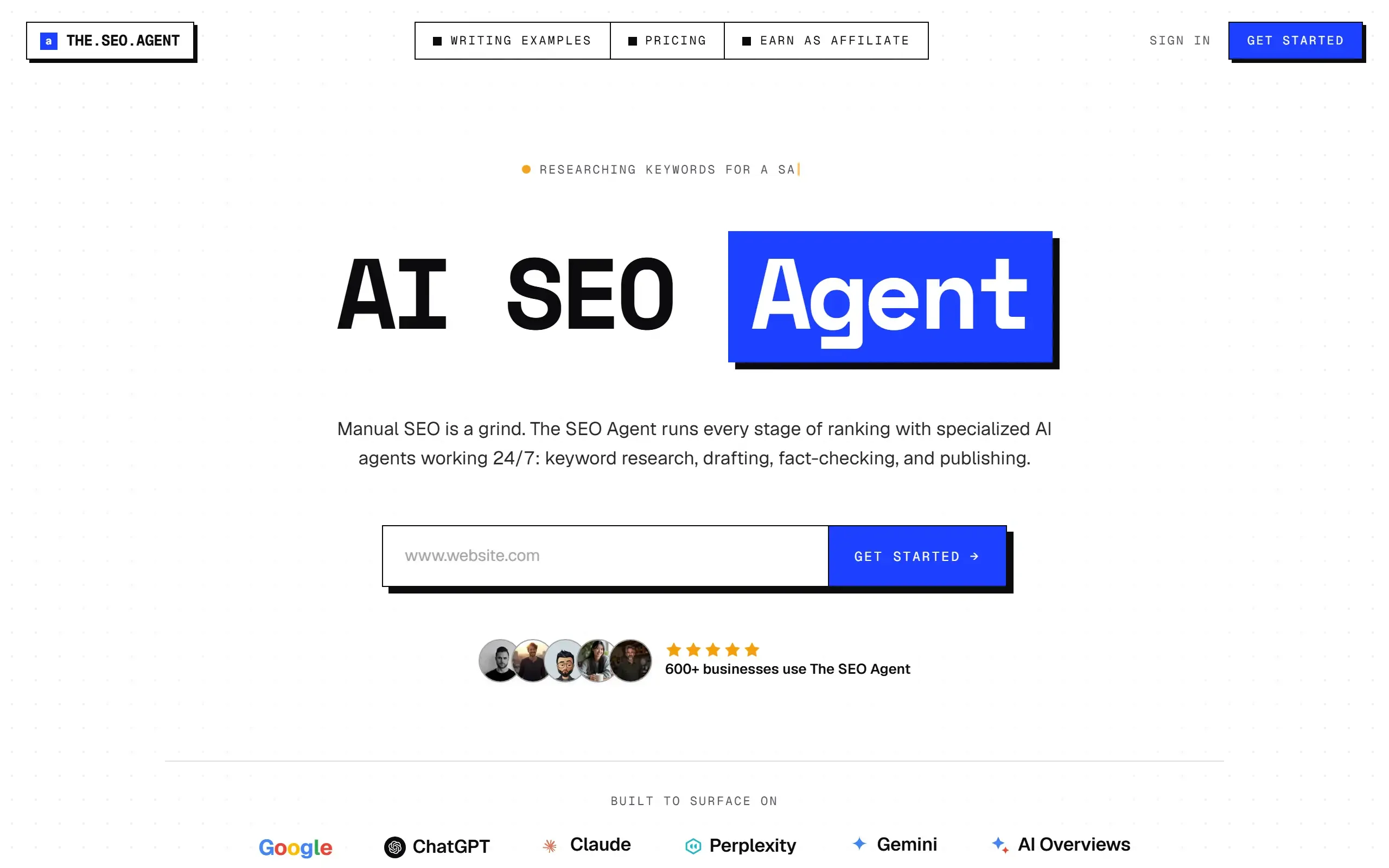
$99/mo per store, $79/mo for each additional store. Not a Shopify App Store listing: it connects to the store and publishes finished articles into the Shopify blog. Researches keywords against live search data, writes a cited draft, checks every claim against its sources, and publishes it with internal links already in place.
Start with the disclosure, because it changes how you read this entry. This is not an app you install from the Shopify App Store. It is a content pipeline you connect to your store, and it publishes into your Shopify blog the same way a person with an admin login would. If your shortlist is strictly App Store listings, skip to number two and come back when the blog is still empty in March.
Every other product on this page works on pages that already exist. They compress the images on a product page, write the meta description for a collection, mark it up with schema, and tell you which titles are too long. All useful. None of it creates a page that did not exist yesterday, and a store with 40 products and no blog has a coverage problem that no amount of alt text fixes. That gap is the whole reason our Shopify SEO tool exists, and the wider version of the argument sits on the SEO automation pipeline.
The economics are the honest pitch. One researched, source-checked, published article a day for $99 a month, against $150 to $400 for a single freelance post. Store owners run it against the buying-guide and comparison queries their product pages will never rank for, then let the product pages take the transactional terms. If you would rather hand the whole thing over, that is what our Shopify SEO service covers, at the same flat $99 a month.
Not a Shopify App Store app, so there is no one-click install from the store admin and no App Store review count to check. It also does not compress images, fix broken links, or repair product schema. Pair it with one of the technical apps below.
Yoast SEO
Teams that write their own copy and want the analysis while they write.
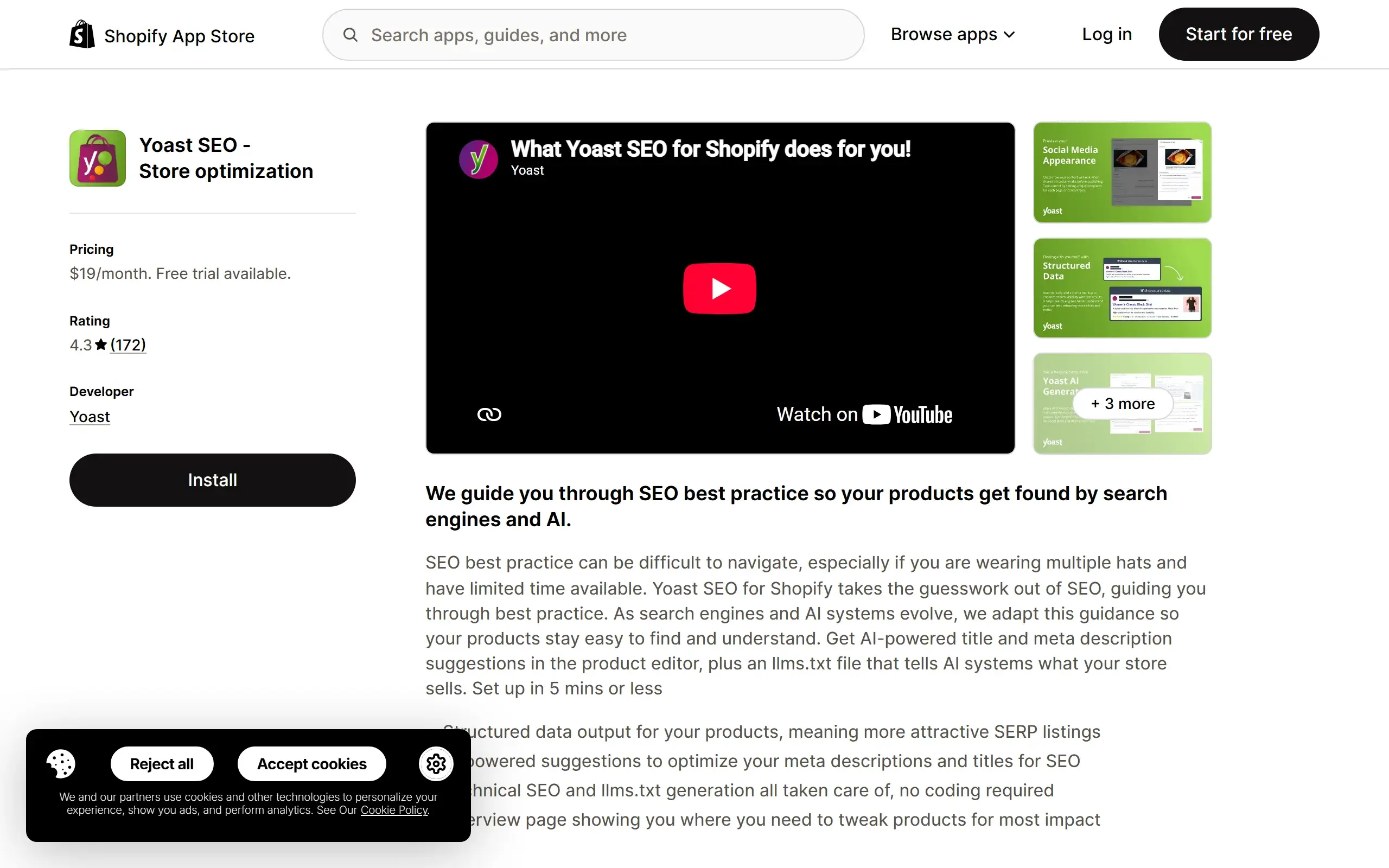
$19/mo with a 14-day free trial, no free tier. Rated 4.3 across 172 App Store reviews, the lowest review volume of anything on this list and the highest name recognition. Runs SEO and readability analysis on products, collections, and blog posts, ships automatic product and breadcrumb schema, and generates an llms.txt file for AI assistants.
The WordPress plugin brought its habits with it, and that is a compliment. Yoast is the only app here built around the moment you are writing rather than the moment you are auditing. You get the traffic-light readability pass, the keyphrase analysis, the snippet preview, and a nudge when a product description is thin, all inside the Shopify editor. For a merchant who genuinely writes their own copy, that feedback loop is worth more than another list of technical warnings.
Two caveats. There is no free plan, so $19 is the price of finding out whether you like it after the 14-day trial, and the 4.3 rating on 172 reviews is a real outlier in a category where 4.8 and thousands of reviews is normal. The llms.txt feature is a reasonable bet rather than a proven one; the broader question of getting a store quoted by assistants is one we cover in the guide to answer engine optimization.
No free tier, and the lowest App Store rating on this list at 4.3. It analyses copy you have already written and never writes any.
Booster AI SEO + AEO Optimizer
Merchants who want the technical debt cleared without learning what it was.
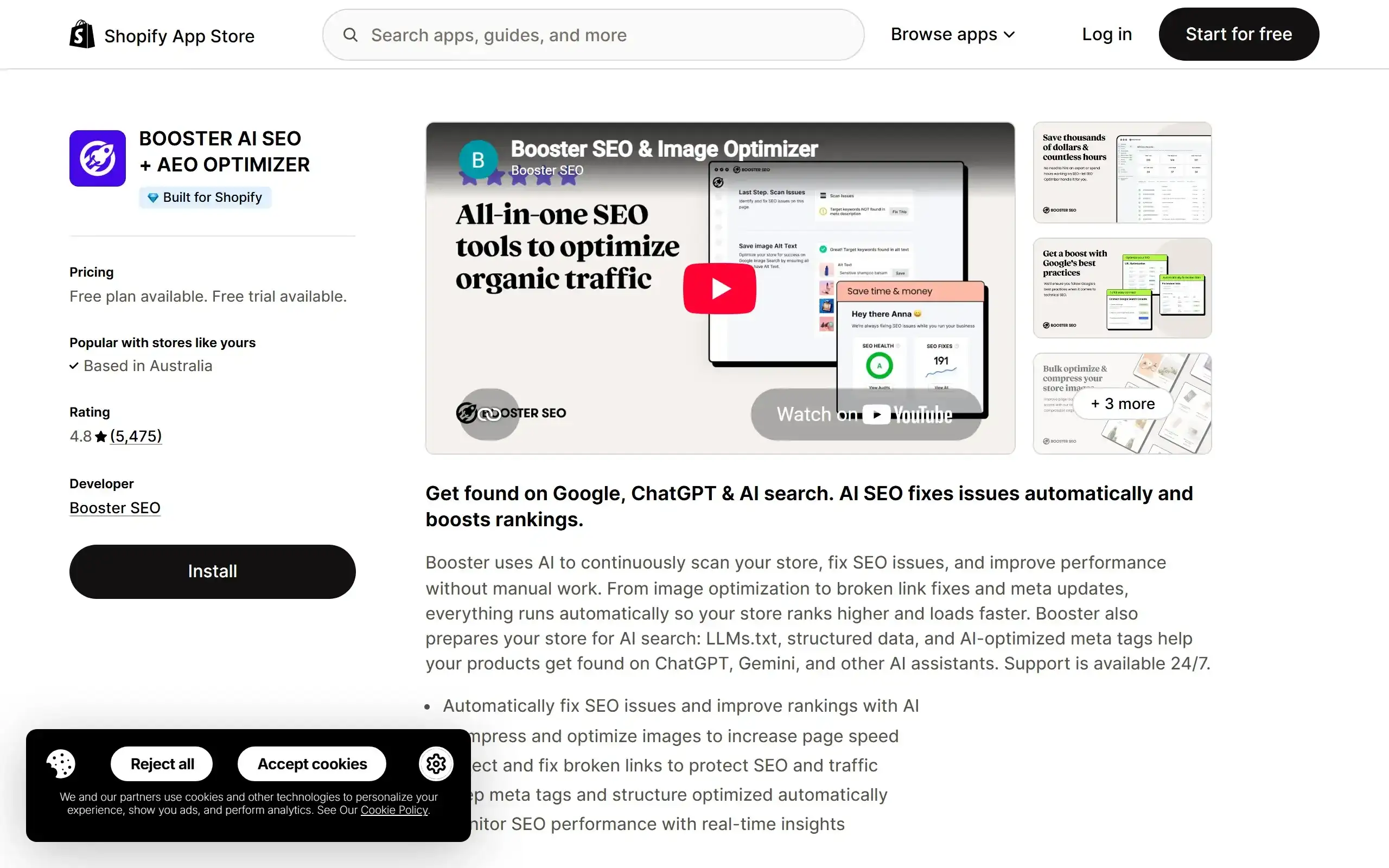
Free tier with basic scoring and limited weekly actions, Pro $39/mo for autopilot fixes and monitoring, Premium $69/mo adding image compression and bulk actions. 4.8 across 5,475 reviews, the largest review base in the category. All paid plans carry a 14-day trial.
This is the app most merchants mean when they say they want SEO handled. It scans, it finds broken links and missing meta tags and oversized images, and on the paid tiers it fixes them on a schedule without asking. For a store owner whose actual job is buying inventory and answering support tickets, an autopilot that keeps the technical baseline clean is a defensible $39.
Read the tiering before you buy: image compression, the feature most people install a Booster-class app for, sits on the $69 Premium plan rather than the $39 one. And be clear about what autopilot means here. It fixes fields on pages you already have. The AEO features are metadata and structured-data work aimed at assistant visibility, which is a sensible foundation and not the same thing as having something worth citing, a distinction we draw out across the answer engine tooling roundup.
Image compression is gated to the $69 tier, not the $39 one. Automated fixes on a large catalogue are worth reviewing before you let them run unattended.
Avada AI SEO Image Optimizer
Getting a real audit and real image work done on a zero budget.
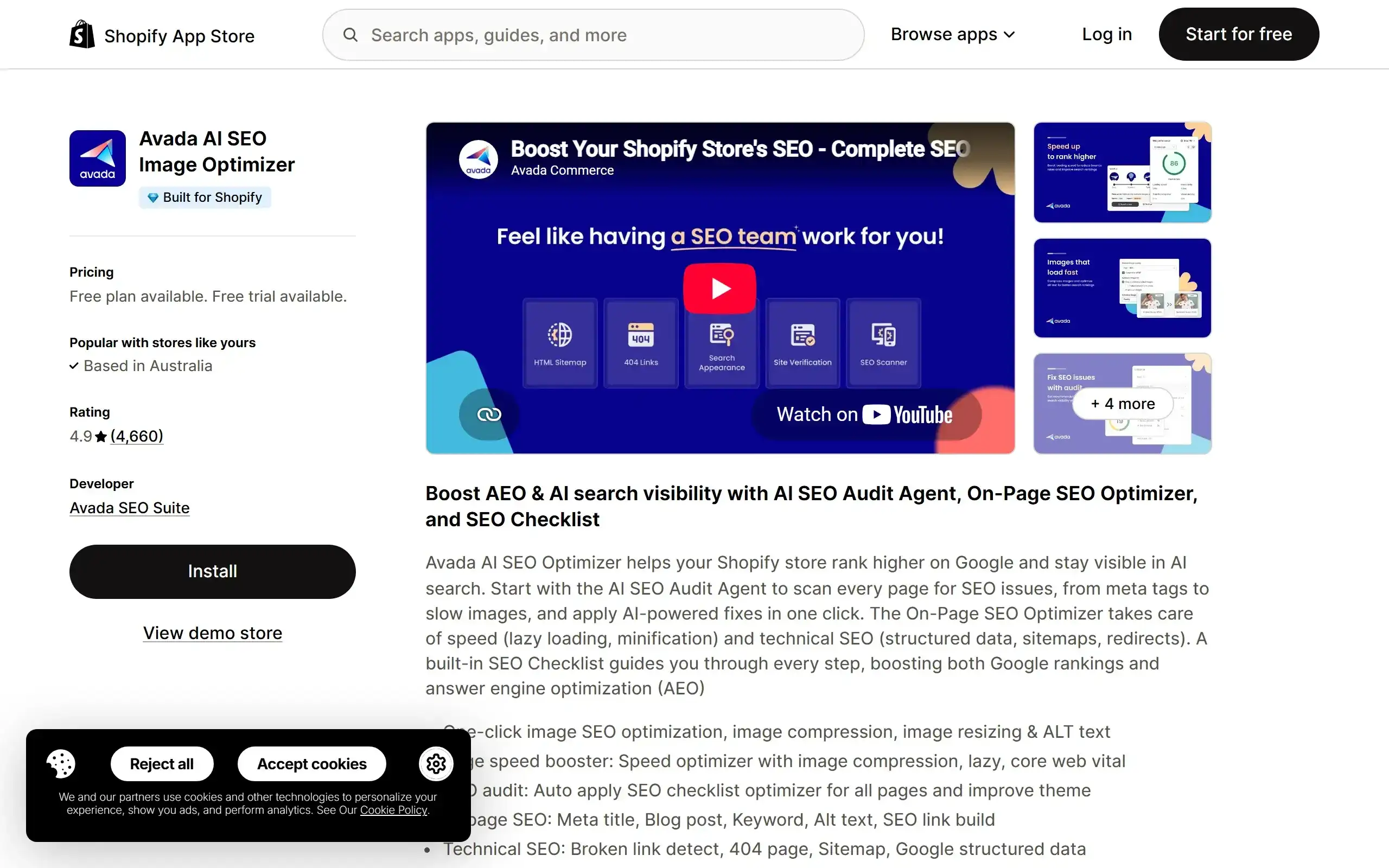
Free plan with 100 image optimizations, 20 on-page audits, and 100 AI credits. Pro $34.95/mo for unlimited image optimization and unlimited audits with 1,000 AI credits, Enterprise $99/mo. Rated 4.9 across 4,660 reviews and carries the Built for Shopify badge.
The free plan is genuinely usable, which is rare. A hundred image optimizations covers a small catalogue outright, and twenty audits is enough to find every structural problem a new store has. Paired with the speed features (lazy loading, minification) it fixes the two things Shopify merchants most often get wrong: enormous hero images and a theme that loads six scripts before the first product.
The AI credit system is the thing to watch, because credits are how a free plan becomes a $34.95 plan. Generated alt text and meta descriptions burn them fast on a large catalogue, and machine-written metadata at volume is exactly the sort of near-duplicate copy that reads fine to a crawler and does nothing for a buyer. Use the credits on your best-selling hundred products and leave the long tail alone. Where automated writing actually earns its place is longer-form work, which is the point we argue in the AI SEO tools comparison.
AI credits meter the useful features, so the free tier runs out fast on a big catalogue. Generated metadata at volume tends toward near-duplicates.

SearchPie: SEO, Speed & Schema
One app covering schema, speed, images, and Search Console monitoring.
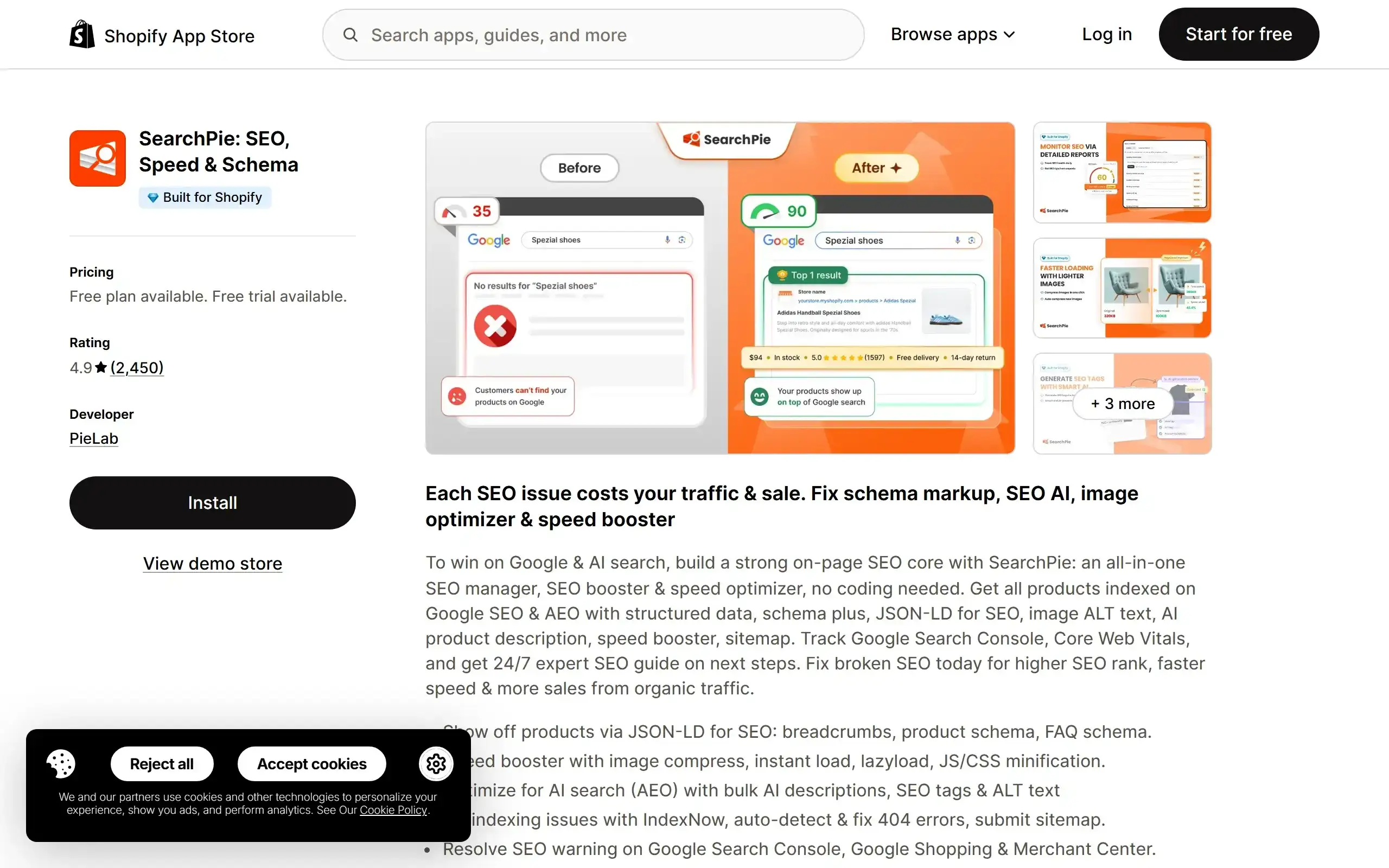
Starter free, Premium $39/mo, Enterprise $99/mo, with 20% off on annual billing. Rated 4.9 across 2,450 reviews. Covers JSON-LD for products, breadcrumbs and FAQs, image compression and alt text, broken links and 404s, sitemap submission, Core Web Vitals tracking, and Google Search Console issue monitoring.
The widest technical surface area on the list for the money. Most apps here own one or two jobs well; this one covers schema, speed, images, redirects, and Search Console monitoring from a single dashboard, and the Merchant Center integration matters if a meaningful share of your traffic comes through Shopping. For a store that would otherwise install three apps, consolidating at $39 is the cheaper and simpler answer.
Breadth has a cost. A suite that touches schema, theme scripts, and redirects is a suite with more ways to conflict with your theme and with whatever else you have installed, so change one thing at a time and keep an eye on Search Console for a week afterwards. It also shares the ceiling every app on this page shares: it can make your existing pages correct, and correct is not the same as ranking, which needs pages that answer questions your product pages do not. Scaling that page inventory is what programmatic SEO is for.
A wide surface area means more chances to conflict with your theme or another SEO app. Roll changes out one at a time.
Tiny SEO Speed Image Optimizer
Image-heavy stores where the theme is fine and the photography is not.
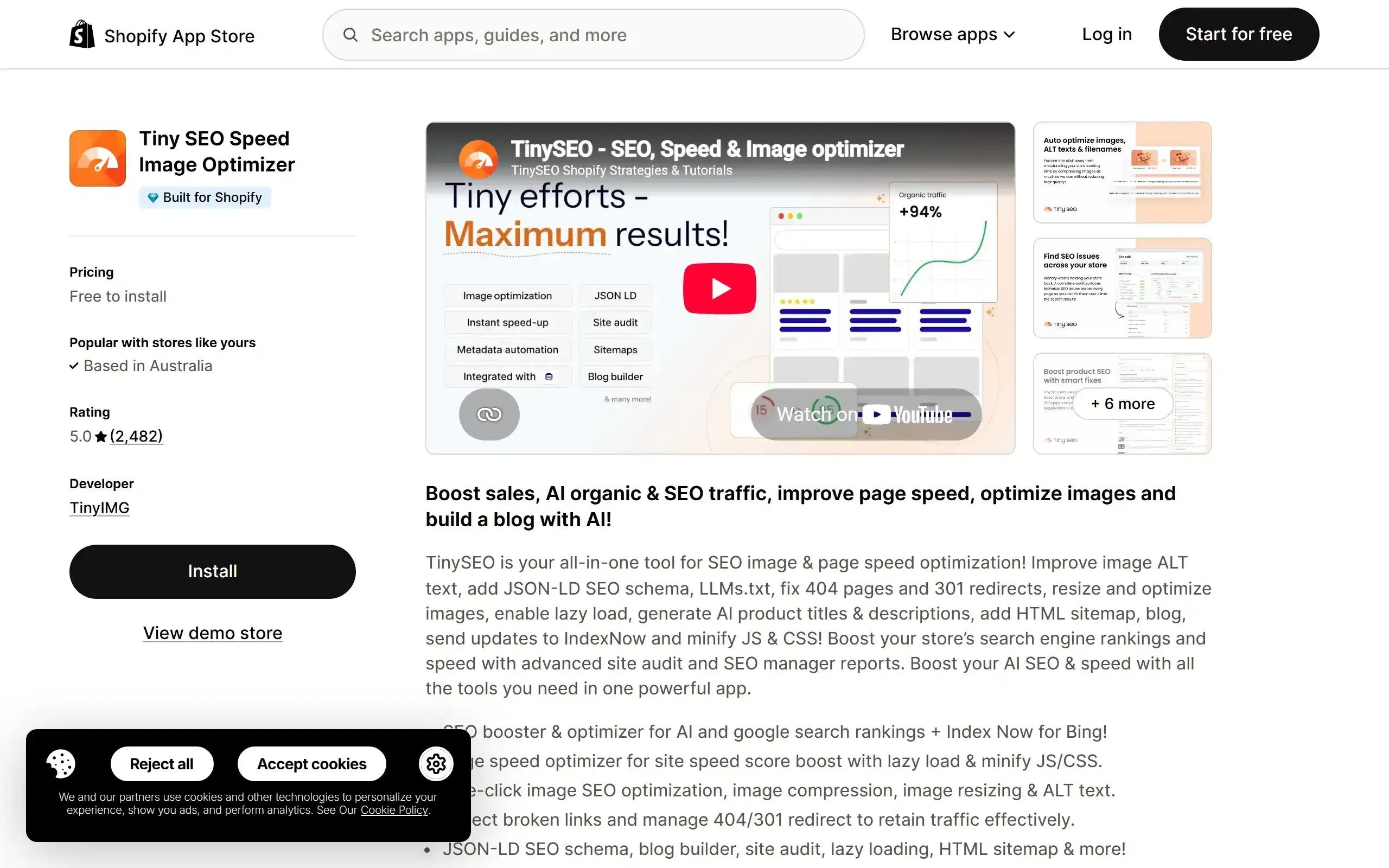
Free to install with 50 optimizations a month, then 3 cents per image. Beginner $14/mo for 1,500 optimizations, Advanced $23/mo for 5,000, Expert $49/mo for 15,000. Rated 5.0 across 2,482 reviews with the Built for Shopify badge. Covers compression, alt text, lazy loading, 404 and 301 management, JSON-LD, CSS and JS minification, and IndexNow.
The narrowest brief on this list and the best execution of it. If your Lighthouse score is being dragged down by 4MB product photography, this fixes that specific problem for $14 a month and gets out of the way. The per-optimization pricing above the plan allowance is unusually honest for the category: you can model the cost of a catalogue migration before you commit to it.
Two things to keep in perspective. Page speed is a ranking factor with a low ceiling, so going from a poor score to a good one helps and going from good to excellent mostly does not, and the conversion argument for fast pages is stronger than the ranking one. The AI blog builder bundled into the higher tiers is a bonus feature rather than a content strategy, which is the distinction we spend the whole of the SEO automation roundup on.
Overage is metered per image, so a big catalogue migration needs the sums done first. Speed is a ranking factor with a low ceiling.
Smart SEO AI & Image Optimizer
Filling thousands of empty meta fields without touching them by hand.
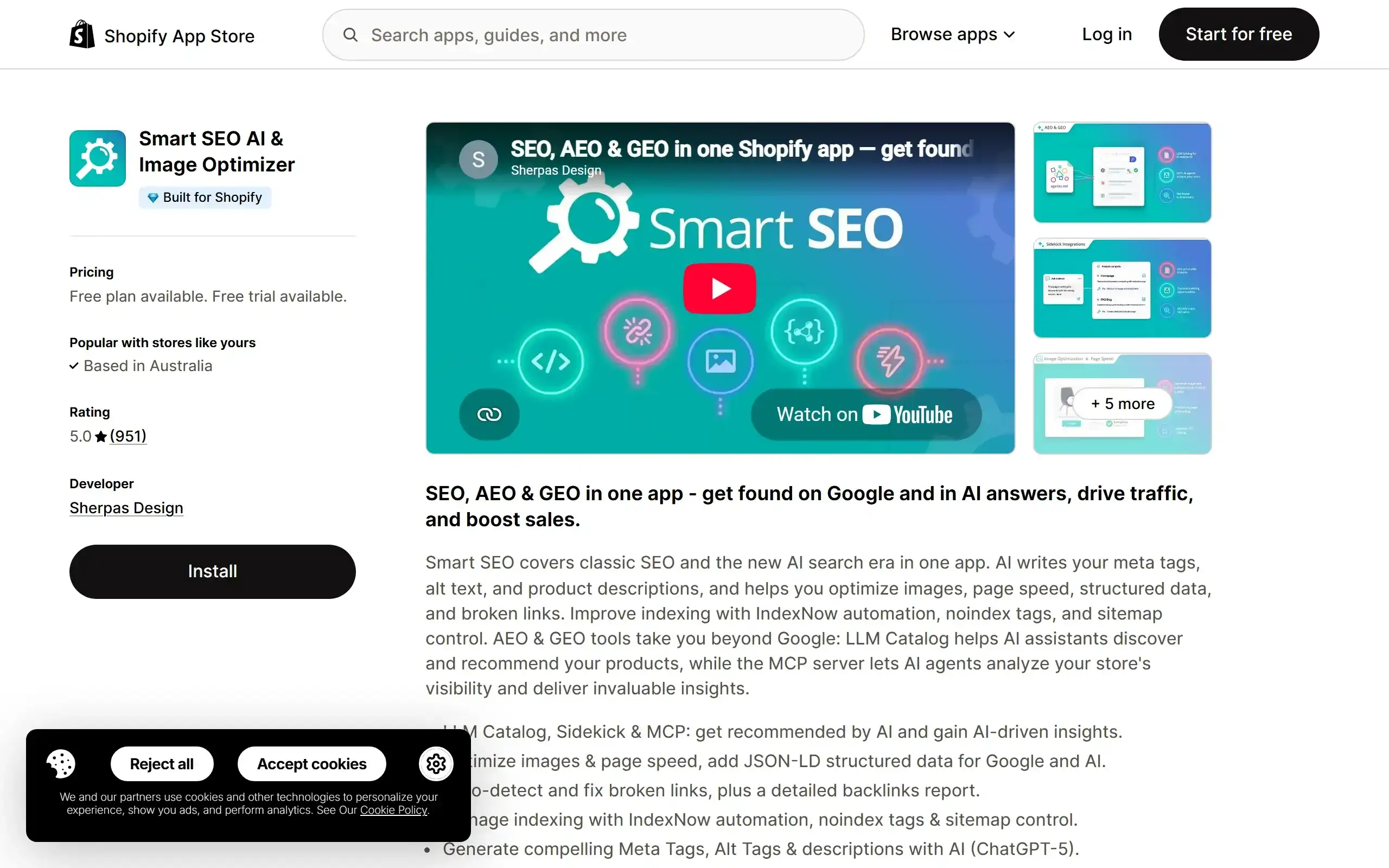
Free plan with 100-page broken-link checks, 50 image optimizations, and 20 AI generations. Pro $14.99/mo adds page speed, JSON-LD, and bulk optimization; Business $24.99/mo adds 500-page audits; Premium $49.99/mo makes AI generations unlimited. Rated 5.0 across 951 reviews.
The bulk-metadata job done cheaply. If you imported a catalogue and every product carries the same auto-generated title and an empty description, this fills those fields across thousands of products at $14.99 a month, and the free tier is enough to see whether the output is any good on your own products before you pay.
Judge the generated copy before you push it live to the whole catalogue. Templated meta descriptions across 3,000 similar products are technically complete and commercially inert, and a title that reads like a template gets skipped in the results even when it ranks. Spend an afternoon writing your top fifty by hand and let the app handle the tail. The same rule applies at article length, which is why our AI SEO agent checks every claim against its sources before it publishes rather than shipping whatever the model produced.
Bulk generation across a large catalogue produces near-duplicate metadata unless you review it. Unlimited AI generation only arrives at $49.99.
StoreSEO SEO & Image Optimizer
Small catalogues worked through product by product.
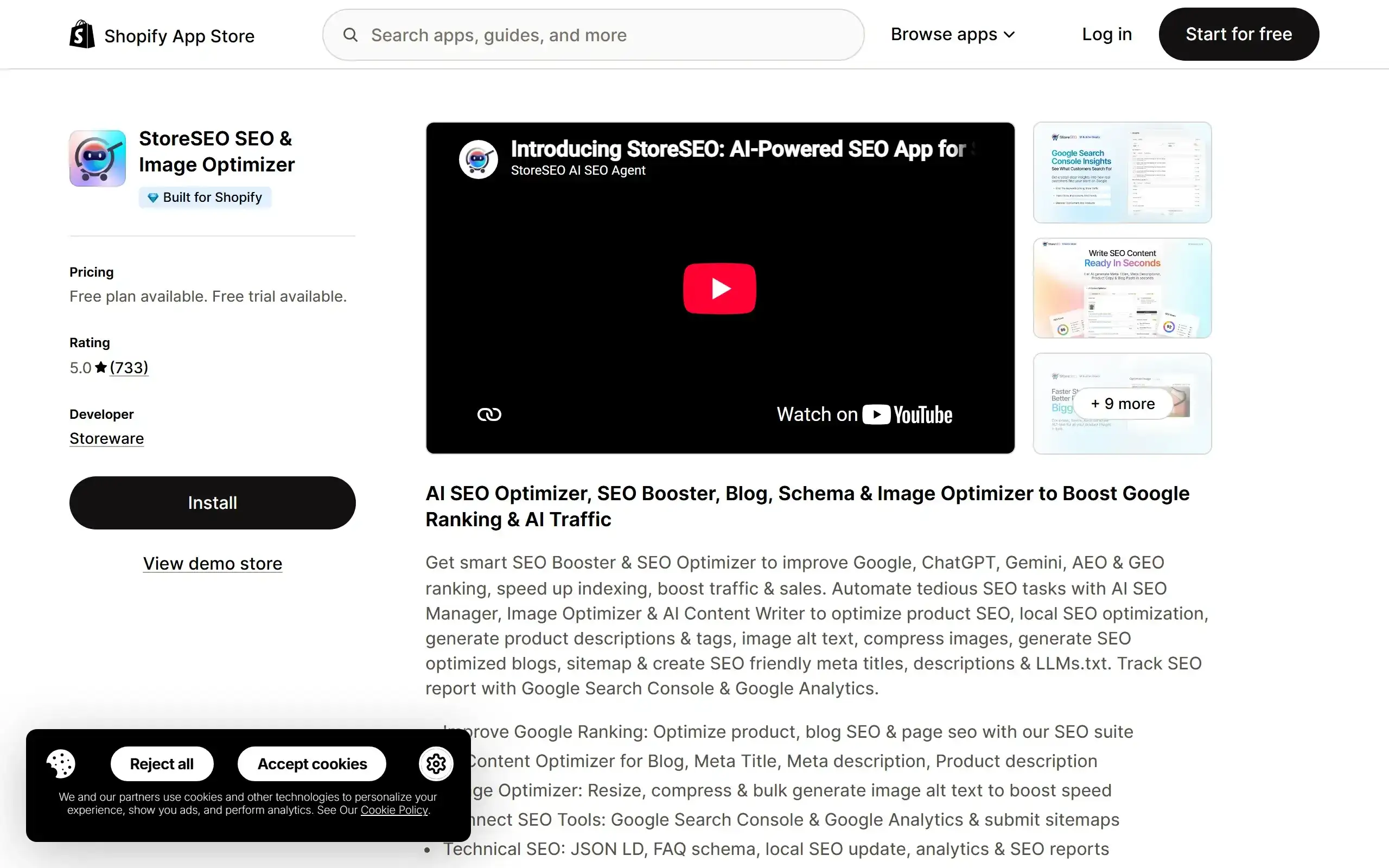
Free plan covering 25 products, 200 AI credits, and 25 image optimizations. Lite $14.99/mo for 100 products, Essential $39.99/mo for 250, Advanced $249.99/mo for 10,000. Rated 5.0 across 733 reviews. Includes JSON-LD, sitemaps, instant indexing requests, local SEO, and Search Console and Analytics integration.
The product-count pricing tells you exactly who this is for. A store with 80 SKUs gets a guided per-product workflow (keyword, title, description, alt text, schema) for $14.99, and works through the catalogue in an afternoon with a score to chase on each product. That structure is genuinely useful for someone who has never done on-page work before.
The same pricing model is what rules it out at scale: 250 products for $39.99 is fine, then the next tier is $249.99, which is a cliff rather than a step. Larger catalogues are better served by the flat-priced apps above. And a per-product optimization score is a checklist, not a strategy, in the same way an automated site grade is; our own site audit leads with findings for that reason.
Priced per product with a hard jump from $39.99 to $249.99. Optimization scores are a checklist, not a plan.

Schema Plus
Fixing Search Console structured-data errors without touching theme code.
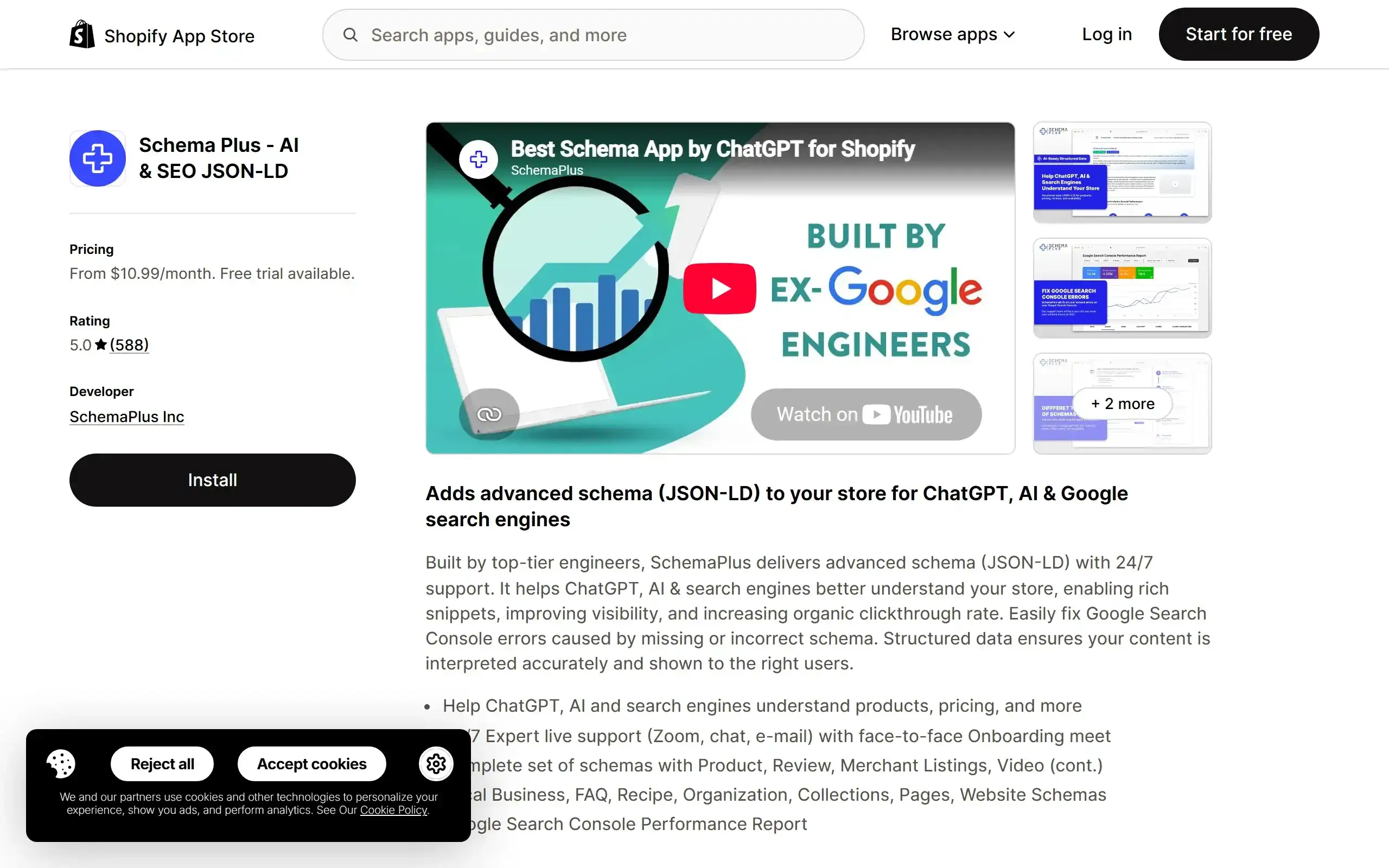
Lite $10.99/mo for up to 5 schemas, Essential $20.99/mo for up to 250, Premium $34.99/mo unlimited, all with a 14-day trial. Rated 5.0 across 588 reviews. Handles product, review, FAQ, and recipe JSON-LD, and integrates with the usual review apps so ratings render in the results.
One job, done properly. If Search Console is reporting invalid product markup or your star ratings stopped rendering after a theme update, this is a faster fix than editing Liquid, and the review-app integrations mean the ratings actually populate instead of sitting empty. Rich results earn clicks at the same position, which is the cheapest kind of traffic gain there is.
Check first whether you need it. Modern Shopify themes and every suite at numbers three through six on this page already emit product schema, so buying a dedicated schema app on top is a good way to end up with two competing JSON-LD blocks and a new Search Console error. Run the Rich Results Test before you install anything. Schema also does not lift a page that is not otherwise competitive: it changes how a result looks, not whether it ranks, which is the same reason we treat markup as table stakes on the AI search visibility side rather than as the play itself.
Duplicates schema your theme or your all-in-one app may already emit, which creates errors rather than fixing them. Test before installing.
Plug in SEO
Owners who want the problem list explained rather than silently fixed.
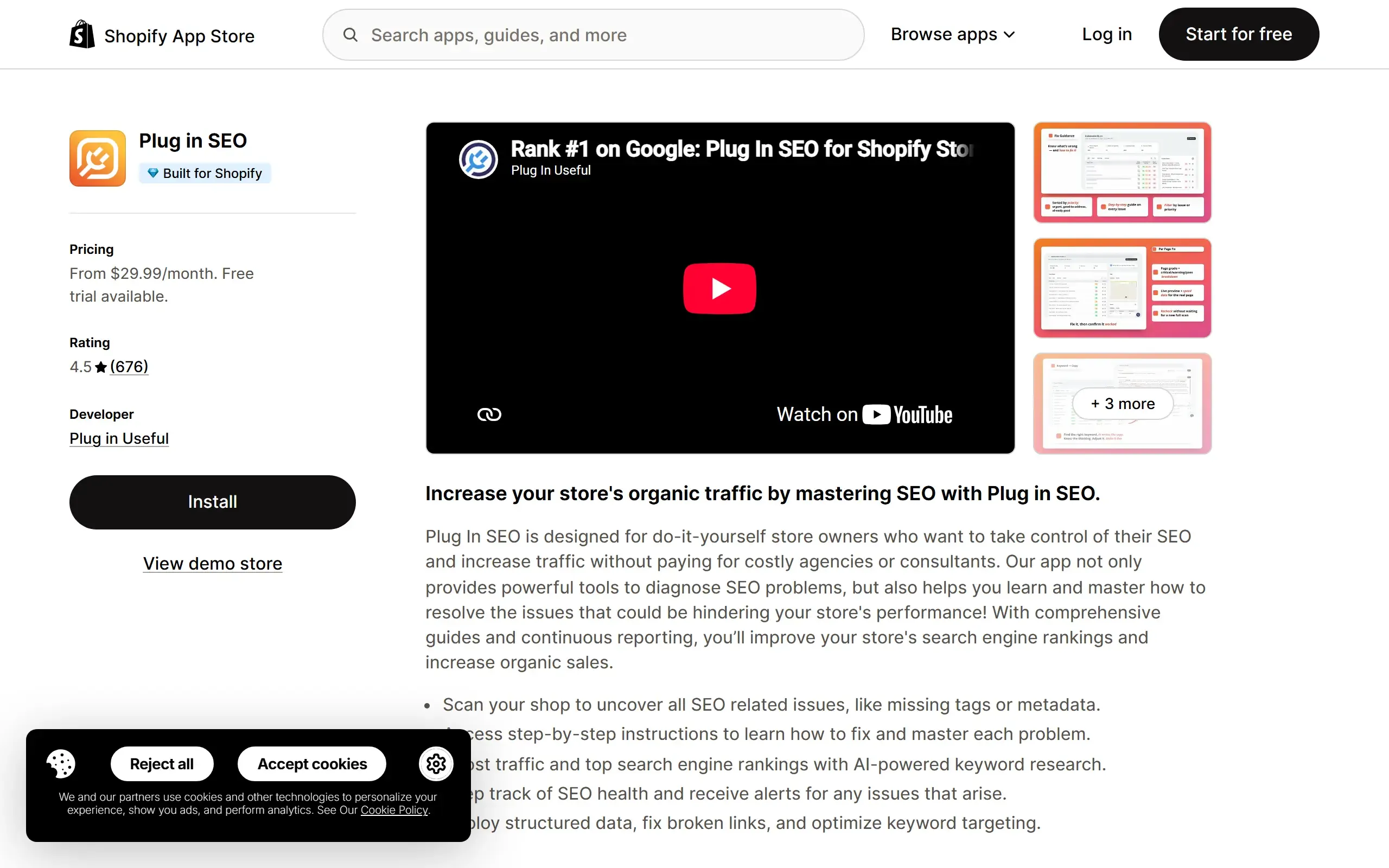
Lite $29.99/mo scanning up to 200 pages, Standard $49.99/mo, Premium $79.99/mo with unlimited scanning, all with a 7-day trial and no free plan. Rated 4.5 across 676 reviews. Runs monthly audits, AI keyword analysis, structured data deployment, and broken-link detection.
The teaching tool of the group. It scans, then explains each problem in plain language with what to do about it, which is the opposite of the autopilot approach and the right call for anyone who wants to understand their own store. The keyword research included at this price is a reasonable bonus for a merchant who is not going to buy a research platform on top.
The pricing is hard to defend against this field. $29.99 is the entry point with no free tier, while Avada and SearchPie hand you a working free plan and Smart SEO covers the same scanning ground at half the price. The 4.5 rating is the second-lowest here. Buy it if the explanations are what you are paying for; if you want the diagnosis without the subscription, an outsourced SEO service is the honest alternative at this price point.
The most expensive entry price on the list with no free tier, in a category where free tiers are normal. Diagnoses rather than fixes.
The App Store is a filter for installability, not usefulness.
An app has to run inside the Shopify admin, which is a good fit for anything that edits store data (metadata, images, schema, redirects) and a bad fit for anything that does not. Keyword research platforms, rank trackers, log-file analysers, and content pipelines all live outside the App Store because they have no reason to be inside it. If you shortlist by browsing the SEO category, you will find ten apps that fix fields and none that decide what to publish.
Two categories matter for a store. Research tools tell you which queries your catalogue could realistically win, which is the half of the job Shopify itself gives you no data for. Production tools turn those queries into published pages, which is the half every app on this list stops short of. The App Store apps that do try it, blog builders and AI blog writers, get their own Shopify blog apps roundup. Google Search Console covers a surprising amount of the first job for free once you have enough impressions to read, and it is the first thing to connect on any store.
Our own position in that second category is the reason we appear on a page about apps at all. The pipeline researches against live search data, drafts with citations, checks every claim against its sources, and publishes into the store blog with internal links already placed, at one flat monthly price rather than a per-product tier. The full mechanics, including how the Shopify connection works, are on the automation overview and in our roundup of the wider AI SEO tool category.
Fix the store once. Then publish something.
The failure mode in this category is treating app installs as an SEO programme. A merchant installs four apps, watches an optimization score go from 62 to 94, and gets no more traffic than they had in January, because the score measured whether the existing pages were tidy and traffic depends on whether the right pages exist. Technical work has a ceiling and most stores hit it in a weekend. That weekend, screen by screen, is our Shopify admin SEO checklist.
Sequence it accordingly. Install one technical app, clear the audit, compress the images, fix the schema, and then stop buying apps. Everything after that is a publishing problem: which questions your buyers ask before they buy, and whether anything on your domain answers them. That is a cadence question rather than a tooling one, which is what our SEO agent is built to remove from your week, and how it compares to the rest of the automation field is set out in the automation tools comparison.
Ten apps, seven jobs, one gap each.
| FEATURE | THE SEO AGENT | YOAST SEO | BOOSTER AI SEO + AEO OPTIMIZER | AVADA AI SEO IMAGE OPTIMIZER | SEARCHPIE: SEO, SPEED & SCHEMA | TINY SEO SPEED IMAGE OPTIMIZER | SMART SEO AI & IMAGE OPTIMIZER | STORESEO SEO & IMAGE OPTIMIZER | SCHEMA PLUS | PLUG IN SEO |
|---|---|---|---|---|---|---|---|---|---|---|
| Shopify App Store listing | ||||||||||
| Free plan | Install free | |||||||||
| Entry price | $99/mo per store | $19/mo | $39/mo | $34.95/mo | $39/mo | $14/mo | $14.99/mo | $14.99/mo | $10.99/mo | $29.99/mo |
| Writes full articles | Basic | |||||||||
| Publishes into the store blog | ||||||||||
| Bulk meta tags and alt text | Manual | Suggests | ||||||||
| Image compression and speed | Premium tier | |||||||||
| Structured data | ||||||||||
| Keyword research included |
What is the best Shopify SEO app?
It depends which job you are buying, because the category is five different products under one name. For hands-off technical cleanup, Booster at $39 a month has the largest review base at 4.8 across 5,475 reviews. For the best free tier, Avada gives you 100 image optimizations and 20 audits at no cost. For the widest technical coverage in one app, SearchPie at $39. For image weight and page speed alone, TinyIMG at $14. For on-page coaching while you write, Yoast at $19. None of them write your articles, which is the job we do at $99 a month per store.
How did you rank these ten?
Not best to worst. They are grouped by the job each app does for a store: content first, then on-page coaching, then the autopilot suites, then images and speed, then bulk metadata, then schema, then audits. Within a group we ordered by fit for a store under a thousand products. Every price and review count on this page was read off the app listing in September 2026.
Are you a Shopify SEO app?
No, and it would be dishonest to imply otherwise on a page about App Store apps. We are a content pipeline that connects to your store and publishes finished articles into the Shopify blog. There is no App Store listing, no one-click install from the store admin, and no App Store review count to check. What you get instead is the job none of the ten apps do, which is researching and writing the pages that rank.
Do I need more than one Shopify SEO app?
Usually two is the right answer and four is too many. One technical app covering images, metadata, and schema (Booster, Avada, or SearchPie) plus something producing content is the whole stack for most stores. Installing three overlapping suites gives you duplicate JSON-LD, competing theme scripts, and a Search Console full of errors that none of the apps caused on their own.
Are free Shopify SEO apps good enough?
For a new store with under fifty products, yes, for a while. Avada gives you 100 image optimizations and 20 audits free, Smart SEO gives you 50 image optimizations and 20 AI generations, and TinyIMG is free to install with 50 optimizations a month. The free tiers are metered on the exact features you use most, so they run out around the point your catalogue starts to matter. That is the business model, not a trick.
Will a Shopify SEO app get my store ranking?
It will remove the reasons your store cannot rank, which is not the same thing. Compressed images, valid schema, filled meta fields, and no broken links are the baseline every competitor already has. Ranking comes from having pages that answer what people search, and a product page answers a buying query, not a research one. That gap is why store blogs exist and why an empty one is the most common SEO problem we see.
What about Shopify SEO tools that are not App Store apps?
Research platforms and content pipelines mostly sit outside the App Store because they do not need to run inside the store admin. Rank trackers, keyword tools, and writing pipelines connect through an API or a login instead. Restricting a shortlist to App Store listings filters for installability rather than usefulness, which is how a store ends up with six technical apps and no content plan.
Is this list sponsored?
No. No affiliate links, no paid placements, and no outbound links to the apps listed: the screenshots of each App Store listing are the evidence instead. We build the product at number one and it is labelled plainly, including the fact that it is not an App Store app at all. The entry names what the apps below it do better than we do, and the summary matrix marks those rows as losses.
Related guides + features.
Shopify SEO tool
Research, cited drafting, a check on every claim, and native publishing into your Shopify blog, which is the one job the App Store apps leave open.
/features/shopify-seo-tool →DONE-FOR-YOU · SHOPIFYShopify SEO services
The store retainer run as software: keywords validated against live data, articles written and checked, published straight into the store. $99/mo instead of an agency.
/features/shopify-seo-services →PILLAR · SEO AUTOMATIONSEO automation
The full pipeline: research, drafting, a check on every claim, and native publish. Where these tools stop, the agent ships the page.
/features/seo-automation →Put your Shopify blog on autopilot.
Connect your store and the agent researches keywords against live search data, writes a cited article, checks every claim against its sources, and publishes it into your Shopify blog. $99 a month per store, free trial first, cancel in one click.
FREE TRIAL · CANCEL IN ONE CLICK