Answer engine optimization: the 2026 guide.
When an AI summary appears on a Google results page, clicks on regular results drop from 15% of visits to 8%. The traffic is not disappearing into nothing: it is being answered, by engines that quote two or three sources and ignore everyone else. This guide covers how those sources get picked, the on-page levers with measured effect sizes behind them, and the content shapes that win citations. Every number in it has a named source, which is also lesson one.
What is answer engine optimization (AEO)?
Answer engine optimization (AEO) is the practice of structuring content so AI systems like ChatGPT, Perplexity, Gemini, and Google AI Overviews cite it when they answer a question. The measured levers: lead with a direct, quotable answer; attach statistics and named sources (each lifted visibility 25 to 28 percent in the Princeton GEO benchmark); keep entity naming consistent; add FAQ and article schema; publish and refresh on a cadence. AEO extends SEO rather than replacing it, because answer engines pull heavily from pages that already rank.
The SEO Agent writes every article answer-first with a cited source for each claim, and publishes one to your site each day. Enter your site to start.
Free trial · Cancel in one click- 01What AEO is, and what it is not.
- 02The numbers behind the shift.
- 03How answer engines actually pick their sources.
- 04The five on-page levers, with effect sizes.
- 05The content shapes that win citations.
- 06Off-page AEO: being named in answers you did not write.
- 07Measuring it without fooling yourself.
- 08A worked example: one paragraph, rebuilt to be cited.
- 09Common mistakes that keep content uncited.
1. What AEO is, and what it is not.
Answer engine optimization is optimizing for the answer, not the list. Classic SEO competes for a position among ten blue links and wins a click. AEO competes for a place inside the synthesized response that ChatGPT, Perplexity, Gemini, or a Google AI Overview gives the user directly, and wins a citation: your page named, linked, or quoted as the source.
The field has four names for roughly one practice. AEO is the oldest, inherited from featured-snippet and voice-search optimization. GEO (generative engine optimization) comes from a 2023 academic paper by researchers at Princeton, Georgia Tech, and the Allen Institute that benchmarked the techniques. LLM SEO and AI search optimization are the practitioner labels. The vocabulary matters less than the shift it describes: the reader you are formatting for is increasingly a model deciding what to quote, not a human deciding what to click. If you are weighing the two disciplines against each other rather than stacking them, our breakdown of what GEO changes and what classic SEO still carries sets out the split line by line, and our guide to generative engine optimization covers how the engines choose which sources to quote.
What AEO is not: a replacement for SEO. Answer engines discover content through search indexes, and Google AI Overviews are assembled substantially from pages that already rank. A site that cannot get indexed and ranked cannot get cited either. Think of AEO as a second scoring function applied to the same pages your SEO pipeline already produces, not a separate channel with separate content.
2. The numbers behind the shift.
Four measured findings define the problem AEO exists to solve.
Clicks halve under AI summaries. Pew Research Center tracked 68,879 real Google searches by 900 US adults in March 2025: users clicked a traditional result on 8% of visits when an AI summary appeared, versus 15% when it did not, and clicked a source cited inside the summary just 1% of the time (Pew Research Center, 2025).
Position one is losing its payout. Ahrefs compared Search Console CTR across 300,000 keywords and measured a 58% lower average click-through for the top organic result when an AI Overview is present, up from a 34.5% reduction in its first study a few months earlier (Ahrefs, 2025).
Most searches now end without a click. Clickstream analysis puts zero-click Google searches at 68% in early 2026, up from 60% in 2024; of every 1,000 US searches, roughly 276 clicks reach the open web (SparkToro, 2026).
The answering surface keeps growing. One major tracker measured AI Overviews on roughly 48% of its tracked queries by early 2026, up from 30% a year earlier (BrightEdge, 2026), ChatGPT passed 900 million weekly users in February 2026 (TechCrunch, 2026), and Gartner projected traditional search volume down 25% by 2026 as chat assistants absorb queries (Gartner, 2024).
Read together: informational clicks are structurally declining, and the value that used to live in position one is migrating into the citation. Being quoted inside the answer keeps your brand in front of buyers even on the searches that never send a click. We explain the dates and scope of selected findings in our AI search statistics with linked sources if you need citeable numbers with sources.
3. How answer engines actually pick their sources.
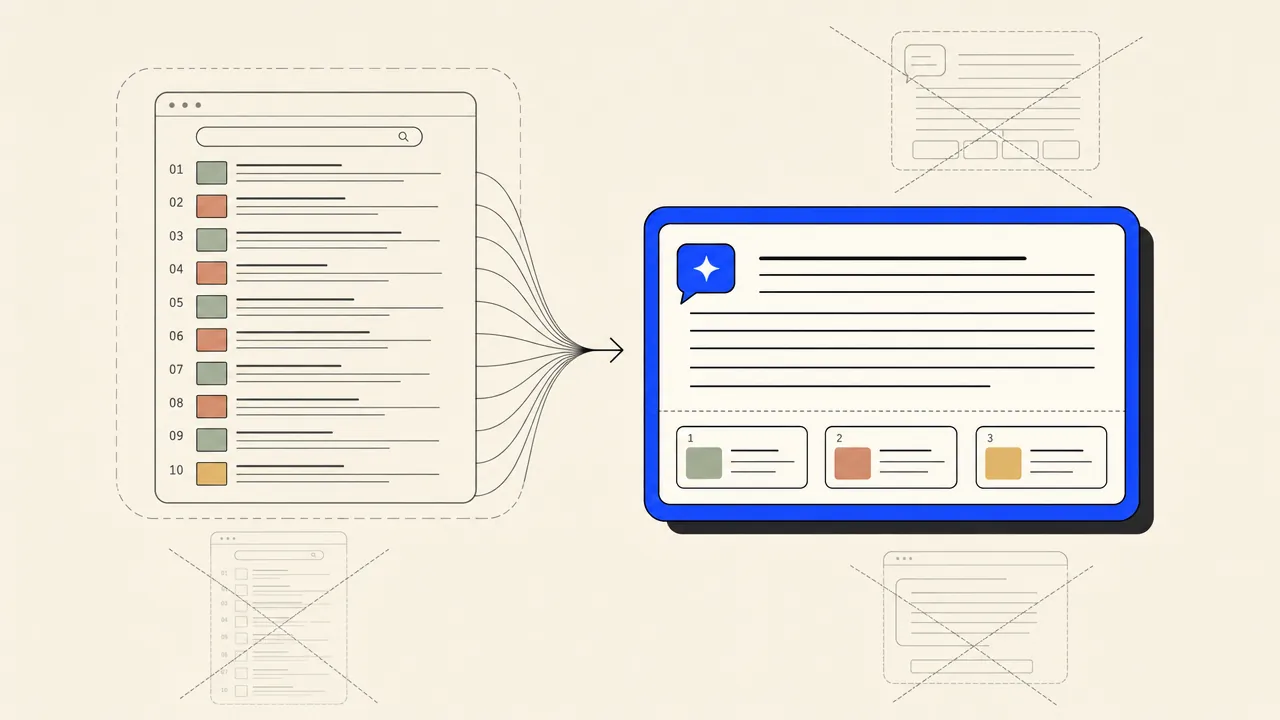
Every consumer answer engine runs some version of the same loop: retrieve a set of candidate documents for the query, then synthesize an answer from the ones the model judges most useful, citing a handful. Two gates, two different games.
The retrieval gate is mostly classic search. Google AI Overviews draw on Google rankings, and AI Mode, the chat tab sitting beside them, fans one question out into several background searches before it retrieves at all. Perplexity and ChatGPT search run live web queries against search indexes, and the same retrieve-then-synthesize loop shows up on the non-Google surfaces covered in our guide to being findable on every search surface. If your page does not surface for the query in some index, no on-page formatting can save it, which is why indexing hygiene, internal linking, and the rest of the conventional playbook still gate everything. It is also why a steady stream of targeted pages beats sporadic hero posts: coverage decides how many retrieval sets you appear in at all. That volume problem is what an AI SEO agent exists to solve.
The selection gate is where AEO earns its name. Among retrieved candidates, the model quotes what is easy to quote and defensible to repeat. The GEO benchmark paper tested nine optimization techniques across 10,000 queries and found content-level evidence changes moved visibility most: adding quotations lifted it about 28%, adding statistics about 26%, and citing sources about 25%, while keyword stuffing, the reflex most teams reach for, was the weakest technique tested. The paper's headline: the right optimizations boost generative-engine visibility up to 40%.
4. The five on-page levers, with effect sizes.
Ordered by measured or observed impact, highest first.
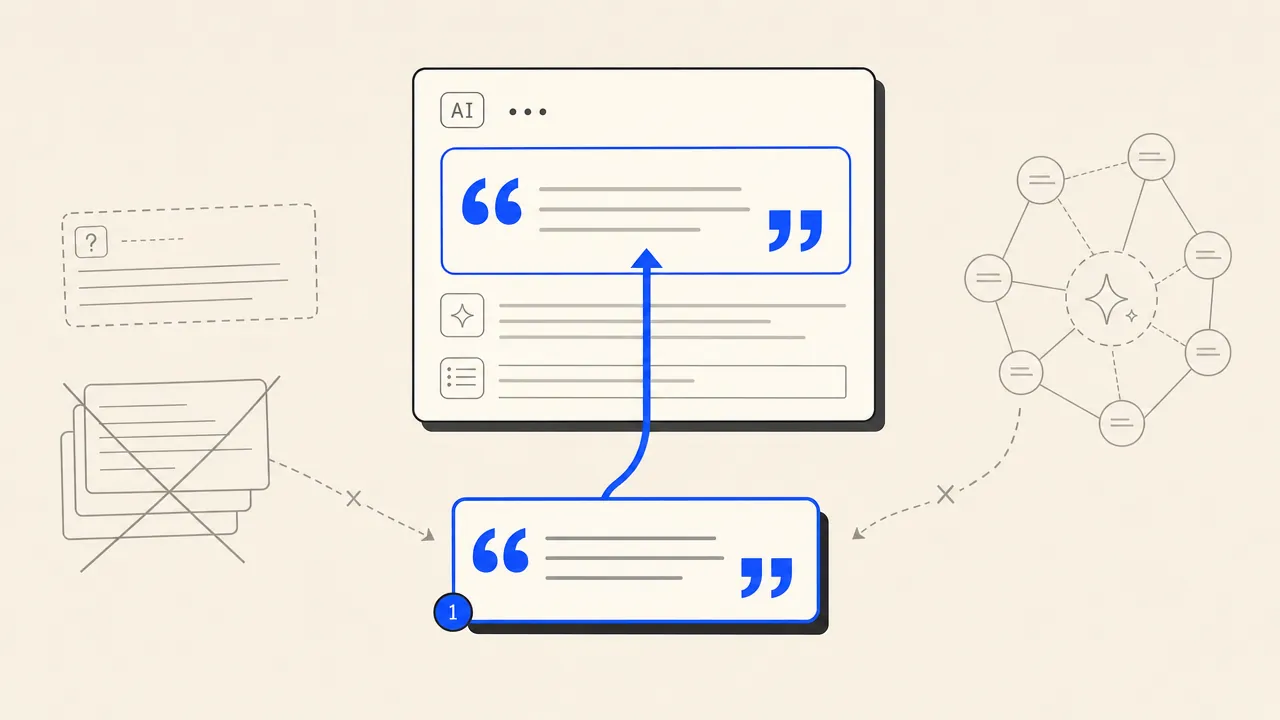
1. A quotable answer block at the top.
Open every page with 40 to 80 words that answer the target question directly: the entity named, one specific number, zero throat-clearing. This is the unit an engine lifts. If a stranger could not paste your first paragraph as a complete answer, neither can a model. Our answer engine optimization agent drafts that block first and builds the rest of the page around it, and AEO services covers what that costs against hiring the work out.
2. Statistics and quotations with named sources.
The three strongest techniques in the GEO benchmark, worth roughly 25 to 28% visibility each. A claim with a number and a source survives into answers; "industry-leading" does not. This is mechanical enough to automate: our pipeline runs a fact-check pass that attaches citations to every defensible claim before anything publishes.
3. Consistent entity naming.
Models resolve entities across documents. A brand that appears as three different names in five formats reads as three weak entities instead of one strong one. Pick canonical names for your brand, product, and category, and use them verbatim everywhere: your site, your bios, the directories and lists that mention you.
4. Structure machines can parse.
Question-shaped H2s, short sections, FAQ and article schema, tables for comparisons, and real server-rendered HTML. None of it substitutes for evidence, but every parsing failure is a silent disqualification. AI crawlers largely do not execute JavaScript, so client-rendered content is invisible to several engines at once. A root-level llms.txt file is not on this list: our guide to how llms.txt works covers what it does and why Google Search ignores it.
5. Freshness, maintained.
Engines answering live queries prefer sources that look maintained: dated updates, current-year figures, active publishing. A page refreshed quarterly with a visible last-updated date keeps citations that a 2023 post quietly loses. Cadence is the cheapest moat here, and it is exactly what a $99-a-month daily pipeline buys.
5. The content shapes that win citations.
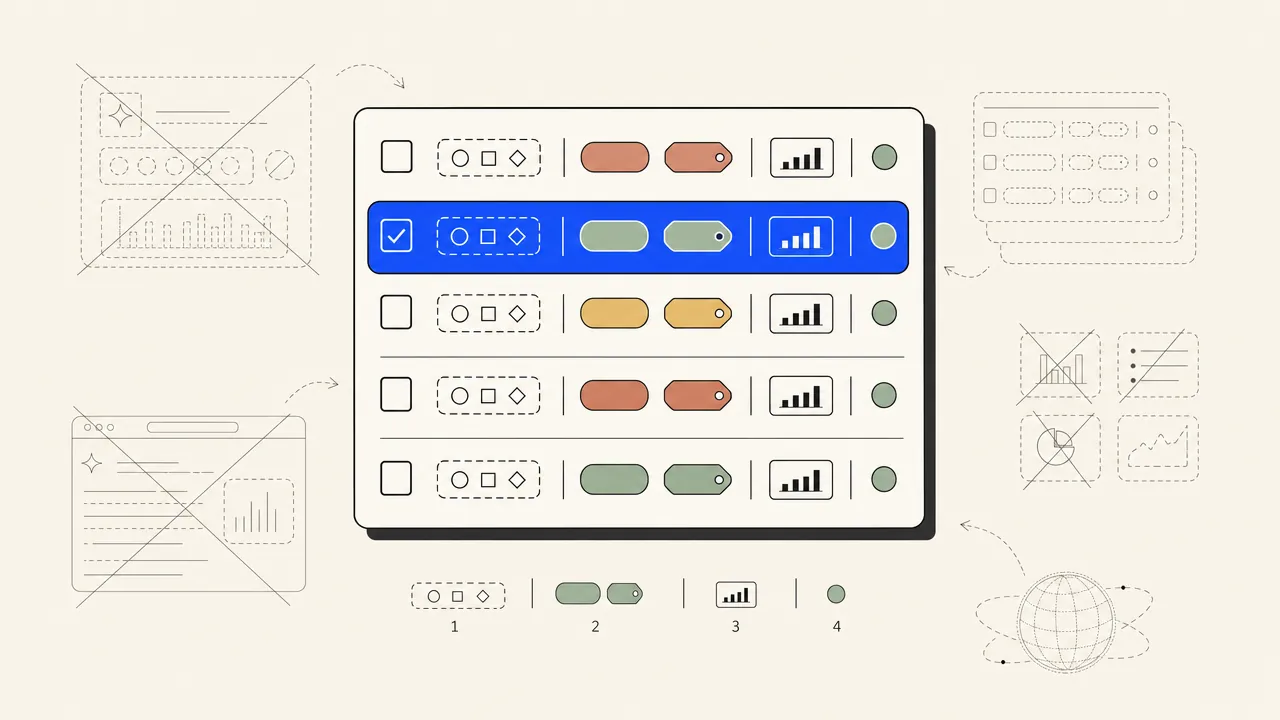
Format is not neutral. A study of 768,000 citations across ChatGPT, Google AI Overviews, and Perplexity found product-focused content (best-of lists, vendor comparisons, head-to-heads, product pages) earned 46 to 70% of all citations depending on funnel stage, peaking above 70% for bottom-of-funnel queries. Conventional blog posts took 3 to 6% (Xfunnel study, via Search Engine Journal).
The practical shapes, in rough priority order for a commercial site: ranked comparison lists with explicit criteria (the shape our GEO tools roundup and best AI SEO tools list use), head-to-head comparisons, definitional guides that own a question the way this page targets "what is AEO", statistics roundups that other writers and models cite as a data source, and FAQ-dense product pages. Producing those shapes on a weekly cadence is the job we hand to an agent built for generative engine optimization.
One page per question is the operating rule. Ten questions answered on one sprawling page compete badly against ten focused pages, both at retrieval (each page matches its query cleanly) and at selection (each page has one quotable answer at the top). This is the same logic that makes programmatic SEO work, applied to answers instead of rankings.
6. Off-page AEO: being named in answers you did not write.
When someone asks an assistant "what is the best X", the engine does not read your homepage and take your word for it. It reads the comparison content in its retrieval set: listicles, review roundups, community threads, directories. If your brand is absent from the documents the engine trusts for that question, you are absent from the answer, whatever your own site says.
Off-page AEO is therefore a presence campaign: get your brand named, consistently and accurately, in the third-party content that answers category questions. Directories with real editorial standards, credible best-of lists, comparison reviews, and active community discussion all feed answer sets. The same factual claims repeated across many surfaces compound, because models weight corroboration: three independent documents agreeing on what your product does beats one loud one.
This is slower and less controllable than on-page work, which is why the order matters: build the citable owned coverage first, then push the same canonical claims outward. A brand with thirty question-answering pages and consistent entity naming gives every third-party writer, and every model, the same story to repeat.
7. Measuring it without fooling yourself.
Three measurement layers, cheapest first. First, referral traffic: visits from chatgpt.com, perplexity.ai, gemini.google.com, and copilot.microsoft.com show up in any analytics tool today. Volumes are small but the intent is unusually high; a visitor who arrives from an AI answer has already been pitched.
Second, manual spot checks: ask the major assistants the ten questions you most want to win, monthly, and log who gets cited. Our comparison of the top AI search engines is a reasonable shortlist of which ones to check. It is unglamorous and it works. Third, paid visibility trackers that run those prompts at scale and trend your share of mentions against competitors. They range from free graders to enterprise platforms; our ranked GEO tools list covers which tier is worth paying for at which stage, and our roundup of AI visibility tracking tools compares the monitoring platforms on prompt coverage and price. For the tools that work the production side of this page rather than the measurement side, see our ranked answer engine optimization tools. For the narrower LLM-search category, compare LLM SEO tools first, then use the LLM SEO workflow for the production process. The honest sequencing: if you have fewer than about thirty citable pages, skip the tracker and spend the budget on coverage, because the dashboard will only confirm you are invisible.
8. A worked example: one paragraph, rebuilt to be cited.
Take a SaaS company answering "how much does SEO automation cost?" Here is the paragraph most sites publish:
"SEO automation pricing can vary widely depending on your needs. There are many factors to consider, from the size of your website to the features you require. Some tools are affordable while others are enterprise-grade investments. It is important to do your research and choose a solution that fits your budget and goals."
Ninety words, zero information. No engine can quote it because it contains nothing to quote: no number, no entity, no claim that survives being repeated. Here is the rebuilt version:
"SEO automation tools cost between $99 and $2,500 per month in 2026. Entry-level autobloggers charge per article, typically $5 to $20 each. Flat-fee platforms like TheSEOAgent run the full loop (keyword research, fact-checked drafting, quality gate, CMS publishing) at $99 per month for daily articles. Enterprise suites with dedicated support start around $500 per month and climb past $2,500 for agency tiers."
Same topic, seventy words, four liftable facts. Notice what changed: concrete price bands an engine can repeat, named tiers, a canonical brand entity in a defined category, and a structure that answers the question in the first sentence with detail behind it. Every technique from section 4 is present, and none of it required writing talent, just discipline. That discipline is precisely what we automated: every article our agent ships opens with the citable version, because the pipeline refuses the vague one.
9. Common mistakes that keep content uncited.
1. Optimizing keywords instead of claims.
Keyword stuffing was the weakest of the nine techniques in the GEO benchmark, and teams still default to it because it is what old tooling rewards. Engines quote claims, not keyword densities. Budget your effort into evidence.
2. Burying the answer.
Six hundred words of context before the answer reads as thorough to a writer and as noise to a retrieval system. The answer goes first. The context earns its place after.
3. Publishing unverifiable superlatives.
"The leading platform trusted by thousands" cannot be cited because repeating it would embarrass the model. Numbers with sources are the currency. If a claim has no source, either find one or cut the claim, and treat every figure a chat assistant hands you the same way, as our guide to using ChatGPT for SEO work explains.
4. Shipping JavaScript-only pages.
Several AI crawlers do not execute JavaScript. A client-rendered page can rank in Google and still be an empty shell to the engines. View source on your key pages: if the copy is not in the HTML, fix rendering before touching prose.
5. Buying the dashboard before the coverage.
A visibility tracker pointed at a twenty-page site reports zero and keeps reporting zero. Production first, measurement second. When the coverage exists, the tracker becomes a steering wheel instead of a scoreboard.
What is answer engine optimization in one sentence?
Answer engine optimization (AEO) is the practice of structuring content so AI systems like ChatGPT, Perplexity, Gemini, and Google AI Overviews select it as a cited source when they answer a question, instead of only competing for a ranked blue link.
Is AEO the same as GEO?
Effectively yes. AEO (answer engine optimization), GEO (generative engine optimization), LLM SEO, and AI search optimization all describe optimizing for AI-generated answers. GEO comes from a 2023 academic paper and leans toward chat assistants; AEO is older and also covers featured snippets and voice answers. The techniques overlap almost completely: direct answers, cited statistics, named entities, structured data, freshness.
Does AEO replace SEO?
No. Answer engines pull heavily from pages that already rank in classic search, so SEO remains the admission ticket. AEO changes what you optimize on the page once it can rank: quotable answer blocks, verifiable claims, and clean structure matter more, while click-optimized titles matter less because the engine, not the human, is doing the reading.
How long does answer engine optimization take to work?
Faster than classic SEO in the best case. Perplexity and ChatGPT search read the live web, so a well-structured page on an indexable site can be cited within days. Google AI Overviews roughly track normal ranking timelines. Broad presence across a topic takes months because it is a coverage problem: one citable page per question your buyers ask.
Do FAQ schema and structured data actually matter for AEO?
They help and they are cheap, but they are not the main lever. The measured winners in the Princeton GEO study were content-level changes: adding quotations, statistics, and cited sources lifted visibility roughly 25 to 28 percent, while keyword stuffing was the weakest tactic tested. Schema makes parsing easier; evidence makes selection likelier. Do both.
Can you pay to be cited by ChatGPT or Perplexity?
No answer engine currently sells citation placement in its organic answers. Perplexity runs ads adjacent to answers and ChatGPT has begun testing shopping ads, but the cited sources themselves are selected by retrieval, not auction. The only reliable route is publishing content the engines find, trust, and quote.
What content formats do AI engines cite most?
Comparison and best-of content dominates. A 768,000-citation study across ChatGPT, Google AI Overviews, and Perplexity found product-focused content (best-of lists, vendor comparisons, product pages) made up 46 to 70 percent of citations depending on funnel stage, while conventional blog posts earned only 3 to 6 percent. Ranked lists with clear criteria are the single most liftable shape.
Do I need different pages for ChatGPT, Perplexity, and Google AI Overviews?
No. The engines reward the same substance: a direct answer, evidence with named sources, consistent entity naming, and a page that renders as plain HTML. One well-built page surfaces across all of them. Where they differ is discovery (Perplexity and ChatGPT search lean on live web indexes, AI Overviews on Google rankings), which argues for good indexing hygiene, not per-engine pages.
Related guides + features.
AI search optimization
Quotable answers, cited statistics, entity naming, and schema baked into every article the agent writes, so AI engines have a source to cite.
/features/ai-search-optimization →DATA · AI SEOAI SEO statistics
The numbers behind AI search: adoption, citation rates, and how AI Overviews reshape clicks, sourced and updated for reference.
/stats/ai-seo →PRICINGSimple pricing
$99 flat per month after a free trial. No per-keyword meter, and cancellation is one click in the app.
/pricing →Ship content built to be quoted.
The agent writes one citable, fact-checked article a day: direct answers, sourced statistics, schema in place, published straight to your CMS. Free trial first, $99 a month after, cancel in one click.
FREE TRIAL · CANCEL IN ONE CLICK