Blogi AI autoblogger review: what $6.99 a month buys.
Blogi is a low-cost autoblogger: campaigns, a cron schedule, a menu of writing engines, and auto-posting into WordPress. At the price it charges it is hard to call it bad value. The question worth asking is narrower. What happens between the model finishing the draft and the post appearing on your site, and is anything checking it?
Is the Blogi AI autoblogger worth buying?
Blogi AI is worth buying if you run one or two small WordPress blogs, you want scheduled drafts for $6.99 a month, and you plan to edit every post before it goes live. It generates and schedules well. It does not validate the keyword, cite its claims, or refuse to publish a weak draft. TheSEOAgent costs $99 a month and covers those three steps, which is the whole difference between a drafting tool and a publishing system.
Comparing AI writers? The SEO Agent picks each keyword from live search data, cites a source for every claim and publishes to your CMS every day. Enter your site to start.
Free trial · Cancel in one click1. What Blogi AI is, and what it costs.

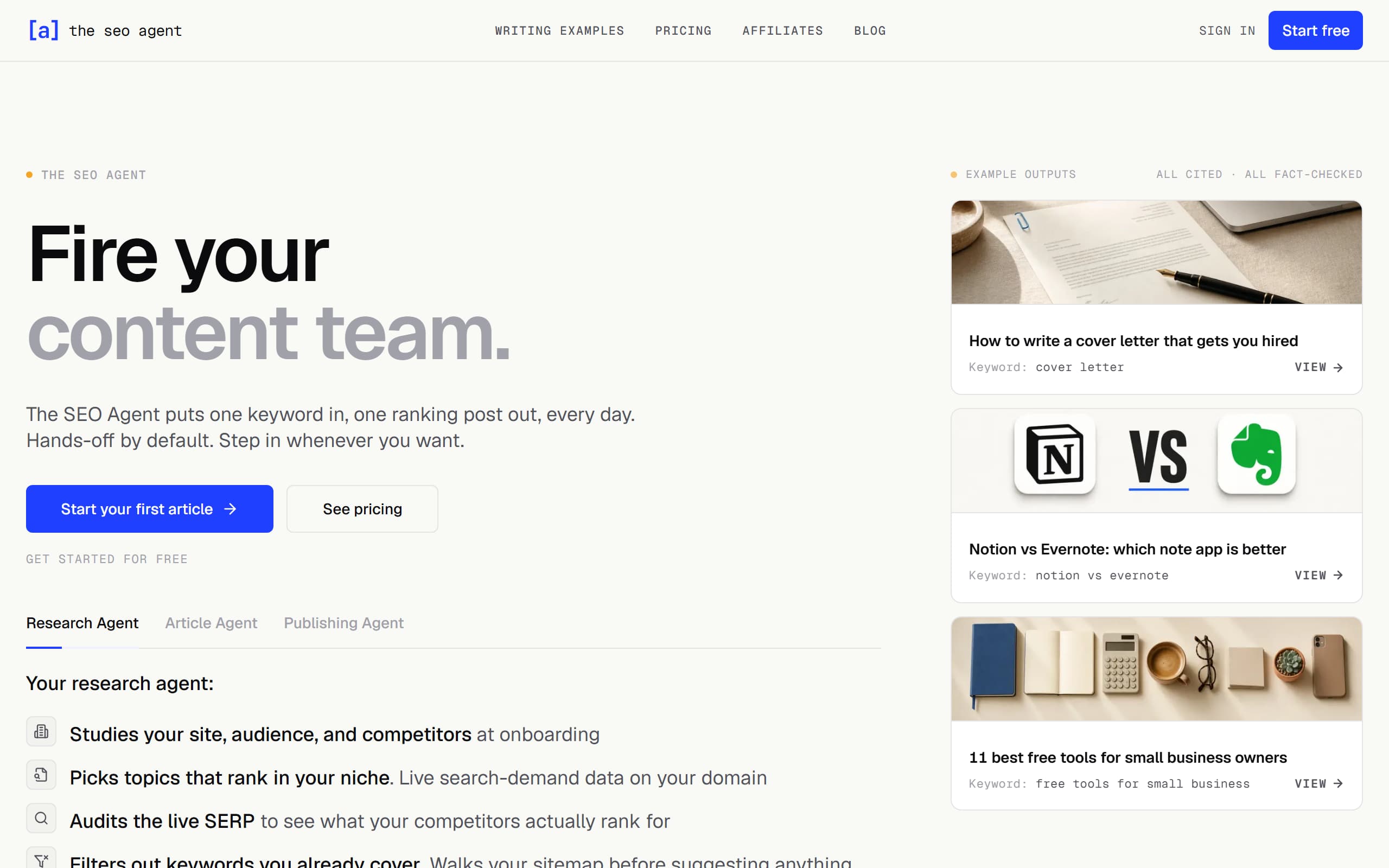
Blogi AI is a campaign-and-cron autoblogger for WordPress, priced at $6.99 a month or $67 a year. It writes, tags and schedules. TheSEOAgent is an autoblogging platform that wraps the same drafting step with keyword validation, citations, internal links, a quality score, and a publish step that can be blocked.
The product model is simple and worth stating plainly, because most reviews of it are not. You create a campaign, hand it topics or keywords, pick a writing engine, set a posting schedule, and the app drafts articles with a headline, meta description, slug, tags and a generated image, then posts them to a connected WordPress blog. There is a manual mode that works like a normal AI writing assistant, and a site-tracking mode that follows other publishers and rewrites what they post.
Pricing is the part buyers get wrong, because the listed prices and the checkout prices are different numbers. Elite Monthly lists at $27 and sells at $6.99 a month: 3,000 writing credits, 3 active campaigns, 10 articles a week, 3 writing engines, personal use licence, aimed at a single blog. Elite Yearly lists at $97 and sells at $67 a year: 10,000 credits, 10 campaigns, 30 articles a week, 7 engines, business use licence. Both carry a 30-day money-back guarantee. The product also circulates through launch funnels with upsell tiers, so the price you find first is rarely the price you end up paying.
For context on where that sits in the category, our auto blogging software roundup covers the same shape of product from $7 up to $150 a month.
2. Where Blogi AI wins.
Reviews of cheap tools tend to be sneering. That is lazy. Blogi does several things well, and the price makes the bar it has to clear very low:
- Price. $6.99 a month is less than one freelance article. If the alternative was an empty blog, this is a real upgrade, and the 30-day guarantee makes the test cheap.
- Scheduling that actually runs. The cron and campaign model is the useful half of autoblogging. Set a cadence, walk away, and posts appear. That is genuinely hard to replicate with a chat window and a calendar reminder.
- Metadata is not an afterthought. Titles, meta descriptions, slugs and tags come out with the draft rather than being left for you to write later.
- Engine choice. Roughly nineteen writing engines sit behind the app. Your plan decides how many you can reach, 3 on monthly and 7 on yearly, but being able to re-run a weak draft on a different engine is a practical lever.
- WordPress publishing works. The connection is the point of the product and it is the platform most small blogs already run. If you want that path done properly at the other end of the market, see WordPress SEO automation.

One caveat on the engine menu, because it is the headline feature everywhere Blogi is sold. Model count is a procurement stat, not a quality stat. Two products calling the same engine can return wildly different articles depending on the brief, whether a research step ran first, and what happens to the draft afterwards. Nineteen engines with no brief is still no brief.
3. Where the workflow breaks down.
The gap in Blogi is not the writing. It is that the schedule runs whether or not the draft deserves to ship. Every check that decides whether a page ranks sits outside the product, which means it sits with you.

- No keyword validation. You supply the topics. Nothing tells you a keyword has 40 searches a month, or that a domain-authority-90 site owns the whole first page. A perfect draft aimed at a dead keyword is still a dead page.
- No citations. Statistics, dates and product claims come out of the model unsourced. On any topic where being wrong is visible, that is the expensive failure mode.
- No gate before publish. A cron schedule pointed at WordPress posts what it was given. There is no score, no threshold, and no mechanism to hold a bad article back.
- Rewriting other publishers is the risky feature. Site tracking, where the app follows other blogs and rewrites their posts, is the one capability we would leave switched off. Rewritten third-party content published on a schedule with nothing added is the scaled-content pattern search engines built policies to demote.
- Credits are the real ceiling. 3,000 credits and 10 articles a week on the entry plan is a hard cap, and credits are consumed by regenerating weak drafts too. The tools that look cheapest are often the ones you re-run most.
- One publishing target. Auto-posting means WordPress. Anything else is copy and paste, which quietly deletes the automation you paid for.
None of this makes Blogi a bad purchase at $6.99. It makes it a drafting tool with a scheduler attached. Our ranked list of SEO automation tools weights pre-publish checks heavily for exactly this reason.
4. Blogi AI vs TheSEOAgent.
These are not the same product at different prices. Blogi sells drafts on a schedule for the price of a coffee. TheSEOAgent sells finished pages, and the $99 covers the research, checking and publishing steps that Blogi leaves to you.

| FEATURE | BLOGI AI | THESEOAGENT |
|---|---|---|
| Entry price | $6.99 a month, or $67 a year | $99 a month flat after a free trial |
| Product shape | Campaign scheduler wrapped around an AI writer | Publishing pipeline with gates around the writer |
| Keyword selection | You supply the keywords or track another site | Live search data validates the keyword before a brief exists |
| Fact checking | Not part of the workflow | Citation-backed pass before publish |
| Quality gate | Cron posts whatever the model returned | Score-based gate that can refuse a weak draft |
| Publishing targets | WordPress auto-post, everything else manual | WordPress, Webflow, Shopify, Ghost, Wix, webhook |
| Volume ceiling | 10 articles a week monthly, 30 a week yearly | Daily cadence you set, capped by the gate not by credits |
| Best buying reason | You want scheduled drafts for almost nothing | You want pages that are publishable without an edit pass |
The price gap is real and we are not going to pretend it away. $6.99 against $99 is fourteen times. The question is what a published page costs once your editing time is priced in, and whether the pages that go live are ones you would have approved.
5. The decision matrix.
Two clean cases. Most buyers know within a minute which column they are in.
- Your budget is under $10 a month.
- You run one or two small WordPress blogs.
- You already know which keywords you want.
- You will read and edit every post before it goes live.
- You want scheduling more than you want checking.
- You want the keyword validated before anything is written.
- You need claims cited and internal links placed.
- You want weak drafts blocked, not posted.
- Your CMS is not WordPress.
- Your editing time is worth more than the price difference.
If Blogi is one of several tabs open right now, the Autoblogging.ai review covers the next tier up on article control, and the Byword AI review covers the scale end of the same category.
6. Who should use which tool.
Blogi suits the hobbyist blogger and the side-project operator. One WordPress site, a topic list you trust, an hour a week to edit, and a bill small enough that a bad month costs nothing. Used that way it is a fair purchase and the guarantee covers the downside.
Pick TheSEOAgent when the blog is a business input rather than a hobby. The system chooses the keyword from live search data, writes to a brief with citations, links the article into the pages you already have, scores it, and publishes only what passes. That is the difference between a full SEO automation pipeline and a scheduler with a writer bolted on.

There is also a case for neither. If you publish four posts a year and each one matters, write them. Autoblogging is a volume answer, and volume is only an answer when the pages are worth having.
7. How to test it in an afternoon.
Do not judge either product from its homepage. Both are cheap enough to test properly, and the test takes about two hours:
- Pick three keywords from one cluster on your own site.
- Generate one article per keyword in each product.
- Open each draft and mark every unsupported claim, wrong date and invented statistic in red.
- Count the internal links that point at pages you actually have.
- Time your cleanup pass to publish-ready, per article.
- Multiply that time by thirty posts a month and price it at your hourly rate.
Step six is where the $6.99 plan usually stops looking cheap. If you want to run the strict path against your own keywords, start the free trial and compare the drafts side by side.
Is Blogi AI good for SEO?
Blogi AI is good for the mechanical part of SEO: it drafts a post, fills in a title, meta description, slug and tags, generates an image, and pushes the result to WordPress on a schedule. It does not decide whether the keyword is worth a page, check the claims in the draft, or refuse to publish a weak article. Those are the parts that decide whether the page ranks.
How much does Blogi AI cost?
Two plans, both sold at a discount off the listed price. Elite Monthly lists at $27 and sells at $6.99 a month for 3,000 writing credits, 3 active campaigns, 10 articles a week, 3 AI models and a personal use licence. Elite Yearly lists at $97 and sells at $67 a year for 10,000 credits, 10 campaigns, 30 articles a week, 7 AI models and a business use licence.
What is Blogi AI best for?
It is best for someone running one or a few small WordPress blogs who wants scheduled posts at a near-zero monthly cost and is willing to edit before anything goes live. At $6.99 a month the tool is cheaper than one freelance article, so the honest comparison is against an empty blog, not against a content team.
What is the main weakness of Blogi AI?
There is nothing between generation and publish. A cron schedule pointed at a WordPress site will keep posting on cadence whether the draft is good or not. The credit and article caps limit volume, but nothing in the product limits quality, so the review job stays with you.
Is the Blogi autoblogger safe to run on a real site?
It is safe if you treat it as a drafting tool and read every post before it goes live. It gets risky when you use the site-tracking feature to rewrite other publishers on autopilot. Rewritten third-party content published at scale with no added value is exactly the pattern search engines demote under scaled-content policies.
How many AI models does Blogi AI actually give you?
The model menu runs to roughly nineteen engines, but the plan decides how many you can use: 3 on the monthly plan and 7 on the yearly one. Model count is a procurement number, not a quality number. Two tools calling the same engine can produce very different articles depending on the brief, the research step and the checks that run afterwards.
Where does Blogi AI publish?
Auto-posting targets WordPress. Other platforms are supported through manual copy and paste. If your blog sits on Webflow, Shopify, Ghost, Wix or a headless setup, the automation stops at the draft and you finish the job by hand.
How is TheSEOAgent different from Blogi AI?
TheSEOAgent starts a step earlier and stops a step later. It validates the keyword against live search data before a brief exists, drafts with citations, scores the result, adds internal links, and publishes natively to WordPress, Webflow, Shopify, Ghost, Wix or a webhook only after the draft clears a quality gate. Blogi starts at the draft and ends at the WordPress post.
Should I switch from Blogi AI to TheSEOAgent?
Switch when the editing is costing you more than the software. If you are rewriting most of what Blogi produces, the $6.99 plan is not the cheap option, your own time is the real price. Stay on Blogi if you want scheduled drafts on one small blog and you enjoy the editing pass.
Is Blogi AI better than Autoblogging.ai?
They solve the same problem at different price points. Autoblogging.ai is a dedicated article generator with more control over article types and structure. Blogi is cheaper and leans harder on scheduling and campaigns. Neither one validates the keyword or blocks a weak draft, so the comparison comes down to output quality per edit.
Publish the post only after something has read it.
Start the trial, connect your CMS, and run three of your own keywords through the full pipeline. If the drafts are not cleaner than what you are editing today, cancel in one click.
FREE TRIAL · CITED DRAFTS · QUALITY GATE