TheSEOAgent vs Outrank: which AI SEO tool ships better content.
Both are pitched as the same thing, an AI SEO agent that automates one loop: pick a keyword, draft an article, publish it to your CMS. The difference is in three places almost nobody compares: real keyword data over estimates, a fact-check pass and quality gate before any draft ships, and cancellation that is one click in app rather than an email and a multi-day delay. We compare them below with the table and the three sections that explain why each choice matters.
TheSEOAgent or Outrank in 2026, picked in one sentence.
TheSEOAgent if you want SEO content that ships only after a fact-check pass and quality gate, with live keyword data behind the brief and a one-click cancellation if it does not work. Outrank if you want a longer commercial track record and a larger user community, and you are comfortable with internal-estimate keyword data and email-only cancellation in exchange.
1. What each product is built for.
Both tools sell the same outcome to the same buyer: a founder or content lead who wants daily SEO articles published to their CMS without writing them. The difference is in what the product does between the keyword and the published page. Outrank optimises for speed and dashboard volume. You point it at a topic, it picks an angle, drafts the article, and publishes it. The path from input to output is deliberately short, which is part of why it scaled fast in 2023 to 2024. For the broader autoblogger landscape see our BabyLoveGrowth versus Outrank breakdown. If your shortlist also includes article-generator tools rather than full autopilot platforms, the adjacent reads are our Autoblogging.ai review, Byword AI review, and RightBlogger review.
TheSEOAgent optimises for the trustworthiness of the published artefact. The pipeline runs more steps: live keyword data on every candidate, an outline you can approve before drafting, a fact-check pass that requires citations on every claim, and a scoring gate that refuses to publish drafts below threshold. The path is longer because we chose to put the quality checks before the publish, not after.
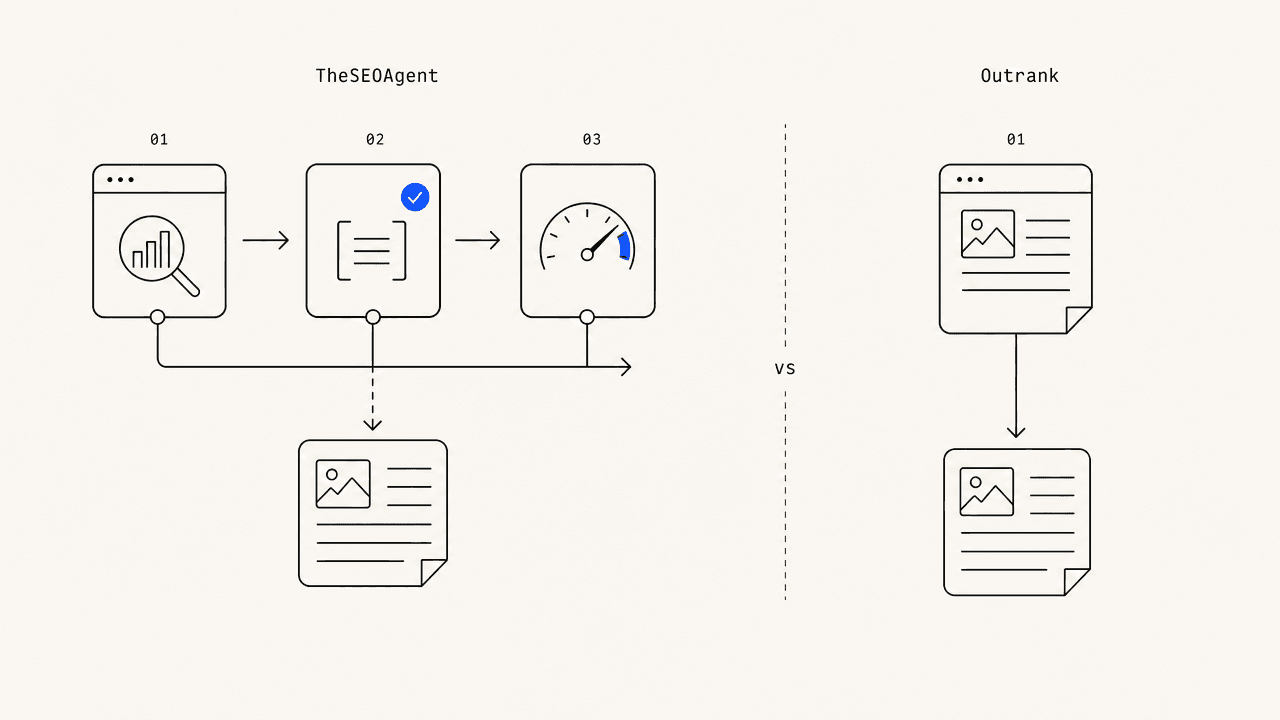
The headline difference: Outrank answers "ship the article fast." TheSEOAgent answers "ship only the article you would not be embarrassed to publish." Both are legitimate product choices. Which one is right for you depends on what your existing review queue looks like and how forgiving your domain is to a middling article.
2. Pricing, side by side.
Both products price competitively at the entry tier; the gap opens as you scale. A good comparison rule: look at the price of producing roughly thirty articles a month, which is the publishing cadence most founders settle into once the automated pipeline is running.
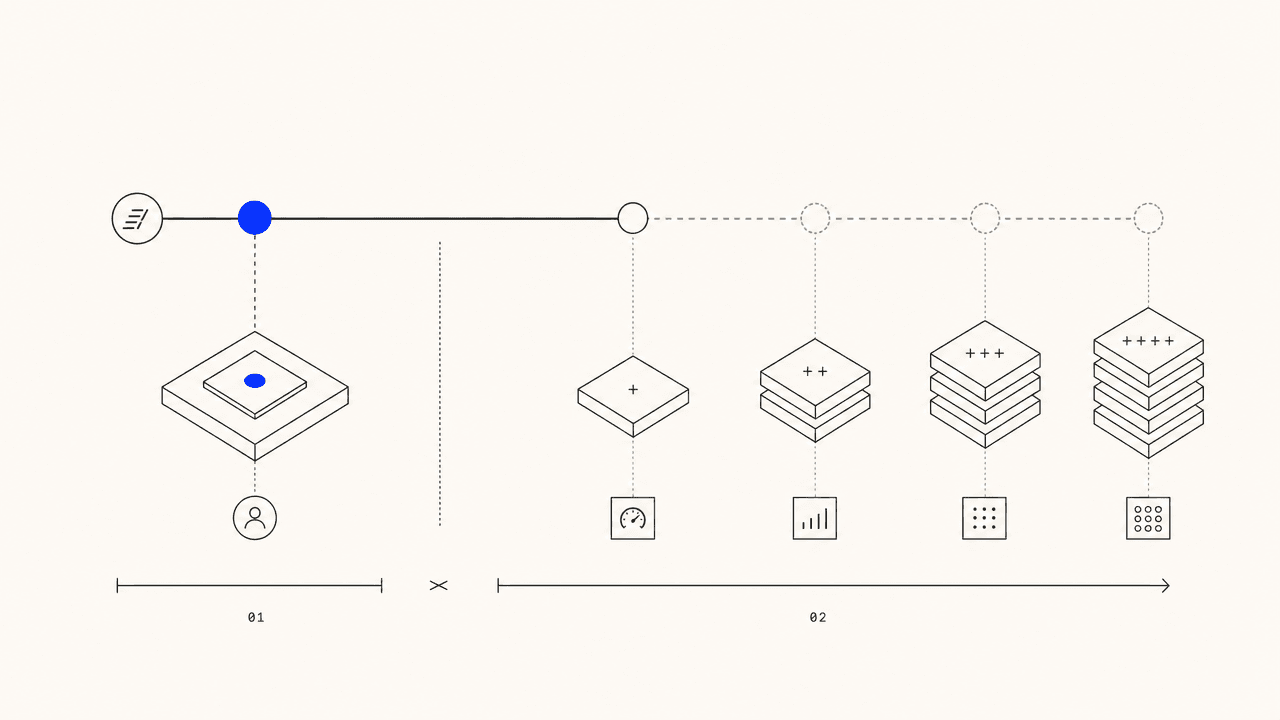
- TheSEOAgent: $99 per month flat, single plan, daily publishing capacity included. No per-keyword, per-article, or token meter. Free trial for three days with full feature access.
- Outrank entry: approximately $59 per month at the lowest tier, scaling up at higher article volumes and longer formats. Free trial of seven days at the entry tier.
- Outrank at volume: the higher tiers add per-article and per-feature unlocks (longer articles, more keywords, additional seats). At thirty articles a month the effective monthly cost is comparable to or higher than our flat $99.
The honest read: at low article volume, Outrank is cheaper. At the volume most customers actually run, the two are within margin of each other and the differentiator is the rest of the product, not the bill. Our pricing page has the full breakdown, and it has not changed since launch.
3. Where Outrank wins.
Three places where Outrank is genuinely the better pick:
- Track record. Outrank shipped in 2023. We launched in late 2025. If your sole evaluation criterion is years-in-market and size of public review corpus, Outrank wins this comparison without further argument.
- Onboarding speed for non-technical users. The Outrank dashboard is fast to click through, and the first article is queued within a few minutes. Ours is also fast, but we add an outline-approval step that trades a small amount of speed for control. If your priority is "something on the site by tomorrow," Outrank is closer to that promise on day one.
- Installed base. More users means more public reviews, more battle-tested integrations, and more discussion on the public forums. We have a smaller community by definition. Some buyers weight that heavily, and they should pick Outrank if they do.
If any of those three are the deciding factor for you, the rest of this article will not change your mind, and you should pick Outrank with our blessing. The remaining sections argue against the case where they are not.
4. Where TheSEOAgent wins.
Four places, in the order we think they matter. None of these are minor product decisions. They are the reason we built a different product instead of joining the one that already existed.
- Live keyword data, not estimates. Every candidate keyword goes through a live volume + SERP fetch before scoring. Estimate-based pipelines can be off by an order of magnitude in the 100 to 1000 monthly-search range, which is precisely the range most founders publish in. Picking the wrong slot is the most expensive mistake in this category, and we built the pipeline to avoid it.
- Fact-check pass with citations. AI writers hallucinate. Statistics get invented. Case studies get attributed to companies that never said the thing. We added a verification stage between draft and publish that requires every factual claim to cite a live source. Drafts that cannot be cited are rejected with a reason. Outrank does not run this stage.
- Quality gate that refuses bad drafts. The single most-cited Outrank complaint among site operators is that low-quality drafts ship and accumulate as a tail of de-indexed pages on the domain. Our gate scores every draft against the brief and the keyword's SERP characteristics, and refuses to publish below threshold. You see the score and the rejection reason; nothing ships silently.
- One-click cancellation. A button on the subscription-management page ends your plan the moment you click it. No retention flow, no email-only path, no three-day delay. The Outrank cancellation flow is the most-cited operational complaint in public reviews, and we picked the opposite default deliberately.
5. Feature by feature, the table.
Skim version. Lean indicators flag the side we believe wins each row. Two rows lean right (Outrank's genuine strengths). Six lean left. Two are even.
| FEATURE | THESEOAGENT | OUTRANK |
|---|---|---|
| Entry pricing | $99/mo flat, single plan | Starts ~$59/mo, climbs at volume |
| Trial | Free trial, full feature access | 7-day free trial |
| Keyword data | Live volume + SERP scrape per candidate | Internal volume estimates |
| Fact-check pass | Required, with citations on every claim | Not part of the pipeline |
| Pre-flight quality gate | Score-based, refuses bad drafts before publish | No gate, all drafts ship |
| Outline approval | Optional. Review the brief before drafting | Approve full draft only |
| Native CMS publish | WordPress, Webflow, Shopify, Ghost | WordPress, Webflow, Shopify, Ghost |
| Cancellation | One click in-app, instant | Email support, multi-day delay |
| Affiliate program | 30% recurring via Rewardful, transparent terms | Reportedly retroactive nukes during 2024-25 |
| Track record | Late 2025 launch | 2023 launch, larger installed base |
6. How to switch, if you decide to.
The switch is a fresh setup, not a data migration. Past Outrank articles stay on your CMS where they were published; the only thing changing is who drafts and ships the next article.
- Cancel Outrank. Email their support; expect a few days before the subscription actually ends. Take a screenshot of the request in case you need to dispute a later charge with your bank.
- Sign up to TheSEOAgent. A free trial covers three full days, enough to ship two or three articles and read them next to the last few Outrank outputs. The signup flow is the standard email + magic link.
- Reconnect your CMS integration. WordPress via our plugin (we mint a 64-char token, no Application Password needed); Webflow, Shopify, and Ghost via the API token from your CMS. The reconnection is a one-time 10-minute setup.
- Pick three keywords from your existing queue. If you have an Outrank backlog, the easiest first comparison is to run the same three keywords through both tools in parallel and read the outputs next to each other. If your call is not clear at three articles, run three more.
- Decide. If our drafts read better than the Outrank ones at your site's editorial bar, keep us and let the trial roll into the $99 plan. If they do not, our cancellation is one click and the trial charge is the only thing you spent.
7. How to pick, in three questions.
If you are still on the fence after the table and the four-reasons section, three questions usually settle it. If two or three answers go the same way, you have your tool. If you are still comparing several automated publishing products, compare BabyLoveGrowth alternatives for a broader shortlist before deciding.
- Is your domain forgiving to a middling article? A new site with no rankings to lose can absorb a few weak drafts. An established domain with traffic worth protecting cannot. If your answer is no, the quality gate is load-bearing and you want us. If yes, either tool will do.
- Do you publish in volume or in quality? Volume-first content programmes can tolerate the occasional dud at scale. Brands that publish two to four articles a week and want every one to clear the editorial bar pick us. Brands that want fifty pieces a month with light review pick Outrank.
- How much does cancellation friction matter to you? The honest test: imagine you decide tomorrow you do not want this product. How much friction is acceptable to walk away? If your answer is "none," that is a strong reason on its own. The cancellation experience is one of the few SaaS operational details that you only notice when you actually need it.
How was this comparison put together?
Pricing, trial mechanics, integration list, and review patterns come from each product’s public docs, FAQ pages, and customer reviews. Where Outrank wins (track record, larger user base, faster non-technical onboarding) is called out in its own section so the choice is on a real axis, not a feature checklist. The data points and citations are verifiable; the weighting is a judgement call.
What does Outrank do better than TheSEOAgent today?
Three things. It has a longer commercial track record (2023 vs late 2025 for us). It has a bigger installed base, which means more public reviews and a more battle-tested integration surface. And the dashboard onboarding is genuinely fast for non-technical users who want to click through and see articles ship the same day.
Is the keyword data difference actually meaningful?
For low-volume long-tail terms it does not matter much, both will write something coherent. It matters most when you are deciding whether to spend a publishing slot on a specific keyword. We pull live volume data plus a SERP scrape on every candidate; estimate-based tools can be off by an order of magnitude on either side, especially in the 100 to 1000 monthly-search range.
How does the quality gate work and what does it actually catch?
Every draft is scored before we send it to your CMS. The gate refuses to publish if the score falls below threshold or if a fact-check claim cannot be cited. The most common rejections are unsupported statistics, hallucinated case studies, and generic intros that score below the keyword brief. You see the rejection reason and can rewrite or skip; nothing ships silently.
How is cancellation different in practice?
Ours is a button on /subscription-management that ends your subscription the second you click it. No retention flow, no email-only path, no three-day delay. Outrank historically requires emailing support, and the public complaints volume around that flow is the single most-cited reason customers say they migrated away. We picked the opposite default deliberately.
Can I keep my existing CMS integration if I switch?
Mostly yes. Both tools publish to WordPress, Webflow, Shopify, and Ghost via the same kinds of integrations (custom plugin for WordPress, API token for the others). If your team is on a custom webhook payload, we will match the shape so your downstream automations keep working. The switch itself is a fresh setup, not a data migration; old articles stay where they are.
What about the affiliate program?
We pay 30% recurring through Rewardful (Stripe-native), 60-day cookie, $50 minimum payout, transparent terms. Outrank affiliates have publicly reported retroactive commission cancellations during 2024 to 2025, which is why we picked Rewardful (commissions are tied to Stripe subscription state, not adjustable from the dashboard).
Should I run both for a few months and decide?
Realistic, especially if you have an existing Outrank queue you do not want to disrupt. The free trial covers three days of full feature access on our side, which is enough to ship two or three articles and read them next to your last few Outrank outputs. If the difference is not visible at that volume, the tools are closer than we would claim.
What about BabyLoveGrowth as a third option?
Worth knowing about. BabyLoveGrowth is the other autoblogger most often cross-shopped against Outrank, and they bundle a 2,500-site backlink exchange and LLM citation tracking that neither Outrank nor we ship today. The trade-off is content quality, which is BabyLoveGrowth’s most-cited customer complaint. We wrote the head-to-head at /blog/babylovegrowth-vs-outrank and the broader landscape at /blog/babylovegrowth-alternatives if you want to see how those three sit next to each other.
Related guides + features.
SEO automation
The full pipeline: research, fact-checked drafting, a quality gate, and native publish. Where these tools stop, the agent ships the page.
/features/seo-automation →PRICINGSimple pricing
$99 flat per month after a free trial. No per-keyword meter, and cancellation is one click in the app.
/pricing →ALTERNATIVESOutrank alternatives
Ten autobloggers ranked for buyers leaving Outrank, with pricing, fit, and where each tool beats the incumbent on data, output, or price.
/blog/outrank-alternatives →If you are reading this because Outrank stopped working, try ours free.
Three days. Full feature access. Cancellation is a single button. If our articles read better than the ones you have been shipping, you keep us. If not, you cancel.
FREE TRIAL · QUALITY GATE ON EVERY DRAFT · CANCEL IN ONE CLICK