Scalenut review: pricing, verdict, and who it fits.
If you last looked at Scalenut as an AI article writer, it is not that product any more. The homepage now sells AI-search visibility, the pricing page meters you in tracked prompts as well as articles, and there is a done-for-you service tier sitting above the software. That repositioning is the whole review, because it changes who should buy it.

Is Scalenut worth it in 2026?
Scalenut is worth it if you want AI-search visibility tracking and content optimization on one subscription, and you buy Plus or higher. Checked 2026-09-17, list pricing is $59, $89, and $199 a month for Starter, Plus, and Professional, discounted to $24, $36, and $80 on an annual promo the page loads with preselected. Starter meters you at 5 articles, 5 optimizations, and 5 clusters a month, which is not a publishing program. It is the wrong buy if the bottleneck is that pages are not shipping, because every draft still needs a person to fact check it, link it, and publish it.
1. What Scalenut is now.

Scalenut is a broad AI SEO tool that now leads with AI-search visibility: track how often a brand appears in AI answers, then optimize and draft against what it finds. TheSEOAgent sits at the other end of the same job, running keyword validation, citations, a quality gate, internal links, and native CMS publish without a person in the editor.
The headline on the live homepage is “Become visible in AI Search, beyond Just AI analytics”, with the line underneath it doing the positioning work: most tools stop at insights, Scalenut takes action. Six pillars sit below the hero: AI Visibility, Content at Scale, Optimize for LLMs, Reddit Engagement, Link Building, and GEO Experts. Note the last one. A human service is one of the six things being sold.
The modules underneath are recognizable if you used the older product: topic discovery, keyword clustering, competitor insights, content automation, internal linking, and the long-standing Cruise Mode drafting flow. What is new is the layer above them. A GEO Action Center, an AI visibility tracker metered in prompts, and Reddit monitoring, all aimed at the answer engine optimization problem rather than the classic blue-link one.
The page claims more than a million users and five million SEO blogs created, and the logo wall runs Adobe, Amazon, Microsoft, NVIDIA, Zoho, and WeWork. Treat those as scale signals rather than product evidence. What matters for the buying decision is that the pitch moved from writing to visibility, and the pricing moved with it. If AI-search measurement is the reason you are shopping, our roundup of the tools that track brand mentions in AI answers compares the dedicated options against suites like this one.
2. Scalenut pricing, tier by tier.
Read this page carefully, because it is built to be read fast. It loads with the annual toggle already selected, a “Save 60%” chip on the switch, and a banner offering 60 percent off with doubled limits. The large numbers you see first are the discounted annual figures. The monthly list prices are struck through above them in smaller type.
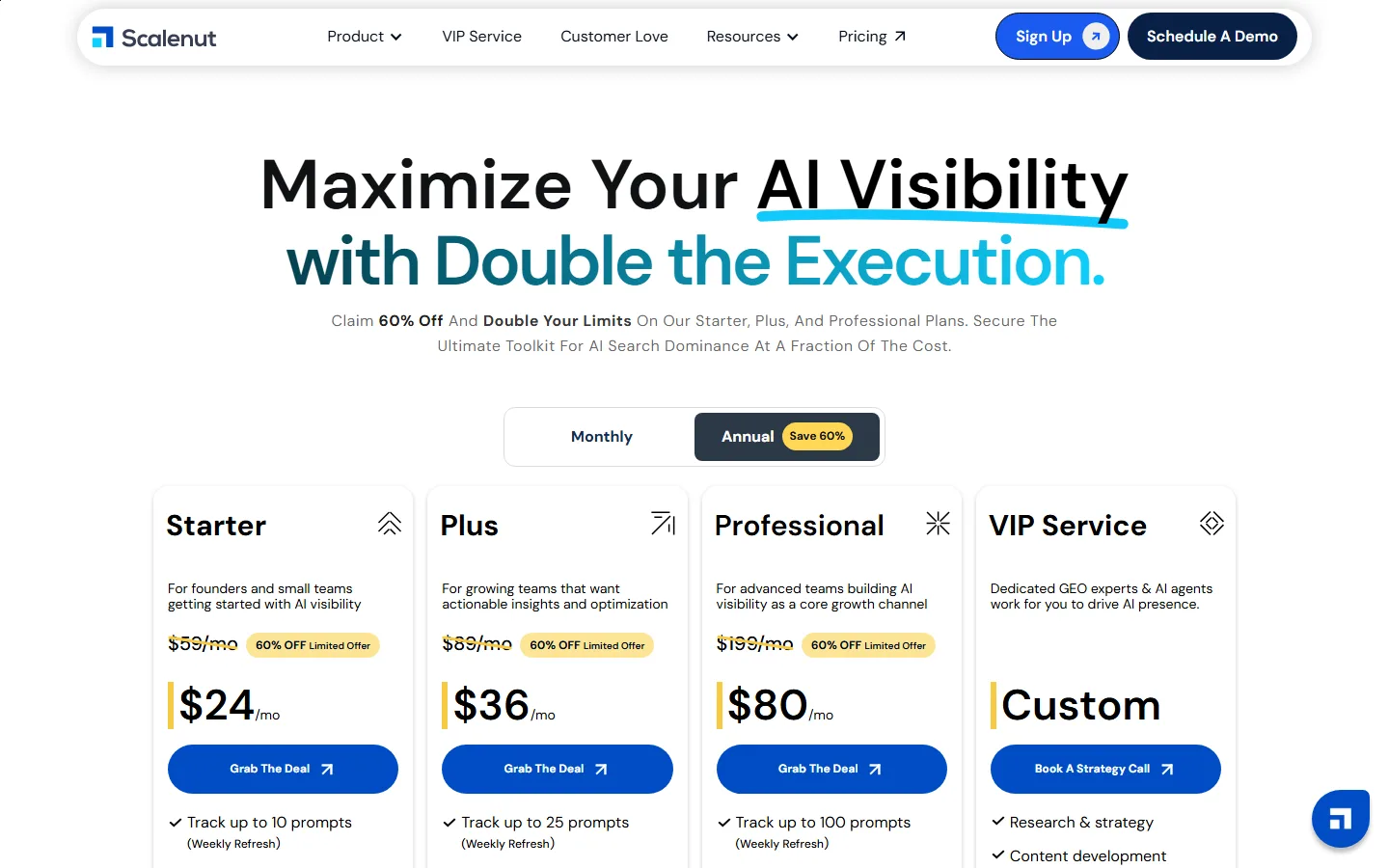
Here is the structure with both numbers attached, so you can compare like for like.
- Starter$59 a month list, $24 on the annual promo
1 workspace, 5 articles, 5 optimizations, and 5 keyword clusters a month, tracking up to 10 prompts on a weekly refresh. Five articles is a trial cadence, not a content program, and the three limits drain together.
- Plus$89 a month list, $36 on the annual promo
2 workspaces, 30 articles, 30 optimizations, and 30 clusters, up to 4 team members, 25 tracked prompts. This is the first tier with the advanced audit, internal linking, Social Upreach, and the backlinks marketplace, so it is the realistic entry point.
- Professional$199 a month list, $80 on the annual promo
Unlimited workspaces and team members, 75 articles, 75 optimizations, 75 clusters, 100 tracked prompts, and visibility coverage across ChatGPT, Google AI Overviews, and Perplexity. Adds the advanced keyword planner, cannibalization analysis, and a dedicated CSM.
- VIP ServiceCustom, book a strategy call
Not software pricing. A dedicated strategist and writer team running research, content development, backlinks, and monthly technical audits alongside the agents. This is an agency retainer sold next to a SaaS plan, and it should be compared against agencies, not against tools.
Two things about that table are worth saying plainly. First, a limited-time discount that has been running long enough to appear in year-old reviews is not a limited-time discount, it is the price, but it is also not what your card gets charged if you buy monthly or renew off-promo. Budget at list and treat the discount as upside. Second, the three limits per tier are separate counters that drain in the same direction: research a cluster, optimize a page, publish an article, and one busy week takes a bite out of all three.
Then there are the extras sold alongside the plan.
- AI Link Manager and Backlinks Marketplace
Link acquisition and management priced beside the plan. The marketplace is bundled from Plus upward, the link manager is sold separately.
- Social Upreach and Reddit tracking
Off-site distribution and monitoring. Useful, and a different job from the one most buyers arrive for, so price it only if you will actually run it.
- AI Detector and Humanizer, OnPage Pro
Two add-ons that exist because the drafts need a pass before they are publishable. Budget the editing time as well as the add-on.
If you are checking this against old reviews, ignore the tier names in them. The packaging has changed more than once, and pages still quoting a Growth plan at $79 or a Pro plan at $149 are describing a product that is no longer for sale. Our own flat monthly plan exists specifically because this arithmetic is exhausting to do inside a 7-day trial window.
3. Where Scalenut wins.
Set the pricing page aside. The product has genuine strengths, and they cluster around research and measurement rather than output.
- It moved early on AI search. Prompt tracking with a weekly refresh across ChatGPT, Google AI Overviews, and Perplexity is a real answer to a question most classic SEO suites are still bolting on. The Professional tier watching 100 prompts is a usable panel for a mid-size brand.
- Cruise Mode is still fast. The one-click keyword-to-long-form flow is the feature existing users name first, and it does get a structured first draft out of a keyword quickly. As a blank-page killer it works.
- Clustering and cannibalization. Keyword clustering plus cannibalization analysis on the top tier is the right pair of features for a site with a few hundred pages that has lost track of which ones compete with each other.
- Breadth on one bill. Visibility, research, optimization, drafting, internal linking, and link acquisition in one account is genuinely convenient for a team that would otherwise run four subscriptions and reconcile them by hand.

Where that breadth lands in the category is covered in our AI SEO tools roundup, which separates tools that help a person work faster from tools that remove a step entirely. Scalenut is firmly in the first group, and the visibility layer is the part that pulls it toward the generative engine optimization stack.
4. Is Scalenut good for SEO?
For the research and on-page half, yes. For the half that decides whether anything ranks, the metering and the missing last mile are the constraints.

- Five articles is not a program. Rankings move on cadence. The entry tier allows one page a week, the middle tier one a day only if you never re-optimize anything, and the top tier is the first one that comfortably supports daily publishing plus revisions.
- Tracking is not ranking. Knowing you appear in 12 of 100 tracked prompts is useful, and it is a report. Something still has to produce the pages that change the number, and that work sits outside the tracker.
- AI detection is not fact checking. A humanizer tells you a sentence reads human. It says nothing about whether the claim is true or where it came from. Attaching a real source to every defensible claim is the expensive half of reviewing an AI draft, and it is the job our citation pass does before anything ships.
- Nothing refuses a weak draft. The optimization score is advisory. A writer can publish a low-scoring page and the tool will let them, so quality depends entirely on editorial discipline rather than a gate that can say no.
- Internal linking starts at Plus. Interlinking is a headline feature and it is not on the entry tier. If cluster work is why you are buying, price from Plus upward and compare it against what an automatic internal linker does as each page publishes.
That gap is the one our automation-tool rankings weigh heaviest: how much of the loop closes without a person picking up a recommendation and doing the work by hand?
5. Scalenut vs TheSEOAgent.
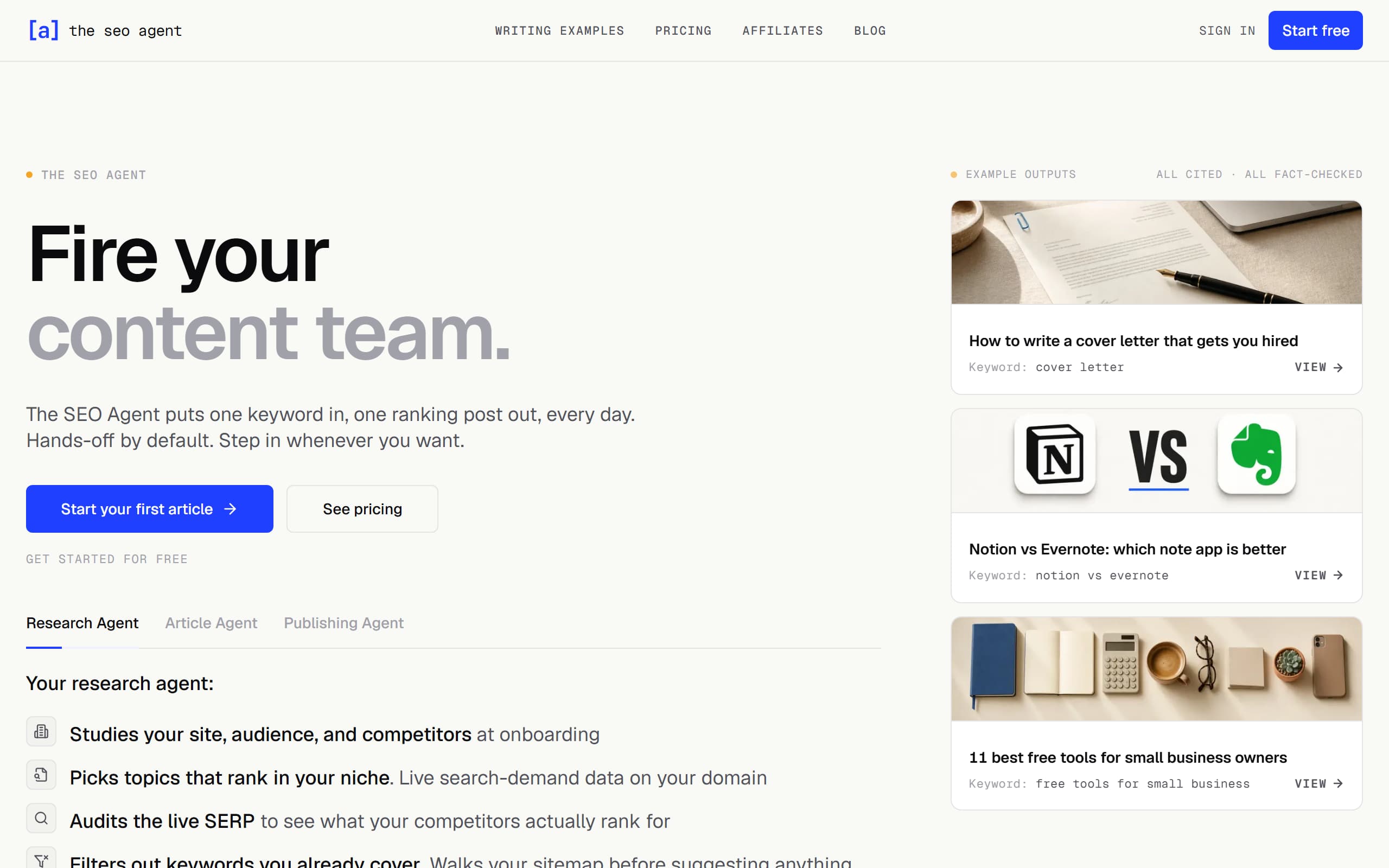
The clean split: Scalenut reports on visibility and makes the person doing the work faster, metered by tier. TheSEOAgent removes the person from the loop and meters nothing but the daily cadence you choose.
| FEATURE | SCALENUT | THESEOAGENT |
|---|---|---|
| Best fit | Marketing teams tracking AI-search visibility and optimizing content | Founders and teams who want published pages without staffing the writing |
| Product shape | Broad suite: visibility tracking, research, optimization, drafting, link tools | End-to-end pipeline from keyword to live post |
| AI visibility tracking | 10, 25, or 100 prompts by tier, weekly refresh across the AI answer surfaces | Not a tracker. Content is written for AI answers, measurement is your own |
| Article volume | 5, 30, or 75 articles a month, shared with the optimization and cluster limits | A daily cadence you set, on one flat plan |
| Keyword selection | Topic discovery and clustering, metered to the same monthly number | Live keyword validation before anything is planned, unmetered |
| Fact checking | AI detection and humanizing, no citation pass | Citation-backed pass before a draft can clear the gate |
| Quality control | A score the writer works against, advisory only | A gate that refuses to publish a draft below threshold |
| Publishing | The optimized document is the deliverable | Native publish to WordPress, Webflow, Shopify, Ghost, and Wix |
| Price shape | Three tiers plus add-ons, anchored on a 60 percent annual discount | $99 a month flat, published, cancel in one click |
6. The decision matrix.
Two cards, one honest question each. Who opens the tool on Monday morning, and what do they do with what it tells them?
- You need AI-search visibility reporting, not just rankings.
- You have writers who will act on the optimization scores.
- Thirty to seventy-five pages a month is your real ceiling.
- One broad subscription beats four focused ones for your team.
- Nobody on the team is going to open the editor.
- You want the keyword chosen for you from live data.
- You want citations and internal links handled by default.
- You want the article published, not exported.
If the answer is that nobody will open anything, the honest recommendation is a hands-off pipeline rather than a better dashboard. The autoblogging page explains what that looks like day to day, and an AI SEO agent that researches, drafts, checks, links, and publishes on one flat plan is a different purchase from a suite that reports on the problem.
7. Scalenut alternatives worth checking.
Scalenut does several jobs at once, so the right alternative depends on which job you are actually replacing. Pick the axis first, then the tool.
- Replacing the on-page optimizer. Surfer is the closest like-for-like swap and the sharper tool at that one job. The Surfer SEO verdict covers what it does and does not include, and the wider list of Surfer swaps maps the rest of that lane.
- Replacing the research and briefs. Frase is brief-first and cheaper to get started with. Read the Frase verdict before assuming the two overlap completely, because they diverge on drafting.
- Replacing the topic planning. MarketMuse plans at site level rather than page level. The MarketMuse verdict covers who that altitude suits, and the Outranking verdict covers the brief-plus-optimizer middle ground.
- Replacing the visibility tracking. A dedicated tracker costs less than a suite if measurement is all you need, and a GEO agent that writes the answer-shaped pages is the other half of that problem.
- Replacing the whole workflow. If the real complaint is that optimized drafts never reach the site, the swap is a pipeline rather than a suite. The auto blogging software comparison ranks that category by what actually reaches a live page.

8. How to test it before you buy.
Seven days is tight, so run the test in this order and do not spend day one exploring the dashboard:
- Write down the list price of the tier you would buy, not the discounted annual figure, and add any add-on you would actually turn on. That total is the number to compare.
- Load your real prompts into the visibility tracker on day one so a full weekly refresh lands inside the trial window.
- Take three keywords from the same cluster all the way to a finished draft and record how many articles, optimizations, and clusters that consumed.
- Count unsupported claims, missing sources, and missing internal links in each draft, then time the cleanup honestly.
- Multiply that cleanup time by the article allowance on your tier. Software plus hours is the real monthly cost, and it is usually the hours that decide it.
To run the same test on the automated side, the free trial covers keyword validation through to CMS publish with no article meter to watch, and the AI SEO software page explains which parts of the loop run without anyone in the editor.
Is Scalenut worth it in 2026?
It is worth it if you want AI-search visibility measurement and content optimization in one subscription, and you are buying the Plus tier or higher. It is not worth it on the entry tier if the goal is a publishing program: Starter gives you 5 articles, 5 optimizations, and 5 keyword clusters a month, which is roughly one page a week before any editing. The product is real and it is broad. The question is whether breadth on a metered plan beats depth on the one job you are short on.
How much does Scalenut cost?
Checked 2026-09-17: the list prices on monthly billing are Starter $59 a month, Plus $89, and Professional $199, with a custom-priced VIP Service tier above them. The pricing page loads with the annual toggle preselected and a 60 percent discount banner, which renders those three tiers at $24, $36, and $80 a month instead. There is a 7-day free trial. Older reviews still quote a Growth tier at $79 and a Pro tier at $149, and those tiers are not on the live page any more.
What is Scalenut best for?
Measuring and improving how a brand shows up in AI search, on a plan that also covers content optimization and drafting. The AI visibility tracker watches a set number of prompts per tier with a weekly refresh, spanning ChatGPT, Google AI Overviews, and Perplexity on the Professional tier. If you need one dashboard that reports AI visibility and lets the same team act on it, that pairing is the strongest thing it sells.
What is Cruise Mode in Scalenut?
Cruise Mode is the long-running one-click flow that turns a keyword into a long-form draft by walking through outline, headings, and sections in sequence. It is the feature most existing users name first and it is genuinely fast for a first draft. It still leaves fact checking, source attachment, internal links, and the publish step to you, so treat the output as a draft rather than a finished page.
What is the main weakness of Scalenut?
The metering against the price anchor. Every tier caps articles, optimizations, and clusters at the same number, so one busy month exhausts all three at once, and the price you compared was the discounted annual figure rather than the renewal figure. On top of that the AI Link Manager, Backlinks Marketplace, Social Upreach, AI Detector and Humanizer, and OnPage Pro are sold as add-ons, so the plan that wins your spreadsheet is not always the plan that does the job.
Is Scalenut good for SEO?
For research and on-page work, yes. Topic discovery, keyword clustering, competitor insights, GEO scoring, and cannibalization analysis on the top tier are legitimate SEO work, and the AI visibility tracking is ahead of most classic SEO suites. For the part that decides whether anything ranks, which is publishing useful pages on a cadence, it caps you at 5, 30, or 75 articles a month and still expects a person to take each draft the last mile.
What are the best Scalenut alternatives?
It depends which half of Scalenut you are replacing. For pure on-page optimization, Surfer SEO is the closest swap. For brief-first research, Frase. For site-level topic planning, MarketMuse. For AI-search visibility alone, a dedicated tracker is cheaper than a full suite. If what you actually want is published pages rather than scores, an end-to-end pipeline that researches, drafts, checks, links, and publishes is a different category of purchase and the one worth testing against it.
How is TheSEOAgent different from Scalenut?
Scalenut gives a team dashboards, scores, and drafts, and a person turns those into pages. TheSEOAgent runs the loop without the person: keyword research against live search data picks the target, drafting attaches citations, a quality gate refuses weak drafts, internal links are added, and the article publishes to WordPress, Webflow, Shopify, Ghost, or Wix. One flat plan at $99 a month, published, with one-click cancellation and no add-on ladder.
Should I switch from Scalenut to TheSEOAgent?
Switch if your Scalenut account is full of optimized drafts that never shipped, which is the usual state when the bottleneck is human time rather than tooling. Stay if the AI visibility tracking is the reason you bought it and someone on the team is genuinely acting on the reports each week. Running both is coherent: track visibility in one tool, publish on a cadence with the other.
Is Scalenut better than Surfer SEO or Frase?
They no longer compete on the same axis. Surfer is the sharper pure on-page optimizer and Frase is the sharper brief-first research workflow. Scalenut traded some of that focus for breadth, moving into AI visibility tracking, Reddit monitoring, link building, and a done-for-you service tier. Pick Scalenut if you want one account covering AI search and content. Pick the specialists if you want the best version of a single job.