A GEO agent that writes content built to get cited.
Generative engines answer your buyers by quoting a handful of sources. Monitoring tools tell you when yours is not one of them. This agent does the other half: it mines the questions, writes the direct answers, sources every claim, and publishes to your CMS every day.
FREE TRIAL · CANCEL IN ONE CLICK
What is a GEO agent?
A GEO agent is software that runs generative engine optimization without a human in each step: it finds the questions buyers ask, writes one page per question with a quotable direct answer, attaches a named source to every statistic, adds FAQ and article schema, and publishes to your CMS. The point is production, not measurement. Most GEO tools count how often ChatGPT or Perplexity mentions your brand; they cannot write the page that changes the count. TheSEOAgent ships roughly 30 citable pages a month per project for $99 flat, with a quality gate that refuses anything below threshold.
Measure the citations. Never earn one.
Almost every product sold as generative engine optimization is a monitor. It prompts ChatGPT, Perplexity, and Gemini on a schedule, counts how often your brand comes back, and charts the result. The chart is real. The lever is missing. Nothing in a monitoring subscription writes the page an engine would rather quote than the one it quotes today.
- Trackers report a visibility score they cannot move
- Most existing blog pages carry no answer an engine can lift
- Claims without a named source rarely survive into a generated answer
- Thin coverage means your brand is absent from most buyer questions
- Enterprise GEO platforms start near $500 a month, content not included
Write the page that gets quoted.
TheSEOAgent runs generative engine optimization as production work. It researches the questions your buyers actually type, writes one page per question with a direct answer at the top, attaches a named source to every statistic, adds FAQ and article schema, and publishes to your CMS. The same pages rank in classic search, so the work is never stranded if AI referrals arrive slowly.
- A quotable direct-answer block opens every article
- Fact-check pass sources every defensible claim before publish
- Consistent entity naming so models resolve your brand the same way
- FAQ and article schema written in, not bolted on later
- Daily publishing keeps the freshness signal engines reward
Four differences between watching AI search and appearing in it.
An agent that moves the number, not one that reports it.
A tracker tells you how often an assistant names your brand. It cannot change the count. Citations go to whoever published the page the engine found most useful, so the only lever that moves the score is production. This agent writes that page: one buyer question, one direct answer, real figures, sources attached. Our GEO tools roundup covers which trackers earn their price once you have coverage worth measuring, and our rundown of the best AI search engines sets out which surfaces are worth being cited on in the first place.

Citation-ready structure applied at write time.
Generative engines lift text they can parse cleanly: a question heading, a short direct answer, a statistic with a named source, an FAQ block with schema behind it. Retrofitting that onto an existing blog is weeks of editorial work. The agent applies it while drafting, alongside everything the SEO automation pipeline already handles. The full pattern is written up in our answer engine optimization guide, and the specific rules for getting quoted by large language models sit alongside it, as does the line-by-line GEO vs SEO breakdown and the guide to how generative engines pick their sources. For the wider version of the same problem, our strategy for ranking on every search surface covers video, communities and marketplaces too. Teams shopping this out to a specialist shop can compare the AEO agency alternative on price and on what actually ships.

GEO is not per-assistant work.
Teams ask for ChatGPT optimization, then Perplexity, then Gemini, then AI Overviews. The engines reward the same substance: verifiable claims, clean structure, consistent entity naming. One article written to the strictest of those standards surfaces across all of them, which is why we ship one citable page per question instead of four platform-shaped variants. Same discipline as our AI search optimization work, run by an AI SEO agent rather than a content team.

Cited once is luck. Cited everywhere is an entity.
A brand quoted once is an accident. A brand quoted across dozens of adjacent questions is an entity the models have learned. Getting there is a volume problem, and volume is the part an agent is for: one fact-checked article every day, every claim run through the AI fact checker before it ships, for $99 a month flat. Competitors run quarterly sprints. You run a cadence.
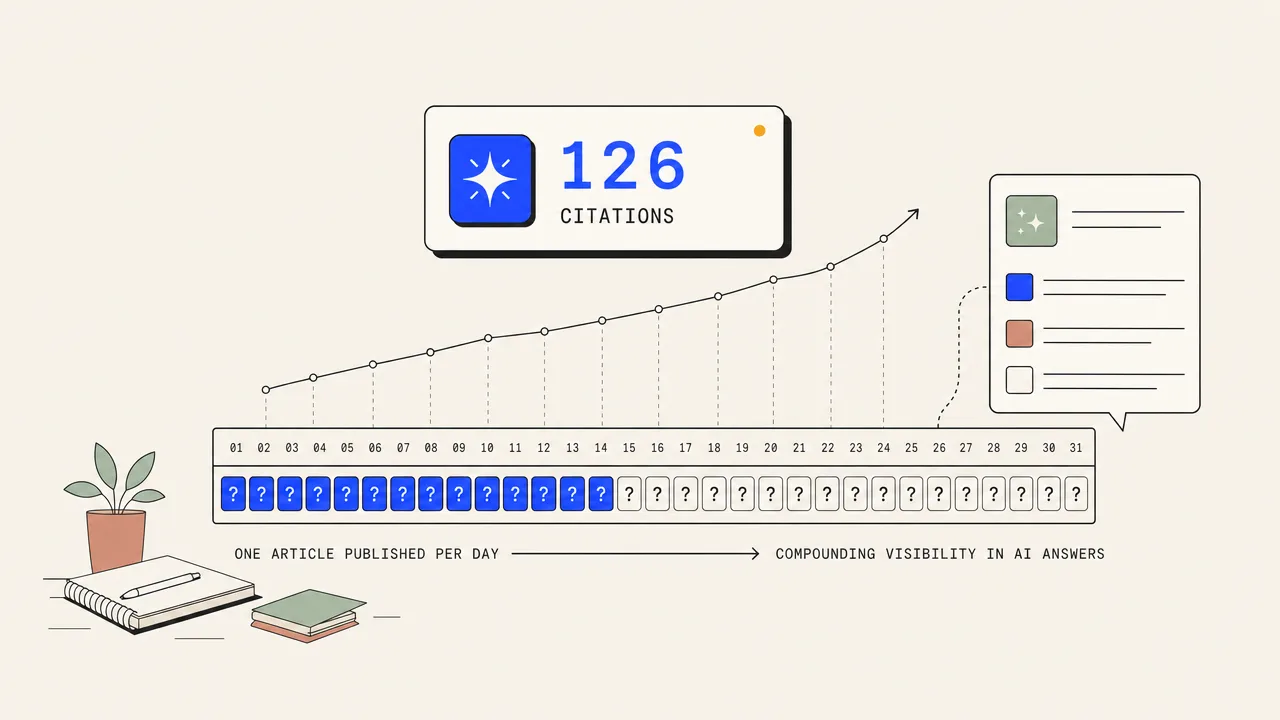
Four steps. Every day. Nothing ships below the gate.
The agent pulls live keyword and SERP data for your category and shapes it into questions. Generative engines answer questions, so questions are what the content plan targets, not vanity head terms.
Each article opens with a 50-word direct answer carrying a specific number and named entities. No throat-clearing, no preamble. That block is what an engine can quote verbatim without editing.
A separate verification pass matches every statistic to a credible source and appends the citation. Claims that cannot be traced get rewritten or cut. A quality gate refuses to publish anything below threshold.
Finished articles land natively on WordPress, Webflow, Shopify, or Ghost with schema in place. Then the agent picks the next question. Coverage across a topic is what turns one citation into a pattern.
The honest one-screen comparison.
| FEATURE | THE AGENT | EVERYONE ELSE |
|---|---|---|
| What it does about GEO | Writes and publishes citable pages | Reports a visibility score |
| Direct-answer block on every article | ||
| Named source on every statistic | ||
| FAQ and article schema | Written in automatically | Not their job |
| Classic Google rankings | Same pages rank | Out of scope |
| Monthly cost | $99 flat, content included | $99-500+ to monitor only |
Q.01What is a GEO agent?+
A GEO agent is software that runs generative engine optimization end to end without a human in each step: it finds the questions buyers ask, writes a page that answers each one in a form a generative engine can quote, attaches sources to the claims, adds structured data, and publishes. The distinction that matters is production versus measurement. Most tools sold under the GEO label monitor how often assistants mention you. An agent writes the content that changes the answer.
Q.02How is a GEO agent different from an AI visibility tracker?+
A tracker prompts ChatGPT, Perplexity, and Gemini on a schedule and charts how often your brand appears. It is a measurement instrument. A GEO agent produces the pages those engines cite. The two are complementary, but the order matters: with 20 published pages a monitoring subscription will mostly confirm you are invisible. Build citable coverage first, add measurement when there is something to measure.
Q.03What makes content likely to be cited by generative engines?+
Five levers do most of the work. A direct answer near the top that can be quoted verbatim, usually 40 to 60 words. Specific numbers instead of vague claims. Named sources attached to those numbers. Consistent naming of entities so a model can resolve who you are. Structured data such as FAQ and article schema. Freshness helps too, which is why cadence beats a one-off content sprint.
Q.04Is GEO the same as AEO or LLM SEO?+
Broadly yes. Generative engine optimization, answer engine optimization, LLM SEO, and AI search optimization all describe optimizing content to be the source behind an AI-generated answer. GEO tends to emphasize chat assistants, AEO includes older answer surfaces like featured snippets. The production playbook is the same either way, and TheSEOAgent applies it regardless of which label your team uses.
Q.05Can an agent really write content good enough to be cited?+
It has to clear a gate first. Every draft runs through a fact-check pass that sources or removes each defensible claim, then a scoring pass on accuracy, structure, originality, and link strategy. Drafts below threshold go back for regeneration rather than to your site. That gate is the reason the output is citable at all: unsourced, generic text is exactly what engines skip.
Q.06Does GEO content still rank in normal Google search?+
Yes, and that is deliberate. The same page that answers a question cleanly with cited evidence is the page classic search rewards. Generative engines also pull heavily from results that already rank, so ranking and citation reinforce each other. Nothing on the page is optimized for AI at the expense of human readers or blue-link rankings.
Q.07How long before generative engines cite my pages?+
Often faster than classic SEO. Perplexity and ChatGPT search read the live web, so a well-structured page can show up in answers within days of being indexed. Google AI Overviews track closer to normal ranking timelines. Sustained presence across a topic is a coverage game measured in months, which is the argument for a daily cadence rather than a batch of ten posts.
Q.08What does the GEO agent cost?+
TheSEOAgent is $99 per month flat after a free trial, with no per-article meter and no token surcharge. That includes the research, the writing, the fact-check pass, the quality gate, images, and native publishing to WordPress, Webflow, Shopify, or Ghost. Cancellation is one click inside the app. Dedicated GEO platforms typically charge more than that to monitor visibility without writing anything.
Related guides + features.
Best GEO tools
The GEO field ranked honestly: which trackers are worth paying for and the one tool that produces citable content instead of measuring it.
/blog/best-geo-tools →GUIDE · AEOAnswer engine optimization
How ChatGPT, Perplexity, and AI Overviews pick their sources, the on-page levers with measured effect sizes, and a worked example.
/blog/answer-engine-optimization →PRICINGSimple pricing
$1 for a 3-day trial if eligible, then $99 per month. No per-keyword meter. Cancel in the app.
/pricing →Be the page the engines quote.
Connect your CMS and let the agent ship citable articles daily: direct answers, statistics with sources, schema in place. Free trial first, $99 a month after, cancel in one click.
FREE TRIAL · CANCEL IN ONE CLICK