BEST FRASE ALTERNATIVES · 2026

10 best Frase alternatives in 2026

Frase built the brief-then-write-then-score workflow into a practical editor: SERP research becomes an outline, then a draft gets measured against the pages already ranking. These ten alternatives are ranked by what happens after that score, from deeper guidance for human teams to a pipeline that verifies claims and sends the finished article to the CMS.

BY THE SEO AGENT TEAMUPDATED 2026-07-2012 MIN READ
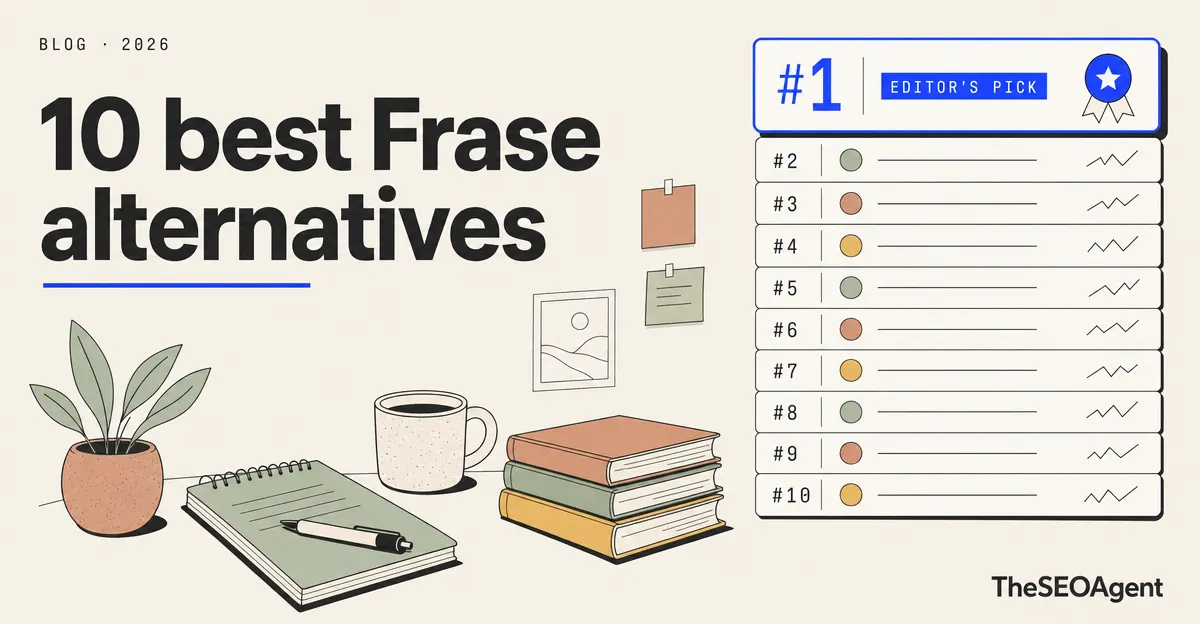
Editorial illustration comparing ten Frase alternatives across research, scoring, verification, and publishing
EDITOR'S PICK · #1

1. TheSEOAgent: Best for turning SERP research into a published, cited article

theseoagent.ai
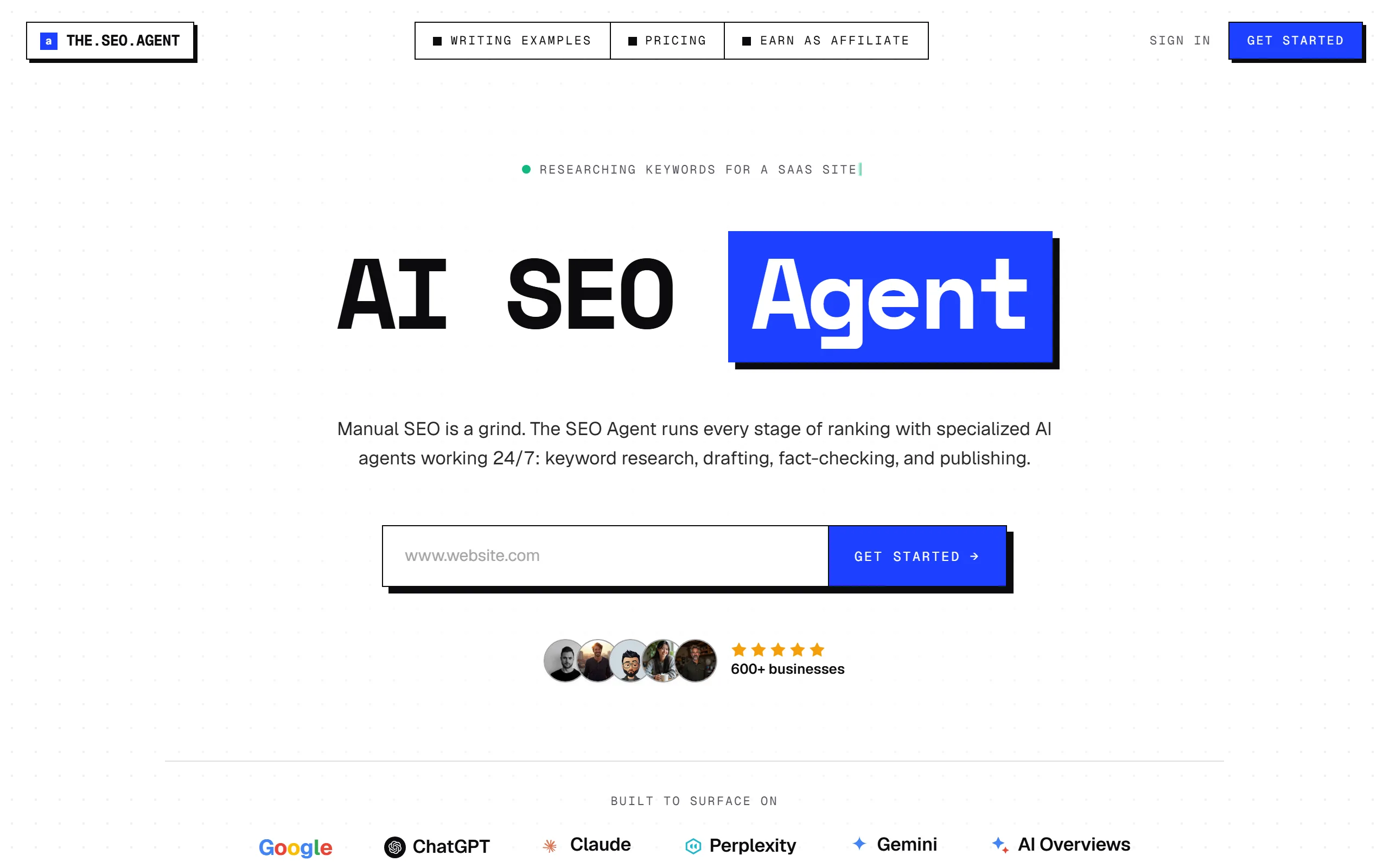
TheSEOAgent homepage screenshot

The classic Frase workflow gives a writer research, a brief, and a score to improve. TheSEOAgent treats those as inputs to an SEO automation pipeline that drafts the page, checks its claims, rejects weak work, and publishes the finished article to the CMS.

PROS
  • Live keyword and SERP data select and ground every article before drafting starts
  • A separate AI fact-check pass adds citations to defensible claims
  • The quality gate can refuse a weak draft instead of turning every generation into output
  • Native publishing sends formatted articles to WordPress, Webflow, Shopify, and Ghost
  • $99 per month flat with a free trial, and no per-keyword or per-article meter
  • Cancellation takes one click inside the app

Frase vs TheSEOAgent

Frase now includes AI drafting and CMS connections, so calling it a brief-only product would be stale. Its core product logic still centers on a human-controlled document: inspect the SERP, build or approve the brief, revise the draft against a score, then decide whether it is ready. That content research and scoring is useful when a writer wants detailed control over every change.

TheSEOAgent removes the recurring supervision points. Live keyword inputs choose the target, a citation pass checks factual claims, and the gate publishes only work that clears its threshold. Frase is the better fit for a human writing team that wants a low-cost editor. TheSEOAgent is for a founder who wants the research to become a finished page on a flat $99 plan.

BEST FOR

Founders and lean content teams that want cited articles published without managing a brief, draft, score, and upload as separate jobs.

PRICING

$99/mo flat. Free trial.

  • ·Single plan: $99/mo, with daily article capacity included
  • ·Trial: free trial with full feature access
  • ·No keyword, article, or token meter
2. Surfer: Rigorous live content scoring

surferseo.com
Surfer homepage screenshot

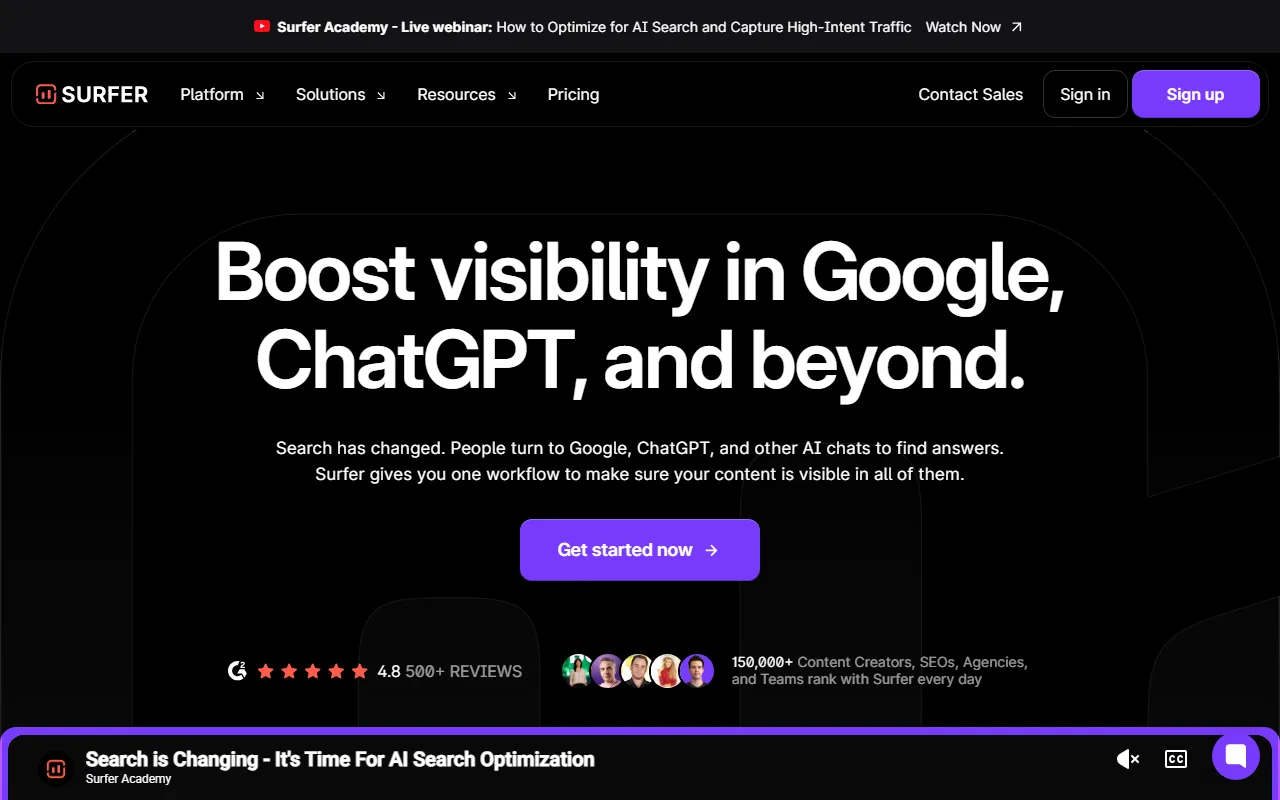
Surfer is the strongest direct replacement when the score itself is the product. Its Content Editor turns the live SERP into terms, coverage targets, and a visible grade, with a broader site-audit layer around it. The full Surfer alternatives breakdown covers that scoring category in more depth.

PROS
  • Content Editor gives specific term, structure, and coverage guidance from the current SERP
  • One-click optimization and internal-linking tools reduce repetitive editing work
  • Site auditing and AI visibility tracking extend beyond a single content document
CONS
  • Discovery is listed at $49/mo only with annual billing, while the fuller Standard plan is $99/mo annually
  • The workflow still rewards chasing a score, which can flatten expert writing when applied mechanically

Frase vs Surfer

Surfer and Frase compete on the same visible artifact: an editor that tells a writer how closely a draft covers the current search result set. Surfer goes deeper on optimization controls, site auditing, and ongoing page monitoring. Frase is cheaper at entry and makes brief creation easier for a writer who wants a lighter interface.

Neither score tells you whether a factual claim is supported. The downstream difference is an independent claim verification layer plus a publish decision that can fail. Surfer and Frase can improve a document, but neither can honestly promise a finished, ranked article.

PRICING

Listed from $49/mo, billed yearly.

  • ·Discovery: $49/mo billed yearly
  • ·Standard: $99/mo billed yearly
  • ·Pro: $182/mo billed yearly

3. Clearscope: Established editorial teams

clearscope.io
Clearscope homepage screenshot

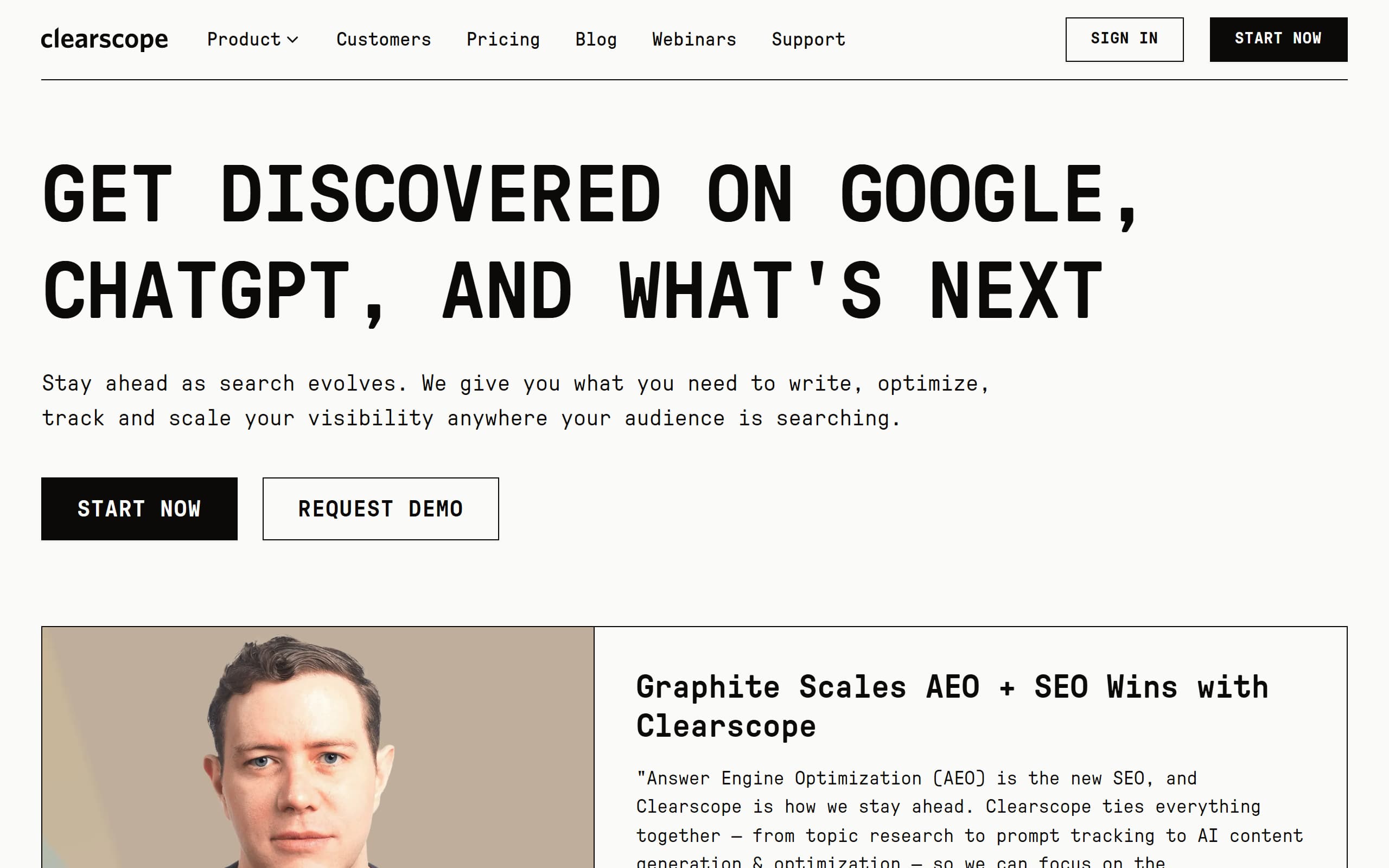
Clearscope is the polished team option: strong topic recommendations, content inventory, draft collaboration, and AI search visibility in one restrained interface. It earns its place among the best AI SEO tools, but the entry price assumes the content operation already has writers and process.

PROS
  • Clear recommendations are easy for writers and editors to adopt without specialist training
  • Unlimited users and projects remove seat friction on the Essentials plan
  • Content inventory and prompt tracking connect draft work to existing-page performance
CONS
  • Essentials is listed at $129/mo, more than Frase Starter and TheSEOAgent
  • It improves and tracks content but does not run an end-to-end publishing program

Frase vs Clearscope

Clearscope costs more than Frase because it is designed around a mature editorial team, not a solo writer trying to build a fast brief. The interface is calmer, collaboration is less constrained, and inventory tracking makes it better for maintaining a large existing library. Frase wins on entry price and speed from query to working outline.

Both products make a human editor the operating system. A team that wants to remove that coordination layer needs an automated content pipeline, not a more expensive scoring screen. Clearscope and Frase can guide strong work, but neither can honestly promise a finished, ranked article.

PRICING

Listed from $129/mo.

  • ·Essentials: $129/mo
  • ·Business: $399/mo
  • ·Enterprise: custom pricing

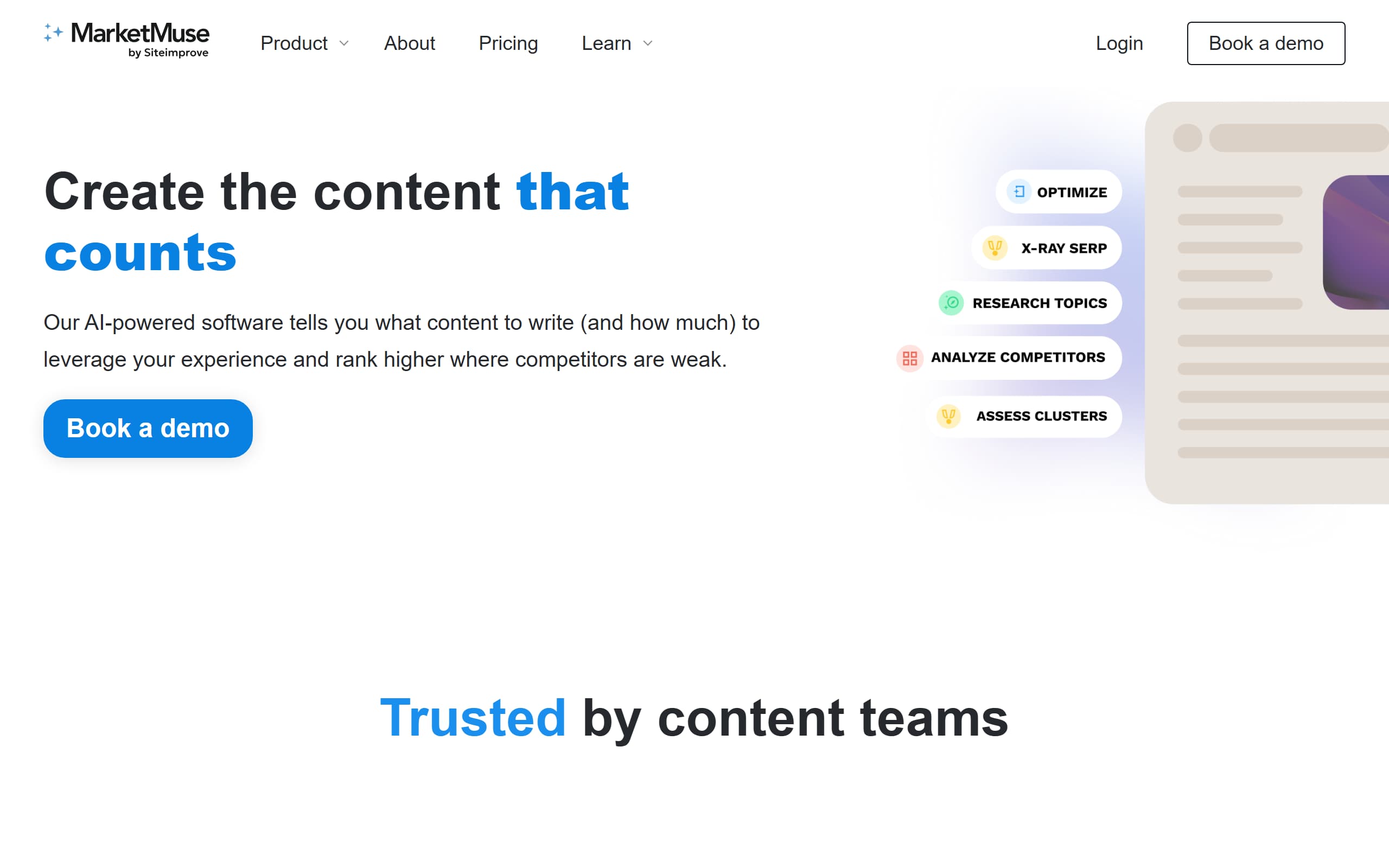
4. MarketMuse: Site-wide content planning

marketmuse.com
MarketMuse homepage screenshot

MarketMuse works one level above the draft. It inventories the site, calculates topic-level strengths and gaps, and turns that model into briefs and strategy documents. That is useful planning depth for teams already running a broader content operations system, not a cheap editor replacement.

PROS
  • Personalized difficulty and topic authority use the site itself instead of generic keyword scores
  • Inventory shows which existing pages to update before commissioning more content
  • Multiple brief types support complex editorial programs beyond standard blog posts
CONS
  • A free plan is listed, but current paid-plan prices require a demo instead of being published
  • Planning depth adds setup and interpretation work that a small Frase team may not need

Frase vs MarketMuse

Frase starts with one query and helps a writer make one document competitive. MarketMuse starts with the domain and asks which documents should exist at all. That makes MarketMuse stronger for portfolio planning, topic authority, and refresh prioritization, while Frase remains faster for an individual brief that needs to move today.

The strategic model still hands execution to a team. The missing piece is an execution layer for SEO content that can turn an approved opportunity into cited copy and a CMS page. MarketMuse and Frase can improve the plan, but neither can honestly promise a finished, ranked article.

PRICING

Free plan. Paid plans are currently quote-only.

  • ·Free: 10 queries/mo with limited applications
  • ·Optimize: price available by demo
  • ·Research and Strategy: price available by demo

5. Scalenut: A broad GEO content suite

scalenut.com
Scalenut homepage screenshot

Scalenut bundles content creation, optimization, keyword clusters, AI visibility, and site audits. It covers more ground than Frase and adds WordPress and Shopify publishing workflows on higher tiers, though the breadth makes the product less focused.

PROS
  • Creation and optimization share the same GEO-focused workspace
  • Keyword clustering and content audits connect planning to production
  • Plus and Professional include auto-publishing to WordPress and Shopify
CONS
  • Starter is listed at $59/mo monthly, while the advertised $24/mo rate depends on an annual promotion
  • The wide bundle is harder to evaluate than Frase when the only need is a brief and scoring editor

Frase vs Scalenut

Scalenut is the broader purchase. Frase concentrates on research, briefs, editing, and scores, while Scalenut also pulls in visibility tracking, content audits, clusters, social distribution, and publishing. A growth team that wants one large workspace may prefer that breadth. A writer who wants the shortest route to a clean brief may prefer Frase.

Scalenut automates more steps, but volume and breadth are not an editorial refusal mechanism. A separate evidence and accuracy check is still the difference between generating a page and deciding it is safe to ship. Scalenut and Frase can produce publishable drafts, but neither can honestly promise a finished, ranked article.

PRICING

Listed at $59/mo monthly, with promotional annual pricing shown.

  • ·Starter: $59/mo monthly, promotion shown at $24/mo annually
  • ·Plus: $89/mo monthly, promotion shown at $36/mo annually
  • ·Professional: $199/mo monthly, promotion shown at $80/mo annually

6. NEURONwriter: Budget content optimizer

neuronwriter.com
NEURONwriter homepage screenshot

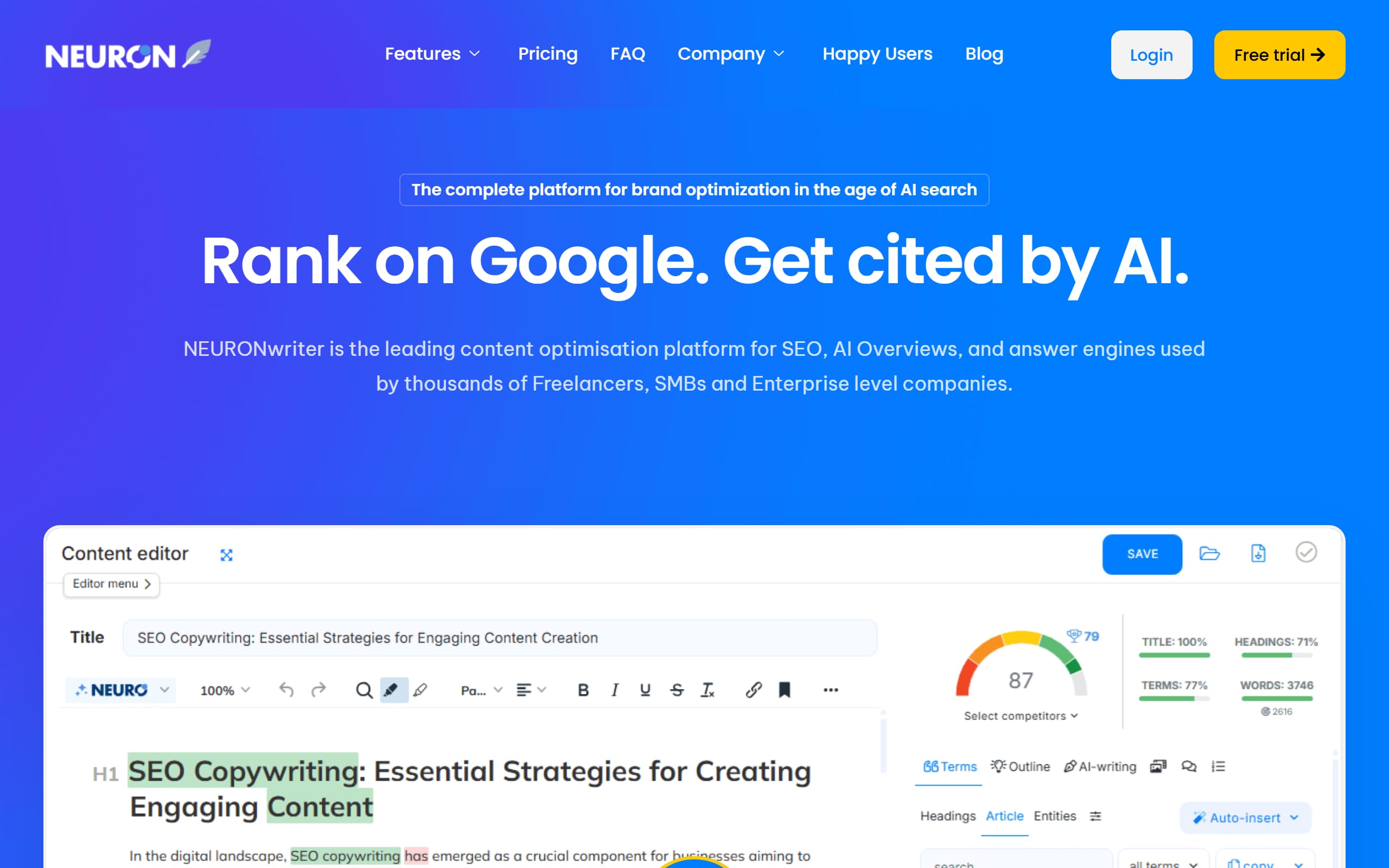
NEURONwriter is the price-first alternative. The $23 monthly Bronze listing includes 25 content analyses, a content plan, and AI credits, while higher tiers add one-click articles and CMS integrations. It is the practical choice when the $99 automation tier is more system than the buyer needs.

PROS
  • Low monthly entry price makes SERP-based optimization accessible to solo operators
  • Content Writer combines entity guidance, structure analysis, and a live content score
  • Gold and higher tiers add one-click articles, team sharing, and WordPress or Shopify integrations
CONS
  • The $23 Bronze plan caps analyses and credits, while the automation and integration features start at $69/mo
  • The interface exposes many controls and still expects the operator to drive each document

Frase vs NEURONwriter

NEURONwriter undercuts Frase on price and gives a solo writer a denser set of optimization controls. Frase is easier to learn, builds cleaner briefs, and now offers a broader audit and publishing loop. NEURONwriter is the sharper deal for buyers willing to trade polish for granular control and strict monthly limits.

That budget trade keeps the operator in charge of every article. A managed SEO workflow costs more because it selects, verifies, gates, and publishes rather than waiting for the next click. NEURONwriter and Frase can lower writing effort, but neither can honestly promise a finished, ranked article.

PRICING

Listed from $23/mo. Seven-day free trial.

  • ·Bronze: $23/mo
  • ·Silver: $45/mo
  • ·Gold: $69/mo with Content Designer and CMS integrations

7. Dashword: Simple briefs shared with writers

dashword.com
Dashword homepage screenshot

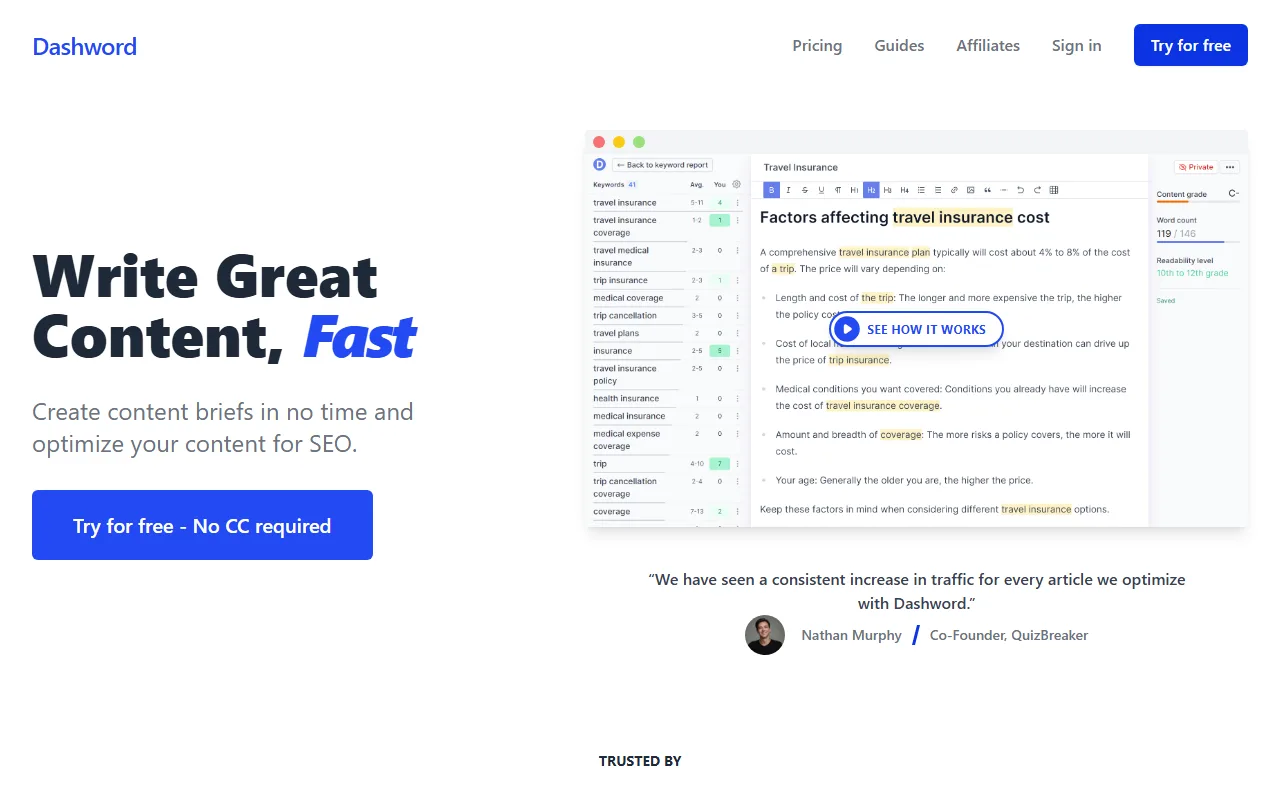
Dashword keeps the job narrow: produce a report, turn it into a brief, share it with a writer, and monitor the published page. The restraint is useful for teams that find the broader AI SEO tool category noisy.

PROS
  • Content reports turn ranking-page analysis into clear term and structure guidance
  • Five seats on Startup make briefs easy to hand across a small team
  • Monitoring flags content decay after the page goes live
CONS
  • Startup is listed at $99/mo and Business starts at $349/mo
  • There is no native CMS publishing path, so the workflow ends before the page is live

Frase vs Dashword

Dashword is simpler than Frase and deliberately so. It gives a content team the report, brief, writer access, and monitoring needed for a conventional editorial process. Frase adds more AI creation, research paths, and optimization controls. Dashword is easier to standardize; Frase can do more inside each document.

Neither product removes the handoffs around the document. An end-to-end article system has to own the target, the cited draft, the quality decision, and the CMS action. Dashword and Frase can make human production cleaner, but neither can honestly promise a finished, ranked article.

PRICING

Listed from $99/mo. First report is free.

  • ·Startup: $99/mo for 30 content reports and 5 seats
  • ·Business: from $349/mo for 100 reports and 10 seats
  • ·Annual billing: 20% discount listed

8. Outranking: Configurable SEO writing workflows

outranking.io
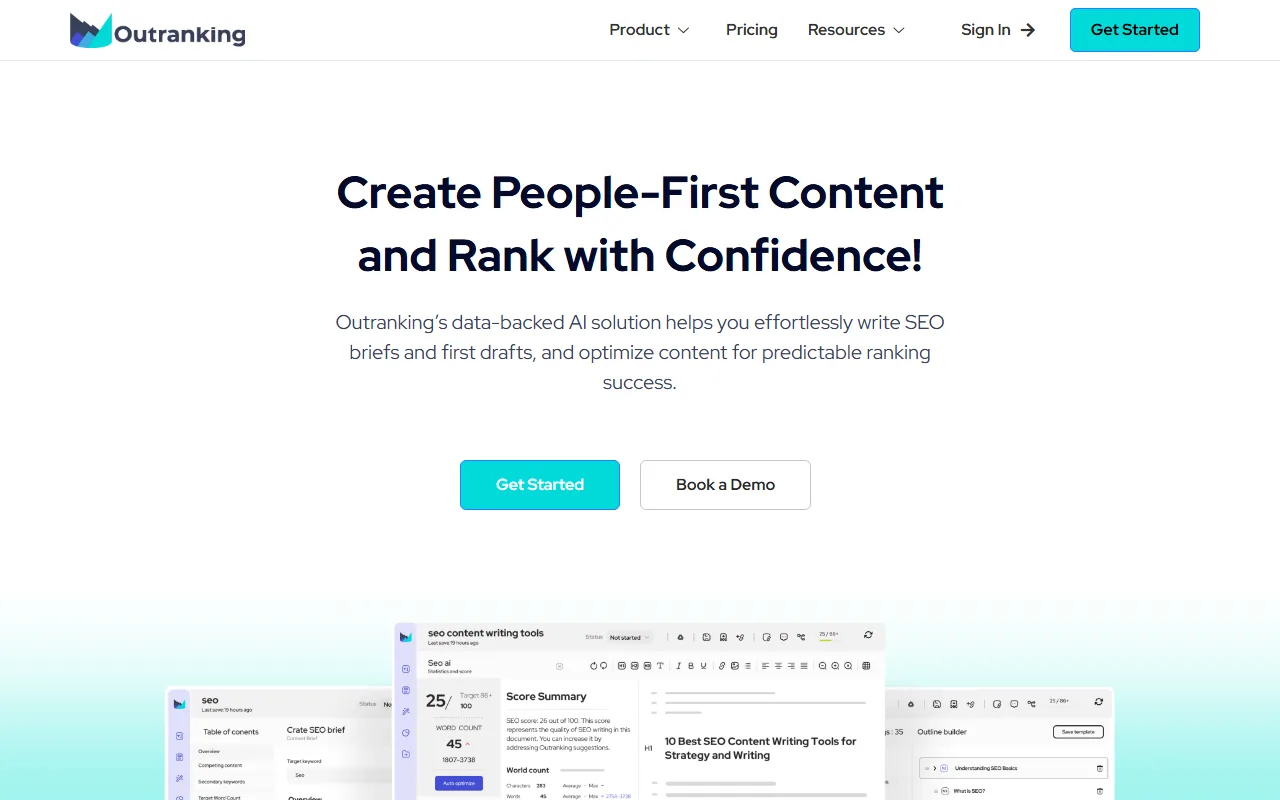
Outranking homepage screenshot

Outranking combines briefs, first drafts, optimization, internal linking, and team workflow controls. It is more configurable than Frase and closer to programmatic content operations, but its credits and add-ons demand closer account management.

PROS
  • SERP research feeds briefs, concepts, and factual first-draft workflows
  • Automatic optimization and internal linking remove repetitive on-page work
  • Assignments and team controls support a managed editorial process
CONS
  • The current pricing page lists overlapping billing figures, and full first-draft use requires an AI character add-on
  • Document, assessment, and character credits make usage harder to predict than Frase

Frase vs Outranking

Outranking gives operators more workflow machinery than Frase. It reaches from keyword strategy into drafting, optimization, internal linking, and assignments, which is useful for agencies that want to configure the system themselves. Frase is easier to understand and its score-led editor is quicker for a human writer to adopt.

Outranking moves farther toward automation, but the buyer still defines and supervises the workflow. A separate cited quality check matters when a draft can publish at scale. Outranking and Frase can accelerate production, but neither can honestly promise a finished, ranked article.

PRICING

Listed from $19/mo on the current pricing page.

  • ·Starter: listed at $19/mo for 4 SEO documents
  • ·SEO Writer: listed at $79/mo for 15 SEO documents
  • ·SEO Wizard: listed at $159/mo for 30 SEO documents

9. Koala AI: Low-cost one-shot articles

koala.sh
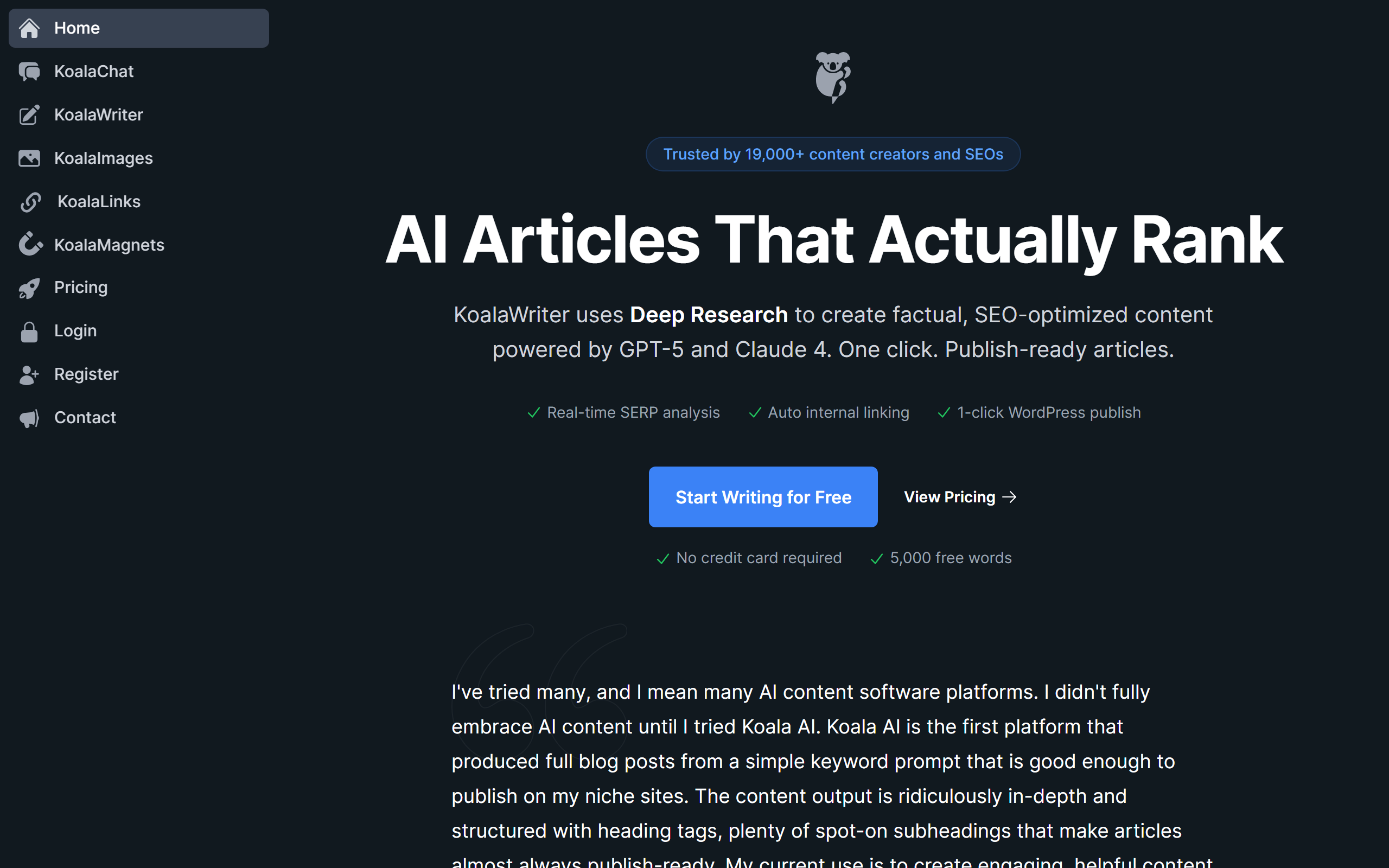
Koala AI homepage screenshot

Koala AI starts from the article, not the brief. KoalaWriter analyzes the SERP, pulls real-time information, builds the draft, inserts links and images, and can send it to the CMS. That shape sits closer to autoblogging software than to a Frase-style writing editor.

PROS
  • Real-time SERP analysis and Deep Research reduce the gap between current sources and the draft
  • Affiliate article formats, automatic internal links, and image handling suit niche publishers
  • Built-in integrations send articles to WordPress, Shopify, Webflow, Ghost, and webhook targets
CONS
  • The $9 Essentials plan is capped at 15,000 words, premium models consume credits twice as fast, and unused monthly credits do not roll over
  • Team-member accounts are not currently supported, so collaboration is weaker than Frase

Frase vs Koala AI

Koala and Frase optimize different moments. Frase is better before and during human writing: research the query, assemble the brief, and revise against a visible score. Koala is better when the operator wants a complete first draft quickly, especially for affiliate formats, and is willing to review the result after generation.

Koala can publish directly and its live-data options are useful, but generation is still not an independent editorial decision. A verification stage for factual claims plus a gate that can stop weak work is the remaining wedge. Koala and Frase can both publish content, but neither can honestly promise a finished, ranked article.

PRICING

Listed from $9/mo. Free test credits.

  • ·Free test: 5,000 word credits and 25 chat credits
  • ·Essentials: $9/mo for 15,000 words
  • ·Professional: $49/mo for 100,000 words and Deep Research

10. Semrush Content Toolkit: Semrush users who want the former ContentShake workflow

semrush.com
Semrush content product homepage screenshot

Semrush Content Toolkit is the live successor to ContentShake. It combines topic ideas, SEO briefs, AI article generation, optimization, repurposing, and WordPress publishing under a familiar account. Buyers already paying for the wider suite should also read the Semrush alternatives analysis before adding another toolkit.

PROS
  • Topic Finder and the SEO Brief Generator use the same search data as the wider Semrush suite
  • AI article generation, optimization, and repurposing share one workspace
  • One-click WordPress publishing supports up to 100 connected sites
CONS
  • The $60/mo Base listing includes five SEO-boosted articles, then charges $30 for ten additional boosts
  • Publishing is WordPress-focused and the toolkit does not add an independent claims gate

Frase vs Semrush Content Toolkit

Semrush Content Toolkit is a broader content creator than the Frase editor and a more natural fit for existing Semrush accounts. It can find topics, build a brief, generate the article, optimize it, repurpose it, and send it to WordPress. Frase offers a cheaper annual entry and a more concentrated experience for human writers.

The Toolkit removes more manual work, but its SEO boost is still an optimization pass, not a claims and evidence gate. That distinction matters when unlimited standard drafts can move quickly. Semrush Content Toolkit and Frase can both publish content, but neither can honestly promise a finished, ranked article.

PRICING

Listed at $60/mo. Seven-day free trial.

  • ·Base: $60/mo billed annually
  • ·Includes 5 SEO-boosted articles per month
  • ·Additional 10 SEO boosts: $30/mo
AT A GLANCE

The top 6, side by side.

FEATURETHESEOAGENTSURFERCLEARSCOPEMARKETMUSESCALENUTNEURONWRITER
Entry pricing$99/mo flat$49/mo annual$129/moFree / paid quote-only$59/mo monthly$23/mo
Free tier or trialFree trial7-day trialFree planFree trial7-day trial
SERP-backed content guidance
Content score or quality signal
Brief or content-plan builder
AI draft generationHuman-in-loop editorGold plan and above
Separate fact-check pass with citations
Quality gate can refuse a weak draft
Native CMS publishingWordPress, Webflow, Shopify, GhostWordPress integrationWordPress, Shopify (Plus+)WordPress, Shopify (Gold+)
QUESTIONS

Common questions about this list.

Missing something? Ask us directly.

Why is TheSEOAgent ranked #1?

This ranking weights the distance between research and a safe published page. TheSEOAgent uses live keyword data, adds citations, rejects weak drafts, and publishes the work that passes. If a human writer wants granular control over every brief and revision, Frase or Surfer is the better fit and this ranking should be reversed for that team.

When does Frase still beat this list?

Frase still wins for human writing teams that want affordable brief-building and visible SERP guidance. Its Starter plan is listed at $39 per month on annual billing, well below Clearscope and Surfer, and the writer keeps direct control over the outline, wording, score, and final approval.

Why is Frase not in the list?

The page is for buyers comparing replacements after deciding the Frase workflow is not enough. If the real decision is whether to keep Starter or move to Professional, compare the article limits, sites, audit pages, and publishing options on Frase pricing instead of treating a plan upgrade as a vendor switch.

How is this different from a head-to-head comparison?

A Frase versus Surfer comparison assumes those two editors are already the shortlist and should go deep on scoring, briefs, integrations, and limits. This page asks a broader question: whether the replacement should be another optimizer, a planning system, a writing workflow, or an automated publishing pipeline.

How often do you refresh these rankings?

We check the lineup quarterly and refresh sooner when a product changes its operating model. That matters here because Frase added broader drafting and CMS publishing, Semrush renamed ContentShake to Content Toolkit, and several vendors now switch entry prices between monthly, annual, and promotional displays.

Why not include general AI writing tools?

A general AI writer can draft prose but does not automatically replace Frase research, SERP comparison, content briefs, or scoring. The tools here either compete directly on that optimizer workflow or replace a larger part of it. Adding generic writing assistants would compare text generation against a content operations product.

What if my favorite tool is missing?

SEO.ai was cut because its managed cadence overlaps the autonomous lane that Koala covers from a lower entry price with more article-level control. WriterZen overlaps the budget research lane without NEURONwriter editing depth. GrowthBar adds less distinction than Dashword in a ten-tool list.

How do I switch from Frase to TheSEOAgent?

Finish or export any active Frase documents, then keep the keyword list rather than trying to migrate scores. In TheSEOAgent, connect the site and CMS, review the proposed topics, and let the pipeline rebuild the research around current results. The change is operational: your team stops managing each content document and starts reviewing shipped output.

THE SCORE IS NOT OUTPUT

Stop grading drafts. Ship articles.

Frase made the score loop useful. TheSEOAgent removes the loop: it researches the target, attaches citations, rejects weak drafts, and publishes the articles that pass. The free trial lets you inspect the work before the $99 monthly plan.

FREE TRIAL · STOP GRADING DRAFTS · CANCEL IN ONE CLICK