The 10 best Shopify blog apps in 2026.
A Shopify blog app does one of two jobs. Builders change how posts look and what blocks they carry. AI blog writers fill the blog with posts. The ten below are judged on four tests: is the topic researched, is the draft checked against sources, does it ship with its SEO fields filled, and does it reach your Shopify blog without copy-paste. Prices and review counts were read off each listing in October 2026.

Which Shopify blog app should a store install?
Pick by job. To fill the blog on autopilot from inside Shopify: AI Blog Agent, free for 3 posts a week or $8.99/mo for 30, rated 4.8 across 231 reviews. Lowest price per post: Essential AI SEO at $9.99/mo for 30. AI writer and layout editor in one app: Avada Blog at $14.90/mo. Layout and product blocks for posts you write yourself: Bloggle from $19.90/mo. Multi-author content teams: DropInBlog from $199/mo. None of the App Store writers says on its listing that it checks claims against sources. The SEO Agent does: it researches topics, writes, checks every claim against its sources and publishes into your Shopify blog, at $99/mo per store. It is not an App Store app.
Skip the empty blog. The SEO Agent researches each post, checks it against its sources and publishes it into your Shopify blog, one a day. Enter your store to start.
Free trial · Cancel in one clickThe shortlist, grouped by the job each app does.
- 01The SEO AgentBest for posts that pass all four tests
- 02AI Blog AgentBest hands-off App Store writer
- 03Auto Blogs AgentBest keyword planning in an App Store writer
- 04Essential AI SEOBest price per post
- 05Avada BlogBest writer and builder in one app
- 06TapitaBest free writer with a layout editor
- 07SEOWILLBest if you also need an SEO suite
- 08BloggleBest blog builder for posts you write
- 09Magefan BlogBest for blog structure on a budget
- 10DropInBlogBest for multi-author content teams
How we picked and ordered these ten.
Search the App Store for a blog app and the results mix two products that solve different problems. A blog builder changes the container: layouts, a table of contents, product blocks, author pages. An AI blog writer changes the contents: it drafts posts and, in most cases, pushes them into the blog on a schedule. A store with a good-looking blog and three posts from 2023 needs the second kind. A store with forty posts in the default theme template needs the first. Work out which problem you have before you compare prices.
Every app here was judged on four tests. Researched: does the topic come from search data, or from a keyword you typed in? Checked: does anything compare the draft against a source before it goes live? SEO-ready: does the post ship with its search listing title and description, headings, image alt text and internal links? Published: does it land in Content > Blog posts without you pasting it there? The order is thematic, grouped by job: the full pipeline, then autopilot writers, then writers with an editor attached, then builders. Within each group, apps that pass more tests rank higher.
We build the product at number one, and it is not a Shopify App Store app: our AI SEO agent connects to the store and publishes into your Shopify blog. It sits first because it is the only entry that passes the checked test, and it loses the App Store and layout rows in the table below. Every price, rating and review count was read off each app's own listing on 17 October 2026, and each screenshot is of that listing. No affiliate links, no paid placements, no links out to the apps. Metadata, speed and schema apps are a different purchase and sit in a separate roundup.

Is the built-in Shopify blog enough?
For the container, often yes. Every Shopify store already has a blog. From your Shopify admin, go to Content > Blog posts and click Add blog post: you get a title field (up to 255 characters), a rich text editor, an excerpt, a featured image, tags, an author, a search engine listing section for the page title, meta description and URL handle, and a Visibility setting that publishes now or on a date you pick. That covers most of the SEO fields blog apps advertise.
Shopify Magic adds a Generate text button to the Title and Content fields, so the built-in editor drafts posts too, at no extra cost. Shopify's own help page is plain about the limit: you are responsible for the accuracy of what you publish, and generated text can include product benefits you did not list and facts drawn from other related content. Nothing in the editor tells you which topic to write next, and nothing checks the draft against a source.
So the built-in blog passes the SEO-ready and published tests if you do the work by hand, and fails researched and checked. Builders improve the look. Writers improve the volume. A few of the writers touch research, and none of the App Store listings below mention a source check, which is the gap our claim check on every draft exists to close.
The SEO Agent
Stores that want posts researched and checked, not just written.
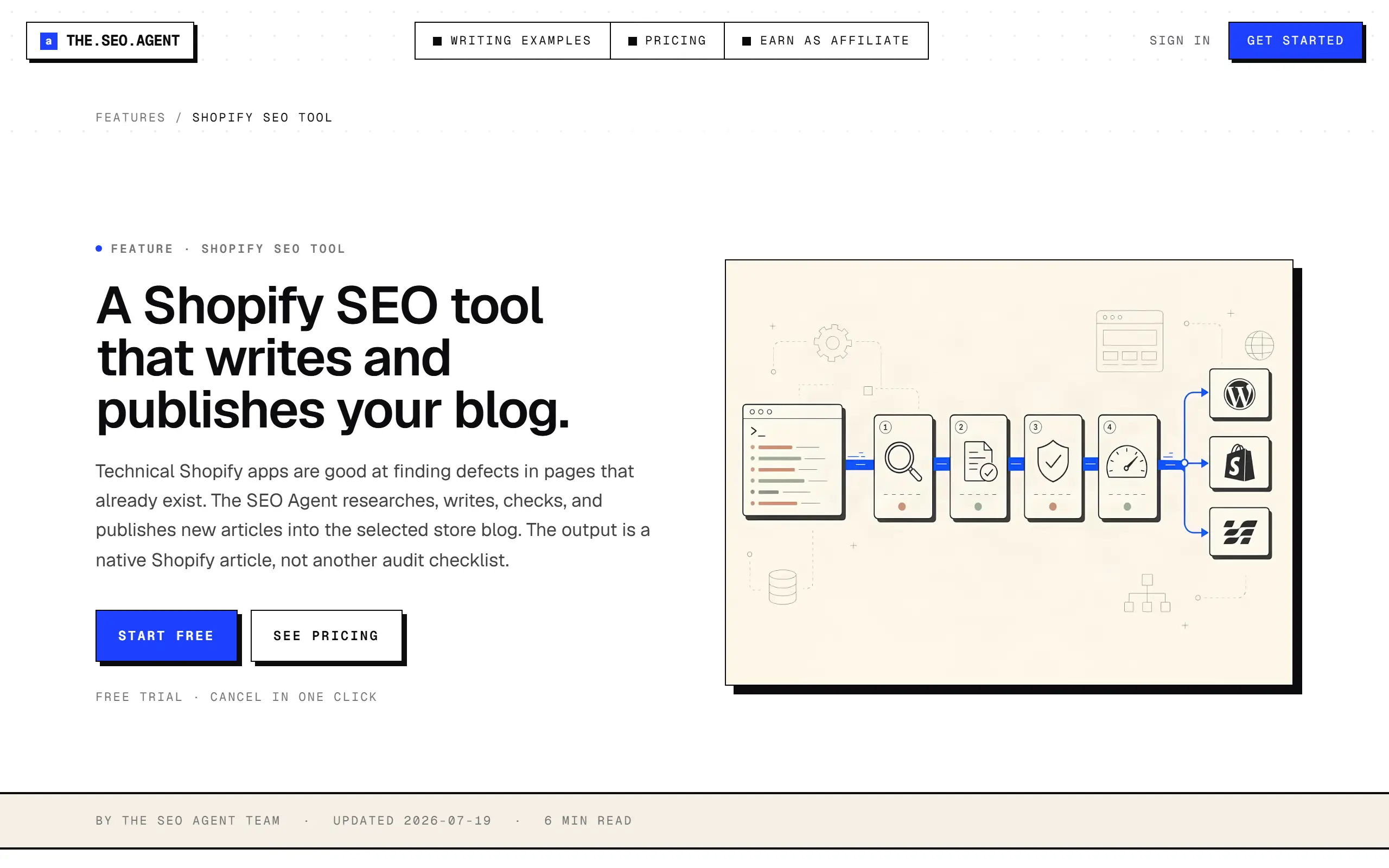
$99/mo per store, $79/mo for each additional store, free trial first. Not a Shopify App Store app: you connect the store from the dashboard and pick the blog. Topics come from live keyword data, every claim is checked against the sources saved during research, and each post lands as a native Shopify article with its title, body, excerpt, tags, author, optional cover image and search listing fields. One post a day, up to 30 a month.
The disclosure first: we build this, and it is not an app you find in the Shopify App Store. It connects to your store, you pick one blog, and finished posts arrive in that blog as native Shopify articles, live or as drafts depending on how you set up the connection. What each article carries, and how the connection works, is on our Shopify SEO tool page.
It ranks first because it is the only entry here that passes all four tests. The topic queue is built from live keyword data rather than a word you typed in. Each draft is checked against the sources saved while researching it: claims the sources back stay, weaker ones get softened, unsupported ones get cut, and an article with a problem left unfixed is held for review instead of published. Auto-publish starts off, so every post waits for your approval until you switch it on. A republish updates the same Shopify article rather than creating a duplicate.
What it does not do: there is no drag-and-drop layout editor, no product block and no comment system. If your theme's blog template looks bad, pair it with a builder from the bottom of this list. The cost case is up to 30 posts a month at a flat $99 a month, where the cheapest App Store writers charge less and check less. Stores that want the whole programme run for them use the done-for-you Shopify SEO option at the same price.
Not a Shopify App Store listing, so there is no install button in the App Store and no App Store review count to check. No layout builder or product blocks. At $99/mo it costs more than the entry plan of every AI writer app on this page.
AI Blog Agent: SEO Auto Blog
Stores that want posts appearing on a schedule with almost no setup.
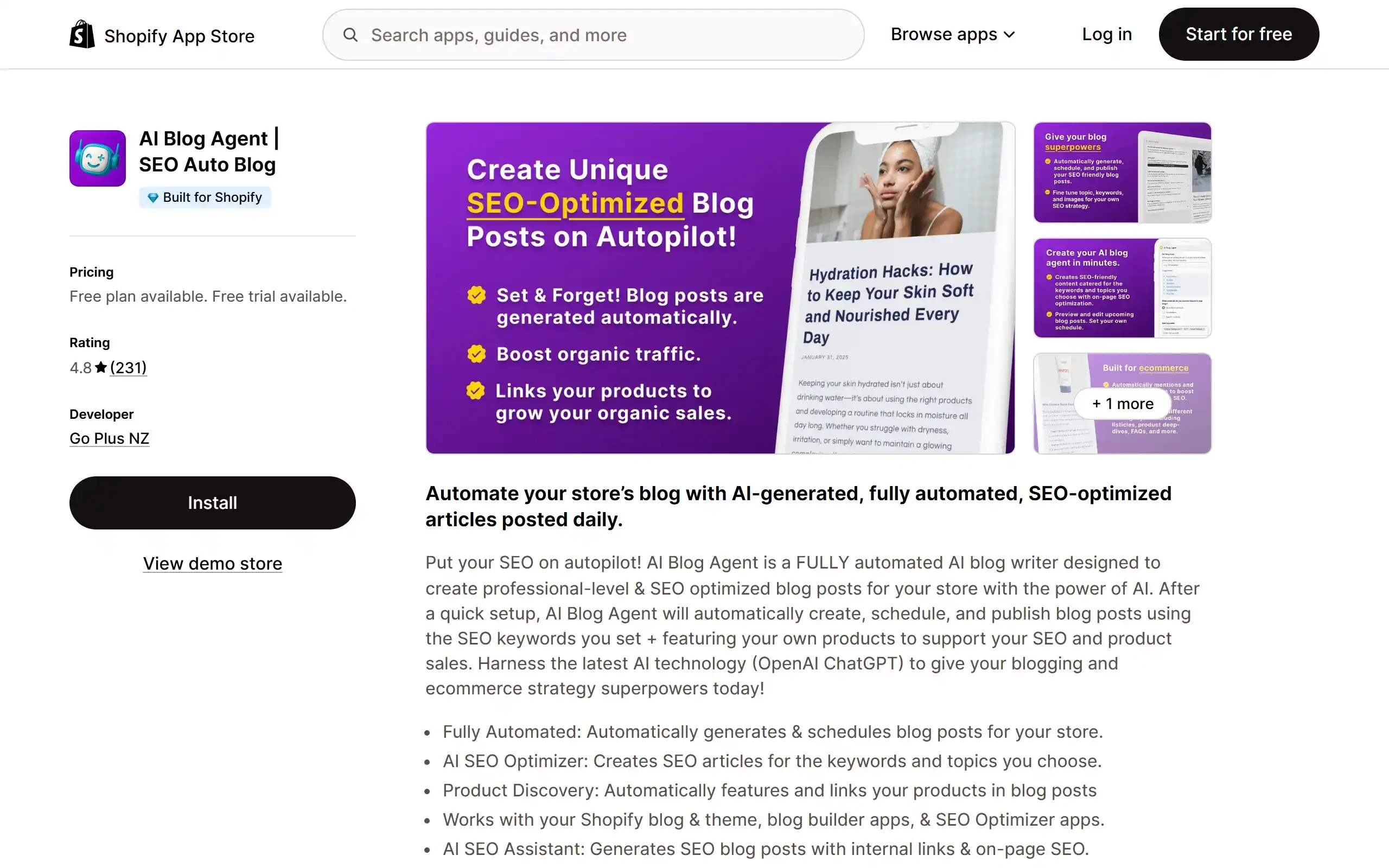
Free plan with 3 posts a week. Starter $8.99/mo for 7 a week (30 a month), Growth $14.99/mo for 15 a week, Pro $23.99/mo for 40 a week (160 a month), each paid plan with a 14-day trial. Rated 4.8 across 231 reviews with the Built for Shopify badge. Creates, schedules and publishes posts into your Shopify blog, adds related images and internal links, and features your own products in posts.
This is the closest App Store match to a blog that fills itself. You set keywords, it writes, schedules and publishes into your existing Shopify blog and theme, and it drops your products into the posts with links. Three free posts a week is enough to judge the writing on your own store before you pay anything, which is the right way to buy any app in this group.
It passes the SEO-ready and published tests and fails the other two. Topics come from the keywords you enter (the listing mentions recommended topics without detail), so the research is yours. Nothing on the listing mentions checking a draft against a source, and that matters more as volume climbs: the top plan is 160 posts a month on your domain. Google judges automated content on whether it helps the reader, not how it was made, a line we draw out in whether AI content hurts SEO.
Topics come from keywords you set, and the listing says nothing about checking claims against sources. The high-volume plans make reading every post before it goes live hard.
Auto Blogs Agent AI Blog Posts
Stores that want a keyword planner bundled with the writer.
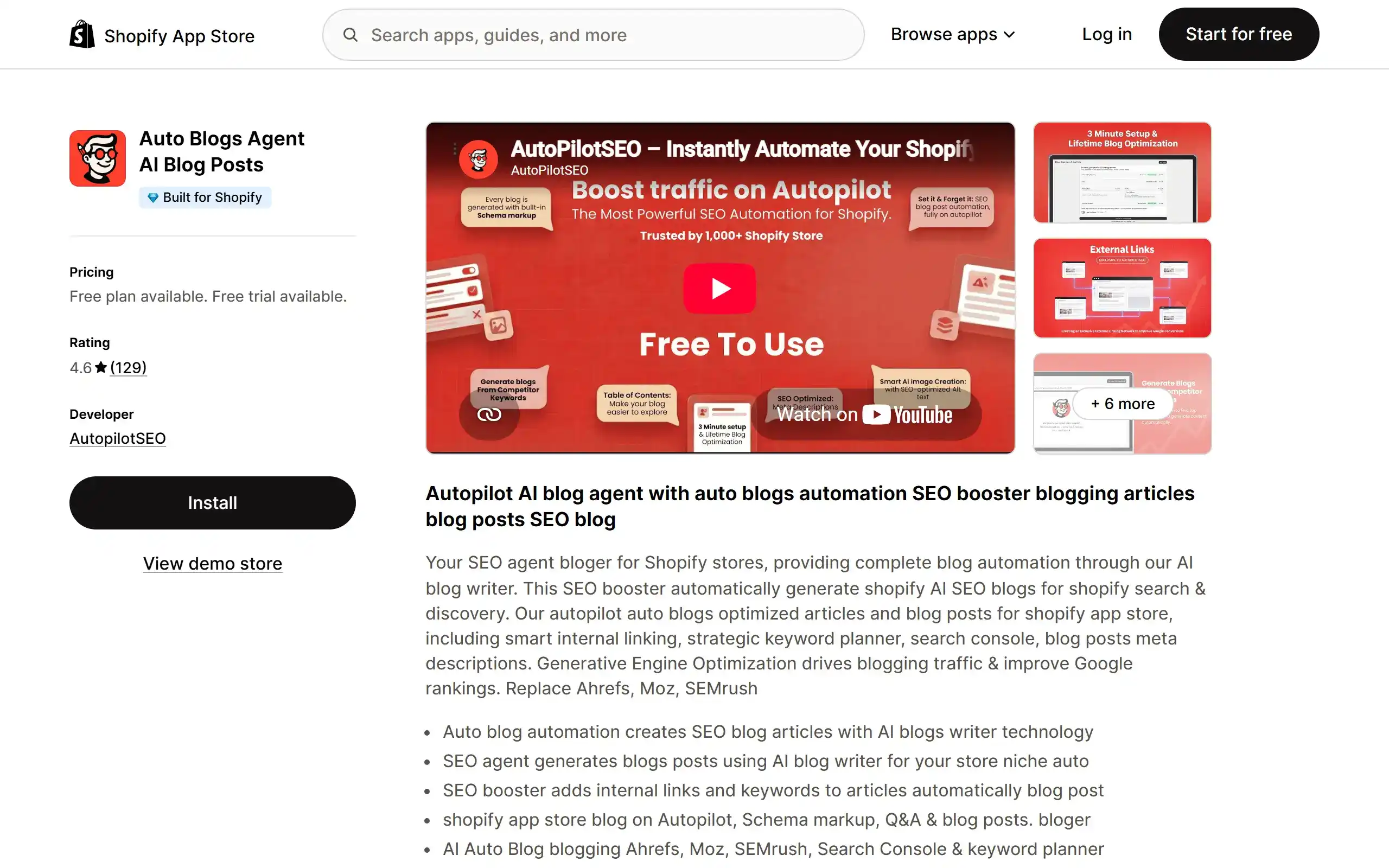
Free plan with 3 posts a month. Starter $12.75/mo for 15, Essential $39.90/mo for 50, Professional $54/mo for 90, each with a 3-day trial. Rated 4.6 across 129 reviews with the Built for Shopify badge. Writes and schedules posts with AI images, internal and external links, schema and meta tags, and builds topics from competitor keywords.
Where AI Blog Agent starts from your keywords, this one tries to find them: the listing leans on a keyword planner and on topics generated from competitor keywords. That gets it partway through the researched test, which is further than most writers here. Schema markup and meta descriptions are generated with each post, so the SEO-ready box is ticked too.
Two caveats from the listing itself. The free plan is three posts a month rather than a week, so it is a trial in all but name, and the 3-day trial on paid plans is the shortest on this page. One reviewer reported AI images that did not make sense and had to be fixed, which is the picture version of the problem every unchecked writer has. Outbound links are added automatically as well, so look at where they point before a post goes live. For the same category beyond Shopify, see our auto-blogging software comparison.
The free plan is 3 posts a month and paid plans carry a 3-day trial. A reviewer flagged AI images that needed fixing, and automatic outbound links need checking.
Essential AI SEO: AI Blog Post
Stores that want the most generated posts per dollar.
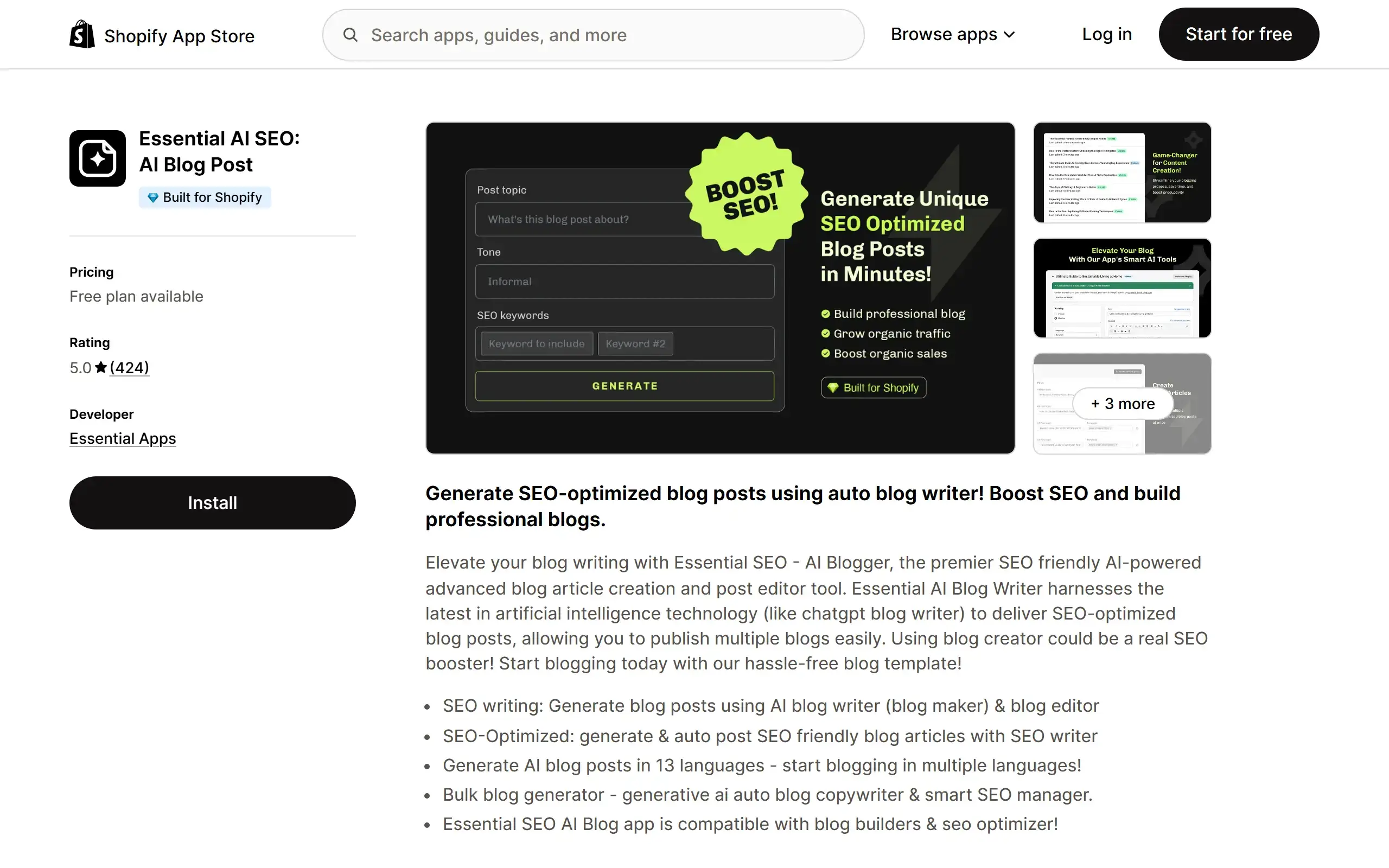
Free plan with 3 generations a month. Starter $9.99/mo for 30, Essential $29.99/mo for 100, Professional $99.99/mo for 300, with 20% off on annual billing. Rated 5.0 across 424 reviews with the Built for Shopify badge. Generates SEO posts from a few keywords, auto-posts them, creates AI images on paid plans, writes in 13 languages and scores each post for SEO.
A 5.0 rating across 424 reviews is the best among the writers here, and $9.99 for 30 posts is the lowest price per post on any paid plan in this list. Bulk creation and 13 languages make it the obvious pick for a store selling into several markets that wants a blog in each language without hiring translators.
The price is per generation, so the honest comparison is not cost per post but cost per post you would keep. The listing says nothing about choosing topics from search data (it offers recommended topics) or about checking claims, and at 300 posts a month on the top plan that is a lot of text with nobody answerable for it but you. If you go this route, read and edit the first ten before you switch on auto-posting, the same advice we give for any AI SEO writer.
No topic research or source checking is mentioned on the listing. Cheap generations make it easy to publish more than you can read.

Avada Blog SEO AEO Content
Stores that want to write with AI help and lay posts out in one app.
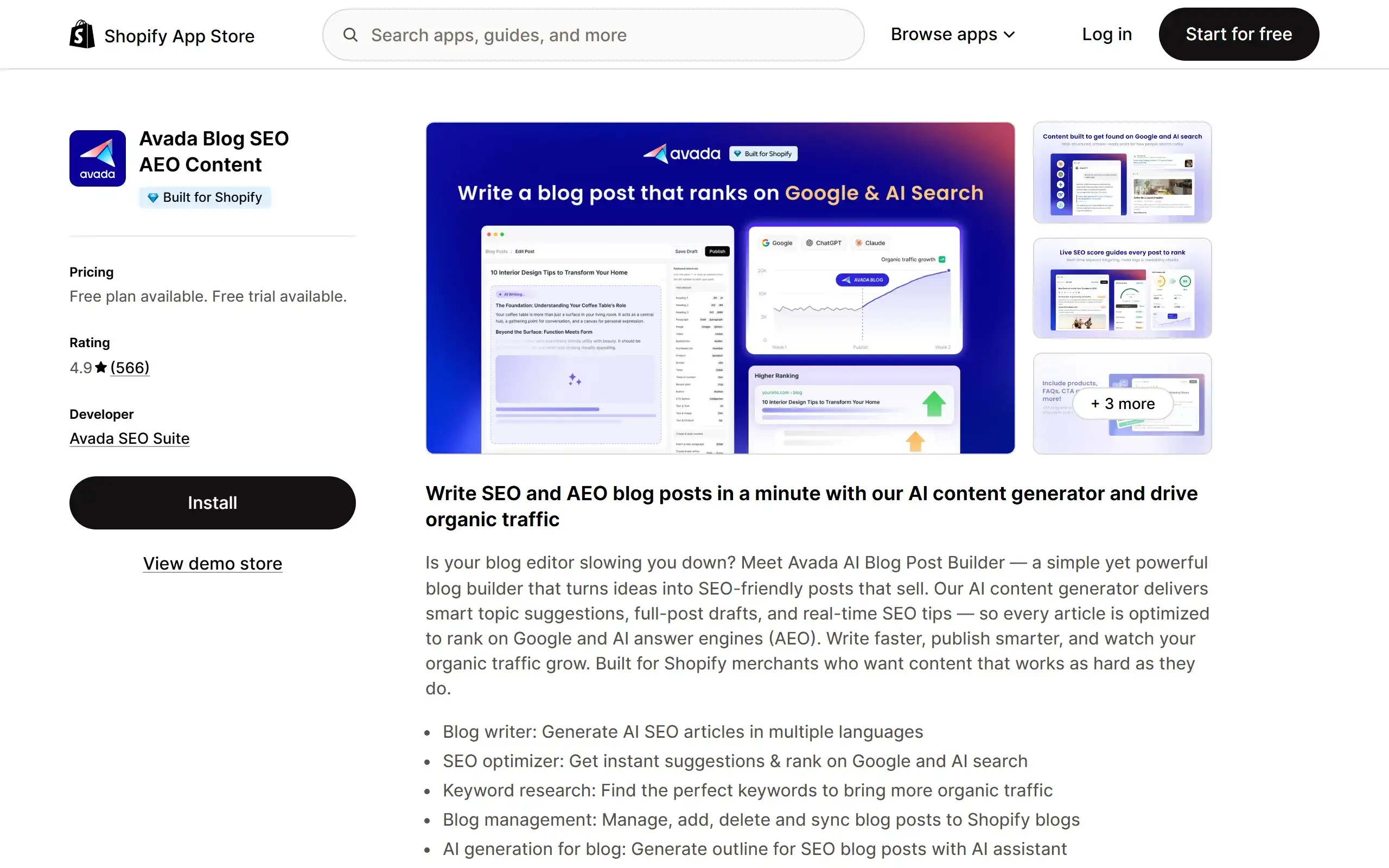
Free plan with unlimited posts, a one-time 200,000 AI tokens, 3 authors and keyword research. Pro $14.90/mo or $149/yr adds 1,000,000 AI tokens a month, advanced elements, an AI assistant, unlimited SEO audit pages and multilingual posts, with a 7-day trial. Rated 4.9 across 566 reviews with the Built for Shopify badge. Includes a blog calendar, auto-scheduling and sync to your Shopify blogs.
Avada built this as a post builder first and a writer second, which is the right order for a merchant who wants control. You get layout elements, an AI assistant for drafts and outlines, keyword research on the free plan, and a calendar to schedule what you have written. It passes the SEO-ready and published tests and gets partway through the researched one, because keyword research is built in rather than left to you.
The free plan's 200,000 AI tokens are a one-time allowance, not a monthly one, so they run out after a handful of full drafts and the real price is $14.90. That is still cheap for a writer and a builder together. What it does not claim is any check of what the assistant writes, so it suits an owner who drafts with AI and edits by hand rather than one who wants posts to appear on their own. Reworking the posts you already have is a separate job, covered in our guide to AI content optimization.
The free AI tokens are a one-time allowance. No source checking is mentioned, so this is a drafting assistant you still edit, not an autopilot.
Tapita GEO Studio & AI Blog
Merchants who want shoppable layouts and AI drafts at no listed cost.
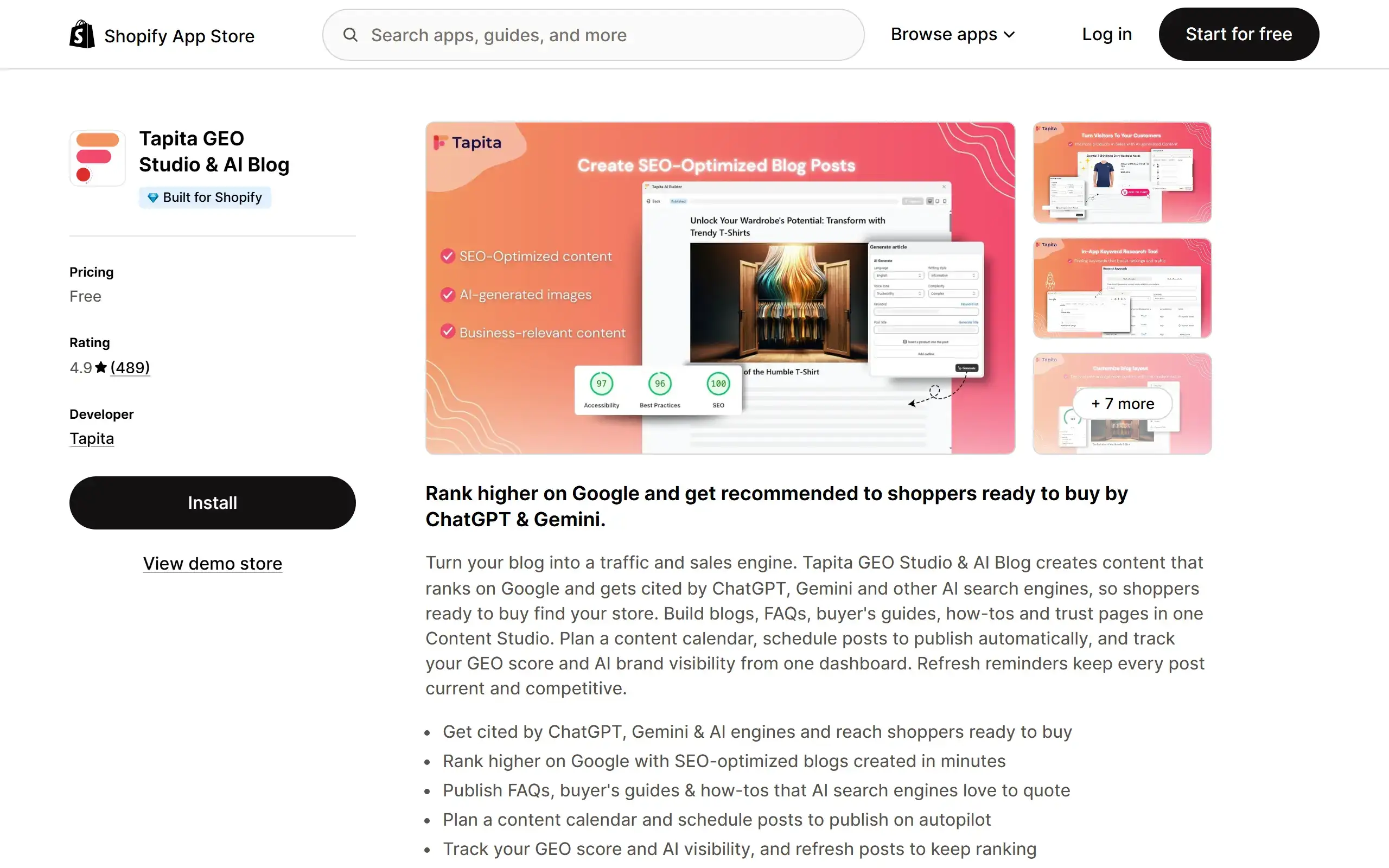
Listed as Free on the App Store, with no paid tiers or post limits shown. Rated 4.9 across 489 reviews with the Built for Shopify badge. Drag-and-drop post editor with a table of contents and custom layouts, AI generation, recommended topics, a content calendar with auto-scheduling, internal linking, embedded products and shoppable links, and translation.
On features alone this is the strongest free entry: a real drag-and-drop editor, product embeds and shoppable links inside posts, a content calendar, and AI generation on top. For a store that wants posts that sell (a buying guide with the products embedded inline) more than posts that merely exist, the layout side is the reason to install it.
The catch is that the listing shows one price, Free, and no limits, so you cannot model what heavier use will cost from the App Store page. Check inside the app before you build a publishing plan on it. The GEO label is about getting quoted by AI assistants, which depends on having the clearest answer on the page far more than on the editor, as our guide to answer engine optimization explains. No source checking is mentioned.
The listing shows no paid tiers or limits, so the cost at volume is unknown until you are inside the app. No source checking is mentioned.
SEOWILL: AI SEO & AI Blog Post
Stores that want blog posts and store-wide SEO fixes from one subscription.
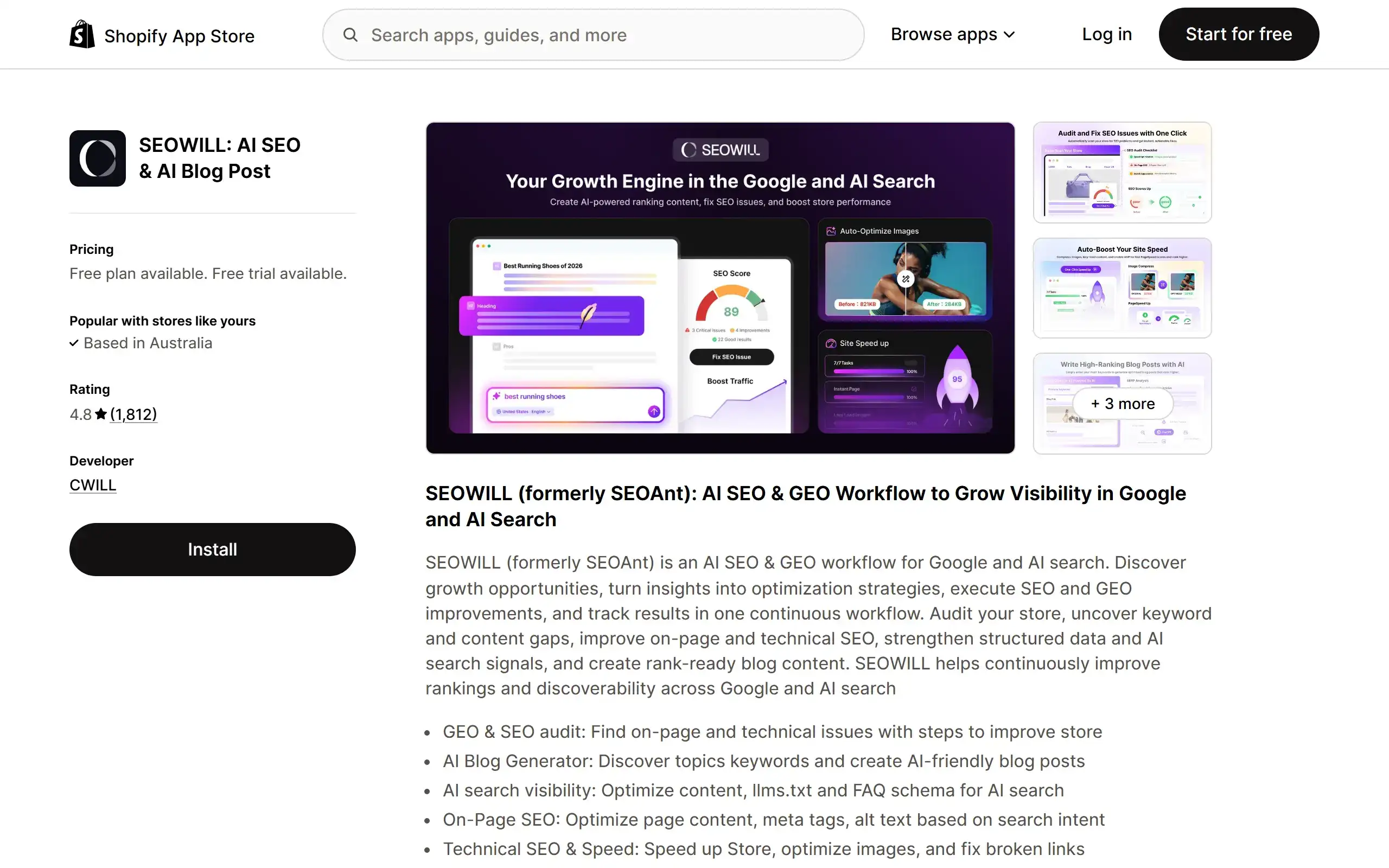
Free plan with 30 AI blog generator credits, 30 content optimization credits, 30 keyword content planner credits and a full-site SEO and GEO audit. Pro $29.99/mo adds 200 optimization credits a month, structured data and llms.txt; Premium $59.99/mo adds AI internal linking and competitor analysis. 7-day trial on paid plans. Rated 4.8 across 1,812 reviews, the largest review base on this list. Formerly SEOAnt.
The biggest review base here by a distance, and the only entry that is really an SEO suite with a blog generator attached rather than a blog app. The keyword content planner gives it a better claim to the researched test than most writers, and the audit covers the store pages a blog app never touches. If you were going to install a technical SEO app anyway, this saves you the second install.
Read the plans closely. The listing does not state how many blog generations Pro or Premium include, internal linking sits on the $59.99 plan, and one recent review reported charges the merchant did not expect (the developer replied that it was an overage setting and offered a refund). Because most of its value is on the SEO side, weigh it against the technical apps in our roundup of the best Shopify SEO apps before you treat it as a blog app.
Blog generation limits on the paid plans are not stated on the listing, internal linking needs Premium, and one reviewer reported unexpected overage charges.
Bloggle: SEO Blog Builder
Stores that write their own posts and want them to look and sell better.
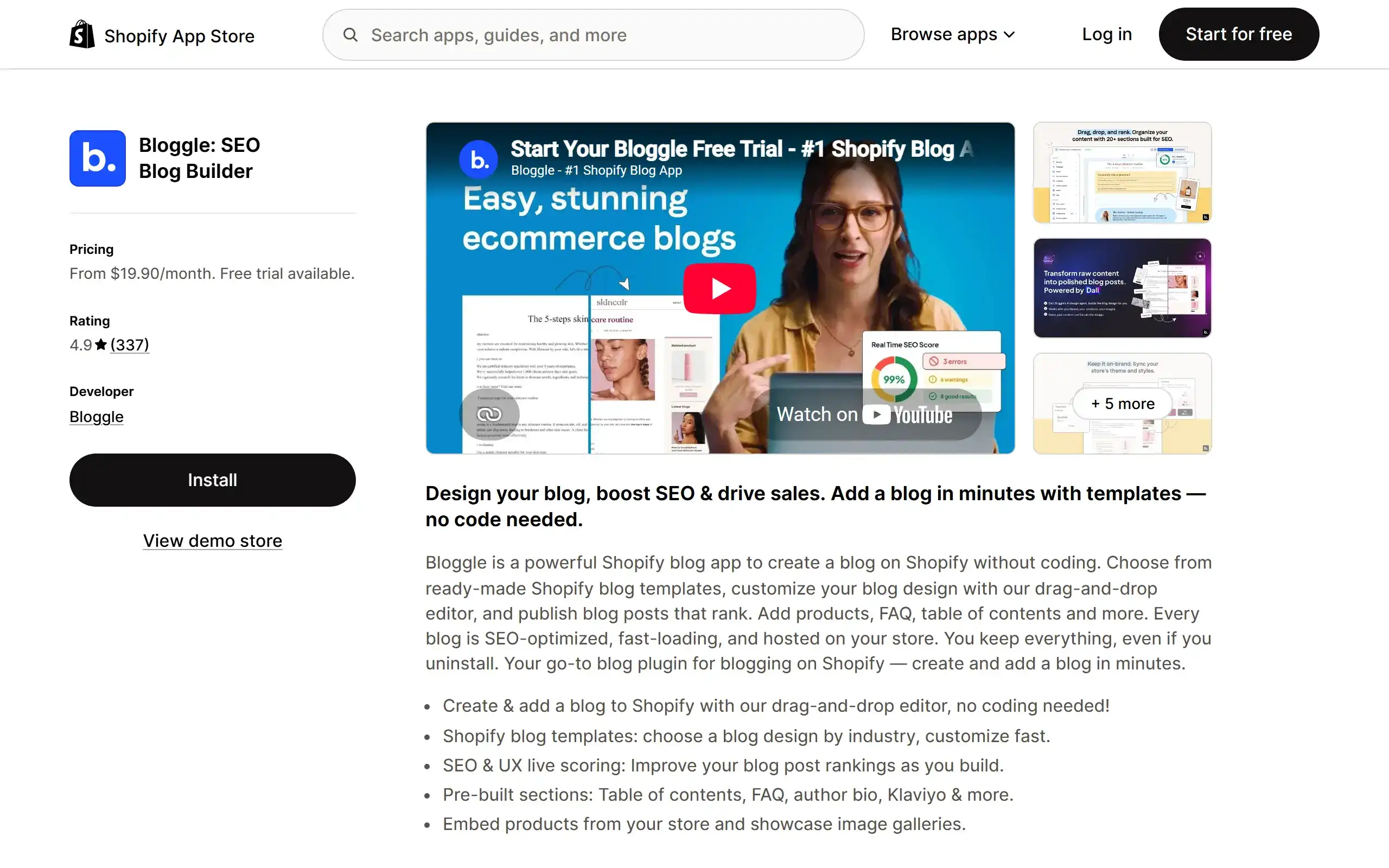
Starter $19.90/mo, Pro $49.90/mo, Business $79.90/mo, each with a 14-day trial and no free plan. Rated 4.9 across 337 reviews. Drag-and-drop builder with templates by industry, live SEO and UX scoring, table of contents, FAQ, author and product sections, theme style sync and blog import. Posts are hosted on your store and stay after you uninstall.
The best pure builder on the App Store. Templates by industry, product galleries and FAQ blocks inside posts, and a live SEO and UX score while you edit turn the plain Shopify blog template into something closer to a magazine. The promise that posts stay on your store after you uninstall removes the usual fear of building on an app.
It is a container, though. The listing mentions AI generation without detail and says nothing about topics or source checks, so it passes SEO-ready and published for posts you already wrote and leaves researched and checked to you. The useful features also climb the tiers: the FAQ block and related posts start at $49.90, Klaviyo forms at $79.90. If the real problem is an empty blog rather than an ugly one, pair it with a writer or with the autoblogging approach.
No free plan, and the conversion features (FAQ, related posts, Klaviyo forms) sit on the $49.90 and $79.90 tiers. Writing the posts is still your job.
Magefan SEO Blog Writer
Stores that want categories, tags, authors and templates like a publication.
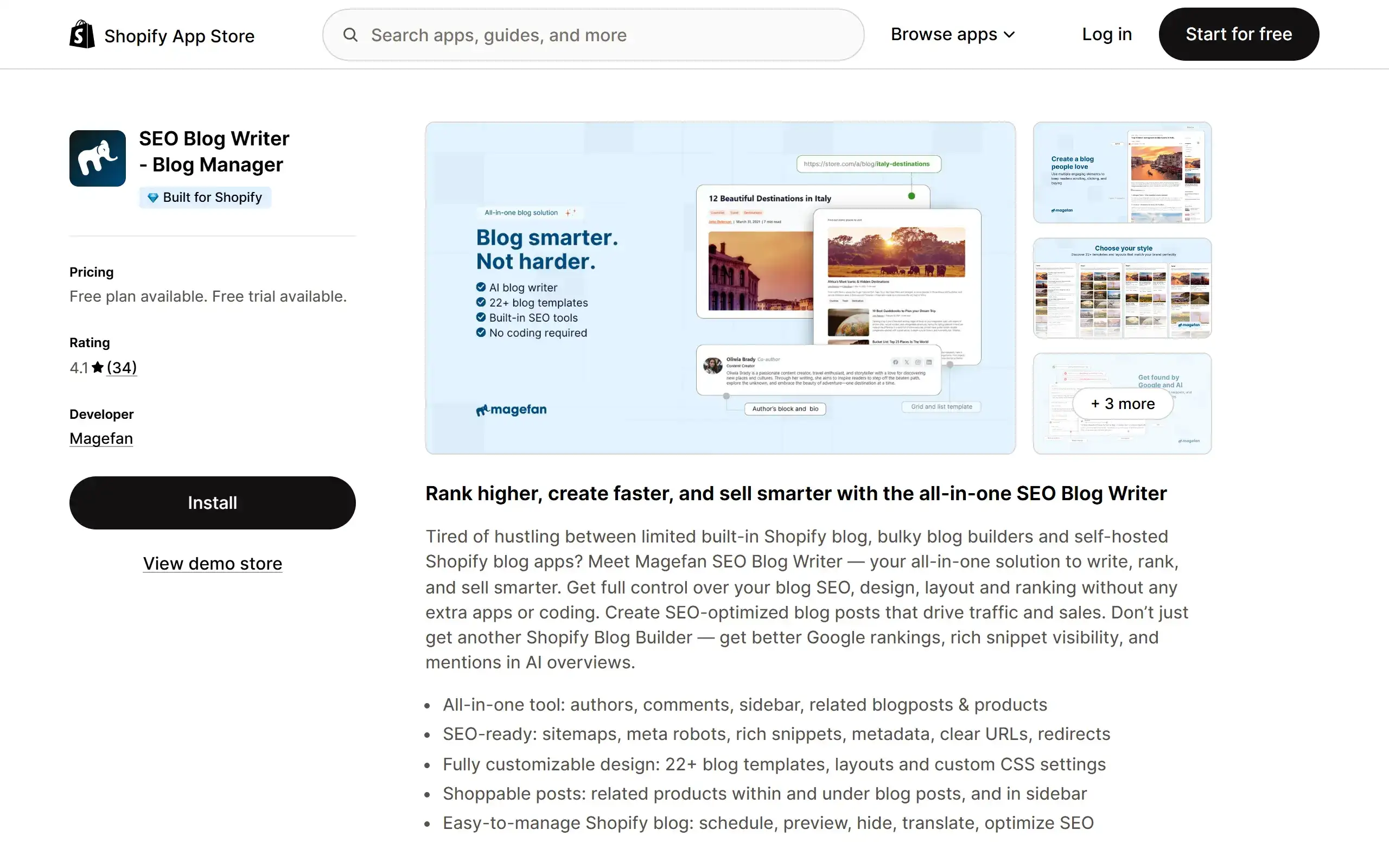
Free Basic plan with 50 entities (posts, categories, tags and authors counted together), 1 template, meta fields, scheduling, comments and an XML sitemap. Standard $19/mo or $190/yr unlocks unlimited entities, author pages, rich snippets and related posts and products; Pro $39/mo or $390/yr adds 22+ templates, a table of contents and translation. 7-day trial. Rated 4.1 across 34 reviews with the Built for Shopify badge.
Listed as SEO Blog Writer and Blog Manager, this is the most structured blog on the list: real categories, tags, author pages, comments, related products and per-post meta settings. Reviewers moving off other platforms single out the support. If your blog needs to work like a publication with sections rather than one long feed, this is the cheapest way to get that.
The free plan's 50-entity cap counts categories, tags and authors as well as posts, so it runs out faster than it sounds, and 4.1 across 34 reviews is the lowest rating and the smallest review base here. Despite the name, the listing gives no detail on the AI writing, so treat it as a blog manager. Structure only helps once there are posts worth sorting, which is the order of work in our blog SEO guide.
The free plan counts categories, tags and authors toward its 50-entity cap. The lowest rating on the list at 4.1, and the AI writing is not described.
DropInBlog: Blog Engine
Content teams with several writers, permissions and an agency-sized budget.
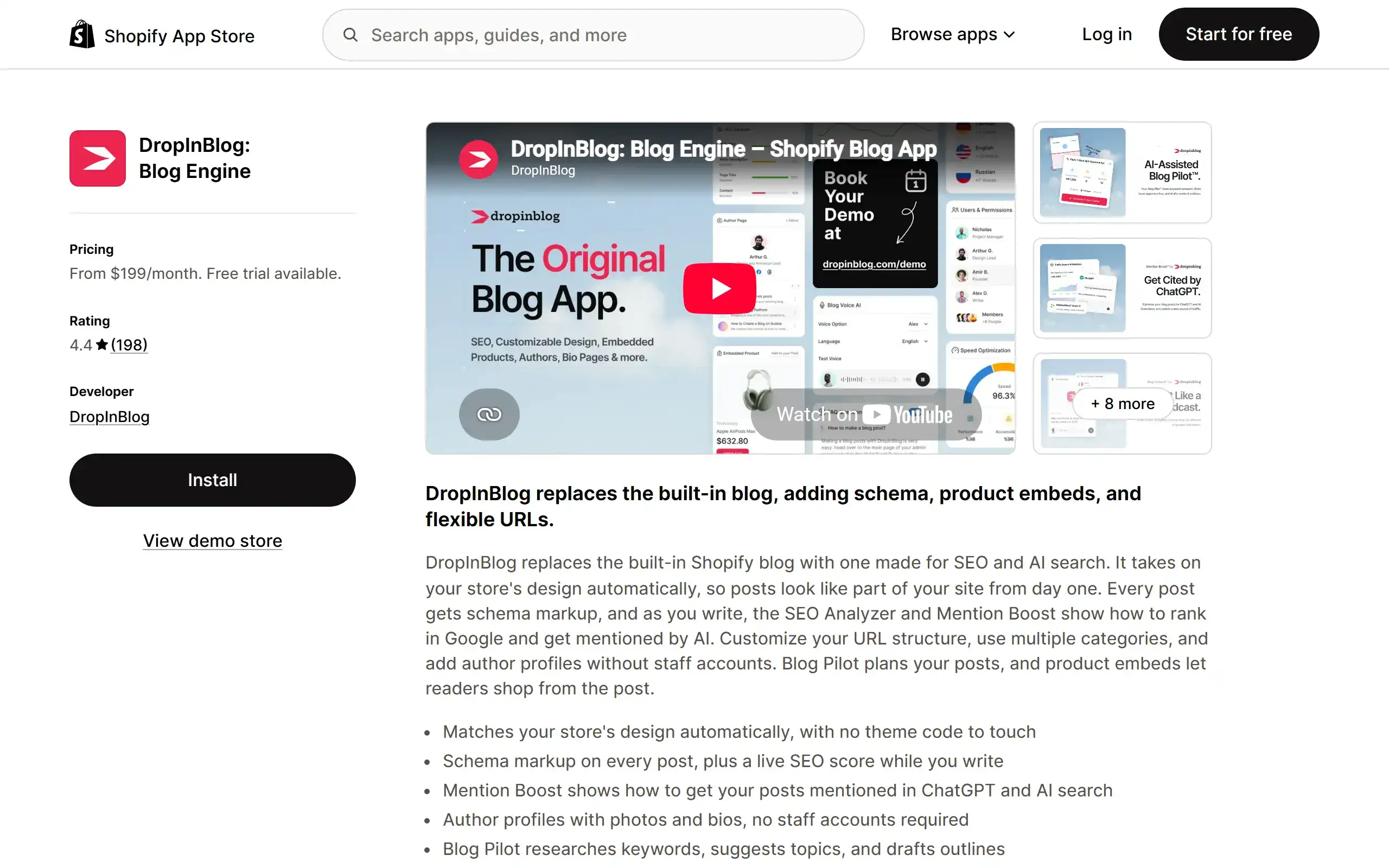
From $199/mo or $1,908/yr (Team: 5 users, 15 authors, unlimited posts, product embeds, SEO Post Analyzer, Mention Boost and the Blog Pilot assistant). Business $499/mo adds 10 users, unlimited authors, a staging environment and white-glove migration. 7-day trial. Rated 4.4 across 198 reviews. Replaces the built-in Shopify blog, takes on your store design automatically and adds schema to every post.
DropInBlog replaces the built-in Shopify blog with its own engine, and on the App Store it is now priced for teams rather than solo merchants. What $199 buys is workflow: user permissions, author profiles without staff accounts, a live SEO score while writing, schema on every post, flexible URL structures and product embeds. Blog Pilot researches keywords, suggests topics and drafts outlines, which puts it ahead of the other builders on the researched test.
For a single-owner store the price ends the conversation: $199 a month is ten times Bloggle's entry plan before anyone has written a word. It drafts outlines, not finished posts, and the listing does not describe any source check. It makes sense for a content team that already has writers and needs the editorial workflow around them. A store without the writers needs the automated content pipeline side of the market instead.
From $199/mo on the App Store, the highest entry price here by far. Blog Pilot drafts outlines, so the writing and checking stay with your team.
Builder, writer, or pipeline.
The ten entries collapse into three purchases. Most stores need one of them, and the expensive mistake is buying the wrong one for the problem in front of you.
You or your team already write, the posts exist, and they look like plain text in a theme template. Bloggle for design, Magefan for categories and authors on a budget, DropInBlog for a team with permissions and approvals.
The blog is empty or stale, you know which topics you want, and you will read each post before it goes live. AI Blog Agent or Essential AI SEO for volume, Avada Blog or Tapita if you want to edit layouts as you go.
You want topics chosen from search data, claims checked against sources, and posts arriving in your Shopify blog without you writing, pasting or fact-hunting. That is the job The SEO Agent does, and the wider case for content on a store is on our ecommerce SEO page.
Why writing outside Shopify costs more than it looks.
Plenty of stores skip the App Store entirely and draft posts in a chat assistant or a general writing tool. The writing is the quick part. Then the post has to be pasted into the Shopify editor, where headings and tables come across broken, images have to be uploaded again one at a time, alt text is blank, the search engine listing fields stay empty unless you fill them, and nobody adds links to your own products or older posts. Every post pays that formatting tax again, and it is usually the formatting, not the writing, that ends a publishing habit.
That is why the published test carries so much weight on this page. Every app above passes it, because they run inside the store admin. Our pipeline passes it through a direct connection instead, filling the search listing fields and placing internal links before the post arrives. General tools that stop at the draft are compared in our roundup of AI copywriting tools, and they are fine for a one-off post. For a cadence, the copy-paste step is what you are really paying to remove.

Fix the container once. Then keep publishing.
The failure mode in this category is treating the blog as a design project. A merchant installs a builder, picks a template, spends a weekend on the layout, publishes four posts and stops. Search traffic from a blog comes from the number of useful posts answering what buyers ask before they buy, and a beautiful template with four posts in it ranks like four posts.
Sequence it the other way round. Use the built-in blog or one builder, accept a plain layout, and put the effort into a steady cadence of posts that are researched and correct. Whether that cadence comes from you, an App Store writer you edit, or a pipeline like our content marketing automation, the store that publishes every week for a year beats the store with the nicer template.
Ten blog apps, four tests, side by side.
| FEATURE | THE SEO AGENT | AI BLOG AGENT | AUTO BLOGS AGENT | ESSENTIAL AI SEO | AVADA BLOG | TAPITA | SEOWILL | BLOGGLE | MAGEFAN BLOG | DROPINBLOG |
|---|---|---|---|---|---|---|---|---|---|---|
| Shopify App Store listing | ||||||||||
| App Store rating | No listing | 4.8 (231) | 4.6 (129) | 5.0 (424) | 4.9 (566) | 4.9 (489) | 4.8 (1,812) | 4.9 (337) | 4.1 (34) | 4.4 (198) |
| Free plan | ||||||||||
| Entry paid price | $99/mo | $8.99/mo | $12.75/mo | $9.99/mo | $14.90/mo | Listed free | $29.99/mo | $19.90/mo | $19/mo | $199/mo |
| Writes full posts | Not detailed | Not detailed | Outlines | |||||||
| Topics from keyword data | Your keywords | Planner | Suggested | Suggested | Planner | |||||
| Claims checked against sources | ||||||||||
| Writes and publishes on a schedule | Once switched on | You schedule | You schedule | Not stated | ||||||
| Drag-and-drop layout editor | Templates | Templates |
What is the best Shopify blog app?
It depends which job is open on your store. To fill the blog on autopilot from inside Shopify, AI Blog Agent is free for 3 posts a week and $8.99 a month for 30, rated 4.8 across 231 reviews. For the lowest price per post, Essential AI SEO is $9.99 a month for 30. For an AI writer and a layout editor in one app, Avada Blog is $14.90 a month. For layout and product blocks on posts you write yourself, Bloggle starts at $19.90 a month. For a multi-author content team, DropInBlog starts at $199 a month. If you want posts researched from keyword data and checked against sources before they publish into your Shopify blog, that is The SEO Agent at $99 a month per store, which is not an App Store app.
Is there a free blog app for Shopify?
Several, and the built-in blog is free too. Every Shopify store has a blog under Content > Blog posts, and Shopify Magic can generate a title and body there at no extra cost. Among apps, Tapita is listed as free, Avada Blog has a free plan with unlimited posts and a one-time 200,000 AI tokens, AI Blog Agent gives you 3 posts a week free, and Magefan has a free plan capped at 50 posts, categories, tags and authors combined. Free plans are metered on the feature you use most, so expect to pay once the blog matters.
Do I need a blog app, or is the built-in Shopify blog enough?
For the container, the built-in blog is usually enough. It has a rich text editor, an excerpt, a featured image, tags, an author, a search engine listing section for the page title, meta description and URL handle, and scheduling through the Visibility setting. Install a builder when you need layouts, product blocks or categories the theme cannot give you. Install a writer when the problem is that nobody is writing. Most stores with an empty blog have the second problem and buy a solution to the first.
What is the best AI blog writer for Shopify?
Among App Store apps, AI Blog Agent is the most hands-off, Essential AI SEO is the cheapest per post, and Auto Blogs Agent has the most built-in keyword planning. None of their listings mention checking claims against sources, so whatever they write is your responsibility to read, which Shopify also says about its own Shopify Magic text. The SEO Agent researches topics from live keyword data, checks every claim against the sources saved during research, holds anything with an unfixed problem for review, and publishes into your Shopify blog.
Is there a Shopify blog plugin like the ones on WordPress?
Shopify calls them apps rather than plugins, but they do the same job: you install them from the Shopify App Store and they add features to the store admin. Blog plugins in the WordPress sense map to the builders on this list (Bloggle, Magefan, DropInBlog), while AI writing plugins map to the writers (AI Blog Agent, Auto Blogs Agent, Essential AI SEO, Avada Blog, Tapita, SEOWILL). Shopify itself covers the basics a WordPress SEO plugin adds, such as the search engine listing fields on every post.
Can AI-written blog posts hurt my store in search?
Being written with AI is not the problem. Thin, repetitive or wrong posts are, and an autopilot writer can publish a lot of those quickly. Shopify warns that generated text can include product benefits you did not list and facts pulled from related content. The safe pattern is to read the first batch from any writer before switching on automatic publishing, and to use a tool that checks claims against sources if you want posts to go live without reading every one.
Is The SEO Agent a Shopify app?
It is not listed on the Shopify App Store today. You connect your store from our dashboard, choose which blog to publish to, and articles arrive in that blog as native Shopify articles with the title, body, excerpt, tags, author, optional cover image and search listing fields filled, either live or as drafts. Auto-publish starts off, so each article waits for your approval until you turn it on. It costs $99 a month per store after a free trial.
How did you rank these, and is this list sponsored?
Each app was judged on four tests: whether topics come from search data, whether drafts are checked against sources, whether posts ship with their SEO fields filled, and whether they reach the Shopify blog without copy-paste. The list is grouped by job (full pipeline, autopilot writers, writers with an editor, builders) and ranked within each group by how many tests an app passes. Nothing is sponsored, there are no affiliate links and no links out to the apps. We build the entry at number one and say so on it. Prices, ratings and review counts were read off each listing on 17 October 2026.
Related guides + features.
Shopify SEO tool
Research, cited drafting, a check on every claim, and native publishing into your Shopify blog, which is the one job the App Store apps leave open.
/features/shopify-seo-tool →PRICINGSimple pricing
$99 flat per month after a free trial. No per-keyword meter, and cancellation is one click in the app.
/pricing →PILLAR · AUTOBLOGGINGAutoblogging
Hands-off publishing on a cadence you set, with every claim checked and anything unsupported cut before it reaches your site.
/features/autoblogging →Put researched posts in your Shopify blog every day.
Connect your store and the agent picks topics from live keyword data, writes each article, checks every claim against its sources, and publishes it into your Shopify blog. $99 a month per store, free trial first, cancel in one click.
FREE TRIAL · CANCEL IN ONE CLICK