Autoblogging.ai review: fast drafts, thin checks.
Autoblogging.ai is a real AI article generator with a clear buyer: people who want to produce blog posts quickly from known topics. The question is not whether it can draft. It can. The question is whether a draft-first autoblogging tool is enough when your site needs live keyword validation, citations, editorial control, and a check that cuts unbacked claims before publishing.
Is Autoblogging.ai worth using in 2026?
Autoblogging.ai is worth using if your main problem is generating many article drafts from a keyword list you already trust. TheSEOAgent is the better fit if your problem is the whole SEO publishing loop: finding the right keyword, checking the SERP, drafting with citations, cutting unbacked claims, and publishing to your CMS without turning your domain into a test folder.
Want autoblogging that checks its facts? Every claim in a SEO Agent draft is tested against its sources, and anything unsupported is cut before it posts. Enter your site to start.
Free trial · Cancel in one click1. What Autoblogging.ai is.
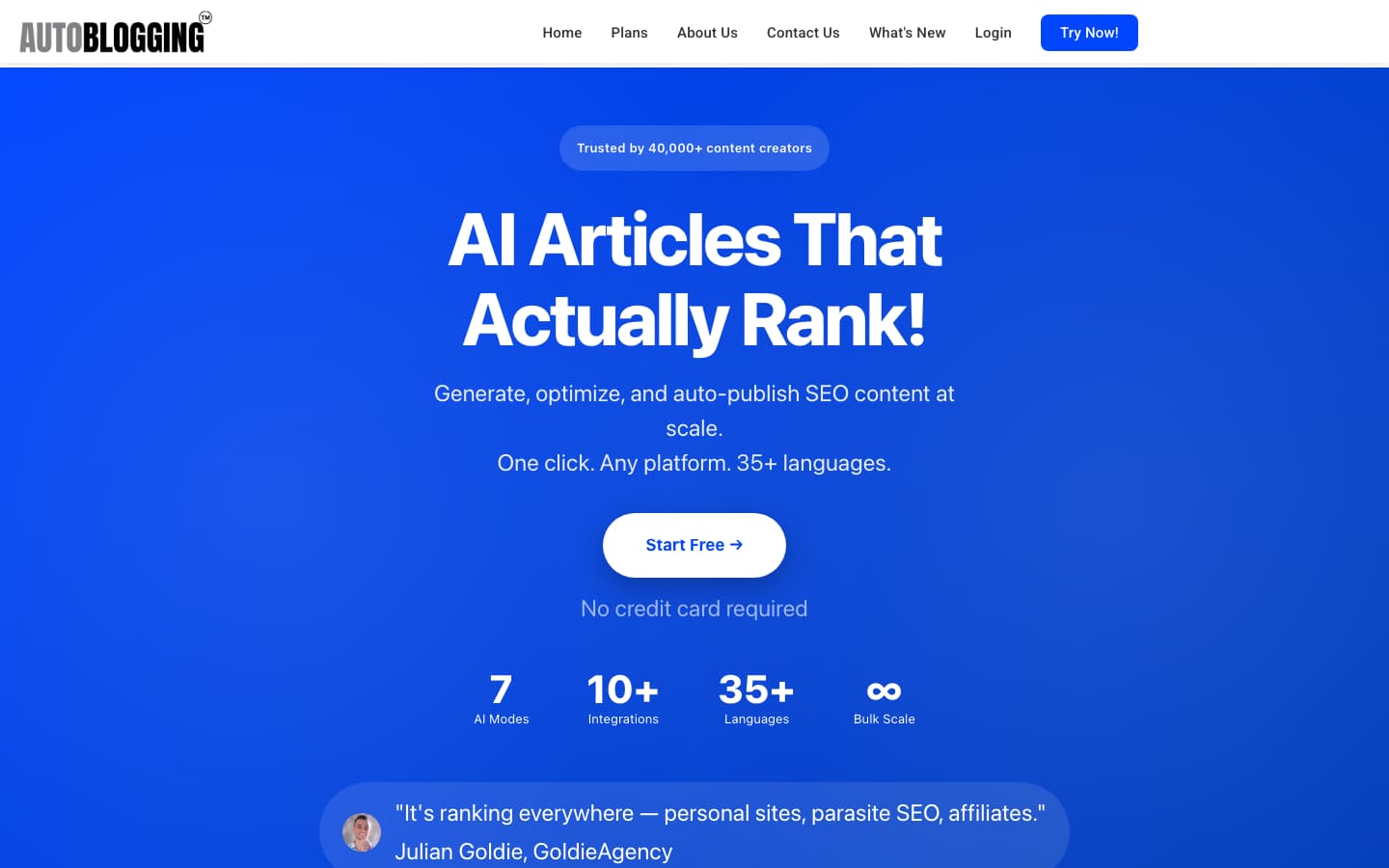
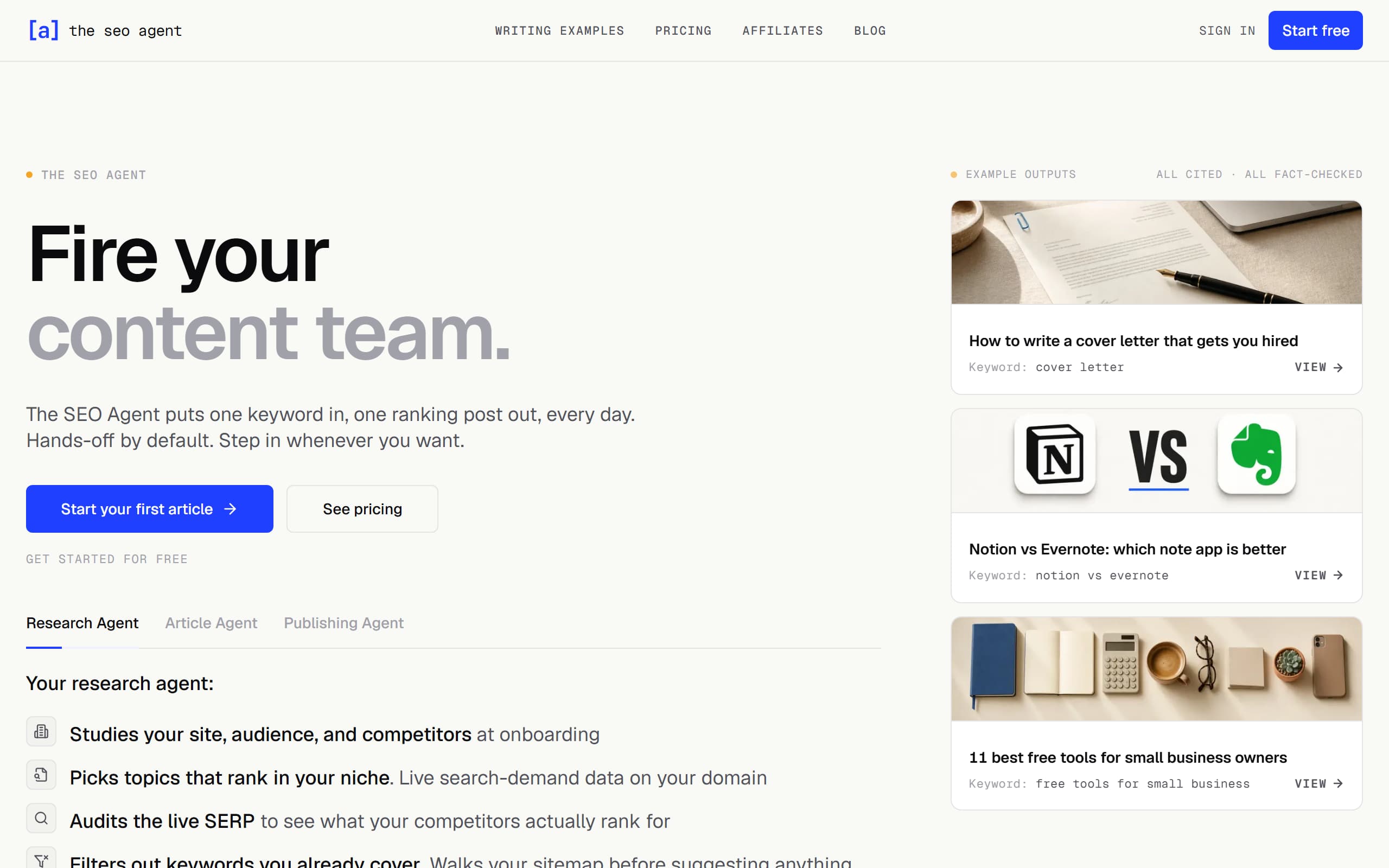
Autoblogging.ai is best understood as a fast AI article generator for publishers who already know what they want to write. TheSEOAgent is better understood as an AI SEO tool that owns the whole workflow: keyword validation, outline approval, drafting, citations, a claim check, internal links, and CMS publishing.
Autoblogging.ai is an AI article generation platform. Its public positioning is simple: create SEO articles quickly, support bulk workflows, publish to WordPress, and give users multiple generation modes for different content needs. That makes it more focused than a general AI writer and more direct than a research dashboard. It sits in the same category as modern autoblogging software.
The product is strongest when the user already has the topic, already trusts the keyword, and wants the article generated now. That is not a small problem. Plenty of affiliate publishers, niche-site operators, and solo founders are stuck at the drafting step. Autoblogging.ai attacks that bottleneck directly, while our SEO automation software category page explains the wider platform difference.
2. Where Autoblogging.ai wins.
The charitable version of this review is important. Autoblogging.ai is not a fake tool or a thin wrapper. It has a clear job and a product built around that job. The strongest parts are:
- Draft speed. If the buyer wants a usable article draft from a known keyword, generation speed is the headline feature. That is where Autoblogging.ai is most comfortable.
- Bulk workflows. A bulk-first tool is useful for publishers managing many similar keywords, especially when every page follows the same affiliate or review template.
- WordPress publishing fit. The WordPress path matters because most autoblog buyers still publish there. If your whole stack is WordPress and the editorial bar is light, that focus helps. Teams that need a broader CMS path should compare it with our WordPress SEO automation page and the non-WordPress integrations listed there.
- Simple buyer promise. The product does not pretend to be a full enterprise SEO suite. It promises article output, which is exactly what its buyers are usually shopping for.

If all you need is draft volume, this is a reasonable shortlist product. The problem starts when draft volume is mistaken for an SEO automation pipeline.
3. Where the workflow breaks down.
The risky part of autoblogging is not that AI writes words. The risky part is that publishing becomes too easy. A system that can generate a post in seconds can also publish a weak post in seconds. If the product does not slow down at the right points, the customer becomes the fact-checker. That is why our broader SEO automation tools list ranks platforms by what they check before publishing, not just what they can generate.

That is the gap TheSEOAgent was built around. We do not treat the article writer as the product. The product is the chain around the writer: keyword research, outline approval, SERP-aware drafting, citations, a claim check, internal links, and native publish. If the check leaves a fact problem unfixed, the article waits for your review.
- Keyword risk. A draft can read well and still target a keyword that is too small, too hard, or wrong for your buyer. The page needs real keyword validation before it exists, especially for SaaS and agency teams working from a fixed publishing calendar. That is the job of our SEO automation pipeline.
- Citation risk. AI writers can invent stats, dates, and product claims. Without a citation pass, the editor has to find every soft hallucination manually.
- Domain risk. Publishing many weak pages is worse than publishing slowly. It trains your own site into a low-trust content pattern.
4. Autoblogging.ai vs TheSEOAgent.
The cleanest split: Autoblogging.ai is a strong article generator. TheSEOAgent is a fuller publishing system. That difference matters most when your domain already has traffic worth protecting.
| FEATURE | AUTOBLOGGING.AI | THESEOAGENT |
|---|---|---|
| Best fit | Bulk article generation for niche sites and affiliate publishers | Daily SEO publishing pipeline for founders and content teams |
| Keyword selection | Works best when the user already knows the keyword | Live keyword research and SERP checks before article planning |
| Drafting modes | Multiple writer modes and bulk workflows | One controlled pipeline optimized for publishable articles |
| Fact checking | Depends on user review and prompt settings | Citation-backed pass before the article can publish |
| Claim check | Draft-first workflow | Every claim checked against its sources, unbacked ones cut |
| CMS publishing | Strong WordPress-oriented publishing support | WordPress, Webflow, Shopify, Ghost, Wix, and webhook paths |
| Best buying reason | You need articles generated fast | You need the whole SEO content job handled |
5. The decision matrix.
Use this quick split if you are comparing Autoblogging.ai against TheSEOAgent, Outrank, BabyLoveGrowth, or another autoblogging product.
- You already have a keyword list you trust.
- You publish mostly to WordPress.
- You have an editor checking every draft.
- You care more about draft volume than pipeline control.
- You need keyword discovery before drafting.
- You want citations and claim checks built in.
- You publish across WordPress, Webflow, Shopify, Ghost, Wix, or webhook.
- You want unbacked claims cut before they reach the CMS.
If you are still shopping the category, compare this page with our TheSEOAgent vs Outrank breakdown and the wider best AI SEO tools list. Those two pages cover the same buyer from the comparison and category angles.
6. Who should use which tool.
Pick Autoblogging.ai if the workflow is already decided and the only missing piece is fast draft generation. That means you already know the keywords, you trust your editor, your CMS is mostly WordPress, and weak drafts will be caught manually. This is closest to a classic autoblogging tool buying motion.
Pick The SEO Agent if you want fewer manual checks between idea and published article. The platform is built for founders and content teams who want SEO as an output, not another writing tool to manage. That is why the pipeline includes keyword scoring, article planning, fact checking, internal linking, and CMS publish in one subscription. Teams building a SaaS content engine should also look at our AI SEO software page for the non-autoblogging framing.

7. How to test before switching.
Do not pick either tool from a landing page. Run the same test across both:
- Pick three keywords your site could realistically rank for.
- Generate one article for each keyword in both products.
- Check whether the title matches search intent before reading the body.
- Count unsupported factual claims and vague source references.
- Measure how many edits an editor needs before the article is publishable.
The winning tool is the one that needs less cleanup at your editorial standard. If the only difference is writing style, choose the cheaper workflow. If the difference is keyword choice, citations, or publish readiness, choose the system with the stronger checks. Our free trial exists so that comparison can happen with your own keywords, not our demo copy. If you need the agency angle, the next page to read is our SEO automation software ranking.
- Autoblogging without the old content-farm smell
- Best auto blogging software for the category shortlist
- TheSEOAgent vs Outrank, the closest same-shape comparison
- AI SEO tools ranked by actual SEO workflow depth
- Blogi AI autoblogger review, tested on the same criteria
- WordPress SEO automation with an official publisher plugin
Is Autoblogging.ai good for SEO?
Autoblogging.ai can be useful for generating SEO drafts quickly, especially when the buyer already knows the target keyword and wants a bulk article workflow. The risk is that generation speed is not the same as publishing discipline. For teams protecting an existing domain, the missing piece is usually a pre-publish claim check, citation discipline, and a clear way to cut unbacked claims before they reach the CMS.
What is Autoblogging.ai best for?
It is best for affiliate publishers, niche-site operators, and content teams that value high-volume drafting more than deep editorial control. The product is built around article generation modes, bulk creation, multilingual output, and WordPress publishing. That shape works when speed is the bottleneck.
What is the main weakness of Autoblogging.ai?
The main weakness is not the writer. The main weakness is the workflow around the writer. If the tool creates a plausible draft but does not force live keyword validation, source checks, outline approval, and a claim check, the buyer still has to do that editorial work manually.
How is TheSEOAgent different from Autoblogging.ai?
TheSEOAgent is built as a full SEO publishing pipeline, not just an article generator. It starts with live keyword research, turns the keyword into a reviewable plan, drafts with citations, checks every claim against its sources, cuts what they do not back, and holds an article with a fact problem it could not fix for your review. The product is slower by design because wrong facts do not ship silently.
Should I switch from Autoblogging.ai to TheSEOAgent?
Switch if your bottleneck is quality control, keyword selection, citation hygiene, or CMS publishing discipline. Stay with Autoblogging.ai if your bottleneck is simply producing many drafts from a known keyword list and you already have an editor reviewing every article before publishing.
Can I use both tools together?
Yes, but most teams should not need both long term. A realistic test is to run the same three keywords through both systems, publish none of them yet, and compare the brief quality, citations, structure, and amount of editing required. The tool that needs less cleanup should own the workflow.
Does Autoblogging.ai replace keyword research?
Not completely. It can help create content once a topic is chosen, but the highest-leverage decision is still which keyword deserves a publishing slot. If the workflow starts from weak or stale keyword data, the best-written article can still miss.
Is Autoblogging.ai better than Outrank?
They solve a similar problem from different angles. Autoblogging.ai is more clearly framed around article generation and autoblogging. Outrank is closer to a full autopilot SEO content platform. If you are comparing both, the deeper question is whether either one gives you enough control over keyword selection, citation quality, and pre-publish review.
Is Autoblogging.ai a good fit for SaaS companies?
It can work for SaaS teams that already have a keyword strategy and an editor reviewing every article. It is weaker when the team needs the software to decide what to write, validate the SERP, cite claims, and publish without manual cleanup. SaaS teams usually need the second workflow.
What should I check in an Autoblogging.ai trial?
Check title quality, source handling, outline structure, internal links, and the number of edits needed before publishing. Do not judge only by speed. A fast draft that needs an hour of cleanup is not actually faster than a slower system that ships closer to finished.
Related guides + features.
Autoblogging
Hands-off publishing on a cadence you set, with every claim checked and anything unsupported cut before it reaches your site.
/features/autoblogging →ALTERNATIVESAutoblogging.ai alternatives
Ten tools ranked for buyers leaving the speed-first autoblogger, from like-for-like swaps to pipelines that check their own output.
/blog/autoblogging-ai-alternatives →COMPARISONBabyLoveGrowth vs Outrank
Two $99 autobloggers compared on pricing, backlinks, AI citation tracking, and refunds, so you can see where each one stops.
/blog/babylovegrowth-vs-outrank →Ship the article only after its claims are checked.
Start the trial, connect your CMS, and run three keywords through the full pipeline. If the drafts are not cleaner than your current workflow, cancel in one click.
FREE TRIAL · SOURCE-CHECKED DRAFTS · CANCEL IN ONE CLICK