How AI drafts SEO articles: a small business guide
Discover how AI drafts SEO articles effectively. This small business guide reveals the key steps to create high-ranking, quality content.

Most small business founders assume that typing a keyword into an AI tool and hitting “generate” produces a publish-ready SEO article. It does not. Understanding how AI drafts SEO articles reveals a structured, multi-step process where AI handles the heavy lifting but human judgment determines whether that content actually ranks. This guide walks you through each stage of that workflow, from keyword research and content briefs through to editing and publishing, so you can build a repeatable system that saves time without sacrificing the quality Google rewards.
Table of Contents
- Starting right: keyword research and content brief creation
- Generating first drafts with AI: tools and workflows
- Human editing: the key to quality and Google-friendly SEO content
- Comparing AI SEO drafting approaches and tools
- Practical steps to apply AI drafting for your small business SEO content
- Why the blend of AI and human expertise is the future of SEO content
- Boost your SEO content with The SEO Agent’s AI-powered tools
- Frequently asked questions
Key Takeaways
| Point | Details |
|---|---|
| Start with research | Effective AI SEO drafting begins with thorough keyword research and a detailed content brief to guide AI output. |
| Draft section-by-section | Producing AI drafts one section at a time improves readability and prevents generic content. |
| Human edits matter | Editing adds specificity, verifies facts, and aligns content with E-E-A-T standards essential for Google rankings. |
| Choose the right tools | Selecting AI SEO tools that fit your speed, quality, and budget needs impacts drafting efficiency and content success. |
| Balance AI and humans | Combining AI’s speed with human expertise creates sustainable, high-quality SEO articles that rank well. |
Starting right: keyword research and content brief creation
The quality of any AI-generated article is determined before a single word is written. If you skip the research phase and hand a vague prompt to an AI tool, you get vague output. The process starts with keyword research, where you analyze search volume, keyword difficulty, and SERP composition to identify realistic ranking opportunities rather than chasing high-competition terms your site cannot realistically win.
AI content workflows from SEO practitioners in 2026 confirm that the process begins with keyword research and brief creation, specifying three to five key points and audience context, taking five to ten minutes per article. That time investment pays off significantly in the editing phase.
Once you have a target keyword, the content brief is what separates AI content generation that performs from content that wastes your publishing budget. A strong brief includes:
- Target audience and search intent (informational, commercial, transactional)
- Primary and secondary keywords to include naturally
- Key points and sub-topics the article must cover
- Tone and reading level appropriate for your audience
- Competitor content gaps your article should fill
- What to exclude to keep the draft focused
Brief generation tools like Frase pull the top 10 SERP headings and related questions in 30 to 60 seconds, costing $45 to $99 per month, enabling small businesses to produce publish-ready drafts five to ten times faster than manual methods. That speed advantage compounds when you are publishing consistently.
Pro Tip: Add a “what not to include” section to every content brief. AI tools tend to pad articles with tangential information when left unconstrained. Explicitly excluding off-topic sub-sections keeps drafts tighter and reduces editing time by 20 to 30 percent.
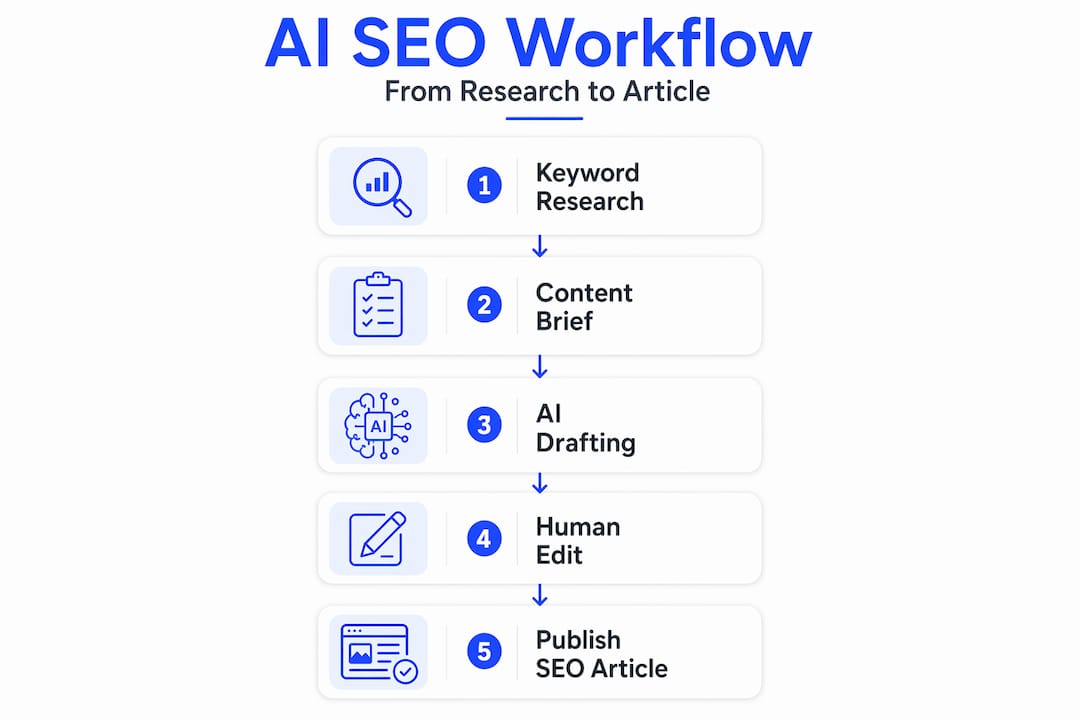
Having set strong foundations with research and briefs, next we will see how AI generates the initial drafts efficiently.
Generating first drafts with AI: tools and workflows
This is where AI content generation earns its reputation for speed. A well-briefed AI tool can produce a structured 1,500-plus word draft in under ten minutes. But the method matters. Generating the entire article in one shot typically produces a uniform, flat tone that reads as AI-generated and scores poorly on readability metrics.

AI drafting tools like Surfer AI and Frase generate first drafts section-by-section in two to ten minutes, producing 70 to 85 percent optimized content scores against top-ranking SERPs, with target word counts of 1,500-plus words. That optimization score is a live measure of how well the draft covers the topic relative to what is already ranking.
The section-by-section approach is the more effective method. Experienced practitioners feed one H2 heading at a time with the brief attached, producing varied structure that prevents AI detection flags and improves Flesch-Kincaid readability scores to the 7 to 9 range. Feeding the entire outline at once produces a single stylistic pattern across the whole piece.
A practical AI drafting workflow looks like this:
- Input your content brief and target keyword into the AI tool
- Generate the introduction separately with a specific tone instruction
- Draft each H2 section individually, referencing the brief each time
- Generate the conclusion as a standalone prompt
- Assemble all sections and run an initial SEO score check
Key considerations when evaluating AI SEO writing tools for draft generation:
- Real-time SEO scoring during draft creation catches gaps before editing
- SERP data integration ensures the draft addresses what top-ranking pages cover
- Word count targeting prevents under-coverage of complex topics
- Readability scoring identifies sections that need structural variation
Pro Tip: Write a one-sentence “voice instruction” at the top of each section prompt. Something like “Write this section as a direct, practical explanation for a non-technical business owner.” This single addition produces noticeably more varied and natural-sounding output across sections.
With drafts generated by AI, the next crucial step is adding human expertise to refine and optimize the content.
Human editing: the key to quality and Google-friendly SEO content
AI-powered SEO tools produce drafts. Humans produce articles that rank. The editing phase is where the real SEO work happens, and skipping or rushing it is the most common reason AI-assisted content underperforms.
Human editing adds specificity including examples and statistics, internal links to three to five related posts, and E-E-A-T signals, taking 15 to 25 minutes, with final optimization targeting Surfer scores of 75-plus before publishing. That 15 to 25 minutes is not optional overhead. It is the difference between content that ranks and content that sits on page four.
“AI content ranks if it is helpful and demonstrates E-E-A-T, but scaled content abuse with 50-plus low-quality pages monthly triggers spam penalties, reducing visibility by up to 40 to 60 percent.” — Google’s 2026 content guidelines
The editing checklist for AI-drafted SEO articles should cover:
- Fact verification: Check every statistic, date, and claim. AI tools hallucinate data with confidence.
- Specificity additions: Replace generic statements with real examples, case studies, or data points
- Internal linking: Connect the article to three to five related posts on your site to strengthen site architecture
- E-E-A-T signals: Add first-hand observations, brand-specific context, or expert quotes
- Tone alignment: Adjust passages that sound generic or off-brand
- Final SEO scoring: Run the edited draft through your SEO tool and target a score of 75-plus
AI SEO editorial workflows that build the editing step into the production pipeline consistently outperform those that treat it as optional. Google’s E-E-A-T guidelines are explicit: content that lacks demonstrated experience and authority, regardless of how it was produced, faces ranking disadvantages.
Pro Tip: Keep a “brand facts” document with verified statistics, customer examples, and proprietary data points. During editing, drop relevant items from this document into the draft. It takes two minutes and immediately differentiates your content from every other AI-assisted article on the same topic.
Once content is polished and aligned with quality standards, we can compare AI methods and tool options in more detail.
Comparing AI SEO drafting approaches and tools
Choosing the right tool affects both the quality of your drafts and the amount of editing time required. Here is how the leading options compare across the factors that matter most for small business SEO article creation:
| Tool | Best for | Draft speed | SEO scoring | Editing required |
|---|---|---|---|---|
| Surfer AI | SEO-first drafts | 5-8 min | 70-85 live score | Moderate |
| Frase | Brief + draft combo | 3-6 min | Good with AEO module | Moderate |
| Koala AI | Speed and volume | 2-4 min | Basic | Heavy |
| Outranking | SERP analysis + writing | 6-10 min | Strong | Moderate |
| Byword | Programmatic bulk content | 1-3 min | Limited | Heavy |
Leading AI SEO drafting tools each serve distinct use cases: Surfer AI scores 70 to 85 on drafts with real-time SEO scoring; Frase generates briefs and drafts with an AEO module optimizing for citations; Koala AI offers the fastest drafts but needs heavier edits; Outranking pairs SERP analysis with writing; and Byword excels at programmatic bulk content.
Key selection criteria for small business founders:
- Budget: Frase at $45 per month offers the best value for combined brief and draft generation
- Quality floor: Surfer AI produces the most SEO-ready drafts out of the box
- Volume needs: Byword suits businesses running programmatic SEO at scale, but plan for thorough review
- Ease of use: Koala AI has the lowest learning curve, useful if you are new to automated article writing
Having compared tools and workflows, let us explore how to put these insights into practice.
Practical steps to apply AI drafting for your small business SEO content
Knowing how AI writes articles is useful. Having a repeatable workflow you actually follow is what produces results. The practical reality for most small business founders is that time is the binding constraint, which means the workflow needs to be efficient enough to sustain without a dedicated content team.
A realistic workflow for a 2,000-word SEO article involves 20 percent human keyword research, 50 percent shared outline creation, 80 percent AI first draft, and 100 percent human editing plus SEO optimization, completing in about two hours versus five to six hours manually. That is a meaningful time saving without sacrificing quality control.
Here is the step-by-step process we recommend:
- Research: Identify a target keyword with realistic ranking potential and analyze the top five SERP results
- Brief: Create a content brief specifying audience, intent, key points, tone, and competitor gaps
- Draft: Generate the article section-by-section using your chosen AI tool
- Edit: Verify facts, add examples, insert internal links, and align tone
- Optimize: Run the final draft through your SEO scoring tool and target 75-plus
- Publish: Schedule and publish with proper schema markup and meta data
- Track: Monitor rankings and traffic for 90 days, then update content every six to twelve months
Managed production suits businesses publishing four to eight pieces monthly without dedicated SEO leadership, while internal teams work best at scale over 15 pieces with prompt engineering and brand voice management. If you are below that threshold, a managed AI SEO platform removes the operational overhead entirely.
Pro Tip: Do not scale volume before you have validated quality. Publish five to ten well-edited AI-assisted articles, monitor their ranking performance over 60 days, and refine your brief template and editing checklist based on what works. Scaling a flawed process just produces more flawed content faster.
To round off, consider our perspective on why blending AI and human skills creates sustainable SEO writing success.
Why the blend of AI and human expertise is the future of SEO content
The conventional expectation that AI will eventually automate SEO content end-to-end without human involvement is, in our view, a misreading of what AI actually does well. AI excels at repetitive tasks like metadata drafting and keyword clustering but should augment, not replace, strategic judgment requiring business context in SEO content creation.
That distinction matters practically. An AI tool can produce a technically optimized article on “how to choose accounting software for small businesses.” It cannot tell you that your target customers are specifically service-based businesses with under five employees who distrust cloud storage. That business context shapes the angle, the examples, the objections addressed, and the calls to action. None of it comes from a language model.
Google’s position is consistent: AI content is acceptable only when it shows firsthand experience via human edits, because pure AI output lacks genuine E-E-A-T and risks demotion. This is not a temporary policy. It reflects a structural reality: search engines reward content that demonstrates real knowledge and trust, and AI tools do not possess either.
The practical implication for small business founders is that the goal should not be to eliminate human involvement but to concentrate it where it creates the most value. AI handles structure, keyword coverage, and volume. Humans handle strategic framing, factual accuracy, brand voice, and the kind of specific insight that makes a reader think “this was written by someone who actually understands my problem.” That balance between AI tools and human editing is what produces content that ranks and converts, not just content that exists.
Boost your SEO content with The SEO Agent’s AI-powered tools
Understanding the AI drafting process is the first step. Executing it consistently, at the quality level Google rewards, is where most small business founders run into capacity limits.
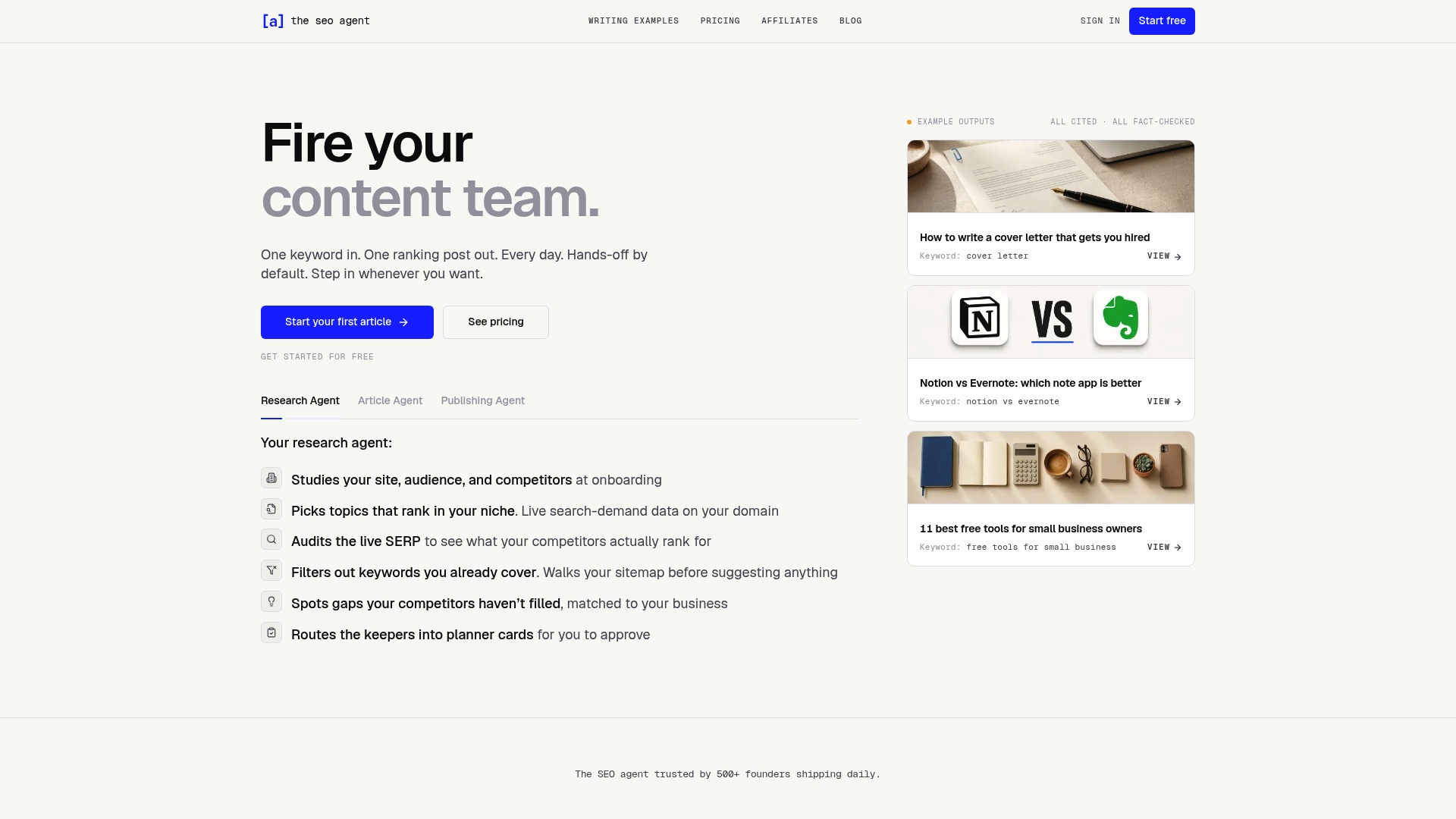
The SEO Agent handles the full production pipeline, from keyword research and content brief generation through AI drafting, fact-checking, internal linking, and CMS publishing, delivering one optimized article per day with minimal input from you. The platform’s SEO automation features include live SEO scoring, schema markup integration, and real-time SERP analysis, so every article is built to rank from the start. For ecommerce businesses, the Shopify SEO automation app connects directly to your store and automates product and category content at scale. If you are ready to move from understanding AI-driven SEO to actually deploying it, The SEO Agent is built for exactly that.
Frequently asked questions
Can AI alone create SEO articles that will rank well?
No, AI alone cannot reliably produce high-ranking SEO articles. Human editing to verify facts, add examples, and ensure E-E-A-T compliance is essential, as Google penalizes low-quality unedited AI content regardless of how it was generated.
How long does it take to draft an SEO article using AI?
Generating a first draft with AI usually takes 2 to 10 minutes, while the full process including editing and optimization averages 60 to 120 minutes for approximately 2,000 words.
What tools are recommended for AI SEO article drafting?
Top tools include Surfer AI for SEO-first drafts, Frase for combined brief generation and drafting, Koala AI for speed, and Outranking for integrated SERP analysis, with each tool suited to different needs depending on budget and volume.
How do you avoid Google penalties when using AI for SEO content?
Avoid publishing large volumes of unedited AI content, ensure human review for quality and E-E-A-T signals, and focus on genuine user value. Google’s 2026 guidelines specifically penalize scaled content abuse and reward content that demonstrates real expertise and helpfulness.