Opinion in Writing: Structure, Tone and Examples
Opinion in writing explained: what it is, how to build a claim, match tone to evidence, and learn from real op-ed and essay examples.
Opinion in writing is a stated position on a question with more than one reasonable answer, supported by reasons and evidence that readers can test and challenge.
You're drafting an essay, a newsletter, or a founder's post. You know what you think, but the paragraph sounds either too personal to persuade anyone or too cautious to say anything useful. The next step isn't to sound more forceful. It's to make your position easier to examine.
Table of Contents
- What Opinion in Writing Actually Means
- The Six Parts of an Opinion Argument
- Separating Facts From Judgments Sentence by Sentence
- Matching Confidence to Evidence With Hedges and Boosters
- Using Polls and Numbers Without Overclaiming
- Annotated Examples From Op-Eds, Essays and Columns
- Common Misconceptions and Where Opinion Writing Fails
- Final Check and Honest AI Disclosure
What Opinion in Writing Actually Means
An opinion gives readers a position they can evaluate. A preference tells them what you happen to enjoy. Both belong in writing, but they ask different things of the reader.
Consider a hypothetical film review:
- Preference: I like this film. Readers learn your taste, but they have nothing to investigate.
- Argument: The film loses momentum because the villain disappears during the central conflict. Readers can check the character's absence and challenge your interpretation of its effect.
The second statement combines an observable detail with an evaluation. Someone could agree about the villain's absence but argue that it creates suspense. That disagreement gives the review substance.
Opinion pages provide a familiar setting for this kind of public argument.

A position is not permission to improvise facts
Think of a courtroom. The verdict is the claim, the case file contains the evidence, and the judge's written reasoning explains why the verdict follows. A pile of documents without reasoning wouldn't explain the decision; a confident verdict without support wouldn't justify it.
Newspaper publishers created a distinct space for such arguments: according to Britannica's history of the op-ed page, The New York Times introduced its dedicated op-ed page in 1970, opening space to outside contributors alongside the traditional editorial page.
Today, opinion writing appears in op-ed columns, editorials, reviews, essays, newsletters, and student argument papers. The conventions differ, but writers still need to distinguish what they believe from what they can establish.
The appropriate tone is direct and committed, not loud. Readers rarely accept a conclusion on the writer's authority alone, so the argument has to carry the weight.
The Six Parts of an Opinion Argument
| Part | What It Does | Writing Test |
|---|---|---|
| Claim | States the position the piece defends | Can a reader disagree with it in one sentence? |
| Reasons | Gives the main lines of argument supporting the claim | Does each reason support the claim, not just the topic? |
| Evidence | Supplies data, examples or testimony | Is every source named, dated and checkable? |
| Warrant | Explains why the evidence proves the claim | Is the link written out, rather than left for readers to infer? |
| Counterargument | States the strongest objection to the claim | Would an informed opponent actually raise this objection? |
| Rebuttal | Answers the objection with stronger evidence or a narrower claim | Does the answer succeed, or does it only restate the claim? |
These parts follow the argument-building approach described in Purdue OWL's guide to organizing an argument. They're planning tools, not a requirement to write a separate paragraph for every row.
Build the case before polishing the prose
Say you're arguing that a city should close its old town centre to private cars.
Your claim might be: The city should restrict private cars in the old town centre while preserving essential access. This gives readers a specific proposal to accept, reject, or modify.
Your reasons identify why the proposal deserves support. You might argue that reducing vehicle movements could improve pedestrian safety and make the streets more usable for people walking.
Reasons aren't evidence. Fewer cars means fewer opportunities for collisions is a line of reasoning, not a local traffic finding. To support it, you'd need relevant collision records, vehicle counts, or an evaluation of comparable restrictions.
Your evidence must therefore answer a concrete question: what information would show whether the proposed restriction addresses an actual problem? Don't invent a traffic count just to complete the paragraph. Identify the document you need and retrieve it.
Write the connection and face the objection
The warrant explains the connection: If through-traffic creates avoidable conflict at pedestrian crossings, restricting that traffic addresses a source of risk. Without that sentence, readers may wonder why your records justify this particular policy.
Practical rule: After presenting evidence, explain why it supports your proposal rather than merely describing the topic.
The counterargument might concern residents with limited mobility or businesses receiving deliveries. It belongs inside the argument because it tests whether your proposal would work.
Your rebuttal could narrow the restriction to through-traffic while allowing accessible transport and scheduled deliveries. That response changes the proposal to meet a legitimate objection instead of pretending the objection doesn't matter.
The same distinction between assertion and proof helps when you improve your cover letter writing: naming a strength isn't enough without an example showing its relevance.
Run each row through its writing test before drafting the next part. A vague answer usually identifies a gap that elegant wording won't fix.
Separating Facts From Judgments Sentence by Sentence
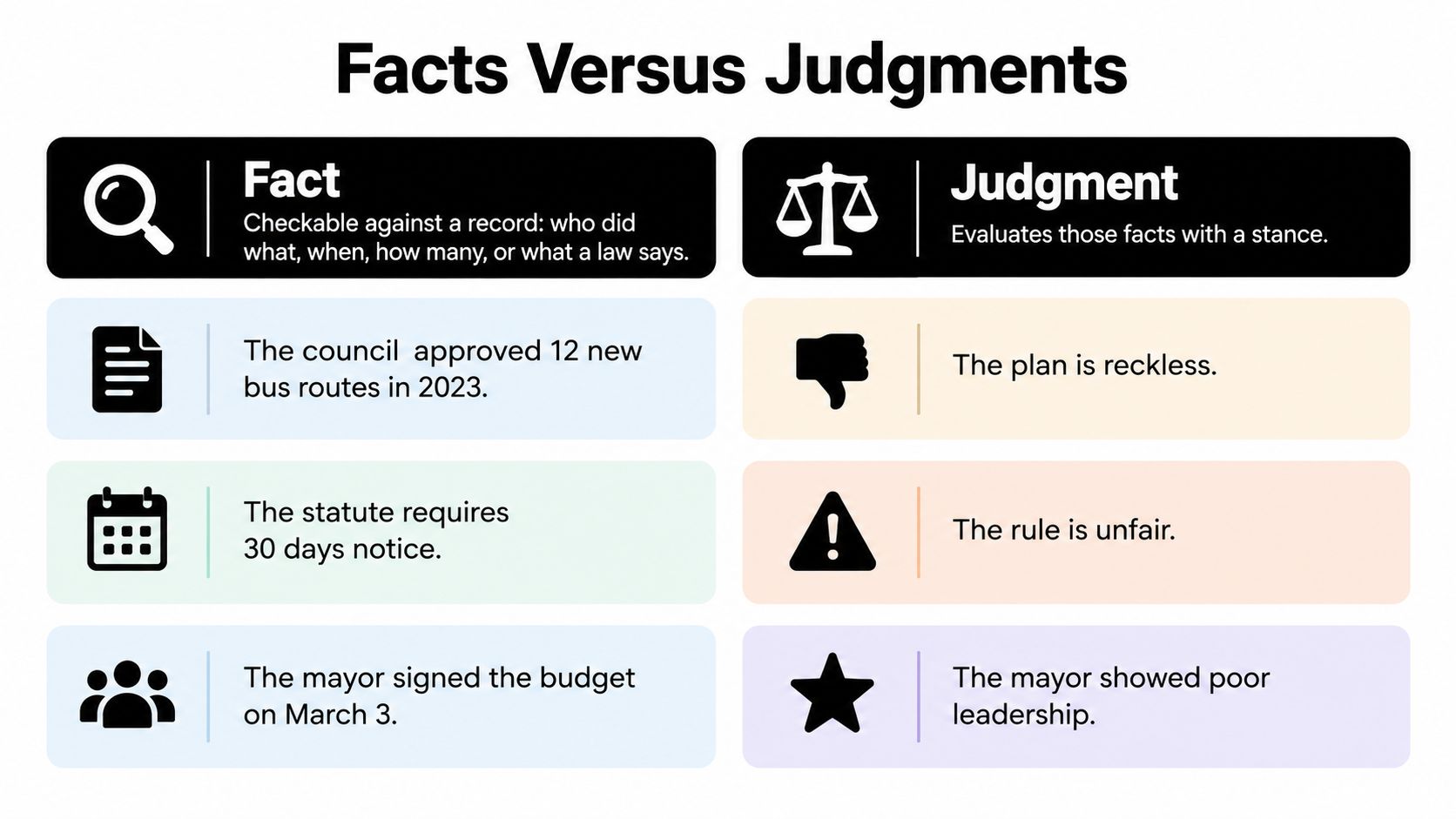
Consider a hypothetical council meeting. The council approved the transport plan is a factual assertion to check against the minutes. The decision was cowardly is a judgment requiring an explanation of what the council should have done instead.
The distinction concerns the kind of statement, not whether you agree with it. A false factual assertion is still a factual assertion because someone can investigate whether it happened.
The chart illustrates the difference using example statements, not reports about an identified council or statute.
Check what sits inside the judgment
A harder example is rent control caused the rise in rents. That may appear in an opinion column, but it makes a causal claim about events. The writer needs evidence capable of separating the policy's effects from other possible explanations.
The Associated Press explanation of what it fact-checks distinguishes factual claims from personal tastes and preferences, and stresses exact wording, relevant facts, attribution, and citations.
Apply that distinction during editing:
- Record-checkable assertion: Identify who acted, what happened, and which document establishes it.
- Evaluation: State the standard behind your judgment, such as fairness, affordability, or public safety.
- Mixed sentence: Separate the factual premise from your interpretation so readers can assess each.
- Exact quotation: Compare the wording with the original, including any omissions that could alter its meaning.
Treat AI fact-checking from The SEO Agent as an aid to locating questionable claims, not a replacement for opening the underlying source.
Use the video as a companion exercise: pause to classify statements before deciding whether you agree with them.
You don't need a citation for every expression of taste. You do need support for embedded assertions about people, events, and policy effects. If a stranger could check the sentence against a record, source it before publishing.
Matching Confidence to Evidence With Hedges and Boosters
Writers signal their level of commitment through small language choices. A study of stance markers distinguishes hedges, boosters, attitude markers, and self-mentions.
Each serves a different purpose:
- Hedges reduce commitment. Words such as may, might, suggests, and appears leave room for another explanation.
- Boosters increase commitment. Clearly and undoubtedly tell readers that the writer considers the conclusion secure.
- Attitude markers express evaluation. Regrettably, for example, identifies the writer's response to an outcome.
- Self-mentions make authorship explicit. I argue and in my view identify a position as the writer's.
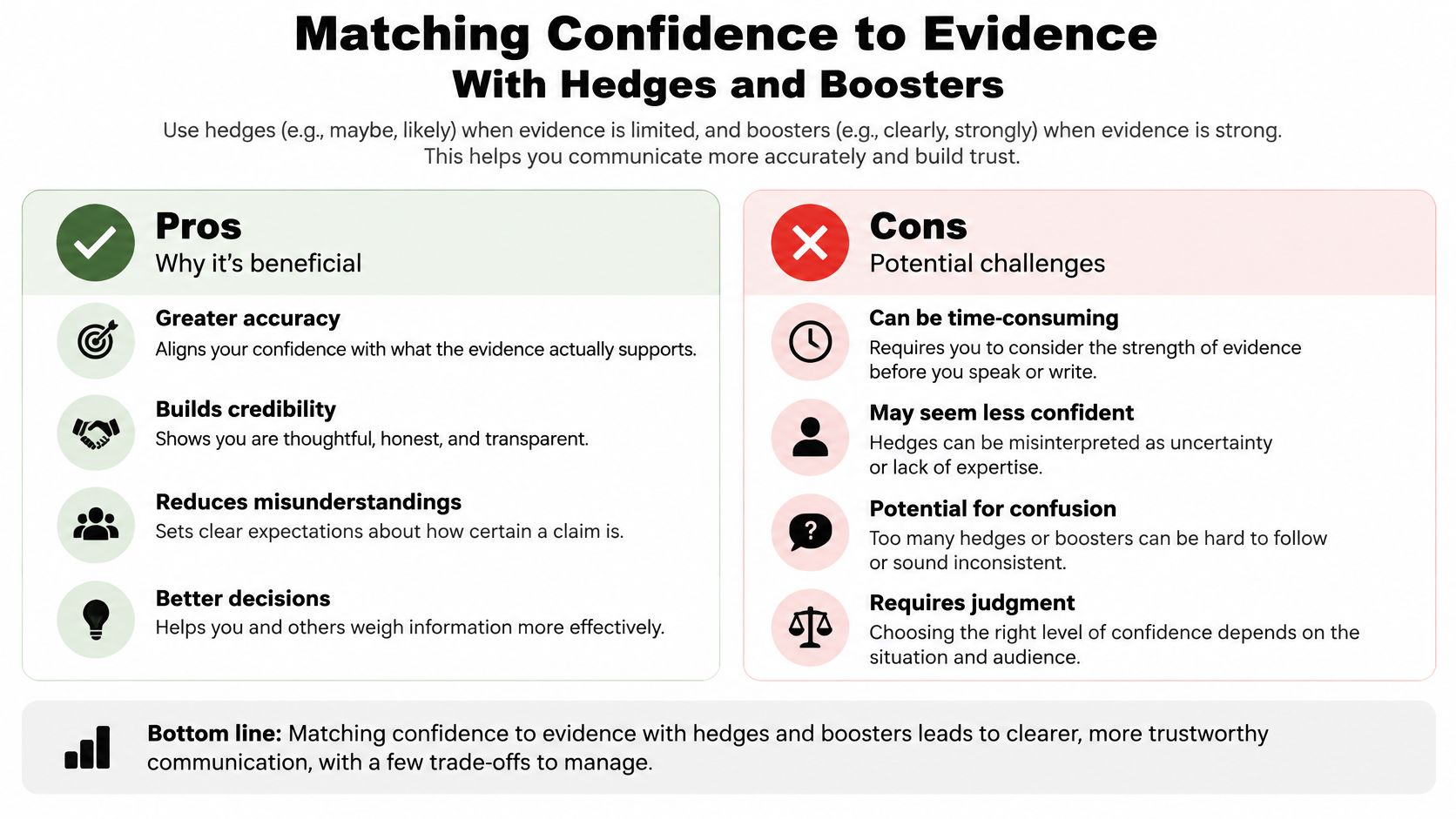
The benefits and risks become clearer when you compare cautious and emphatic wording.
Avoid caution without a position
It could perhaps possibly be argued that the policy might help leaves readers unsure what you believe. If your evidence supports a tentative benefit, write The policy may help. Then explain the remaining uncertainty.
The opposite problem is unjustified emphasis. The policy will undoubtedly solve congestion promises more than limited observations can establish. Removing undoubtedly doesn't repair an unsupported prediction; you may need to narrow the claim itself.
Match the sentence to the support
Use categorical language for directly established facts: The figures are published in the council's report. If that document exists and contains the figures, hedging only makes the sentence less accurate.
For limited or correlational evidence, use appropriately cautious language: The records suggest a link between longer opening hours and attendance. Identify the relevant setting rather than extending the conclusion to every institution.
Confidence should come from the evidence, not from the volume of the wording.
When you give ChatGPT writing a natural voice, preserve meaningful uncertainty instead of deleting every cautious word. Editing for fluency shouldn't turn a possibility into a promise.
Remove each hedge and booster in turn. Ask whether the evidence supports the changed sentence, then restore only the language that accurately represents what you know.
Using Polls and Numbers Without Overclaiming
In the 1936 U.S. presidential election, the Literary Digest mailed more than 10 million ballots and forecast 57% for Alf Landon and 43% for Franklin D. Roosevelt, yet Roosevelt won approximately 61% of the popular vote, as Britannica's account of public-opinion polling explains. The magazine relied heavily on automobile ownership and telephone directories, overrepresenting wealthier Americans, and also depended on voluntary responses.
The lesson isn't merely that the forecast was wrong. A huge response pool couldn't repair biased coverage and participation. Before asking how many people answered, ask who had a realistic chance of being included.
Read precision separately from representativeness
Pew Research Center's margin-of-error explanation gives an approximate margin of plus or minus 3 percentage points for a simple random sample of 1,067 respondents at 95% confidence. The table gives rounded textbook approximations under that same confidence level and simple-random-sampling assumption, calculated conservatively for a proportion near an even split.
Approximate margin of error by sample size
| Sample Size | Approximate Margin | How to Cite It |
|---|---|---|
| 100 respondents | about plus or minus 10 points | Treat as directional; do not state a precise share |
| 160 respondents | about plus or minus 8 points | Cite only as a rough signal for a specific subgroup |
| 400 respondents | about plus or minus 5 points | Quote with the margin and the date |
| 1,067 respondents | about plus or minus 3 points | Suitable for an overall national estimate |
These are illustrations, not margins to assign to any survey with a matching head count. Weighting and survey design affect precision, and a national estimate still requires appropriate population coverage.
Don't borrow the full sample's confidence
A subgroup doesn't inherit the precision of the whole poll. According to Pew Research Center's subgroup-reporting policy, roughly 100 interviews may produce margins of 10 percentage points or more, and it won't publish an estimate with fewer than 100 raw interviews or an effective sample size below 50.
Before using a poll in an opinion piece, record:
- Population and coverage: Who was surveyed, and who might be missing?
- Fieldwork date: When were responses collected?
- Relevant sample: Does your sentence concern all respondents or a small subgroup?
- Reported uncertainty: What margin and design limitations does the pollster give?
Use roughly when appropriate, but don't use it to rescue an unusable estimate. If the result is too imprecise to support your point, leave it out.
Annotated Examples From Op-Eds, Essays and Columns
Say you want to argue that public libraries should offer Sunday afternoon hours. Your central position can remain the same while the form changes how readers encounter it.
An op-ed presents an outside contributor's argument for a public audience. You might begin with the practical difficulty of returning books after work, then state the proposed change early enough that readers know what you're defending.
An essay allows more exploration. You could begin with your own difficulty visiting a branch, but that experience would introduce the question rather than establish what every library user needs.
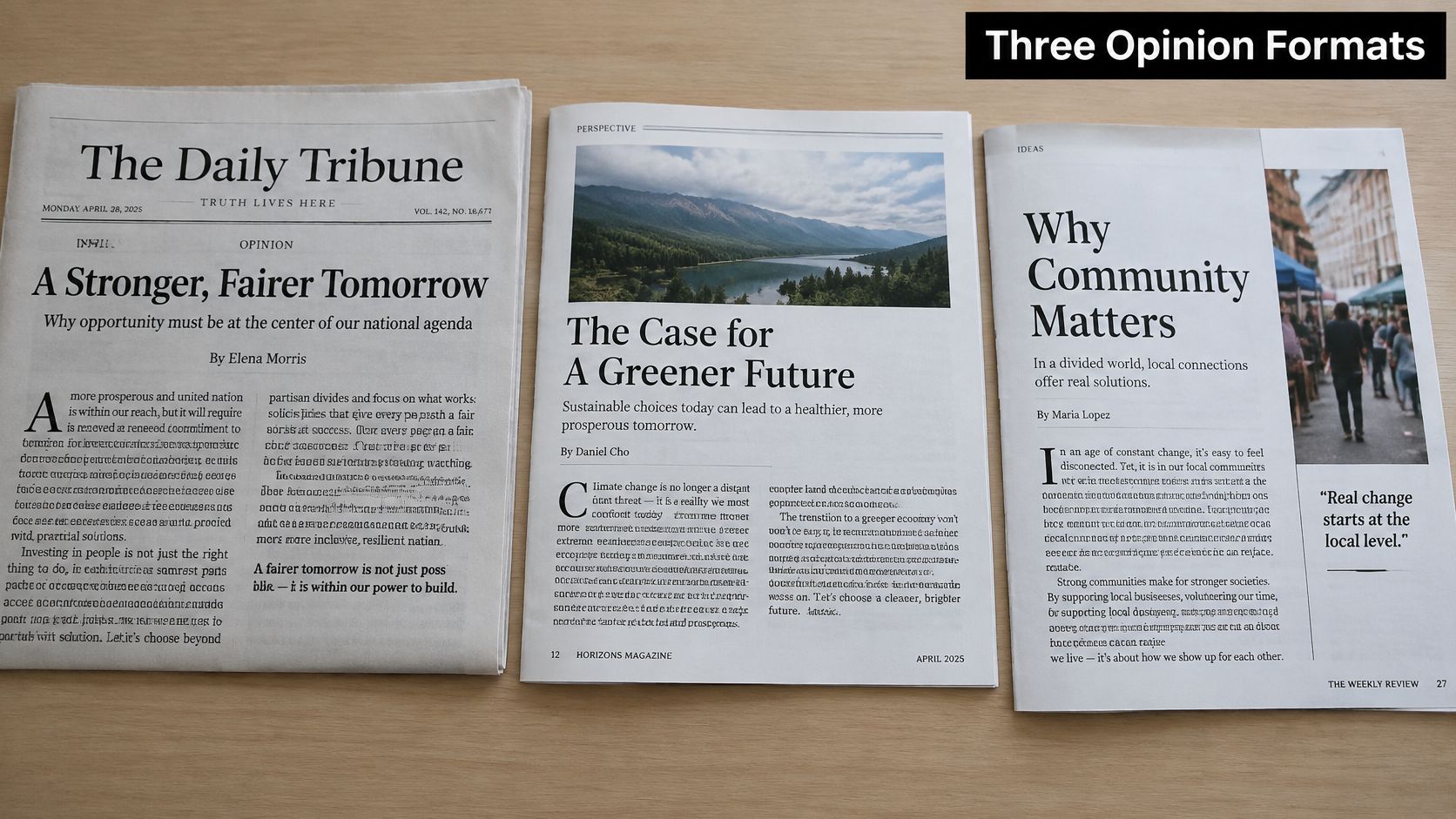
Different publications give arguments different amounts of space and emphasis.
Choose the form without losing the argument
A column gives a recurring writer room to develop a recognizable perspective. Voice can make the piece engaging, but a familiar byline doesn't make an unsupported assertion reliable.
A student argument paper usually needs a visible thesis in the introduction and body paragraphs organized around reasons. Address a substantial objection where you can examine it properly, rather than saving it for a rushed closing sentence.
The following model is entirely hypothetical. Imagine that you've obtained dated attendance records from a fictional Riverside Branch and checked the visitor feedback described below.
A paragraph with its reasoning exposed
[Claim] Riverside Branch should offer Sunday afternoon hours. [Reason] Working parents who report difficulty visiting on weekdays need access outside their working hours. [Evidence] In this imagined case, the branch's attendance records show weekend peaks, and visitor feedback identifies weekday schedules as a barrier.
[Warrant] Those findings support testing Sunday access because an available service is only useful when people can reach it. [Qualification] The case is strongest at branches serving commuter populations, and a trial should account for staffing costs and whether Sunday visits replace visits on other days.
Notice what the evidence does and doesn't establish. Weekend peaks alone wouldn't prove that working parents need Sunday hours. The feedback helps identify the access problem, while the qualification prevents the proposal from becoming a demand for identical hours everywhere.
Label a draft by function. An unlabeled sentence may still belong, but you should know whether it supplies context, support, interpretation, or a transition.
Try the labels on your own paragraphs, then remove them before publication. When writing SEO articles with ChatGPT, ask it to identify missing functions without supplying imaginary records or quotations. A visible gap is more useful than a smoothly invented example.
Common Misconceptions and Where Opinion Writing Fails
Opinion means evidence is optional. A personal preference may need no defense, but a recommendation affecting other people requires reasons they can examine. Adding I think doesn't excuse a false premise.
A strong opinion ignores the other side. Ignoring a serious objection makes your argument easier to reject. Answering it may require changing the proposal, not merely changing the tone.
Fairness doesn't require neutrality
Balance means taking no position. You can represent an opposing argument accurately and still explain why your position is better supported. Giving every assertion equal weight would conceal meaningful differences in evidence.
Repeated criticism shows rigour. Listing faults doesn't establish their importance, explain their causes, or identify a workable alternative. A useful critique tells readers what should change and why.
A study of 82 economic opinion editorials found a predominance of negative evaluations and identified a need for broader inclusion of female commentators, non-Anglophone writers, and cross-cultural perspectives. That finding describes the examined editorials, not every opinion writer, but it provides a useful prompt for checking whose assumptions shape an argument.
Test the boundaries of your viewpoint
A founder writing about remote work may assume reliable home internet and private workspace. A transport commentator may assume that readers can drive. Neither assumption becomes universal because it feels ordinary to the writer.
Use a deliberate correction:
- State the proposal clearly: Identify the decision you want readers to support.
- Represent a serious objection: Choose one an informed opponent would recognize, not an easily dismissed caricature.
- Broaden the evidence: Look beyond your home market when making claims across countries or cultures.
- Name limits and action: Explain where your conclusion applies and what someone should do next.
Lived experience can reveal a problem that aggregate figures miss. Present it as a situated account, then investigate how widely the conditions apply. Choose the opposing view a serious, informed critic holds, not the weakest version available.
Final Check and Honest AI Disclosure
Before publishing, apply the structural tests to the whole argument and check each paragraph's role. Review your confidence markers, confirm that statistics have a source, date, and scope, and compare quotations word for word with their originals.
For readability, aim for clearer blog content for startup audiences without removing qualifications that readers need. A simpler sentence must still mean the same thing.
Describe the assistance precisely
A 2025 study found that evaluators penalized writing when AI assistance was disclosed despite strong underlying quality, while a separate 2025 experiment found that a lightweight warning made readers 83% more likely to adopt a position opposing the chatbot's answer, according to the paper on AI disclosure and evaluation.
Disclosure can invite scrutiny, so be accurate rather than defensive:
- Name the role: Distinguish proofreading, brainstorming, research synthesis, stylistic rewriting, and substantive argument generation.
- Keep accountability clear: Use a line such as I used an AI tool to tighten sentences; the argument and conclusions are mine only when it's true.
If a tool generated the substantive argument, disclose that rather than describing the assistance as proofreading. The human author remains responsible for every published claim.
The SEO Agent offers keyword research, source-checked drafting, internal linking, and publishing, with customer review before articles go live. Visit The SEO Agent to build a content workflow that helps you publish supported arguments while keeping editorial decisions in your hands.