How to write a cover letter that gets you hired.
Most hiring managers spend under thirty seconds on a first-pass read, and a third of them spend less than that. The five things that move a cover letter from skipped to read are not secrets. They are the parts most candidates skip. This guide walks through each one with a worked example, career-stage openers, and the hiring-manager surveys behind the advice.
How do you write a cover letter that gets you hired?
Open with a quantified result from your last role, mirror three to five exact phrases from the job description, pick the three skills that match the listing's load-bearing requirements, quantify each one with a real number, and close with a specific scheduling ask. Keep it to three short paragraphs, 250 to 400 words total. Hiring managers spend under thirty seconds on the first-pass read, so the structure has to do the work.
- 01Open with a result, not an introduction.
- 02Mirror the job description, word for word.
- 03Pick three things, not ten.
- 04Quantify everything you can.
- 05Close with a specific ask.
- 06A worked example, three short paragraphs.
- 07Cover letter examples for three career stages.
- 08Common mistakes that get cover letters rejected.
1. Open with a result, not an introduction.
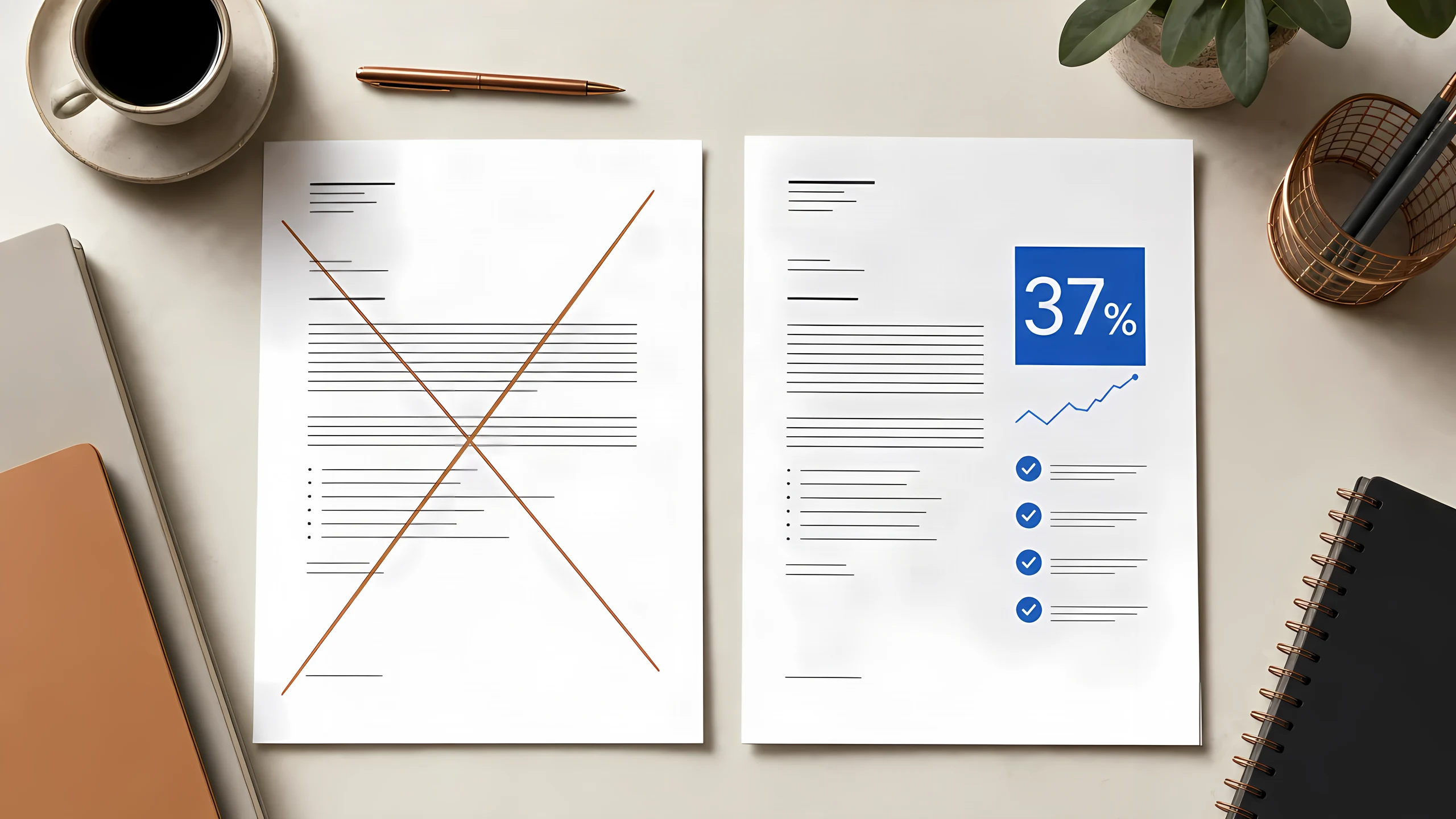
The first sentence is the only one read by 100% of reviewers. Most candidates waste it on "I am writing to apply for the position of..." That information is in the file metadata, the email subject, and the application form. Repeating it costs you the one line that actually does work. (We at The SEO Agent treat the same rule as load-bearing for every SEO article we publish: the first sentence has to commit to an answer.)
Open with a specific outcome you produced, in one sentence, with a number. Something like: "I cut support response time by 41% in six months at Notional, on a team of five." That is what the reviewer is scanning for, and it is what the role is ultimately hiring for.
Why it works at the survey level: ResumeGenius' 2024 hiring-manager survey found that 27% of recruiter attention goes to fit between past work and the role, more than any other factor. A quantified result puts the fit answer in line one. The reviewer can read another two paragraphs for context, or stop, but they already have what they came for. (The same lead-with-the-answer discipline shows up in good product comparisons and good listicles, for the same reason.)
2. Mirror the job description, word for word.
ATS systems and human reviewers both pattern-match on the language of the listing. If the JD asks for "campaign management" and your letter says "marketing operations," both readers register them as different skills, even when they describe the same work. The cost of using your own vocabulary instead of theirs is real, and it is avoidable. (The same pattern-match shows up in SEO content automation: the article has to use the keyword cluster's vocabulary, not its own paraphrase.)
Read the listing twice. Pull three to five exact phrases from it and use them in context. "The role asks for end-to-end campaign management. At Notional I ran end-to-end campaign management for our paid acquisition program, including the briefs, the agency relationship, and the reporting." The phrase appears once in the JD and once in your letter, applied to a real example. A meta description generator does the same thing for the SERP: pull three exact phrases from the top-ranking competitors, weave them into a 155-character pitch.
This is not keyword stuffing. Stuffing is repeating phrases without context to game a filter. Mirroring is matching the vocabulary the company has already decided describes the work. Reviewers reward the second and rule out the first within a few sentences. (The same line separates good SEO from blackhat practice; the SEO research tools we ranked against Ahrefs all flag the difference inside a paragraph.)
If the JD uses a buzzword you would not say in conversation ("ninja", "10x", "rockstar"), still mirror it once. The hiring committee wrote that listing, and the committee is who reads your letter. Match their register first, refine yours after the offer.
3. Pick three things, not ten.
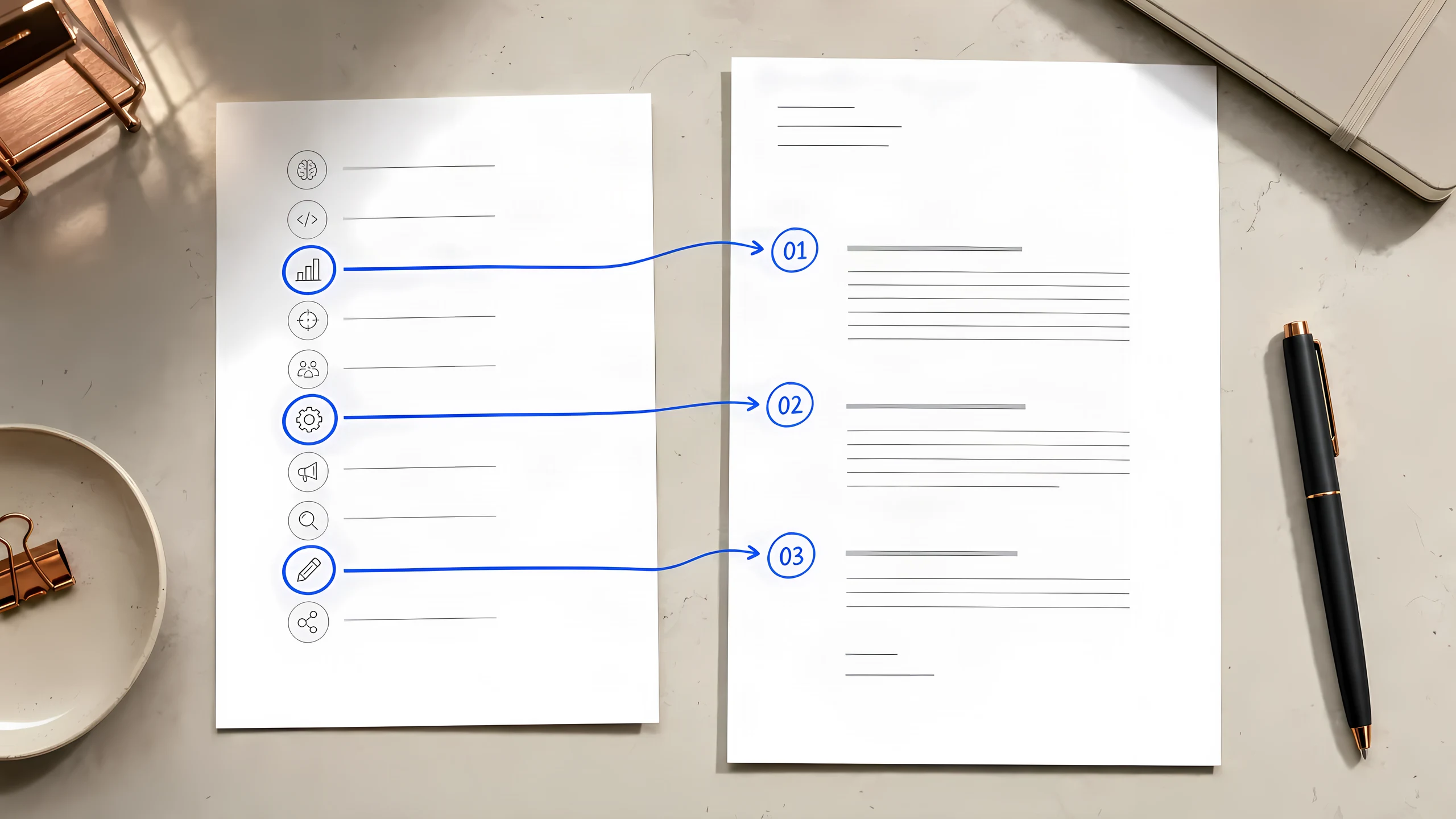
The reviewer is scanning for a fit signal. They want to confirm three things from the JD show up in your background. They do not want to read about the other twenty-two skills you have. The other skills belong on the resume; the cover letter is the argument for the role.
Identify the three things by reading the listing again with a highlighter. The first two requirements in a JD are usually the load-bearing ones, and any requirement repeated in two sections (responsibilities and qualifications) is non-negotiable. Pick from those.
Build one short paragraph per skill. Each paragraph is one sentence of context, one sentence of result, and one sentence of relevance to the role. That is roughly 60 to 80 words. Three of those gets you to the 250-word body sweet spot without filler. (For comparison, a long-form ranked listicle needs 1,500-plus words because the format is doing different work.)
4. Quantify everything you can.
"Managed a team" tells the reader you had a title. "Managed a team of seven, with two direct reports promoted in eighteen months" tells them what kind of manager you are. The second version is no longer than the first, and it answers the question the reviewer would have asked next.
Numbers do not have to be revenue. They can be scope (number of products, customers, regions), pace (delivery cadence, time-to-X), scale (team size, budget, throughput), or change (before-and-after, percentage delta). Most candidates default to revenue and stop. Pick whichever shape of number is most legible for the work, not the easiest one to pull from a spreadsheet or your personal project tracker.
If the work genuinely is not quantifiable, name a specific decision and its consequence instead. "I argued for shipping the simpler v1 instead of the integrated stack. The simpler v1 hit profitability in nine months. The integrated stack would have taken eighteen." A specific decision plus a specific outcome reads stronger than a softened percentage. (Same calculus shows up in any product call. Our founder story is mostly the same shape: cut the integrated v1, ship the simpler one, learn from a real customer in nine months instead of arguing for eighteen.)
5. Close with a specific ask, not "look forward to hearing from you".
The closing line is read by everyone who read the opening. Most candidates spend it on "I look forward to hearing from you." That sentence asks for nothing, and it leaves the reviewer to do the scheduling work. Both costs are avoidable.
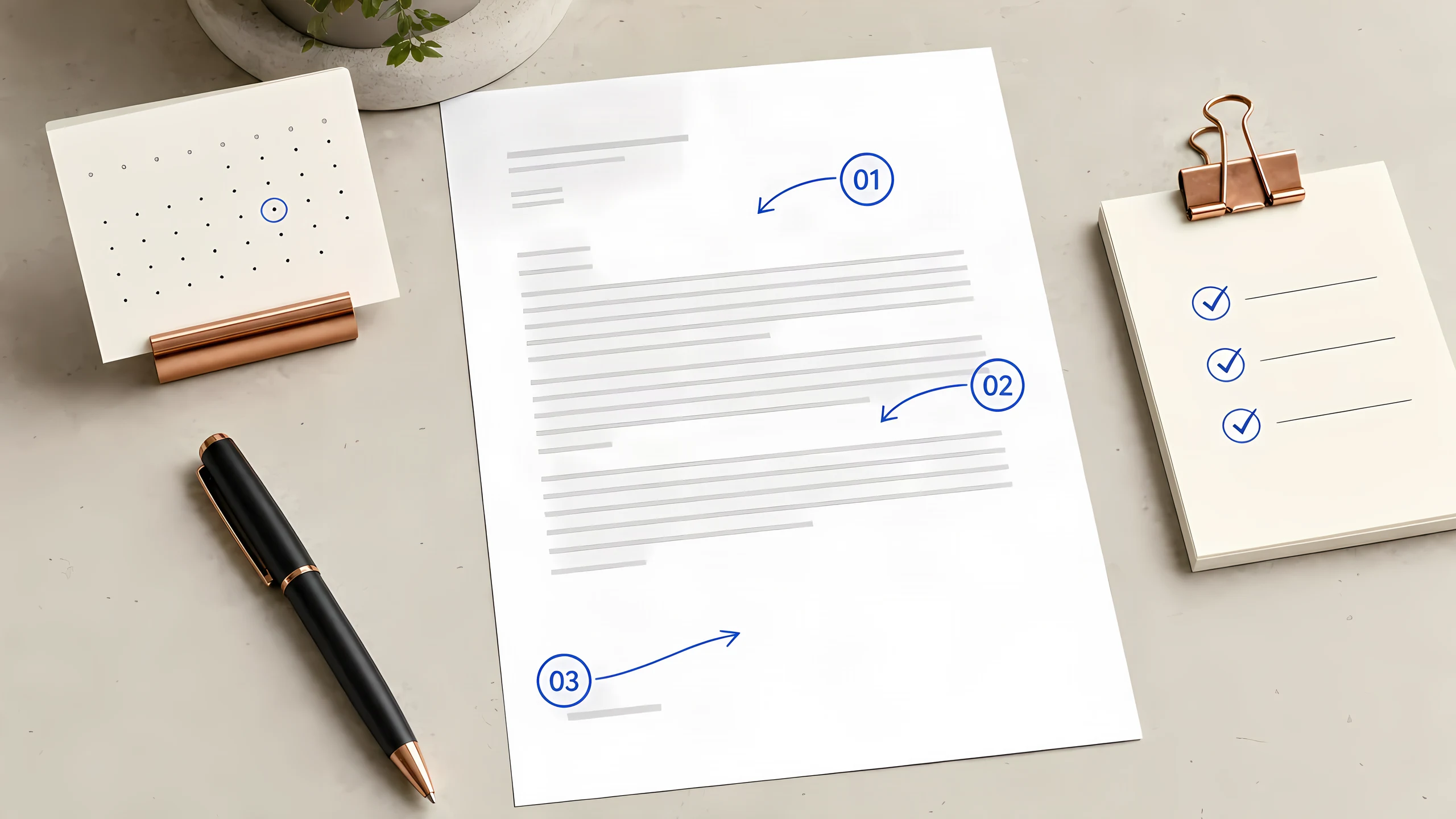
A specific ask names a next step in a specific window. "I am available for a fifteen-minute call this Thursday or Friday after 2pm. The link to my calendar is at jane.calendar/now." A free scheduling tool with one event type is enough; the calendar link is the load-bearing detail, not the platform. That looks presumptuous in the abstract. In the reviewer's inbox, it reads as someone who has already started.
The reviewers who would object to a specific ask object to specific asks in any context, and they tend not to be the ones making the hire. The ones making the hire read the line, click the link, and put fifteen minutes on the calendar. That is the outcome the cover letter is for.
A worked example, three short paragraphs.
Below is a fictional letter applying to a Senior Growth Marketer role at a B2B SaaS company called Plotline. The role asks for paid-acquisition leadership, lifecycle email ownership, and cross-functional partnership with product. Three things, three short paragraphs, one specific ask.
Hi Plotline team,
I cut Notional's blended CAC by 38% in nine months while doubling paid spend, by rebuilding the lifecycle email program around the activation event rather than the signup. The Senior Growth Marketer role at Plotline asks for paid-acquisition leadership, lifecycle email ownership, and cross-functional product partnership, which is the exact shape of the work I have been doing for the last three years.
On paid acquisition, I led a team of three managing $2.4M in annual spend across Google, LinkedIn, and partner-content channels, and built the attribution model the founders use in board reporting. On lifecycle email, I rebuilt Notional's onboarding sequence twice, the second time pinned to a single activation event, which drove the 38% CAC drop above. On the product side, I sat in the weekly product review for two years and shipped four conversion-focused changes the growth team specced and product implemented.
I am available for a fifteen-minute call this Thursday or Friday after 2pm Pacific. My calendar link is at jane.calendar/now. Thanks for the read.
Jane
Word count: 247. Three skills, three paragraphs, three numbers, one ask. Most cover letters that get hired share that exact skeleton, with different bones inside.
Cover letter examples for three career stages.
The five-rule structure holds at every career stage. The bones move. Below are the opening paragraphs from three real-shape letters: entry-level (no full-time experience), career-changer (different industry, same skills), and senior IC moving into management. Each opener is the load-bearing line; the rest of each letter follows the same three-paragraph skeleton from the worked example above.
"I ran the social media program for the campus entrepreneurship club for two years and grew our weekly newsletter from 140 to 2,100 subscribers, on a budget of zero, by interviewing one founder a week and shipping the transcript on Friday. The Junior Content Marketer role at Plotline asks for owned-channel growth and weekly publishing cadence, which is the exact shape of the work I have been doing."
Why it works: no apology for being new. A real number, a real cadence, a direct line from the activity to the JD's two named requirements.
"I spent six years as a hospital pharmacist, the last two leading the rollout of our electronic medication-reconciliation workflow across four sites. I am applying for the Implementation Specialist role at Plotline because the work is the same shape: change-management for clinical staff, vendor coordination, a go-live week that has to land without errors. I want to do that work for a software team instead of a hospital."
Why it works: names the prior industry without apology, then translates the transferable work into the JD's vocabulary. The change is reframed as continuity, not a pivot.
"Over the last eighteen months I have been the de facto lead on a team of six engineers at Notional: I ran the technical-design reviews, owned the on-call rotation, and the two most recent hires were ones I sourced and interviewed. The Engineering Manager role at Plotline is the formal version of that work, and the title is the only part I am missing."
Why it works: names the gap honestly (no formal title) while documenting the informal version of the work. Reads as ready, not aspirational.
Three different career stages, three different opening lines, one identical structure. The five rules do not change. The numbers, the JD phrases, and the specific decision-and-consequence framing carry the weight, regardless of how much experience sits behind them. (The same scaffold works for any short-form persuasive writing where the reader is scanning for fit before they commit attention.)
Common mistakes that get cover letters rejected.
An 81% share of recruiters in a 2023 Zety survey said they have rejected a candidate based on a detail in their cover letter. Most of the rejections fall into the same eight buckets.
- Wrong company name in the salutation. The single fastest rejection. Search-and-replace fails on letter eight of the day.
- "I am writing to express my interest" opener. Reads as boilerplate. The reviewer knows by sentence two whether the rest will be specific.
- More than one page. Three short paragraphs is the ceiling for almost every role below VP. Length signals the opposite of what most candidates think it does.
- Generic body that could apply anywhere. If you can swap the company name and the letter still makes sense, the reviewer will notice.
- Listing every skill instead of the three the JD asked for. Resume territory, not cover letter territory.
- No specific ask at the close. Wastes the second-most-read sentence in the letter.
- Typos in the company name or product. Different from the salutation mistake. Spelling Plotline as "PlotLine" throughout suggests you did not read the homepage.
- AI-generated language with no specifics underneath. Reviewers now flag the most common AI-assistant openers within a sentence. Use the model for polish, not for the first draft.
The same five rules apply to almost any short-form writing.
Open with a result, mirror the language, pick three things, quantify, close with a specific ask. The order changes, the structure does not. The reason a good ranked roundup of free tools gets read is that its first sentence answers the search question and its entries include the real screenshots readers expect. The reason a balanced product comparison gets read is that it commits to a position by the second paragraph and supports it with proof for the rest of the article.
We built the product behind this blog on the same instinct: lead with the answer, support every claim with a source, add real visuals where they prove something, and refuse to publish anything that does not clear the gate. Five rules for cover letters, the same standard for the SEO articles we automate for your site at $99 a month flat.
If you found this useful.
Is a cover letter still necessary in 2026?
Yes for most hires above entry-level. The most-cited 2024 ResumeGenius hiring-manager survey put the share of recruiters expecting a cover letter at 89%, including roles that mark it optional in the application. The exception is high-volume hourly hiring (retail, hospitality, gig) where the ATS skips the field entirely.
How long should a cover letter be?
Three short paragraphs, 250 to 400 words total. Anything longer is rarely read past the first screenful. Anything shorter reads as low-effort, unless the company explicitly asks for a one-paragraph note.
Do hiring managers actually read cover letters?
Some always do, some only on the shortlist. The same 2024 survey reported 45% of hiring managers always read the cover letter and 38% usually do. Most of that reading happens in under two minutes, and a third of it in under thirty seconds, which is why the first sentence carries so much weight.
What if the application says the cover letter is optional?
Submit one anyway, unless the role is high-volume hourly. "Optional" is a filter for effort. The candidates who skip it on a salaried role are signaling that they applied to dozens that day. The candidates who include a tight 300-word letter are signaling the opposite.
Should I use ChatGPT to write my cover letter?
Use it for structure and grammar, not for the specifics. AI-generated openers ("I am writing to express my keen interest") are now the most common reason a cover letter gets skimmed and skipped. The numbers, the worked example, and the specific ask have to come from you. Polish with the model after.
How do I open if I do not have quantifiable results yet?
Lead with a specific decision and its consequence instead. "I argued for shipping the simpler launch and we got to break-even six months earlier than the original plan" reads stronger than a generic opener, even without a percentage attached.
Should I include salary expectations?
Only if the listing asks for them. Volunteering a number in a cover letter anchors the negotiation before the interview. If the listing requires it, give a range with the upper bound 15% above your target, and add "open for the right scope".
Do I need a different cover letter for every role?
A different first paragraph and a different middle, yes. The closing paragraph and the structural skeleton can be reused. Most candidates fail in the opposite direction: same letter for everything, with the company name search-and-replaced. Reviewers spot it instantly.
This is the kind of guide our agent can publish for your site.
A search-intent answer, cited claims, concrete examples, original visuals, FAQ schema, internal links, and a quality check before publish. The agent handles that workflow from keyword to CMS.
FREE TRIAL · NO PER-ARTICLE METER · CANCEL IN ONE CLICK