10 Types of Genres of Writing Every Writer Should Know
Explore the 10 main types of genres of writing, from narrative to technical, with defining features, real examples, and practical tips for each.
Genre alone won't sell a book, rank a page, or hold a reader. That's not opinion. In 2025, ISBN-registered titles in the U.S. exceeded four million, with fiction leading at 477,104 titles, according to Publishers Weekly's report on 2025 book output. Picking a popular category puts you in a crowd, not ahead of it.
Most writers produce two or three of the types of genres of writing on autopilot and blur the rest. They write a how-to like an essay. They write sales copy like a report. The reader feels the mismatch and leaves.
Genre isn't a literature class label. It's the operating system that decides structure, tone, evidence, and whether the reader finishes. The Arizona Department of Education framework in its elementary ELA and ELD guidance separates written genres by social purpose, overall organization and structure, and specific language features. Change one, and you've changed the job.
What follows treats each genre as a tool. What it's built for. Where it shines. Where it breaks. And how to borrow from one to fix another, especially in commercial and search writing.
Table of Contents
- 1. Narrative Writing
- 2. Descriptive Writing
- 3. Expository Writing
- 4. Persuasive (Argumentative) Writing
- 5. Technical Writing
- 6. Journalistic (News) Writing
- 7. Academic Writing
- 8. Poetry (Lyric and Creative Verse)
- 9. Instructional (How-To) Writing
- 10. Business and Marketing Web Content
- 10 writing genres at a glance
- Match the Genre to the Job, Then Ship Consistently
1. Narrative Writing
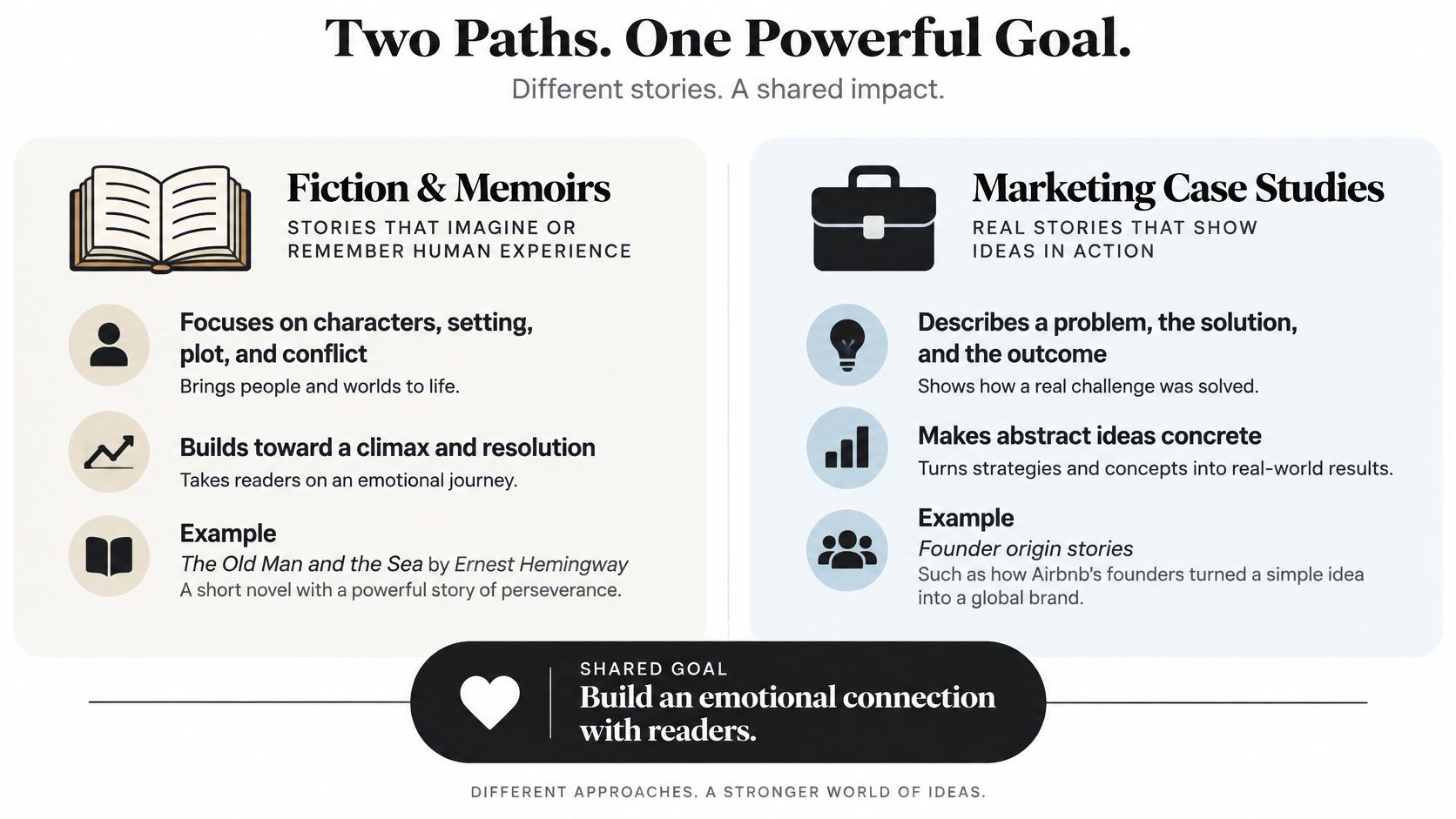
Narrative writing tells a story around characters, setting, conflict, and resolution. It's the base layer for fiction, memoir, and the customer case studies that get read. Abstract claims slip away. A specific person with a specific problem sticks.
Say a SaaS founder writes an origin post. Background first, company history second, point last. Nobody finishes. Flip it. Open on the night churn spiked, show the fix, end on the retained account. Same facts, different retention.
Where It Earns Its Keep
Creative nonfiction shows the boundary clearly. Purdue's guidance in its creative nonfiction basics gives it a narrative plot with an inciting moment, rising action, climax, and denouement, but events must be based on truth. Borrow the arc, don't invent the facts.
- Open on a moment: Start with the problem, not the preamble.
- Tie beats to takeaways: Each turn should prove a point.
- Ground it: Use concrete numbers and timelines readers can check.
- Use the spine: Setup, conflict, turning point, resolution.
It fails when story becomes decoration. Hemingway's The Old Man and the Sea works because every beat tightens the struggle. Your case study needs the same discipline.
2. Descriptive Writing
A product page says a jacket is high quality and versatile. It converts poorly. Descriptive writing fixes that by showing texture, weight, sound, and fit in language the reader can almost touch.
This genre doesn't argue or explain first. It renders. Thoreau does it for Walden Pond in Walden. A good travel guide does it for a cliff path at dusk, salt air, loose gravel, wind cutting through a shell. E-commerce copy does it for flavor, fabric, or finish.

Use It With a Job Attached
Indeed's classification in its guide to types of nonfiction describes descriptive nonfiction as emphasizing figurative language, sensory detail, and rich depiction, with travel guides as a common example. Detail without purpose is just length.
- Pick specific nouns and verbs: Don't stack adjectives to compensate.
- Hit two senses: Sight plus sound, touch, smell, or taste.
- Pair detail with benefit: Warm isn't enough. Warm on a wet platform is.
- Cut the rest: Describe what the buyer checks first.
It fails when it slows a task page. On a landing page, one vivid paragraph sells. Five bury the button.
3. Expository Writing
Expository writing explains. Definitions, facts, examples, logical order. It doesn't lead with persuasion or entertainment, and that's why it dominates search results. Readers arrive with a question. You answer it cleanly.
Rachel Carson's Silent Spring explains pesticide effects with documented evidence. A knowledge base article does the same job at smaller scale. So does an encyclopedia entry. Different stakes, same contract with the reader.
Built for Search Intent
UNESCO's framework in its revised recommendation on publishing statistics separates fiction, school textbooks, children's books, government publications, and scientific books because each serves a different audience and evidence standard. Expository pages win when they respect that separation.
- Answer first: Put the primary answer in paragraph one.
- Mirror the query: Headings should match how readers phrase questions.
- Cite current sources: Don't assert statistics you can't support.
- Make it scannable: Summaries and step lists help readers extract value fast.
That's also why how AI changes search optimization matters here. Answer engines lift clear exposition. Muddy exposition gets skipped.
4. Persuasive (Argumentative) Writing
Persuasive writing needs a claim, reasons, and proof strong enough to survive a skeptical reader. Thomas Paine's Common Sense argued for American independence. Martin Luther King Jr.'s Letter from Birmingham Jail answered critics point by point. A comparison landing page does a smaller version of the same work.
Weak persuasion shouts. Strong persuasion concedes the obvious objection, then beats it with better evidence. Readers trust writers who don't hide the trade-off.
What Converts and What Doesn't
Say you're writing a product comparison. List features and you lose to the cheaper option. Lead with the outcome your buyer can't get elsewhere, prove it, name where the rival wins, then close with one low-friction action.
Practical rule: If you can't state the other side fairly in one sentence, you don't understand your own argument yet.
- Lead with your strongest reason: Don't warm up with your weakest.
- Answer the main objection: Directly, not in a footnote.
- End with one action: Specific, small, and immediate.
The same discipline applies in cover letter guidance for content marketers. A cover letter is persuasion with a hiring manager as the audience. Claim, evidence, ask.
5. Technical Writing
Technical writing trades style for precision and usability. API references, setup guides, standard operating procedures, the IETF RFC series that defines internet protocols. If the reader can't complete the task, the writing failed, no matter how elegant it sounds.
The common failure is writing for yourself. You know the system. Your reader doesn't, or knows a different version of it.

Precision Is a Structure Problem
Genre doesn't transfer automatically. A needs analysis in a PMC study of bilingual university science students found 80% reported difficulty structuring scientific writing around introduction, methods, results, and discussion expectations. Good general writing doesn't fix a missing structure.
- Define skill level first: Beginner and admin docs aren't interchangeable.
- Number procedures: One action per step, bullets for options.
- Show the task: Add code examples or screenshots for key actions.
- Reuse terms exactly: Build a glossary and don't improvise synonyms.
New standards need the same treatment, which is why exploring the llms.txt standard works best as technical exposition, not opinion.
6. Journalistic (News) Writing
News writing puts the most important fact first. That's the inverted pyramid, and it's ruthless for a reason. Readers may stop after two sentences. They should still leave informed.
Upton Sinclair's The Jungle exposed meatpacking conditions. Ida B. Wells reported on lynching in the United States with documented evidence when few outlets would. Modern industry news does lighter work, funding rounds and launches, but the standards don't change. Attribute. Verify. Link the primary source.
Borrow the Discipline Everywhere
Say you cover a product launch on a company blog. Don't open with market context. Open with what shipped, when, for whom, and what it costs. Context follows for readers who want it.
Good trade reporting shows the value. Publishers Weekly in its report on 2024 print book sales reported fantasy was the fastest-growing adult-fiction category in U.S. print sales, increasing 35.8%. One sourced figure up top beats three paragraphs of vibe.
- Verify before publishing: Dates, figures, and names, every time.
- Update when facts change: A stale news post damages trust fast.
It fails when marketing borrows the look of news without the sourcing. Readers notice.
7. Academic Writing
Academic writing is formal, evidence-based, and built for scrutiny. Journal articles, theses, literature reviews, research reports. Darwin's On the Origin of Species presented evidence for natural selection in a form other scholars could test and challenge. That testability is the point.
It's also not one genre. The Soka University Writing Center in its guide to conventions and genres of academic writing separates research from sources, empirical inquiry, and problem solving. Empirical work commonly follows Introduction, Method, Results, and Discussion. A literature review doesn't. Treat them as interchangeable and you'll structure both badly.
Use the Rigor, Drop the Fog
Commercial writers should steal the citation habit and leave the jargon. Say a think tank publishes original research. The PDF can be dense. The summary page shouldn't be.
- Start with a research question: Or a thesis a reader can repeat.
- Cite primary sources: Peer-reviewed where the claim demands it.
- Summarize in plain language: Reach expands when findings travel.
- Follow the required style: Your publication sets it, not your preference.
It fails outside academia when formality becomes a shield for weak thinking. If you can't say it plainly, you may not know it yet.
8. Poetry (Lyric and Creative Verse)
Poetry compresses. Rhythm, sound, imagery, and line structure carry meaning that plain prose would need a paragraph to reach. Frost's The Road Not Taken and Whitman's Song of Myself don't waste syllables. Neither does a tagline you remember ten years later.
This is the genre commercial writers dismiss fastest and borrow from most. Headlines, brand voice, campaign lines. All of them live or die on compression and cadence.

Small Form, Long History
Oxford's tutorial overview in its English tutorials information traces English writing to the 7th century, with early forms including epic, lament, riddle, and dream vision, and Middle English adding lyric and romance. Verse came before most prose genres you're using today.
- Use concrete images: Don't label the emotion. Show its object.
- Read aloud: Your ear catches broken rhythm your eye misses.
- Borrow sparingly: One device per headline is usually enough.
- Keep the idea clear: Compression isn't obscurity.
It fails when writers chase cleverness. If the reader admires the line but can't repeat the offer, cut the line.
9. Instructional (How-To) Writing
Instructional writing gets the reader to a finished task. Julia Child's Mastering the Art of French Cooking breaks technique into steps a home cook can follow. A software setup guide does the same. So does a search article on setting up a redirect.
It's among the most searched types of genres of writing because the intent is urgent. The reader is stuck now. They don't want history. They want the next correct action.
The video below shows the step logic in practice, outcome first, then sequence.
Test It or Don't Ship It
Genre confusion hurts most here. A journal article in Teaching Writing on genre and college writers frames understanding genre or format as a common struggle for first-year college writers. Adult readers hit the same wall when a how-to reads like an essay.
- State the outcome first: What will be done when they finish.
- One action per step: Two actions hide the failure point.
- Test every step: Yourself, on a clean setup, before publishing.
For content teams, learning to streamline WordPress post writing with AI is instructional writing applied to publishing itself. Add troubleshooting for the steps that break most.
10. Business and Marketing Web Content
Business web content blends exposition, persuasion, and description around search intent and a conversion goal. Pillar pages, comparison pages, alternatives pages. It's the genre most companies depend on for organic growth, and the one they most often write without naming it.
David Ogilvy's 1951 Hathaway shirt campaign paired a memorable eyepatch image with a specific story. That's narrative and descriptive technique doing commercial work. The mechanics haven't changed. The distribution has.
Genre Is a Signal, Not a Guarantee
Reader preference is real but narrow. BookNet Canada's study at its Canadian Leisure and Reading Study 2025 page found 52% of Canadian print-book readers chose mystery or thriller fiction in 2025. Useful for positioning. Useless as a publishing strategy by itself.
- Map one intent per page: One primary keyword, one reader job.
- Differentiate with originals: Data, examples, or case studies competitors can't copy.
- Wire internal links: Connect supporting posts to the pillar they feed.
- Refresh winners: Search demand shifts. Update before rankings slip.
The SEO Agent is one option if volume is your constraint. Judge any tool by whether it respects genre per query, not by output count.
10 writing genres at a glance
| Genre | Primary purpose | Best-known example | Best for | Main limitation |
|---|---|---|---|---|
| Narrative Writing | Tell a story through characters, events, and conflict | The Old Man and the Sea by Ernest Hemingway | Building emotional connection and making ideas memorable | Can lose focus and take more words than direct formats |
| Descriptive Writing | Create a vivid sensory impression of a subject | Walden by Henry David Thoreau | Bringing products, places, and experiences to life | Can feel vague or slow when details are excessive |
| Expository Writing | Explain a topic with facts and clear organization | Silent Spring by Rachel Carson | Educational content, explainers, and knowledge articles | Can feel dry and requires accurate, current research |
| Persuasive (Argumentative) Writing | Convince readers to adopt a view or take action | Common Sense by Thomas Paine | Advocacy, sales copy, and calls to action | Weak evidence can make it seem biased or manipulative |
| Technical Writing | Explain complex processes or specifications precisely | IETF RFC series | Documentation, manuals, and technical procedures | Can be dense and requires frequent accuracy checks |
| Journalistic (News) Writing | Report timely events using verified facts and sources | Ida B. Wells' reporting on lynching | News coverage and industry updates | Time pressure can threaten accuracy |
| Academic Writing | Present research and arguments using scholarly conventions | On the Origin of Species by Charles Darwin | Scholarly research and evidence-based analysis | Dense conventions and long production cycles limit accessibility |
| Poetry (Lyric and Creative Verse) | Use shaped language, rhythm, and imagery to express meaning | “The Road Not Taken” by Robert Frost | Memorable brand language and creative expression | Ambiguity can obscure the intended message |
| Instructional (How-To) Writing | Guide readers through a task in clear steps | Mastering the Art of French Cooking by Julia Child | Tutorials, setup guides, and troubleshooting | Instructions can become outdated and require testing |
| Business and Marketing Web Content | Inform and persuade audiences toward brand-related action | David Ogilvy's 1951 Hathaway shirt campaign | Organic traffic, brand authority, and conversions | Requires ongoing maintenance and faces competitive search dynamics |
Match the Genre to the Job, Then Ship Consistently
Ten genres, one rule. Pick the genre the reader's intent demands, then execute it cleanly. Expository and instructional pieces dominate search because they answer urgent questions in a scannable form. Persuasive and business content close readers who are already comparing. Narrative and descriptive techniques keep any of those pages from reading dry, and poetic compression sharpens the headlines that earn the click.
Don't expect the label to do the work. A peer-reviewed study in EPJ Data Science on book sales prediction found publisher quality and publishing experience were the strongest predictive features for fiction and nonfiction, while genre, topic, and publication month had only limited influence. Genre is a structured audience signal. Credibility, packaging, distribution, and differentiation decide whether that signal converts.
The market rewards execution inside a category, not the category itself. Publishers Weekly in its reporting of preliminary 2024 industry data reported U.S. adult-fiction sales increased 12.6% to $3.26 billion in 2024, while adult nonfiction rose 1.3% to $2.88 billion. Two broad categories, very different momentum, and neither figure tells you whether your next piece is positioned well.
Learn the convention well enough to break it on purpose. Breaking rules you can't name is just missing them.
Start with hybrid awareness. A case study is narrative with persuasive intent and technical proof. A pillar page is exposition with descriptive examples and a business goal. A launch post is journalistic structure carrying marketing content. Name the primary genre, borrow one technique from a second, and stop there. Three genres competing on one page usually means none of them is in charge.
If the bottleneck is volume rather than craft, The SEO Agent's pipeline handles that side. It researches keywords, builds briefs, drafts source-checked articles in the right genre for each query, and publishes them to your CMS with images, schema, and internal links attached, built for traditional search and AI answer engines. On cost, the pricing page lists typical market rates of $400+ a month for a freelance writer, $3,000+ for an agency, and $4,500+ for an in-house writer.
Pick your next article's genre deliberately. Write the brief around purpose, audience, evidence, and structure before you draft a line. Publish on a cadence you can sustain, refresh what's working, and let consistency do the compounding.
Pick the right genre for each keyword and let The SEO Agent handle the research, source-checked drafting, internal links, images, and native CMS publishing for you. You approve the direction, it ships a structured article built for search and AI answer engines every day.