8 Authors Writing Style Examples to Study in 2026
Explore 8 Authors Writing Style Examples from Hemingway to McCarthy, with brief analysis, excerpts, and tactics you can apply to your own writing in 2026.
Most writers imitate the surface of a famous style and miss the mechanism underneath. A study comparing AI-generated imitations of Hemingway and Shelley found that the imitations showed some stylistic alignment but still formed separate groups from the human-authored texts, a reminder that familiar surface features don't automatically create an authentic voice (Digital Scholarship in the Humanities). The useful question isn't “How can I sound like Hemingway?” It's “What choice is Hemingway making, and when would that choice help my reader?”
Each author below is broken down into a transferable technique, a short original example, and a warning about where the technique can fail. You'll get practical rules for blog and SEO writing, not just praise for famous books. Treat these styles as editing tools, not costumes. Borrow one move, adapt it to your subject, then read the result aloud to check whether the writing still sounds like you.
By the end, you'll have a short set of editing rules you can apply to an existing draft within the hour. Start with the reader's need, choose the technique that serves it, and leave the rest of the author's style on the page.
Table of Contents
- 1. Hemingway's Iceberg Style
- 2. Orwell's Plain English Rules
- 3. Joan Didion's Personal Essay Style
- 4. Stephen King's Conversational Craft Style
- 5. Paul Graham's Essay Style
- 6. Malcolm Gladwell's Narrative Explainer Style
- 7. Seth Godin's Short-Form Punchy Style
- 8. Cormac McCarthy's Sparse Punctuation Style
- How the 8 Author Writing Styles Compare for Content Creators
- Turning Famous Styles Into a Voice You Can Repeat
1. Hemingway's Iceberg Style
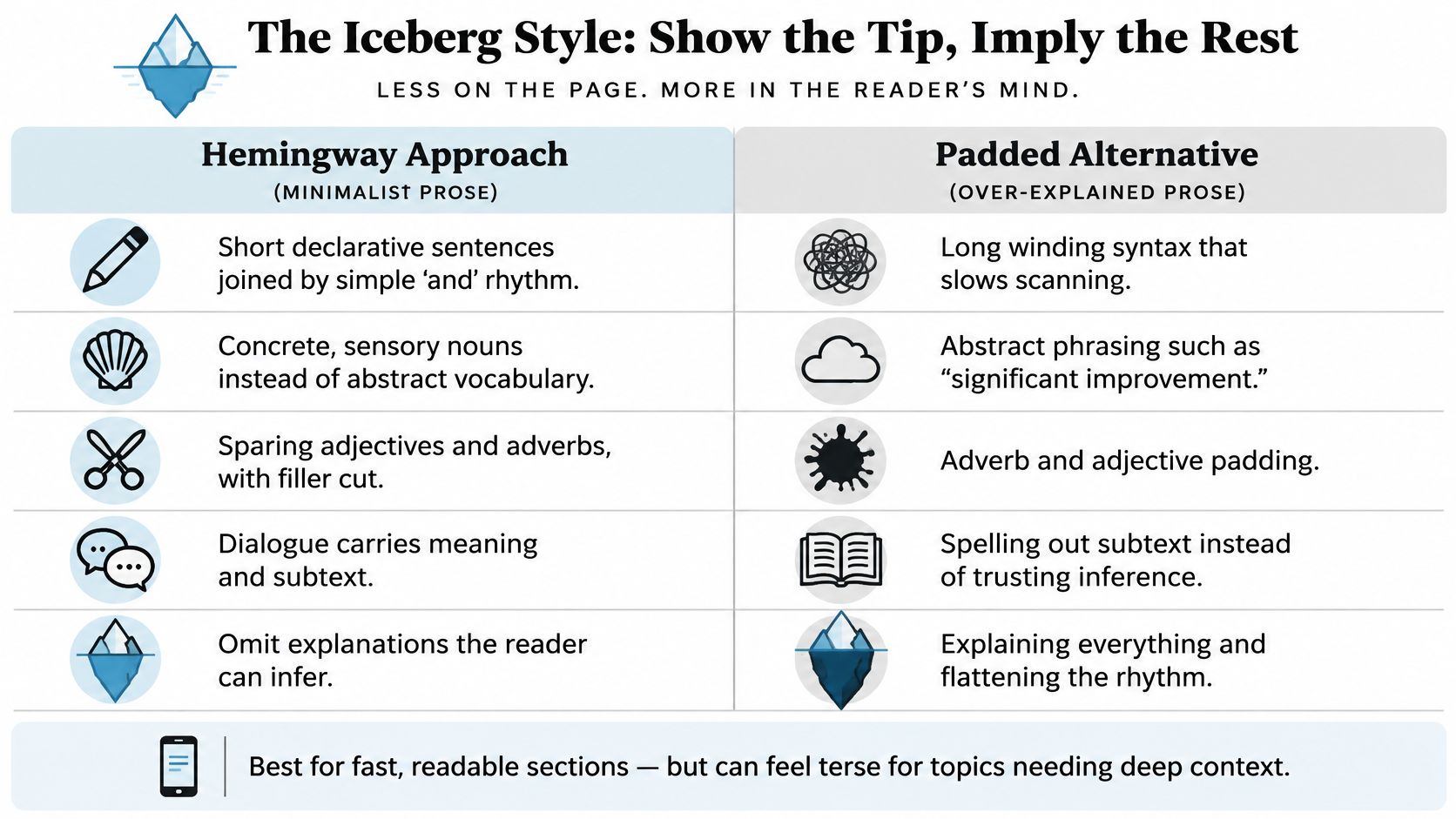
The technique: Keep the visible prose plain, then let specific details carry the feeling or meaning the text doesn't spell out. Hemingway's so-called iceberg approach is often associated with restraint: the writer gives readers enough to understand a moment, but doesn't explain every implication.
An original practice example: “The trial ended on Tuesday. The team kept the old landing page.” The second sentence doesn't tell us whether the team feels relieved, disappointed, or cautious. It leaves room for the reader to infer what the choice means from the surrounding context.
For web writing, the equivalent is a direct claim followed by a concrete detail. Don't write “The update delivered a significant improvement.” Say what changed, such as which task now takes fewer steps or what readers can do that they couldn't do before. Plain detail is stronger than a pile of intensifiers.
A Lancaster University stylistics exercise illustrates how sentence length can shape rhythm: its sample from Jane Austen averaged 42 words per sentence, while the Steinbeck sample averaged 18.4. Those figures describe particular passages, not universal rules for either author. They're still a useful reminder to measure a passage before calling its sentences “long” or “short.”
Steal the restraint, not the omissions
Editing rule: Give readers the observable outcome before you explain what it means.
For a product blog, lead with the plainest version of the answer. Follow with the supporting detail, then explain the implication. Short paragraphs can help mobile readers, but extreme compression can make a page feel abrupt or leave a beginner without the context they need.
Where it breaks: Search and business readers often need explicit answers, steps, and qualifications. If a claim depends on an important caveat, don't leave that caveat implied. Use Hemingway's economy to remove padding, not to hide information the reader needs.
2. Orwell's Plain English Rules
Orwell's essay “Politics and the English Language” treats unclear prose as more than a style problem. Inflated words and vague phrasing can make weak thinking harder to spot. The practical lesson for content marketers is direct: choose the simplest wording that preserves the meaning.
An original practice example: “The platform facilitates the optimization of workflows.” That sentence sounds formal but tells the reader little. “The platform helps teams plan and publish articles” names the action and the people doing it.

Use plain language as a credibility check
Try this quick edit on each paragraph:
- Replace padded wording: Change “in order to” to “to” when the shorter phrase means the same thing.
- Name the actor: Use active voice when the person or team taking action is known.
- Explain specialist terms: Define a necessary technical term the first time it appears.
- Test each sentence: Keep it if it adds a fact, a claim, or a step. Cut it if it adds none.
For instance, a software company could replace “A configuration must be completed by the user” with “Choose your settings.” If the user needs to know which settings, name them next. This keeps the instruction short without making it incomplete.
Use a reading-level checker to evaluate how easily your content reads, then review the wording yourself. A readability score can flag sentences that may need attention, but it can't tell you whether a technical term is essential or whether a simplification has changed the claim.
Where it breaks: Plain English isn't an excuse to flatten every sentence into a command. In thought leadership, careful qualifiers may be more accurate than blunt certainty. Keep the precision. Remove the fog.
3. Joan Didion's Personal Essay Style
Didion makes observation do argumentative work. A detail can establish a setting, suggest a tension, and lead into a broader point without the writer announcing an opinion in every sentence. That's a valuable technique for thought leadership, especially when a topic feels abstract.
An original practice example: “The team had a new content calendar. The first page was full. The review column was empty.” The scene gives the reader a small, specific problem to hold onto. A post about editorial workflows can then move from that visible gap to the larger question of who approves drafts and when.
Let the detail earn the opinion
For a blog post, open with an observation that belongs to the subject. It could be a customer question, a recurring error in a process, or a tension between a company's stated goal and its actual workflow. Then make your point. Don't use a dramatic scene just to delay the answer the reader came for.
A disciplined sequence works well:
- Show one relevant detail.
- Offer a brief first-person judgment if it adds expertise.
- Return to the reader's problem and support the argument with evidence.
Sentence rhythm matters here. A longer sentence can establish context, then a short one can deliver the turn. If every line is clipped for effect, the writing starts to feel staged rather than reflective.
For practical guidance on writing SEO content with Claude, the transferable lesson is to give the tool real observations and a clear point of view, then edit the draft so the details serve the argument. A personal voice can make an article distinctive, but the personal element should illuminate the reader's question, not replace its answer.
Where it breaks: A scene-first opening can bury the answer behind atmosphere. For a high-intent query, give the direct answer early, then use the observation to explain why it matters. Keep the anecdote short enough that it earns its space.
4. Stephen King's Conversational Craft Style
King's craft advice favors clear, accessible prose that keeps attention on the story rather than the decoration. For a blog writer, the useful translation is simple: explain the topic as if you were speaking to a smart colleague, then revise the draft so the conversation stays focused.
An original practice example: “Your article has useful advice. But the reader has to reach the fourth paragraph to find it.” That sounds conversational because it names the problem directly. It doesn't need a string of slang or a forced joke to feel human.

Draft for momentum, edit for clarity
Try separating the drafting and editing jobs. First, get the explanation down in a natural order. Then check whether each paragraph moves the reader toward the promised answer, and remove adverbs that merely repeat the verb.
“Walked slowly” may be less precise than “strolled” or “hesitated.” But don't delete every adverb on principle. If it changes the meaning, it's doing useful work.
For a startup blog, imagine explaining a new feature to a colleague who understands the product but hasn't used it. What would they need to know first? What would you clarify before they tried it? That conversation gives you a natural path through the article, from problem to explanation to next step.
The link to human-sounding AI articles for startup blogs is best understood as an editing problem, not a request for fake informality. A draft can sound relaxed and still be precise. A conversational voice should make the reasoning easier to follow.
Where it breaks: A chatty tone can wander, especially when every section adds another aside. Keep a clear through-line. If a sentence wouldn't help a colleague understand, decide, or act, cut it or move it.
5. Paul Graham's Essay Style
Graham's essays often develop an idea by stating a claim, testing it with examples, and adjusting the reasoning as the argument unfolds. That exploratory approach suits founders and solo builders because it resembles the way practitioners think through a problem: start with a useful observation, examine where it holds, and acknowledge where it doesn't.
An original practice example: “A launch plan can look complete and still fail. If nobody owns the first customer conversations, the team may learn too late that the message is unclear.” The first sentence gives the argument. The second makes it concrete.
Make the reasoning visible
For a founder writing about a product decision, state the central claim early. Use a specific example or observed pattern to test it, then include the strongest limitation. That qualification doesn't weaken a sound argument. It tells the reader where to apply it.
Short sections help busy readers scan, but don't reduce the essay to disconnected slogans. Each paragraph should build on the previous one. If you introduce a term or framework, explain it in language a reader can use, not just admire.
The same discipline helps when you're choosing an LLM for SEO writing: judge the result by whether it can support your argument with clear examples, not by whether it produces a confident-sounding draft. The writer remains responsible for the judgment, the evidence, and the limits.
Where it breaks: An exploratory essay can take too long to reach its point. Search readers may not follow a chain of reasoning if the destination stays hidden. State the answer up front, then let the essay show how you arrived there.
6. Malcolm Gladwell's Narrative Explainer Style
A narrative explainer makes an idea easier to remember by connecting it to a specific case. The writer introduces a person, event, or problem, brings in evidence, then draws a wider lesson. That structure works well when readers need help understanding why a finding matters.
An original practice example: A shop owner changes a product page after customers keep asking the same question. The page becomes clearer, but the broader lesson isn't “add more copy.” It's to identify the unanswered question behind the repeated request, then make the answer easy to find.
Give the story a job
A useful explainer answers the core question near the start. The story should help readers understand the answer, not hold it back. When you introduce a study or business finding, link to the underlying source in the body and describe what it examined. Don't stretch a narrow result into a universal rule.
A memorable label can help readers retain a framework, but only if the label describes something real. For example, an editor might call a simple review sequence “claim, evidence, action”: state the point, show the support, then tell the reader what to do. The framework is useful because it maps directly to the work.
Here's a practical order: answer the query, introduce the case, explain the evidence, then state what readers can apply. That structure can carry a data-heavy article without making the data feel like a detour.
Where it breaks: A lively anecdote can overpower the evidence. Don't imply that one example proves a broad claim. Keep the case in its proper role: a way to make the explanation tangible, not a substitute for support.
7. Seth Godin's Short-Form Punchy Style
Short-form writing makes one idea easy to notice. Godin's blog posts are known for compact arguments that invite readers to reconsider an assumption. That approach can help with frequent publishing and social distribution, but brevity works only when the idea is complete enough to stand on its own.
An original practice example: “A full calendar doesn't mean your content has a strategy. It may just mean nobody has said no yet.” The first sentence sets the contrast. The second makes the reader look again at a familiar metric.
Keep the point, add the useful step
A short post can support a longer guide by highlighting one narrow question and linking readers to the full explanation. For instance, a post about product-page copy could focus on one common objection, then offer a direct takeaway: put the answer beside the feature it concerns.
That doesn't mean every post should be cryptic or provocative. A memorable line needs a practical point beneath it. If the reader can't tell what to do next, the post may be punchy but not useful.
A steady publishing habit can help a team build a recognizable voice, but don't publish thin variations of the same idea just to keep a cadence. Plan short posts around distinct reader problems, then connect them to deeper material where that helps.
For teams coordinating a content workflow, The SEO Agent is one option to consider. The editing task remains the same whether a post is short or long: keep the claim clear, the detail relevant, and the takeaway useful.
Where it breaks: A one-liner can oversimplify a technical or high-stakes subject. Add the caveat or fuller explanation when a short format would mislead. Brevity is an editing choice, not a reason to leave out necessary context.
8. Cormac McCarthy's Sparse Punctuation Style
McCarthy's prose is known for stripped-back punctuation, including dialogue without quotation marks in some novels, and for rhythms that can build through repeated conjunctions. The transferable lesson for web writing is economy and cadence, not copying the punctuation. Readers still need clear signals about who's speaking and where an instruction begins.
An original practice example: “The draft was short and direct and easy to scan.” Repeating “and” gives the sentence a steady, accumulating rhythm. It can work once for emphasis. If every sentence uses the same pattern, the rhythm becomes predictable.
Borrow the rhythm, preserve usability
In brand storytelling, a deliberate run of short clauses can create pressure or momentum. In product documentation, the same choice may slow readers down. Use punctuation to clarify relationships between ideas, and reserve stylistic experiments for places where readers can follow them without extra effort.
A practical edit is to read the passage aloud and mark where you naturally pause. If the punctuation fights the sense, revise it. Vary sentence length so the short lines carry emphasis and longer ones provide context. Repetition should highlight a point, not become the default beat.

Economy isn't the same as omission. Keep every detail the reader needs to understand the sentence.
Where it breaks: Unusual punctuation can make a web page harder to scan, particularly when readers are looking for a quick answer or an instruction. Borrow McCarthy's attention to rhythm and restraint. Don't make readers decode the formatting before they can understand the point.
How the 8 Author Writing Styles Compare for Content Creators
| Author Style | Core Technique | Best Content Type | Main Risk for Web Content |
|---|---|---|---|
| Hemingway's Iceberg Style | Short, concrete prose that implies more than it explains | Scannable articles and concise storytelling | May omit context or feel terse |
| Orwell's Plain English Rules | Cut filler, prefer direct wording and active voice | Practical guides and trustworthy informational content | Can sound flat or oversimplify technical topics |
| Joan Didion's Personal Essay Style | Use precise observation and personal reflection to build broader analysis | Thought leadership and long-form essays | Personal tone may not suit corporate content or quick queries |
| Stephen King's Conversational Craft Style | Write conversationally, then revise for clarity and momentum | Engaging blog posts and accessible explainers | Informality may weaken authority in technical or regulated fields |
| Paul Graham's Essay Style | Explore one central claim through examples and candid reasoning | Startup, programming, and founder-focused essays | Requires genuine expertise and may miss how-to search intent |
| Malcolm Gladwell's Narrative Explainer Style | Open with a story, connect research, and reveal a broader lesson | Research-based explainers and trend articles | Anecdotes may oversimplify or bury direct answers |
| Seth Godin's Short-Form Punchy Style | Deliver one provocative, memorable idea in a few sentences | Short blog posts and social content | Limited depth may not satisfy comprehensive queries |
| Cormac McCarthy's Sparse Punctuation Style | Use spare language, minimal punctuation, and deliberate rhythm | Brand storytelling and distinctive creative content | Unconventional punctuation can hinder readability |
Turning Famous Styles Into a Voice You Can Repeat
A repeatable voice is built from techniques, not from imitating one author's sentence habits. Pick the moves that fit your subject, your reader, and the job the page has to do. Then apply that same short list to every draft. A product guide and a founder's essay can sound different and still read as the work of one writer.
Run this editing pass on your next draft:
- Lead with a claim: Put the answer or main point where the reader can find it.
- Cut filler: Remove words that repeat an idea without adding precision.
- Choose one concrete detail: Use an example, observation, or piece of evidence that makes the point tangible.
- Vary the rhythm: Use short sentences for emphasis and longer ones where readers need context.
- Check the limit: Ask whether a borrowed technique is clarifying the message or making it harder to use.
Most drafts improve at this stage. The idea is often sound and buried under setup, inflated wording, or the same explanation delivered twice. A careful revision makes the argument easier to follow without sanding off its personality.
A recognizable voice and a clear answer can coexist on the same page. Use a sharper opening, one honest example, or a deliberate rhythm change, but keep the answer visible near the top and every claim supported. Where a style fights the reader, the reader leaves and the page stops earning traffic.
For teams publishing at volume, The SEO Agent runs an editing pass that removes stock AI phrasing from drafts, so your review can focus on voice instead of cleanup. Articles arrive structured, sourced, internally linked, and reviewed before they go live, and you approve each draft before it publishes.
Pick one author's technique and rewrite a single existing paragraph with it. Compare the new version with the original: keep the changes that make the idea clearer, and discard the ones that only make the prose resemble someone else.
The SEO Agent helps founders and lean teams research, draft, fact-check, and publish SEO content daily. Use it to hold a repeatable voice while review and editing stay in your hands. Visit The SEO Agent to explore the content workflow.