Audience Segmentation That Drives Real Marketing Results
Learn audience segmentation the practical way. Frameworks, data sources, KPIs, and a step-by-step playbook for founders and lean teams in 2026.

You've probably felt this already. Traffic keeps coming in, your product is solid, and your homepage says all the right things, but conversion rates flatten because every visitor gets the same pitch, the same CTA, and the same follow-up. Founders hit this wall all the time. They aren't short on effort. They're short on segmentation that maps intent to action.
The fix usually isn't another persona deck. It's a tighter operating model. When a solo founder researching automated publishing lands on the same page as an agency comparing multi-site workflows or a SaaS team checking CMS compatibility, broad messaging starts leaking revenue. Audience segmentation fixes that by deciding who deserves which message, on which channel, based on what they've already shown you.
Table of Contents
- What Audience Segmentation Means in Practice
- The Five Frameworks That Actually Move Numbers
- Where Segmentation Data Comes From Now
- A Repeatable Implementation Playbook
- KPIs and Validation Methods That Hold Up
- Privacy, Trust, and Bias as Segmentation Variables
- Your 30-60-90 Day Segmentation Rollout
What Audience Segmentation Means in Practice
A pricing-page visitor returns through branded search after comparing integrations. Another reader has only skimmed a top-of-funnel article. They may share a market, but they do not share the same intent. Sending both the same message creates friction at the point where the next action should become clearer.
Audience segmentation groups people by a meaningful problem, intent, behavior, or permission status, then adjusts the message, channel, offer, or follow-up accordingly. The useful test is operational: can the segment change an activation signal such as a completed setup, trial milestone, demo request, upgrade, or retained use? If it cannot, it is descriptive rather than actionable.
The principle has a long history. In 1956, Wendell R. Smith formalized market segmentation in his Journal of Marketing article, arguing that firms should identify groups with similar needs instead of treating demand as uniform. LibreTexts on market segmentation/04:_Segmentation_in_a_Marketplace/4.01:_What_is_Market_Segmentation) summarizes that foundation.
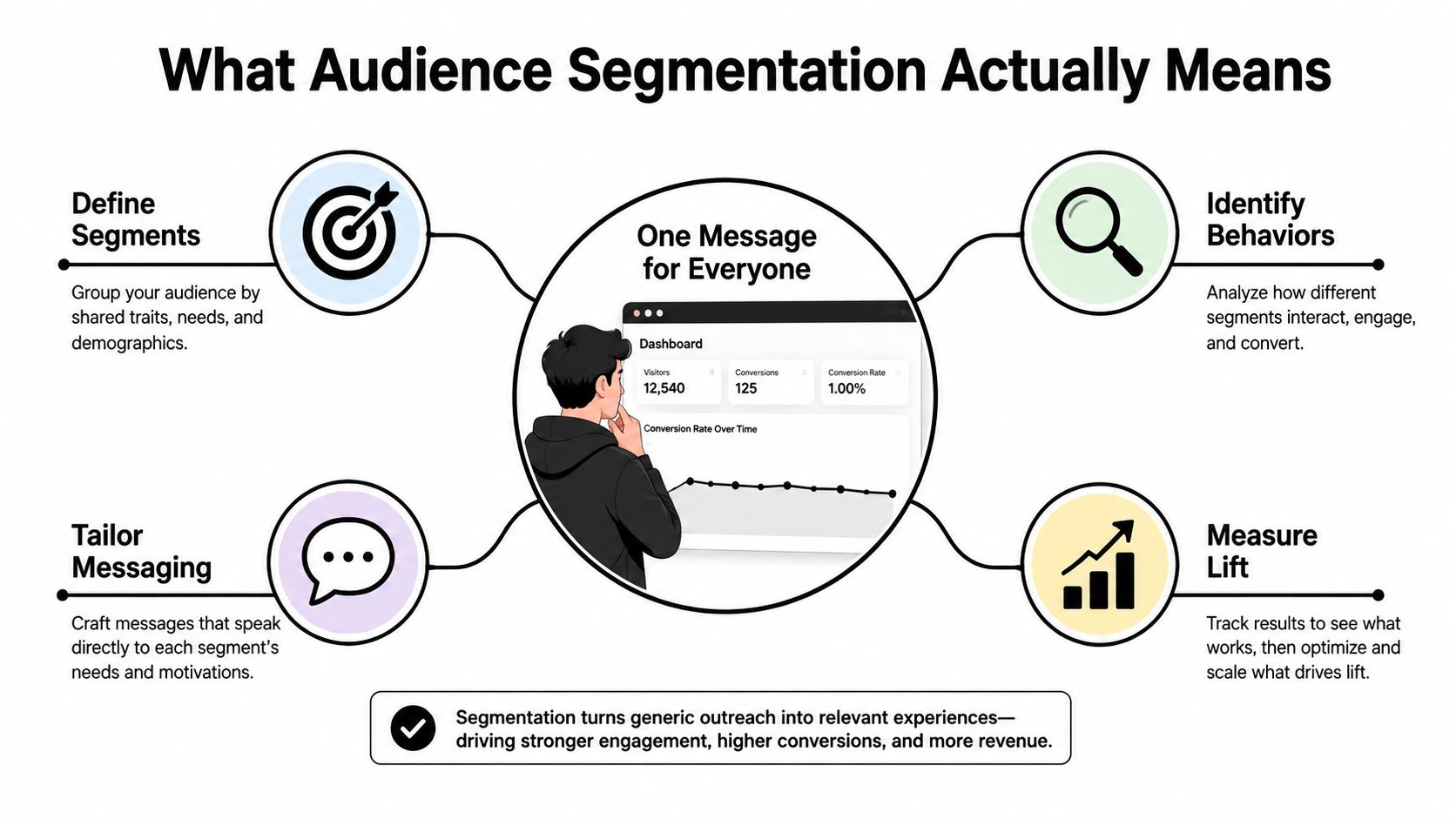
The difference between segments and dead personas
Persona work fails when it describes an audience without changing execution. Names, age bands, and broad motivations may look useful in a presentation, yet they offer no rule for choosing a page, CTA, or sales response. A segment earns its place when a team can act on it and measure the result.
A usable segment connects three layers:
- Identity data, such as role, company type, or platform
- Observed behavior, such as pages viewed, features explored, or trial status
- Business outcome, such as activation, upgrade, or retention
Consent belongs in the same operating model. A person who has not agreed to a marketing use case should not enter the same activation path as someone who has granted that permission. Retain the consent state, collection context, and permitted channel with the segment, so a privacy review can reconstruct why a message was sent.
Segmentation therefore works as a measurement system, not a branding exercise. It should answer one line of inquiry: Who is this visitor, what did they do, what are we allowed to use, and what changed after we responded?
Practical rule: Segmentation is the difference between shouting into a stadium and handing the right flyer to the right person at the door.
For content and SEO teams, intent-aware routing applies to production as well as distribution. A founder searching for publishing automation may need a different article, proof point, and CTA from a marketing team evaluating workflow scale. Tools such as The SEO Agent support that routing by connecting content decisions to audience intent.
The five useful bases
Teams rarely need dozens of segment types. They need a small set that can drive a page change, message change, or activation experiment. Practical bases include demographic, behavioral, technographic, firmographic, and needs-based segmentation. Each describes a different part of the buying situation, and each becomes more valuable when tied to a permitted action and a measurable outcome.
When the segment changes execution and the activation signal moves, the framework is doing revenue work rather than decorating a slide.
The Five Frameworks That Actually Move Numbers
The easiest way to waste time with audience segmentation is to use the wrong base for the wrong decision. Teams often reach for demographics because they're easy to collect, then wonder why campaign performance barely changes. The issue isn't that demographic data is useless. It's that it answers a different question.
Firmographic, technographic, needs-based, value-based, and behavioral segmentation are the most useful set for B2B and SaaS teams because they describe different layers of buying reality. OpenStax on B2B market segmentation lays out these bases clearly, and that framework holds up in practice.
Five segmentation bases compared
| Base | What It Describes | Core Attribute | Best For | Sample Variable |
|---|---|---|---|---|
| Demographic | The person | Personal characteristics | Broad messaging and audience description | Job title |
| Firmographic | The company | Business characteristics | B2B targeting and sales routing | Company size |
| Technographic | The stack | Tools and platforms in use | Integration pages and migration content | CMS platform |
| Needs-based | The problem | Desired outcome or pain point | Positioning and offer design | Need for hands-off publishing |
| Behavioral | The action | Observable intent or engagement | Activation and conversion work | Trial started |
What each framework is good at
Demographic segmentation tells you who someone is. Behavioral segmentation tells you what they've done. Those are not interchangeable. Experian's explanation of demographic versus behavioral segmentation makes the distinction cleanly, and it's one of the most important rules to preserve in your reporting. Age, role, and income might describe context. They don't establish intent.
Firmographic segmentation is the B2B version of demographics. It's useful when the buying motion changes with company structure. A startup, an agency, and a larger SaaS company may all need SEO output, but they don't buy for the same reason or with the same approval path.
Technographic segmentation becomes powerful when your product depends on integrations, implementation speed, or publishing workflows. If one group runs WordPress and another runs Webflow, the content path should diverge early.
Needs-based segmentation is where positioning gets sharper. This is the difference between “we serve marketers” and “we help lean teams publish without adding headcount.”
Segments that move pipeline usually combine at least two bases. One describes the account. One captures intent.
If you want another perspective on segmentation for pipeline growth, that piece is useful because it keeps the discussion tied to revenue mechanics rather than abstract targeting theory.
A workable combination for B2B SaaS
A clean segment definition for a SaaS team might look like this:
- Firmographic layer: Mid-market SaaS company
- Technographic layer: Uses Webflow
- Behavioral layer: Viewed integrations and pricing, but hasn't started a trial
- Needs-based layer: Wants faster publishing without manual handoffs
That segment is useful because it's interpretable. It tells content what landing page to build, tells growth what email branch to trigger, and tells sales what friction likely remains. If you're mapping stack-specific acquisition, a list of geo tool recommendations can also help teams think more precisely about localized and platform-aware workflows.
Where Segmentation Data Comes From Now
The old habit was simple. Collect as much data as possible, then figure out what to do with it later. That model doesn't survive current privacy rules, consent requirements, or activation constraints. Today, the useful question isn't just “What data do we have?” It's “What data can we reliably collect, explain, and activate?”
For segmentation work, data now comes from a small number of practical sources. First-party web analytics shows content consumption and pathing. CRM records show lifecycle stage, ownership, and commercial context. Product usage logs reveal whether interest became adoption. Customer interviews and on-site surveys add motive, which behavior alone can't fully explain. Some teams layer in intent tools and enrichment, but those should support first-party evidence, not replace it.
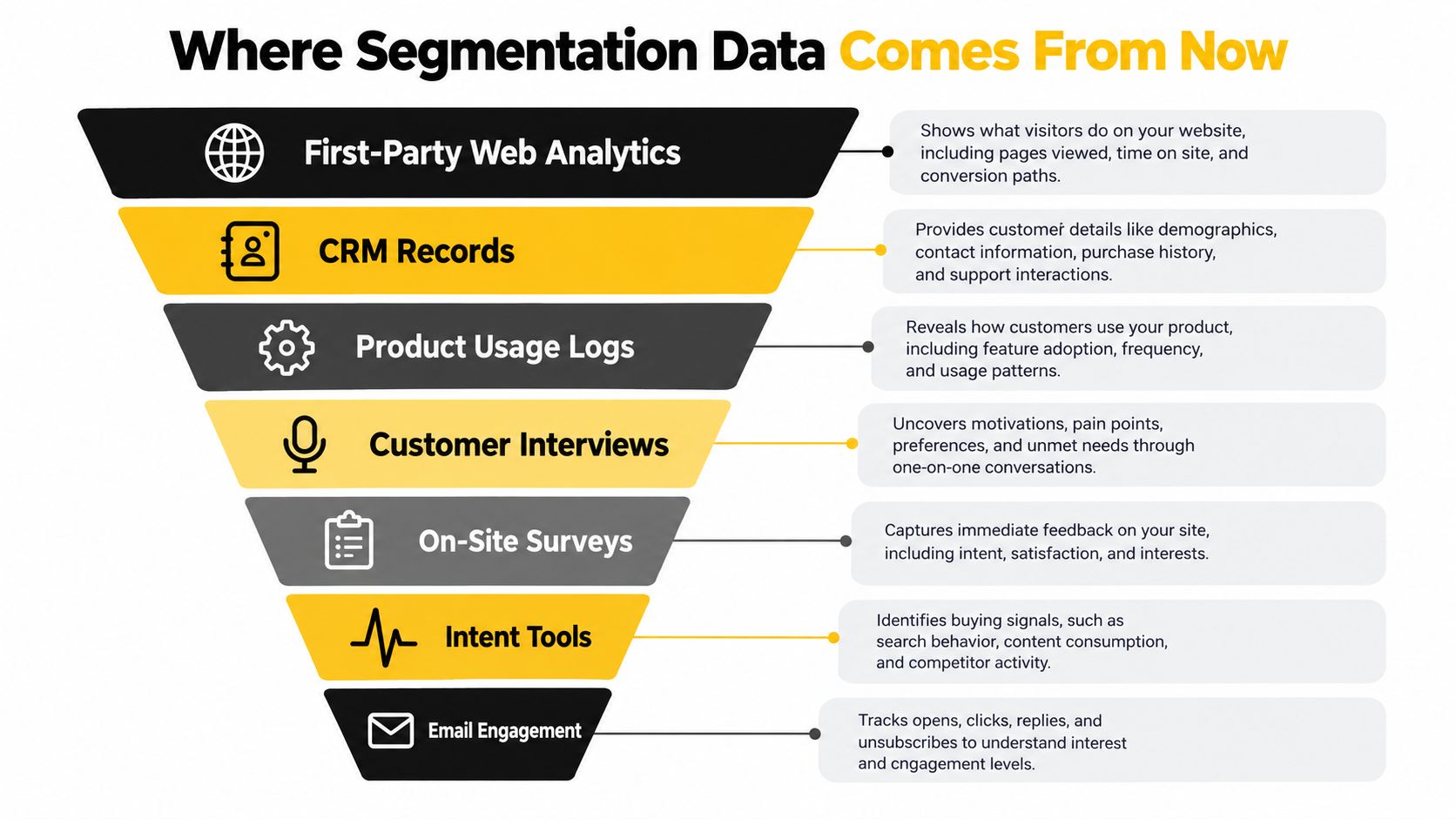
What's dependable now
If I were rebuilding segmentation for a lean SaaS team today, I'd start in this order:
- First-party behavioral data from analytics, email, and product events
- CRM lifecycle data like lead stage, owner, pipeline status, and close reason
- Firmographic enrichment for company type, industry, and size
- Direct qualitative input from interviews, support logs, and survey responses
That order matters because behavior is usually the cleanest proof of intent. A page view on integrations yesterday says more than a vague audience label from six months ago.
Academic work on the history of audience measurement also supports this shift toward measurable, distinct segments. The progression moved from circulation totals to sampled audience estimates and then to psychographic and behavioral models, with the central lesson that a useful segment must be both meaningfully distinct and measurable, as described in the Oxford overview of audience segmentation history.
What's restricted or conditional
Activation is where many teams get surprised. A segment can exist in analytics and still be unusable for advertising. Google states that advertisers using applicable tags or SDKs must collect consent from end users in the EEA and share consent signals for measurement, ad personalization, and remarketing. Without that, only users outside the EEA are included in linked advertising audiences, according to Google Analytics consent requirements for audience features.
That changes how you design segments. Consent status and region are no longer compliance footnotes. They determine which audiences can be activated in ads and remarketing.
A lot of teams also overreach with inferred traits. My rule is blunt. Start with what the user did on your properties. Add company context second. Treat inferred psychographics as a last resort. If your content system supports structured topic-to-intent mapping, a model like vector search content architecture can help organize those first-party signals without leaning too hard on invasive data guesses.
A Repeatable Implementation Playbook
Segmentation projects usually stall because they begin with attributes instead of a decision. The team asks, “What segments do we have?” The better question is, “What business question must this segment answer?”
That decision determines the workflow. For low trial starts, isolate visitors whose actions suggest purchase intent but stalled activation. For weak sales efficiency, separate high-fit accounts from noisy leads. Build the segment backward from the decision, then define the activation signal that will show whether the work changed behavior.
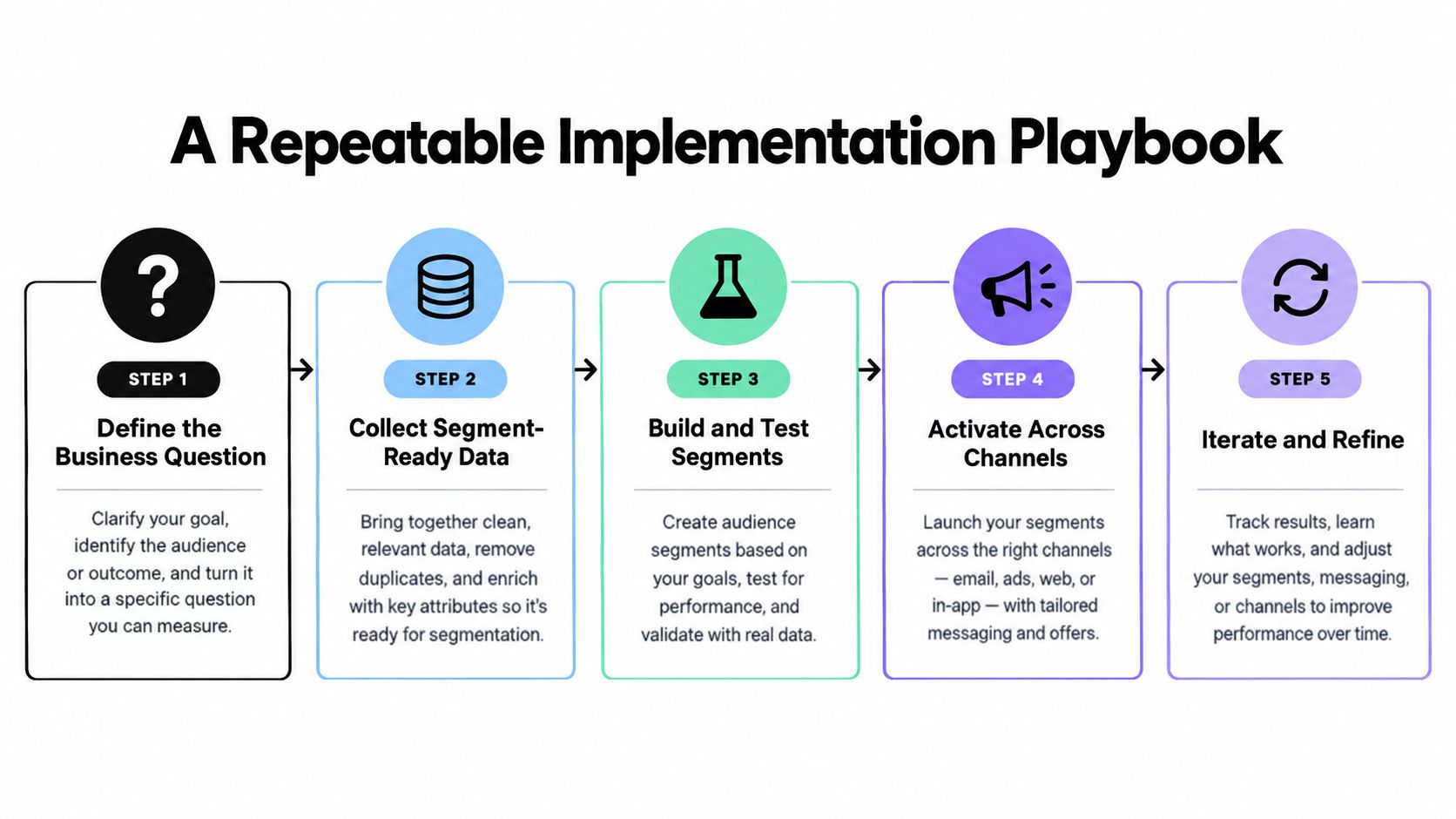
Start with the question, not the audience
A practical implementation flow has six steps:
Define the business question
Example, which visitors show buying intent but do not activate?Choose the segmentation base that matches the question
Use firmographic data for sales routing, technographic data for integration messaging, and behavioral data for activation problems.Write a minimum segment schema
Document the definition before building dashboards. Include the conditions that qualify and disqualify a user.Wire the schema into analytics and CRM
The segment must exist wherever the team measures performance or takes action.Ship a matched message or landing page
A segment without a differentiated experience is only a label.Measure downstream activation
Track trial starts, qualified demos, or paid movement instead of stopping at traffic.
Google Analytics supports behavioral segmentation based on campaign source, content consumption, product usage, purchase history, and conversion status. It also allows teams to compare multiple segments in one report to isolate behaviors associated with purchase, as documented in Google Analytics segment comparisons.
A minimum viable segment schema
Here is the smallest schema I would accept for a serious implementation:
- Acquisition source
- Query or topic cluster
- Viewed feature
- Trial status
- CMS platform
- Conversion event
- Inclusion rules
- Exclusion rules
- Consent status
- Region
If a segment definition does not include exclusion rules, reporting confusion will follow.
Exclusions matter because one user can qualify for several overlapping “high intent” groups. Without a clear priority or exclusion rule, channel comparisons become difficult to interpret.
Three B2B paths make the distinction concrete. A solo founder may read automation pages and pricing. An agency may inspect multi-site workflows, approvals, and client publishing. A SaaS team on WordPress or Webflow may focus on integration depth and content operations reliability. These differences support separate landing pages, onboarding emails, and sales handoffs.
Here's a quick visual walkthrough before the activation layer gets more complex:
Activation beats labeling
Once the segment exists, send matched traffic to a page or message that addresses the job the audience is trying to complete. Change the proof, CTA framing, examples, and objections handled, rather than limiting the test to minor copy edits.
For lean teams, process discipline matters more than headcount. Segment variants require a repeatable production system, clear ownership, and enough speed to avoid inconsistent experiences. That's why lean team content automation becomes strategically important, not just operationally convenient.
Market attention also reflects the value of systems that operationalize personalization instead of merely describing it. A resource such as search for investors in personalization startups can indicate where that interest is concentrated, while implementation should remain grounded in simpler first-party use cases.
The strongest teams do not build the most elaborate segments. They build segments they can measure, explain, activate consistently, and review when consent or regional eligibility changes.
KPIs and Validation Methods That Hold Up
Conversion rate is the first metric everyone asks for. It's rarely enough on its own. A segment can lift conversions while excluding good-fit users, decaying over time, or creating performance swings across cohorts that make scaling risky. That's why serious audience segmentation needs two scoreboards. One for commercial lift, and one for segment health.
The metrics worth reporting upward
These are the metrics leadership usually needs:
- Segment lift versus a non-segmented or broad-message baseline
- Click-to-trial rate for content, email, and landing-page variants
- Paid activation or qualified pipeline movement
- Retention by segment after activation
Those metrics answer the business question. Did the segment create a better commercial outcome than the default experience?
Email is a good example because it shows both the upside and the trap. Segmented email campaigns have been reported to achieve 14% higher open rates and more than 100% higher click rates than non-segmented campaigns, though results vary by list quality, industry, deliverability, and segment definition, according to research on segmented email engagement. That's directionally useful, but I still wouldn't overvalue opens. Privacy changes make open data shaky. Click-to-trial and paid movement are harder to fake.
The metrics most teams skip
These should sit in your quarterly validation review:
Representation rate
Are important audience groups missing from the segment?Exclusion rate
How many users are filtered out because of rules, region, or consent constraints?Performance variance across cohorts
Does the segment work for one market or one channel only?Complaint rate
Are users signaling that the targeting feels off or intrusive?Consent status
Can this segment legally and operationally be activated where you want to use it?Segment drift
Is the segment still describing the same behavior it described a quarter ago?
Validation lens: A strong segment doesn't just convert. It stays interpretable when performance changes.
A simple quarterly review
Run this check every quarter:
| Check | Keep | Refine | Retire |
|---|---|---|---|
| Commercial lift | Clear positive movement | Mixed by channel | No durable difference |
| Segment clarity | Rules are stable | Rules overlap | Nobody can explain it |
| Coverage | Good representation | Missing some cohorts | Excludes too much useful traffic |
| Trust signals | Low complaints | Some friction | Targeting feels invasive |
If your team needs better planning discipline around this, The SEO Agent's forecasting insights are a useful example of how to think in scenarios instead of vanity metrics. Good segmentation reporting works the same way. You're not trying to prove that a dashboard moved. You're trying to prove that a decision rule improved revenue quality and still deserves to exist.
Privacy, Trust, and Bias as Segmentation Variables
A lot of segmentation advice still assumes that more granularity is always better. It isn't. The moment a segment depends on data customers see as intrusive, performance can fall even if the targeting looks smarter on paper.
That tension is visible in current consumer data. A 2025 global study of 23,730 consumers across 23 countries found that 64% prefer companies that tailor experiences to their needs, yet 53% are very or extremely concerned about personal-data privacy and only 33% trust companies to use their information responsibly, according to the Qualtrics XM Institute study on privacy and personalization. That's the gap many teams ignore. Relevance is welcome. Intrusion is not.
Better segments use less sensitive signals
The safest rule is also the most practical. Use the least sensitive viable signal that can still support the decision. In many cases, contextual behavior and first-party product or content interactions are enough.
That's why I treat consent status, trust level, and data sensitivity as segmentation variables. Some users can enter remarketing audiences. Others can't, and that's fine. Some segments can be explained clearly to a customer. Others rely on opaque inferences and should never ship.
AI raises the bar for governance
AI-driven segmentation adds another layer of risk. Recent review work found that AI personalization often correlates with relevance and satisfaction, while fairness, discrimination, manipulation, and consumer autonomy are examined far less consistently, as discussed in the systematic review of AI-driven personalization research.
That's why every segment should have a short governance record:
- Purpose. Why does this segment exist?
- Permitted data. Which signals are allowed?
- Risk review. Could it exclude, exploit, or misclassify users?
- Human oversight. Who can challenge or retire it?
If you can't explain a segment to a customer, a privacy reviewer, or your own team, don't keep it.
Your 30-60-90 Day Segmentation Rollout
In the first 30 days, put analytics and growth in charge of one business question, not five. Pick the segment base that matches it, then document a minimum schema with acquisition source, topic cluster, viewed feature, trial status, CMS platform, conversion event, inclusion rules, exclusion rules, consent status, and region. Content should map which pages or emails need a segment-specific version.
By days 31 to 60, launch the first customized experiences. Growth owns holdouts and reporting. Content owns the message variants. Analytics reports segment lift, representation, and exclusion rate together so the team doesn't mistake narrow wins for durable progress.
By days 61 to 90, run a cleanup cycle. Retire segments nobody can explain, merge overlapping ones, and add a formal review with a privacy or legal reviewer for any segment that touches sensitive data or inferred traits. For the segments that remain, document purpose, allowed data, activation channel, and the metric that justifies keeping them alive.
This is enough to start on Monday. It's not glamorous. It works.
If you want to operationalize this without stitching together research, briefs, drafts, and publishing by hand, The SEO Agent gives lean teams a way to turn audience signals into intent-matched SEO content and live pages faster. It's built for founders, agencies, and SaaS teams that need segmented content production, publishing, and iteration without adding a bigger content ops team.