Blaze AI review: pricing, features, and who it is for.
Blaze AI sells breadth. One subscription, from $79 a month, covers social posting, paid ads, landing pages, reputation, and blog content, with a human approval step on every asset. The buyer question is narrower than the feature list: is your bottleneck running five channels at once, or is it ranking on one?
Is Blaze AI worth it in 2026?
Blaze AI is worth it if you are consolidating a social scheduler, an ad tool, and a writer into one $79 to $149 per month subscription, and you want a human approval step on every asset. It is the wrong buy if organic search is the channel you are betting on: output is metered in shared generation credits, and the blog is the first thing that gets starved. TheSEOAgent is $99 flat and does one channel end to end, validating the keyword, citing sources, scoring the draft, and publishing to your CMS only after the article clears the gate.
1. What Blaze AI is.

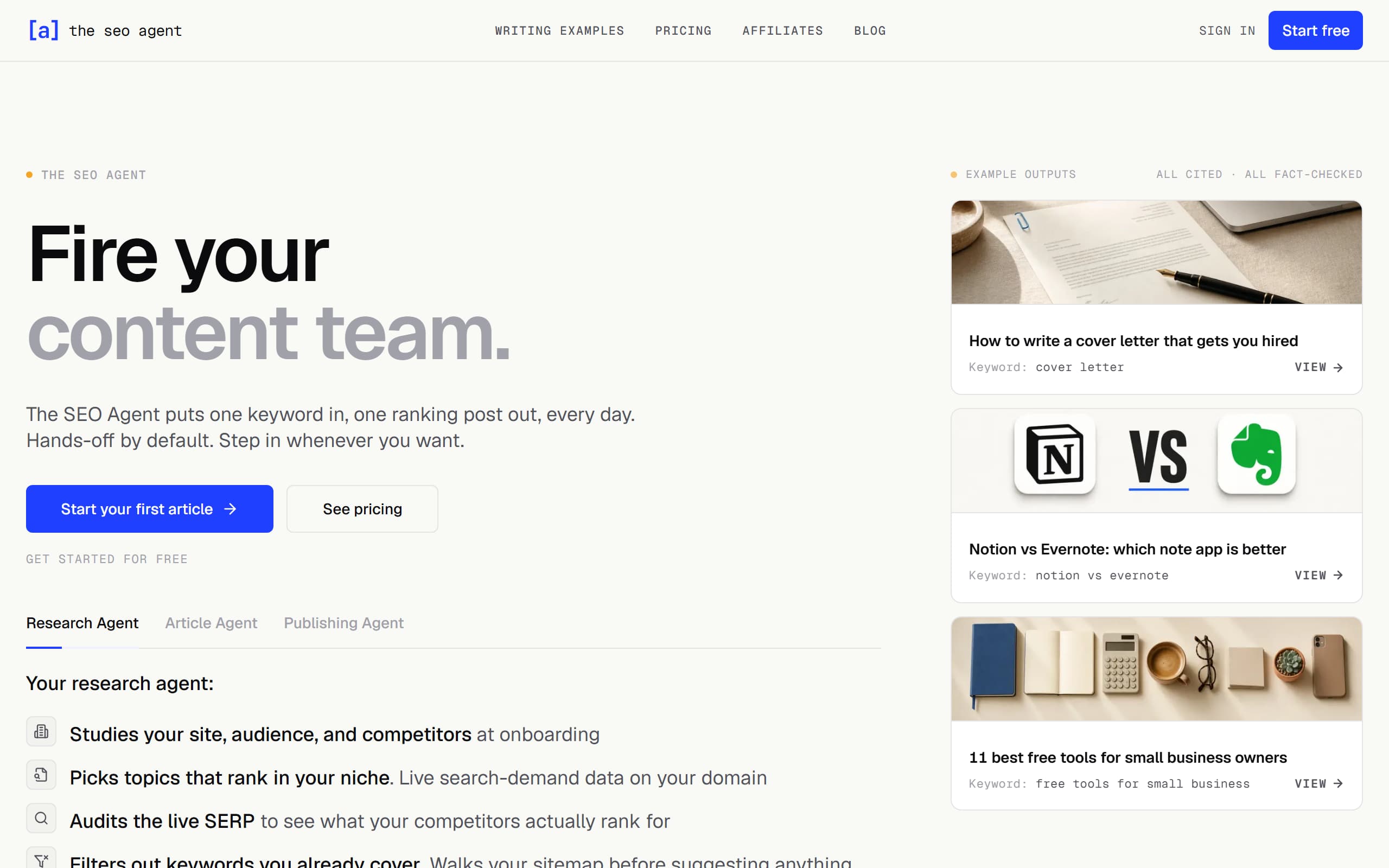
Blaze AI is a marketing platform that covers many channels at a workable depth. TheSEOAgent is an AI SEO tool that covers one channel at full depth: keyword validation, citations, internal links, a quality score, and publishing control.
The headline on the homepage is “Marketing done for you”, and the product delivers on that framing more literally than most AI writing tools. Social posting, paid ad campaigns, landing pages, email, reputation, and blog content all live in the same account. The AI drafts, and you review, approve, and direct each step. That approval loop is the part worth noting: it is not a fire-and-forget autopilot.
The company also sells a fully managed tier at $999 a month, which tells you who the product is really for. Blaze is aimed at local and service businesses that do not have a marketing team, not at content operations that already know which keywords they want to own. If that second description fits you, the tradeoff is covered in our SEO automation software roundup.
2. Blaze AI pricing, plan by plan.
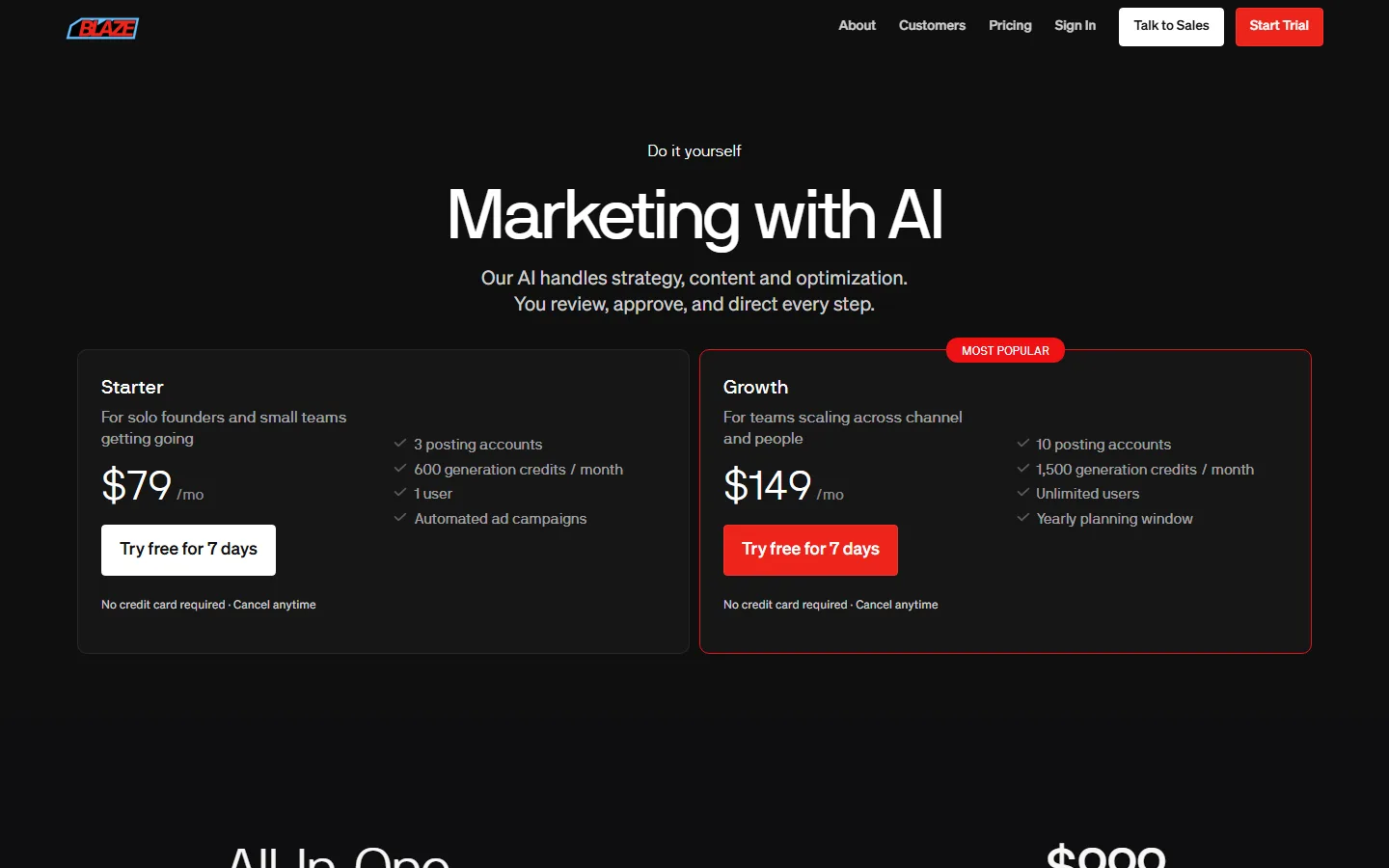
Blaze AI pricing splits into two self-serve plans and one managed service. Both self-serve plans carry a 7-day free trial with no card required. Checked against the public pricing page on 6 September 2026.
$79 / mo
Solo founders and small teams
- 3 posting accounts
- 600 generation credits per month
- 1 user
- Automated ad campaigns
$149 / mo
Teams scaling across channels and people
- 10 posting accounts
- 1,500 generation credits per month
- Unlimited users
- Yearly planning window
$999 / mo
Businesses buying a managed service, not software
- Flat-rate managed execution
- Google Business Profile and search ads
- Inbound lead qualification and review requests
- Performance reporting
Read the credit line carefully, because it is the number that decides what you actually get. Generation credits are shared across every channel, so 600 credits a month is not 600 blog posts. A long-form article costs multiples of a social caption, and the caption ships today while the article pays back in three months. Every team resolves that pressure the same way: the blog goes last.
For comparison, our plan is $99 a month flat with a daily publishing cadence rather than a credit meter, because the failure mode we care about is a blog that quietly stops shipping.
3. Where Blaze AI wins.
Blaze has a clear buyer: an owner or small team running every channel personally and losing hours to tool-switching. The strongest parts are:
- Consolidation. Social scheduling, ad campaigns, landing pages, and content in one subscription genuinely removes three or four line items and the copy-paste between them.
- Approval built in. Nothing ships without a human pass. For a business whose name is on the post, that is the right default.
- Priced for small teams. $79 to $149 a month is below what most agencies charge for social alone, and the 7-day trial does not ask for a card.
- A real managed path. If the software turns out to be more work than expected, the $999 tier is an actual escape hatch rather than a sales-call dead end.

If breadth is the job, Blaze is a credible shortlist product. If the job is ranking, compare it against a stricter SEO automation pipeline before you sign up.
4. Where it breaks down for search.
Search is the slowest channel in the list and the only one that compounds. That combination punishes any system where it competes for the same budget as channels that pay back the same week. Three specific failure points:

- Shared credits. When social, ads, and blog draw from one pool, the cheap fast asset always wins the allocation argument. Cadence is the single strongest predictor of whether a blog ever ranks, and a meter makes cadence negotiable.
- Keyword choice stays with you. The platform will write toward whatever target you hand it. Picking the wrong target is the most expensive mistake in SEO and no amount of drafting quality recovers it, which is why we validate the term against live search data before an article is planned.
- Approval is not a quality gate. Clicking approve on a draft you skimmed is not the same as a scored check that refuses to publish. A gate that can say no is the only thing that stops volume from becoming pages that never surface in AI answers or search.
None of this makes Blaze a bad product. It makes it a marketing platform that includes a blog, which is a different purchase from a system built to rank one.
5. Blaze AI vs TheSEOAgent.
The clean split: Blaze AI is many channels at a workable depth. TheSEOAgent is one channel at full depth. Neither is a substitute for the other, so compare them against the outcome you are actually buying.
| FEATURE | BLAZE AI | THESEOAGENT |
|---|---|---|
| Best fit | Teams running social, ads, and content from one seat | Founders and teams whose growth plan depends on ranking |
| Product shape | Multi-channel marketing platform with an AI drafting layer | Single-channel SEO pipeline with gates around the writer |
| Channel coverage | Social, paid ads, landing pages, email, reputation, blog | Organic search only |
| Keyword selection | You bring the target, the tool writes toward it | Live keyword validation before the article is planned |
| Output metering | Generation credits shared across every channel | Daily article cadence, no per-keyword meter |
| Fact checking | Human review and approve at the end of each step | Citation-backed pass before publish |
| Quality gate | Approval is the check | Score-based gate that can reject weak drafts |
| Entry price | $79 per month, 7-day free trial | $99 per month flat, free trial, cancel in one click |
| Best buying reason | You want five tools collapsed into one | You want the whole SEO job handled end to end |
6. The decision matrix.
Use this split if Blaze AI, Jasper, and TheSEOAgent are all on your shortlist.
- You run social, ads, and content yourself.
- Consolidating three subscriptions is the win.
- You want to approve every asset before it ships.
- Search is one channel, not the whole plan.
- Ranking is the outcome you are buying.
- You want keyword validation before drafting.
- You want citations and internal links built in.
- You want weak drafts blocked, not just reviewed.
Still mapping the category? Read the best AI SEO tools list, then the Abun review for a closer look at the SEO-only end of the market.
7. Is Blaze AI worth it.
Do the arithmetic on what it replaces. If you are paying for a scheduler, an ad tool, and a freelance writer, then $79 to $149 a month is straightforwardly cheaper and the coordination saving is real. That is the honest yes.
The honest no is narrower and worth stating plainly. If the only line on your growth plan is organic traffic, you are buying five channels to use one, and the one you care about is the one the credit meter squeezes first. In that case a dedicated AI SEO agent spends the entire budget on the channel you are betting on. The autoblogging feature page covers the hands-off version of that loop.

The third answer is the one most teams land on: run both, with a hard boundary. Blaze on social and paid, a search pipeline on the blog, and never two systems publishing to the same CMS.
8. How to test before you commit.
Both products offer a trial, so do not judge either from the homepage. Run this test inside the 7 days:
- Pick three keywords from the same cluster.
- Generate one article for each keyword in both products.
- Count the credits a single long article consumed, then divide your plan by it.
- Check the brief against search intent, not against your brand guidelines.
- Count unsupported claims, weak sources, and missing internal links.
- Time the cleanup from generated draft to published post.
The better tool is the one that creates less review debt per published page. If you want to test the stricter path, start the trial and run your own keywords through the full pipeline.
What is Blaze AI?
Blaze AI is a multi-channel marketing platform. One subscription covers social posting, paid ad campaigns, landing pages, reputation, email, and blog content, with an AI layer that drafts the work and a human review step before anything goes out. The pitch is breadth: one tool instead of five.
How much does Blaze AI cost?
Blaze AI pricing starts at $79 per month for Starter (3 posting accounts, 600 generation credits, 1 user), $149 per month for Growth (10 posting accounts, 1,500 credits, unlimited users), and $999 per month for the fully managed All-In-One tier. Both self-serve plans include a 7-day free trial with no card required.
Is Blaze AI worth it?
Blaze AI is worth it if you are currently paying for a social scheduler, an ad tool, and a writer, and consolidating those into one $79 to $149 subscription saves money and coordination. It is not worth it if the only outcome you are buying is organic search traffic, because search is one channel among many inside the product rather than the thing it is built around.
Is Blaze AI good for SEO?
It can produce blog posts, but SEO results depend on keyword selection, source quality, internal links, and the discipline to not publish weak pages. Blaze AI is built to keep many channels fed. A tool built specifically for search validates the keyword before drafting and blocks the article if the draft does not clear a quality bar.
What is the main weakness of Blaze AI?
Credits. Output is metered at 600 or 1,500 generation credits per month across every channel, so social posts, ad variants, and blog articles all draw from the same pool. In practice the blog is the first thing that gets starved, because a single long article costs far more than a social caption and delivers its return months later.
How is TheSEOAgent different from Blaze AI?
TheSEOAgent does one channel and does the whole job on it. It validates the keyword against live search data, drafts with citations, scores the draft, adds internal links, and publishes to your CMS only after the article clears the gate. Blaze AI covers many channels with a review-and-approve step at the end of each.
Should I switch from Blaze AI to TheSEOAgent?
Switch if your growth plan depends on ranking and the blog is the part of Blaze that keeps slipping. Stay with Blaze if social and paid are genuinely doing the work and you want one place to run them. Some teams run both, with Blaze on social and paid and a dedicated pipeline on search.
Can I use Blaze AI and an SEO tool together?
Yes, and it is a common split. Blaze AI handles the channels that need daily volume, an SEO pipeline handles the channel that needs depth and citations. The one thing to avoid is publishing the same generated draft to your blog from two systems, which creates duplicate posts and messy internal links.
Does Blaze AI do keyword research?
Blaze AI plans content around your brand and audience rather than around validated search demand. If you already know your target keywords it will happily write toward them. If keyword choice is the decision you want the software to make, check what search data the tool is actually reading before you commit.
Does Blaze AI publish to WordPress?
Blaze AI is strongest at publishing to social accounts, which is what the posting-account limits on each plan are counting. Before you buy, confirm the exact publishing path for your CMS, because a blog draft that lands in a content library still needs someone to move it, format it, and link it.