What Is Programmatic SEO and How Pages Scale
What is programmatic SEO? It publishes many search pages from data and templates, not thin copy swaps. See the architecture, Google’s line, and when not
Programmatic SEO produces many search-targeted pages from a structured dataset, reusable templates, and automation, ranging from hundreds of URLs to thousands or millions. Swapping a city or product name into identical copy creates page volume, not substantive relevance.
The popular advice is to find a keyword pattern, connect a spreadsheet, and publish every possible combination. That skips the hardest decision: which rows deserve a searchable page? For a founder, the valuable asset isn't a large URL count. It's a repeatable way to publish useful answers and reject weak ones before they reach the site.
Table of Contents
- What Programmatic SEO Actually Means
- The Three Parts Behind Every Page
- Where Google Drew the Line in 2024
- When a Programmatic Page Should Not Exist
- Topical Clusters That Earn Their URLs
- Benefits, Limits, and How to Choose a System
- Ship the Next Page with a Clear Rule
What Programmatic SEO Actually Means
A product catalog changes the facts for every item. A photocopied flyer changes the city name while leaving the offer, explanation, and evidence untouched. Both use templates, but only the catalog gives someone a reason to choose a particular page.
That's the useful starting point for answering what is programmatic SEO? A database supplies variables such as locations, products, services, or integrations. A template determines how those variables appear. An automated publisher turns eligible records into pages aimed at distinct long-tail searches.
The practical scale ranges from hundreds of pages for a specialized software business to thousands or millions for marketplaces, travel websites, directories, and comparison platforms. Familiar examples include Zillow location pages, TripAdvisor hotel and destination pages, Yelp local-service pages, Zapier integration pages, and Wise financial or currency pages, as described in this overview of programmatic SEO patterns and scale.
Think in answers, not documents
The operating unit isn't an article assignment. It's a recurring search task that your business can answer with structured information.
For example, consider a hypothetical equipment catalog. Someone searching for a particular model needs its specifications, compatibility, and availability. The reusable layout helps them compare items, while the underlying records supply the differences that matter.
A generic introduction about choosing equipment wouldn't replace those facts. Nor would rewriting that introduction for every model.
- Editorial content explains a subject. It can develop an argument, teach a process, or interpret evidence.
- A data page resolves an entity-specific task. Its usefulness depends on the record behind the URL.
- A shared template provides consistency. It shouldn't erase the distinctions visitors came to find.
The distinction is therefore neither automation nor volume. It's whether each page answers a defined query with information neighboring URLs don't already provide.
Practical rule: Remove the changing keyword from your draft. If nothing else distinguishes the page, improve the data before improving the copy.
A small, coherent collection can be a stronger starting point than an exhaustive catalog of possible keyword combinations. Treat scale as the result of having many useful records, not permission to manufacture them.
The Three Parts Behind Every Page
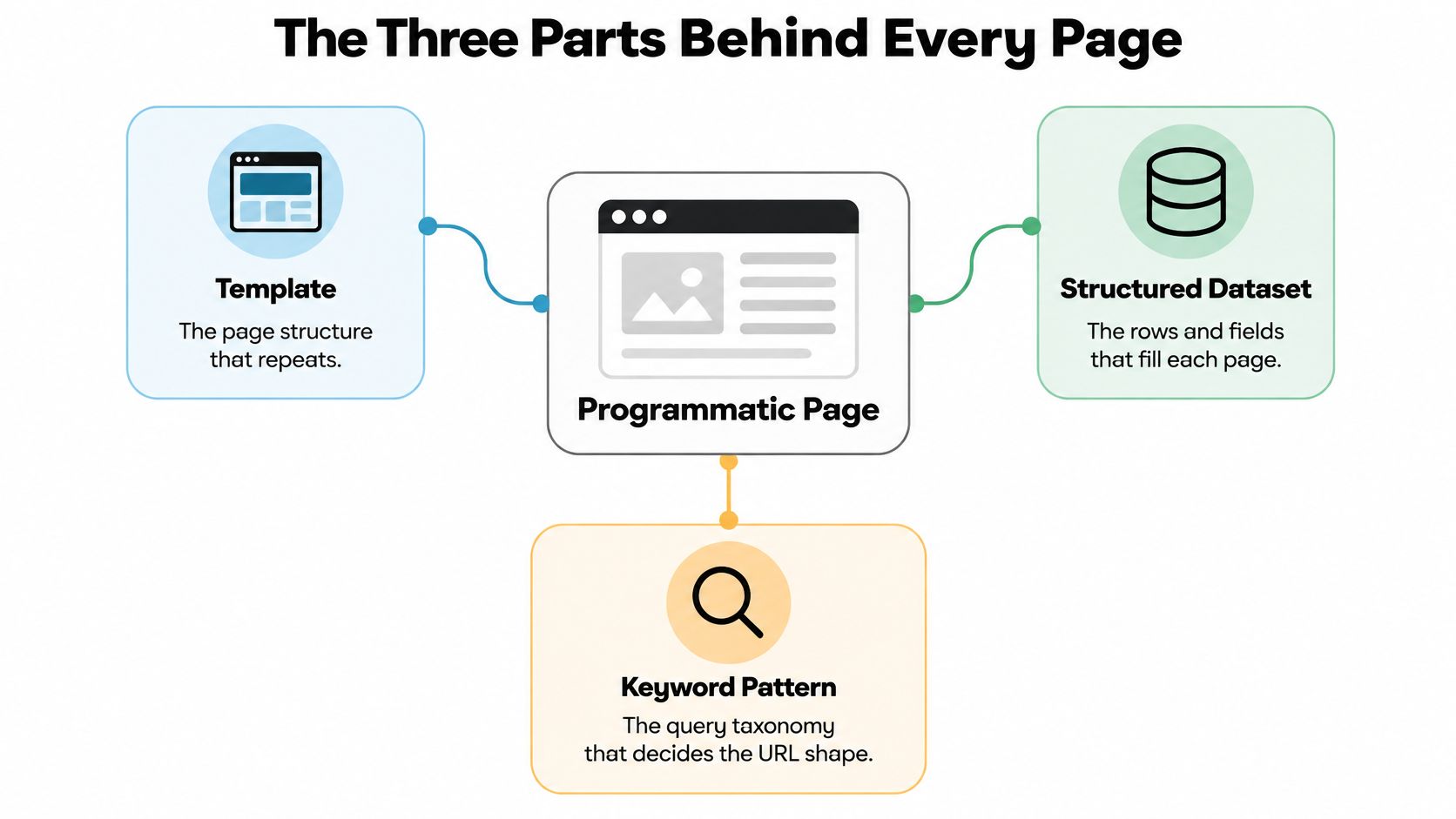
Build the page structure before choosing publishing shortcuts. The template should make the answer easy to inspect, the dataset should supply the answer, and the query taxonomy should explain why that answer needs its own URL.
The components connect like this.
Design the template around the task
Start with a representative page, not the easiest row. Decide which headings, metadata patterns, URL structures, internal-link modules, and schema belong to the page type. Then identify which sections are required and which should appear only when supporting data exists.
For an integration page, a required section might describe the supported connection. An optional section might cover a limitation that applies only to that integration. Don't fill an absent field with generic prose just to preserve the layout.
Next, define the structured dataset. Each row might represent a location, product, integration, or comparison pair, but its identifier isn't enough. Useful differentiation can come from facts, calculations, inventory, prices, availability, specifications, or expert analysis.
Make each record prove eligibility
Use explicit fields rather than leaving publication decisions to a writer or generator. A workable record can contain:
- Entity identity: What real product, location, service, or pairing does this row describe?
- Intent mapping: What task does the corresponding searcher want to complete?
- Required evidence: Which fields must be populated before the template can answer that task?
- Distinct contribution: What will this page provide that its neighboring URLs won't?
- Maintenance ownership: Who checks information that can become outdated?
Finally, define the keyword pattern or query taxonomy. This determines which combinations represent different tasks and which are merely wording variations. Don't create separate records just because a keyword tool presents synonyms separately.
Treating each row as an eligibility record is the implementation standard. Google's spam policies for scaled content provide the governing boundary: automation itself isn't the violation; generating content primarily to manipulate rankings is.
When you build automated content workflows, put validation before generation. A missing required field should stop the job, not trigger a request for more filler. That trade-off reduces immediate output, but it gives the team a publishing system it can inspect and maintain.
Where Google Drew the Line in 2024
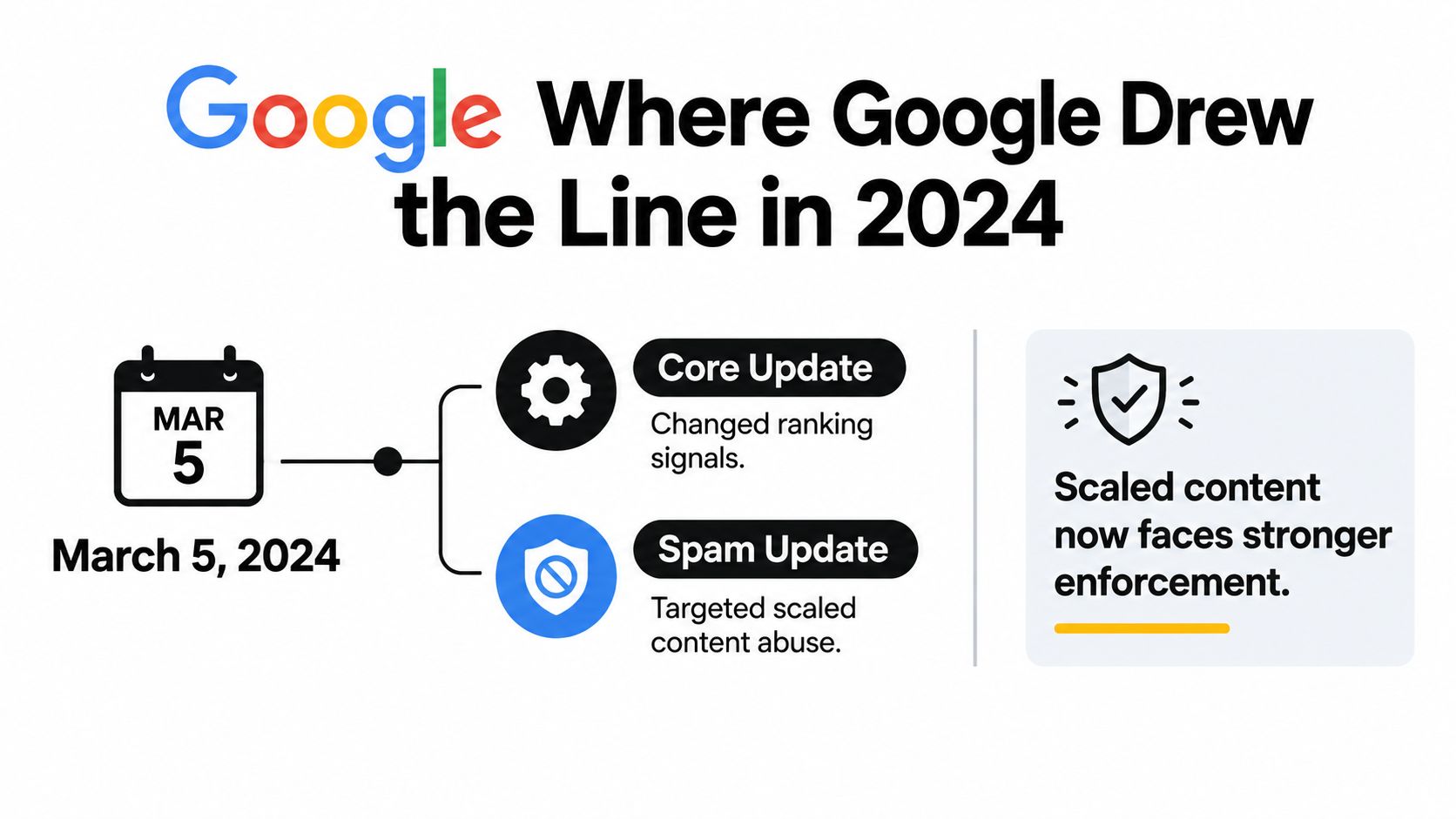
On March 5, 2024, Google introduced its scaled content abuse policy alongside its core and spam updates. Google later reported a 45 percent reduction in low-quality, unoriginal content in Search, exceeding the 40 percent reduction it had initially expected, in its March core update and spam policy announcement.
That result describes Google's broader changes. It isn't a forecast for an individual website, and it doesn't tell a founder how many pages are safe to publish.
The policy moment matters because it changed the framing.
Production method isn't the dividing line
Older discussions often reduced the issue to automatically generated text. Google's standard instead addresses pages created primarily to manipulate rankings rather than help users, whether software, people, or a mixture produces them.
That makes a human-written assembly line no automatic protection. It also means templates and structured data aren't prohibited merely because they support large-scale publishing.
Google's examples of scaled content abuse include low-value generative AI output, transformed scraped material, stitched-together content without added value, and keyword-heavy pages that don't make sense to readers. The common failure is the absence of a useful contribution, not a particular tool.
A production process can be sophisticated while the published page remains useless.
Turn policy into review criteria
For a business, the practical response is to review the finished answer rather than defend the production method. Ask whether its claims are accurate, whether the page-specific information is substantial, and whether the visitor can complete the intended task.
- Require evidence for generated claims. Fluent wording doesn't establish accuracy.
- Connect pages deliberately. Internal links should help visitors move between relevant answers.
- Inspect repetitive sections. A long introduction shouldn't conceal a nearly empty record.
- Keep the searcher benefit explicit. The team should be able to explain why the URL exists without mentioning rankings.
These are also useful AI publishing considerations for lean marketing teams. Adding a human approval button won't solve weak inputs if the reviewer has no acceptance criteria.
The business trade-off is straightforward. Stricter review can delay publication, but publishing more quickly doesn't compensate for pages that lack a defensible purpose.
When a Programmatic Page Should Not Exist
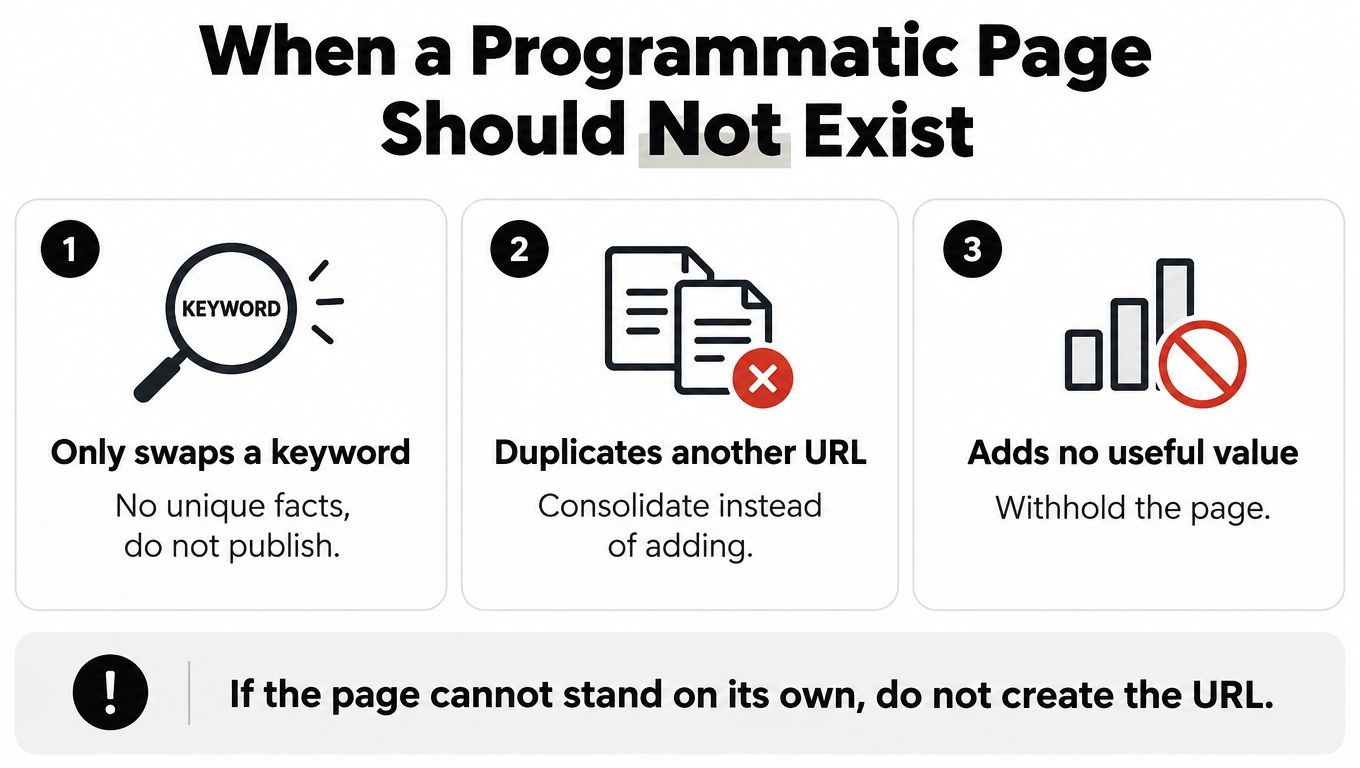
The most useful feature in a programmatic publishing system may be its ability to refuse a record. A database row is a candidate, not an entitlement to an indexable URL.
A keyword-swapped row can introduce near-duplicates, compete with an existing answer, and consume crawl attention without improving the site. A record containing distinct pricing, availability, specifications, local constraints, or a meaningful comparison has a stronger claim to publication.
Use the warning signs below before generating copy.
Score the evidence, not the word count
Use a qualitative scorecard with pass, needs work, and fail judgments. This is an operating recommendation, not a Google scoring formula. The dimensions follow the practical eligibility approach in this programmatic SEO strategy guide.
- Unique factual inputs: Identify the facts that belong specifically to this record.
- Independent user intent: Explain why an existing page can't satisfy the same task.
- Freshness: Confirm that changing information has an owner and a maintenance path.
- Conversion value: Define the useful action a visitor can take, without treating sales potential as proof of quality.
- Answer advantage: Show how the page helps someone complete the task better than the current alternative.
Don't average away a fatal defect. A commercially attractive query still fails if the entity doesn't exist or the required data is missing.
Publish, merge, or withhold
| Row condition | Index decision | Why |
|---|---|---|
| Real entity, distinct task, complete evidence | Publish as an indexable page | The record supports a useful independent answer |
| Different wording, same task and facts | Merge into the existing page | Another URL would divide the answer unnecessarily |
| Required information is missing | Withhold publication | Copy can't substitute for absent evidence |
| Useful operational page without distinct search value | Keep out of the index where appropriate | A functional URL needn't become a search landing page |
| Outdated record with no maintenance owner | Withhold or consolidate | The team can't stand behind the answer |
For a lean team, this gate deserves more attention than elaborate prompt variations. An incorrect rule can reproduce the same defect throughout the page set.
Record the reason whenever you withhold a row. That creates a concrete improvement queue: collect the missing specification, confirm the service constraint, or merge the overlapping intent. Successful programmatic SEO can mean publishing fewer pages, because rejecting unsupported records is part of the system's job.
Topical Clusters That Earn Their URLs
A topical cluster needs more than related titles. It needs a broader hub and specific pages that contribute different answers. Visually related articles can form a collection, but a data-page cluster also requires differentiated records.
This editorial collection illustrates the distinction between related presentation and a structured entity system.

Borrow the pattern, not the page count
The familiar brands introduced earlier offer useful pattern names. The following are design examples to adapt, not claims about those companies' current implementation details.
| Familiar pattern | Repeating query | Differentiating input to require | Broader hub |
|---|---|---|---|
| Zillow-style location pages | Property in a location | Location-specific inventory | Region or property directory |
| TripAdvisor-style hotel or destination pages | Hotels in a destination | Relevant properties and availability | Destination guide |
| Yelp-style local-service pages | Service in a city | Actual providers and service constraints | Service category |
| Zapier-style integration pages | Connect an application to another | Supported actions and limitations | Integration directory |
| Wise-style financial pages | Currency pair or financial task | Pair-specific calculations or terms | Currency or product hub |
The internal link should have a reason beyond distributing attention. A destination page can help someone reach relevant hotel pages. An integration directory can help a user discover supported applications before inspecting a particular connection.
Choose the cluster your team can maintain
A SaaS startup might begin with supported integrations because product documentation already contains the necessary facts. A service business might support city pages only where delivery conditions, availability, or local requirements genuinely differ.
Comparison pairs require more restraint. Both entities must be real, and the contrast must help a decision. Don't generate every mathematical pairing just because the database allows it.
For an additional walkthrough of the topic, use the embedded video alongside your own page review.
Before expanding, write down the changing fields for each proposed cluster. Inventory, availability, price, supported actions, or specifications can justify separate answers. A changed keyword alone can't.
You can simplify your internal linking workflow once the relationships are clear. But choose the relationships first: which hub introduces the task, which child page resolves it, and which neighboring page offers a relevant next step? Reject cluster shapes that your existing data can't support.
Benefits, Limits, and How to Choose a System
The strongest benefit of programmatic SEO is repeatability. A team can cover a predictable long-tail pattern without composing every page manually, give eligible entities stable URLs, and connect a broad directory to specific answers.
The cost is operating the underlying information system. Someone must maintain the data, test template changes, resolve overlapping records, and review pages whose facts have changed. Faster generation doesn't remove that responsibility.
Publishing isn't the same as indexation
Google defines crawl budget through crawl capacity and crawl demand, meaning the URLs it can and wants to crawl. Its crawl budget guidance is especially relevant to large sites, recommends improving content quality, and makes clear that publishing thousands of URLs doesn't guarantee crawling or indexing.
Build technical controls into the publishing path:
- Control URL quality: Exclude records that haven't passed eligibility review.
- Avoid unnecessary duplicates: Don't expose multiple searchable routes to the same answer.
- Maintain an accurate sitemap: Keep the submitted page set aligned with publication decisions.
- Make important pages accessible: Check that visitors and crawlers can reach the pages you intend to publish.
Don't treat noindex as a substitute for deciding whether a URL should exist. Withholding an unnecessary page is a different decision from keeping a useful operational page outside search.
Match the system to the asset
| Decision | Data-page programmatic SEO | Editorial automation |
|---|---|---|
| Primary input | Structured entity records | A topic, sources, and editorial direction |
| Main asset | A page-specific data answer | A researched article |
| Core quality check | Record completeness and differentiation | Evidence, reasoning, and intent coverage |
| Ongoing work | Data and template maintenance | Source review and editorial updates |
For the editorial route, The SEO Agent is an option alongside manual writing or a custom publishing workflow. It maps audiences and competitors, filters topics already covered, drafts section by section against live sources, and stops drafts below a configured quality floor.
Its automated SEO content workflow also handles internal links, images, schema, slugs, scheduling, and publishing to WordPress, Webflow, Shopify, Ghost, Wix, Notion, and Framer. That's an article-production job, not a replacement for a marketplace's entity database.
Choose based on the information you own. Structured records support data pages. A question requiring interpretation and cited explanation usually calls for an article. Don't force either asset into the other system just because the publishing process is automated.
Ship the Next Page with a Clear Rule
Pick a query pattern you can support with complete data this month. Before generating anything, write its withholding rule in the same place the team manages the dataset.
Make the acceptance criteria concrete. Require a real entity, distinct intent, complete required fields, and a page-specific fact that the neighboring URL doesn't contain. Name the fields rather than allowing a reviewer to approve a vague impression of usefulness.
Test the weakest eligible record
Review the sparsest row that would pass your proposed gate. Render it through the template and check the answer as a visitor would.
- Inspect the substance: Can someone complete the task without searching elsewhere for the missing essentials?
- Compare adjacent pages: Is the difference useful, or merely textual?
- Check the next action: Can the visitor inspect availability, understand compatibility, or make the relevant decision?
- Assign maintenance: Does someone know when to update or withdraw the page?
Release standard: Approve the weakest acceptable record before trusting the system to reproduce the template.
If that page fails, tighten the eligibility rule. Don't expand the introduction to disguise the missing information. The next release might be a smaller collection or a well-sourced article instead of another data-page variant.
Use an article when the opportunity is editorial
For founders whose opportunity is a researched topic rather than an entity database, try The SEO Agent on your own site. Start from a keyword, let the research and quality gate run, and inspect the result before publishing through the CMS you already use.
The trial costs $1 for three days, followed by $99 a month. Cancel in the app if the published page isn't worth keeping.
Make the decision against a visible standard, not the excitement of automated output. Keep the page because its evidence, explanation, and usefulness justify its place on the site. Expand only when the next page can meet that same standard.
For editorial opportunities, The SEO Agent offers source-grounded drafting, a quality gate, and CMS publishing without treating every keyword as permission to publish. Bring a keyword your audience needs answered, test the resulting article on your site, and scale only when the page helps the searcher.