What Is Eeat in Seo
What is eeat in seo. Learn what is E-E-A-T in SEO, how Google uses Experience, Expertise, Authoritativeness, and Trustworthiness to evaluate content, and how
E-E-A-T stands for Experience, Expertise, Authoritativeness, and Trustworthiness, and it is the framework Google's Search Quality Raters use to evaluate whether a page deserves to rank. Google treats trust as the central outcome of the four.
You've published an article with a clear headline, sensible keywords, and polished writing, but it still isn't gaining visibility. Before you commission another rewrite, ask a different question: what evidence gives a stranger a reason to believe this page?
That's the useful starting point for understanding what E-E-A-T is in SEO. The important qualification is that raters assess quality, not award ranking positions, so your job isn't to chase a hidden score. It's to make your content's credibility visible.
Table of Contents
- The Framework Behind Google's Quality Ratings
- What Each Letter Actually Means
- Why Trust Sits at the Center of the Framework
- How the Guidelines Evolved Over Time
- Where Each Signal Matters Most
- Practical Implementation Across Your Site
- Common Myths Worth Retiring
- Putting It All Together for Your Next Article
The Framework Behind Google's Quality Ratings
Consider a founder publishing articles about project management software. The pages look professional, but the recommendations could have been written without opening any of the products. When rankings stall, the founder adds more keywords and longer introductions.
That response may miss the underlying editorial problem. A reader still can't tell whether the writer has used the software, understands the trade-offs, or has a commercial reason for recommending it. Polish and credibility aren't interchangeable.
Think like an evaluator, not a scorekeeper
E-E-A-T gives human evaluators a way to examine those credibility questions. Rather than asking only whether a page mentions the right subject, they consider the creator, the information, and the website responsible for publishing it.
Google formally added Experience to E-A-T on December 15, 2022, while emphasizing that trust is the most important component, as explained in its announcement of the updated quality-rater guidelines. The added dimension recognizes a useful distinction: knowing about something and having personally done it aren't necessarily the same.
Treat E-E-A-T as a lens for evaluating evidence, not a dashboard you can turn green.
For your editorial team, that changes the questions worth asking:
- Who's behind this? Identify the person or organization taking responsibility for the information.
- What supports the explanation? Look for relevant knowledge, direct observations, and verifiable sources.
- Why should readers rely on it? Examine whether the recommendations are honest, appropriate, and adequately qualified.
These questions are useful even when a page has no obvious factual error. An article can be technically correct yet give readers no basis for evaluating its advice.
You'll also encounter resources using the earlier acronym. Netco Design LLC provides a place to find E-A-T guidance; when consulting older terminology, keep the added experience dimension in mind.
The practical lesson for the founder is straightforward: before adding more copy, identify the missing evidence. A documented walkthrough may help readers more than another paragraph claiming the software is easy to use.
What Each Letter Actually Means
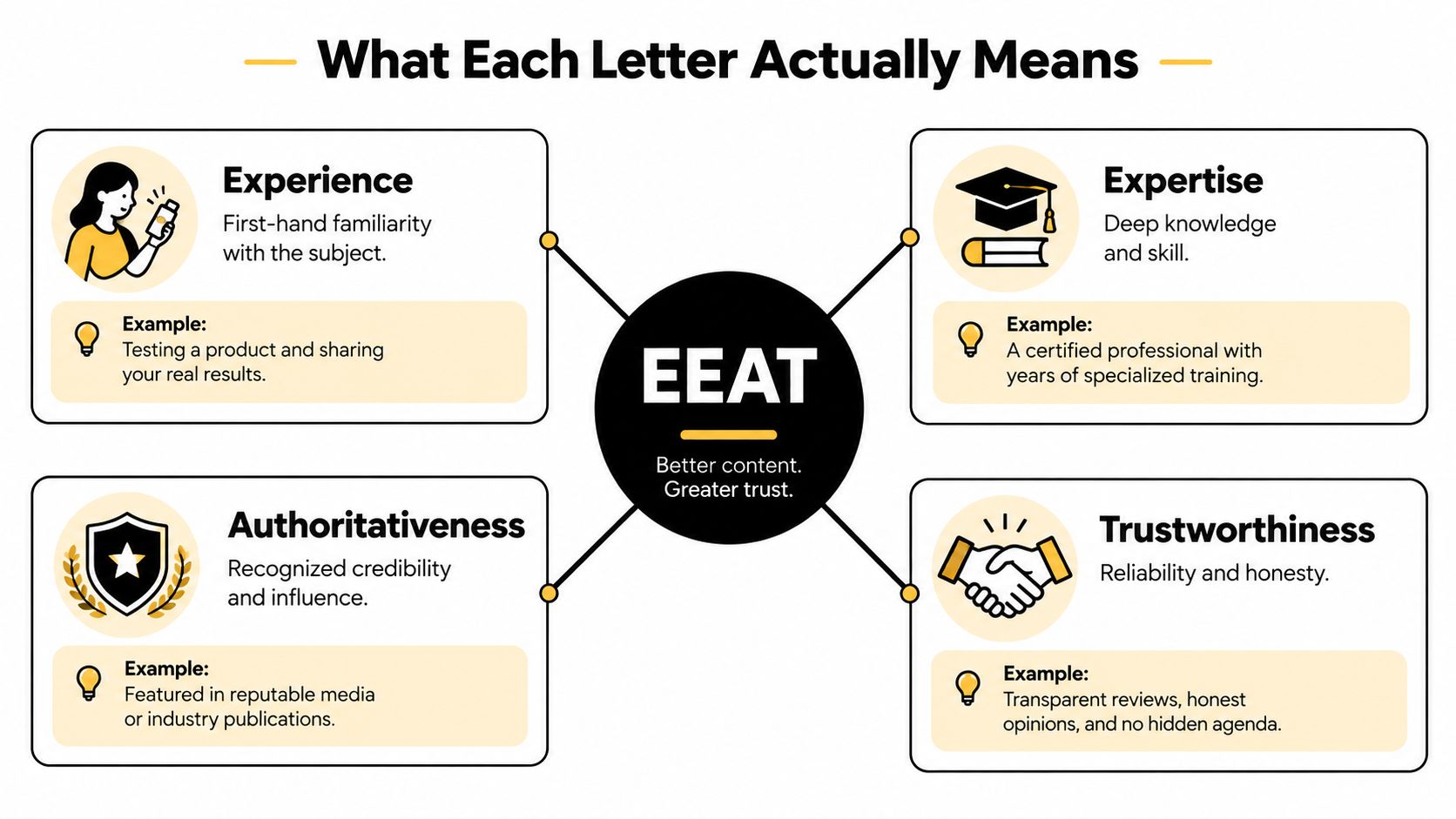
The letters describe different reasons someone might deserve your confidence. Keeping them separate helps you diagnose a page instead of making a vague judgment that it needs more authority.
The diagram provides a useful reference for those distinctions.
Experience and expertise answer different questions
Experience asks whether the creator has direct familiarity with the subject. In a hypothetical office-chair review, photographs of the assembled chair and observations about adjusting its armrests would help demonstrate actual use. Rewriting the manufacturer's specifications wouldn't provide the same evidence.
Expertise concerns the knowledge needed to explain the subject accurately. An ergonomics professional might explain how chair adjustments relate to working posture, including where general advice stops being appropriate.
| Dimension | Reader's question | Illustrative evidence |
|---|---|---|
| Experience | Have you actually used it? | Original photographs and documented observations |
| Expertise | Do you understand what you're explaining? | Accurate reasoning and relevant qualifications |
Someone can have experience without professional expertise. Someone else can have deep technical knowledge without having used the particular product under review.
That distinction explains the added letter in E-E-A-T. The right contributor depends on the question the page promises to answer.
Authority and trust complete the picture
Authoritativeness concerns recognition of the creator or website on the topic. For example, independent references to a specialist's work can provide context that a self-written biography cannot. Calling yourself a leading expert is a claim, not corroboration.
Trustworthiness asks whether readers can rely on the page. A chair reviewer who discloses a free review sample and explains the limits of their testing gives readers a clearer basis for judging the recommendation.
For a healthcare publishing context, Helbling Digital Media's SEO guide offers an adjacent resource to consider alongside these distinctions.
Google's people-first content guidance explains the underlying mechanics: automated systems use a mix of signals associated with E-E-A-T, while human raters apply the framework and don't directly change rankings. These aren't interchangeable processes, and neither supports treating the letters as a simple point system.
Why Trust Sits at the Center of the Framework
Think about choosing a restaurant from a review. The reviewer visited the restaurant, understands the food, and has an established reputation. Those details matter because they help you decide whether to believe the recommendation.
But suppose the reviewer conceals that the restaurant paid for the coverage. The visit still happened, and the culinary knowledge may be genuine. The undisclosed relationship nevertheless changes how you assess the advice.
That's the relationship between the E-E-A-T dimensions: experience, expertise, and authority provide reasons for confidence, but they don't excuse dishonesty. Google's overview of its quality-rater process places trust at the center and explains that evaluators consider the creator, the main content, and the publishing website.
Separate credibility from presentation
An impressive author biography can make a page look credible before anyone checks its substance. Your editorial review should move beyond that first impression.
- Check the claims. Does each source support the wording beside it?
- Inspect the relationship. Would sponsorship, affiliate revenue, or another commercial interest affect how readers interpret the recommendation?
- Identify responsibility. Can visitors find the publisher, contact the organization, and raise a concern?
- Examine consequential actions. If the page asks visitors to purchase or share information, is the process appropriately transparent and secure?
These checks concern different parts of the reader's experience. A strong explanation doesn't compensate for misleading checkout information, just as a professional website doesn't make unsupported health advice safe.
Editorial test: Would a reasonable reader feel misled if they learned how this page was produced?
For claim review, fact-checking tools for content teams can be part of your workflow, but keep a human responsible for deciding whether evidence justifies the conclusion.
Usefulness deserves a separate review too. You can browse 2026 blogging value tips from VeloCMS as an editorial prompt, then examine your own draft for specific explanations rather than decorative reassurance.
The useful mental model is trust as the verdict, not another badge to place beside an author's name.
How the Guidelines Evolved Over Time
A training manual that gets revised every year usually signals a company paying attention. Google's handbook for its quality raters works the same way: the document has been rewritten repeatedly, and each revision tells publishers something about where the evaluation bar is moving.
According to Bruce Clay's history of E-E-A-T, E-A-T appeared in the Search Quality Guidelines by 2014, and Google made the full guidelines publicly available in 2015. That public release gave publishers their first clear look at the questions human evaluators were being asked to consider.
The handbook kept changing
The same account records how the document's length shifted across editions:
| Guideline edition | Document length |
|---|---|
| 2020 | 175 pages |
| 2021 | 172 pages |
| July 2022 | 167 pages |
| December 2022 | 176 pages |
Look at the direction before the numbers. The handbook shrank across two consecutive editions, then grew again in the December 2022 revision, the edition that added Experience as a fourth signal. A manual that gets shorter between editions is being edited, which means Google was sharpening the evaluators' questions rather than appending rules.
Page count isn't an SEO requirement. It describes the handbook's history. It tells you nothing about how long your articles should be or how many credibility elements they need.
What publishers should take from the history
Raters apply these guidelines when they evaluate quality, and their judgments inform how Google's algorithms are developed and tested. There is no E-E-A-T score computed for your page. So when the guidelines change, the wrong response is hunting for a cosmetic tweak that makes every existing page compliant. Renaming an author bio does not establish that the author did the work described.
A better response is to revisit your editorial assumptions. If your review template never asks the writer for original observations, the template may need changing. If your medical content workflow doesn't identify who is qualified to review a claim, that responsibility needs to be assigned.
The historical lesson is adapt the process, not just the page furniture. Keep a record of who created important content, what evidence supports it, and who owns future corrections. Every guideline revision funnels its four signals back into one question about trust, and a publishing practice built around that question survives terminology changes that would break a checklist built around labels.
Where Each Signal Matters Most
Start with the reader's task. Someone choosing a backpack needs different evidence from someone deciding how to respond to a medical symptom.
In a hypothetical backpack review, the writer might document packing it, adjusting the straps, and using the compartments. The useful contribution is the difference between what the manufacturer promises and what the reviewer personally observed.
A medical article needs a different boundary. A patient can describe their own experience, but that experience alone doesn't establish the professional knowledge needed to recommend treatment. Personal testimony and professional guidance serve different purposes.
Match the evidence to the consequences
Use this as an editorial decision aid, not an official weighting formula.
Dominant E-E-A-T signals by content type
| Content Type | Dominant Signal | Why |
|---|---|---|
| Hands-on product review | Experience | Readers need evidence of actual use and its limitations |
| Technical tutorial | Experience and expertise | The procedure should be reproducible and correctly explained |
| Medical guidance | Expertise and trust | Readers need qualified, responsible explanations |
| Financial or legal explanation | Expertise and trust | Advice needs appropriate context and clear boundaries |
| Specialist industry analysis | Authoritativeness and expertise | Readers need sound reasoning and relevant recognition |
The dominant signal is the one you should investigate first, not the only one that matters. A product reviewer still needs accurate descriptions, and a qualified professional still needs transparent sourcing.
Work backward from potential harm
For health, finance, safety, and other high-impact subjects, use the stricter standard described in the official guidance discussed earlier. Ask what could happen if a reader acts on an incomplete or mistaken explanation.
For a financial article, that might mean distinguishing general education from a recommendation suited to someone's circumstances. For a medical page, it might mean having an appropriately qualified reviewer assess the substance rather than merely approving the headline.
Don't apply the same author template indiscriminately. A software founder's product-building experience may be relevant to a development tutorial but irrelevant to a treatment recommendation.
Use The SEO Agent's SEO checklist alongside this topic assessment when reviewing a page's broader publishing readiness. Keep the two tasks distinct: technical completeness doesn't establish subject-matter credibility.
The decision rule is simple: choose evidence that answers the reader's actual risk and uncertainty. Don't substitute a prestigious credential for hands-on proof, or a personal anecdote for qualified advice.
Practical Implementation Across Your Site
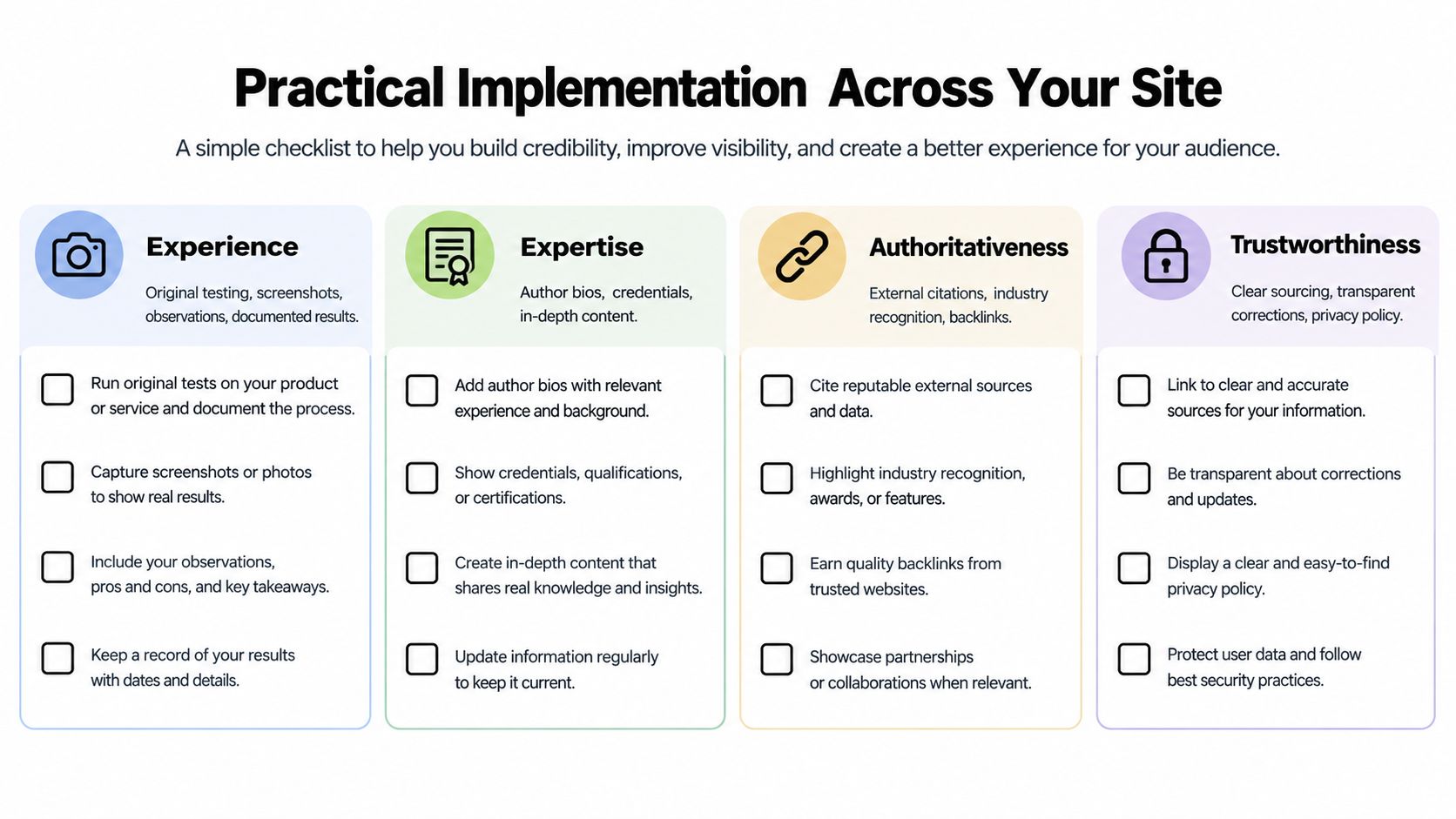
A quality rater working through the guidelines asks a series of concrete questions about a page. Your job is to convert each of those questions into a named assignment before anyone starts writing. "Make this article more trustworthy" gives a writer nothing to act on. "Attach the original test notes behind your recommendation" does.
The checklist below works like a handoff document: each line assigns one signal to one owner, so the four letters converge into a single outcome the rater can verify, a page that earns reliance.
Collect evidence before drafting
For an experience-led article, have the contributor save screenshots, photographs, setup details, and observations while doing the work. Reconstructing evidence retroactively rarely succeeds, and an undocumented process forces the article into weaker claims.
For a knowledge-led article, name the qualified contributor or reviewer before commissioning the draft. Their job is to check the reasoning, exceptions, and limitations rather than the polish of the terminology.
- Experience owner. Supplies original evidence and states plainly what was not tested.
- Expert reviewer. Verifies explanations and flags claims outside their competence.
- Topic editor. Connects the article to related coverage and checks any claims of independent recognition.
- Publishing owner. Confirms authorship, disclosures, ownership details, and contact routes before release.
Then set an update trigger tied to real change: a product redesign, a revised source, a discovered error. A displayed date that moves without a content review tells readers less, not more.
Make verification a release condition
Treat publication the way a pilot treats a preflight checklist: the page stays in draft until every item has an answer. Before anything goes live, someone on your team should be able to confirm:
- Authorship. Is the named person responsible for the contribution attributed to them?
- Sources. Did someone open the original references and check the surrounding context?
- Evidence. Can readers distinguish documented observations from opinion?
- Disclosure. Are relevant commercial relationships visible on the page?
- Corrections. Does a named owner handle error reports and the updates that follow?
If a claim cannot be supported, qualify it or cut it. A deadline is not a source.
For a walkthrough of a similar review process, watch the accompanying video while auditing your own workflow.
When evaluating publishing platforms, including The SEO Agent, measure them against these responsibilities rather than assuming automation establishes credibility. Software can organize the work. Accountability for what goes live still sits with the people who decide to publish it.
Common Myths Worth Retiring
Misunderstandings about E-E-A-T often lead teams to optimize the appearance of credibility instead of its substance. The result is more editorial decoration without better evidence.
E-E-A-T is a score you can raise
There's no single publicly documented Google E-E-A-T score for your team to optimize. As established earlier, the evaluator framework and automated ranking systems have related but distinct roles.
If an audit reports a proprietary credibility score, treat it as that tool's assessment. Ask what it measures and inspect the underlying findings rather than treating the number as a Google metric.
An expert biography solves the problem
A biography tells readers something about a contributor. It doesn't demonstrate that the article is accurate, that the contributor reviewed it, or that the publisher's claims are honest.
- Weak fix. Add an expert's name to an unchanged article.
- Substantive fix. Have the expert examine the explanation, correct it, and accurately describe their role.
The same principle applies to AI-assisted publishing. A guide on AI content for startup blogs can help frame the workflow discussion, but the editorial question remains what evidence and accountability support the finished page.
A required length will satisfy Google
Google's helpful-content guidance doesn't specify a universal numeric E-E-A-T threshold, percentage, or minimum word count, as reflected in its E-E-A-T guidance discussion. Adding paragraphs to reach an imagined requirement doesn't resolve missing expertise or unsupported claims.
Write until the reader can complete the task responsibly, not until the draft reaches an arbitrary length.
People-first publishing requires judgment. Sometimes that means expanding an explanation to include an important exception; sometimes it means deleting repetitive copy so the answer is easier to find.
SEO should help people discover and find useful work. It shouldn't become a substitute for doing that work.
Putting It All Together for Your Next Article
Take a draft review of a remote-work application. The author installed it, ran a real project through it, and documented exactly where the workflow broke down. Their write-up separates observed behavior from assumptions about how the product works.
Now stack the rest of the page on top of that. Readers can see the contributor's relevant background and any independent recognition. The publisher names itself, discloses commercial relationships, and attaches references to factual claims. Experience, expertise, authority, and trust stop looking like four separate boxes to tick. They collapse into a single outcome, the same judgment a quality rater is trained to make.
Can a stranger rely on this page?
Use the stranger test
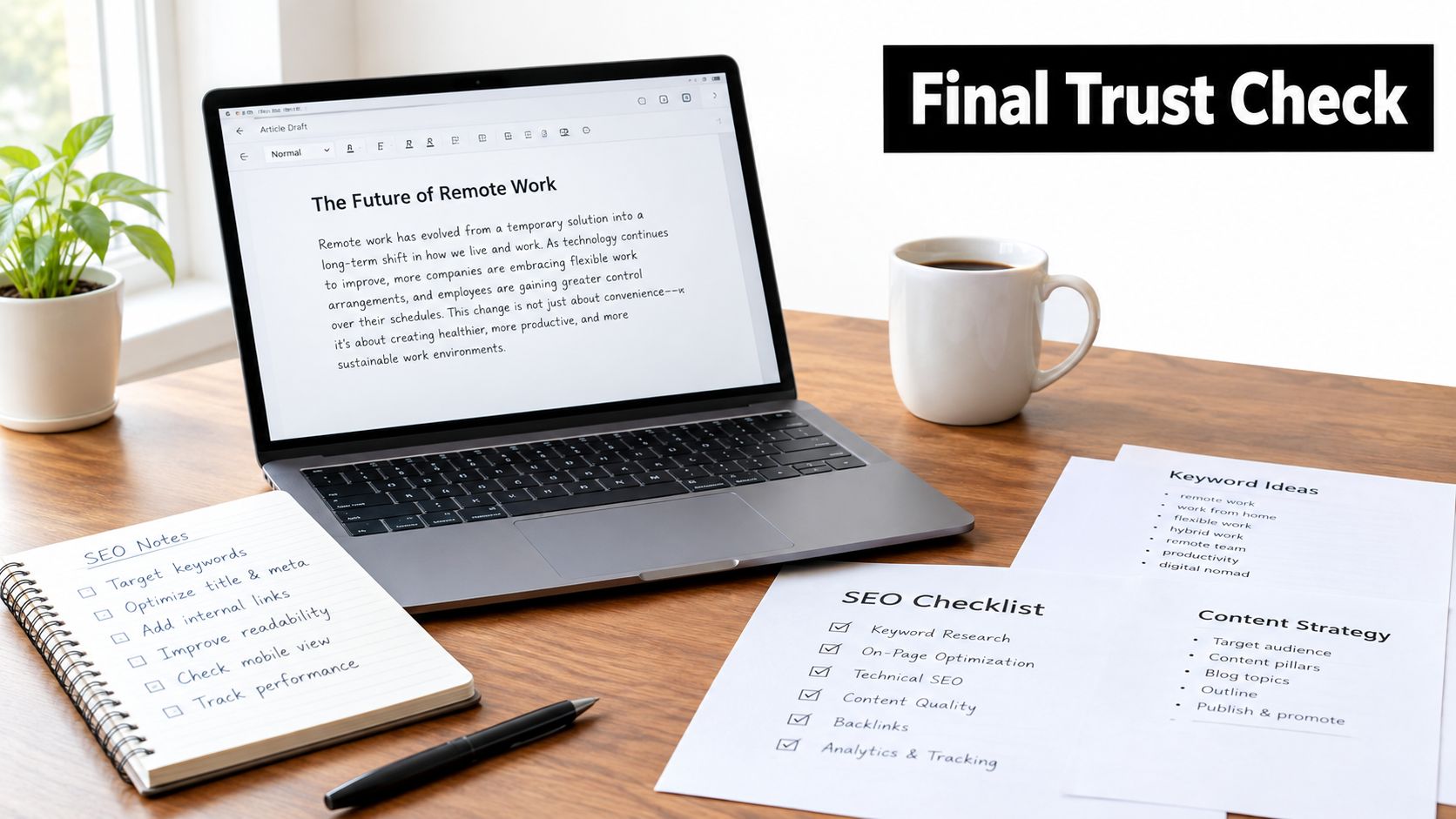
Before approval, hand the draft to someone who wasn't involved in producing it. Ask them to identify the evidence behind the recommendation without receiving an explanation from your team.
- Find the basis. What shows that the author has relevant experience or knowledge?
- Check the conclusion. Does the evidence justify what the article recommends?
- Locate accountability. Who would the reader contact about an error or an undisclosed relationship?
Their hesitation is your editing signal. If they can't distinguish a tested observation from a marketing claim, revise the page before it goes live.
Whether you review manually or run an AI-powered content strategy, that final check stays with a human. You cannot guarantee a ranking, because no dial labeled E-E-A-T exists for you to turn; the framework guides human evaluation, and that evaluation informs the algorithms. What you can do is make credibility inspectable and remove every avoidable reason for a reader to distrust the work.
The SEO Agent offers keyword research, cited drafting, quality checks, and CMS publishing for founders and lean content teams. Visit the pricing page to start a $1, 3-day trial, and keep editorial responsibility where it belongs: with your team.