Search Engine Positioning SEO: A 2026 Guide to Ranking
Search engine positioning SEO explained for 2026. Learn the ranking factors, SERP strategies, and AI Overview shifts that decide who gets the click.
You've refreshed a page, tightened the title, and watched its search position improve. Yet the visits aren't following, and you're wondering whether to publish more content, fix the website, or stop treating rankings as a business metric. The useful starting point isn't another keyword list. It's understanding what happens between someone searching, seeing your page, and deciding they need your business.
Table of Contents
- Why a Page Can Rank and Still Lose Traffic
- What Search Engine Positioning Actually Means
- The Ranking Factors That Move a Page
- The Post-AI-Overview Positioning Framework
- Four Levers a Lean Team Can Actually Pull
- Technical Eligibility Is the Bottleneck
- Measuring Position Without Fooling Yourself
- A 90-Day Positioning Plan and Quick Answers
Why a Page Can Rank and Still Lose Traffic
Suppose your startup's guide climbs from position eight to position three. Search Console shows more impressions, but your traffic graph stays flat or falls. That's a hypothetical example, not a customer result, and it captures a problem founders need to investigate rather than explain away.
A better organic position doesn't necessarily mean the user sees your link sooner, needs to click it, or intends to buy anything. The surrounding search results matter. If an AI Overview answers the question directly, someone may finish their research without visiting your website.
In Pew Research Center's analysis of Google searches in March 2025, 58% of users encountered at least one AI-generated summary. Users clicked a traditional result in 8% of visits with a summary, compared with 15% without one. Those observations aren't a forecast for your website, but they show why rankings alone can't explain traffic.
Visibility needs a purpose
For search engine positioning SEO in 2026, I'd separate the founder's problem into distinct questions:
- Position: Did the intended page become more competitive for the intended query?
- Opportunity: Does the results page still give the user a reason to visit?
- Value: Did that visibility contribute to qualified leads, purchases, or later brand interest?
Google's passage-level evaluation adds another consideration: a detailed article can be relevant to a narrow subquestion without satisfying the reader's broader buying needs.
Positioning principle: A higher ranking is an intermediate result. Qualified visibility is exposure that serves a defined business outcome.
A useful operating model therefore needs a working definition of positioning, a map of the signals you can influence, and a measurement rule that connects exposure to outcomes. Without those, a green ranking arrow can distract you from a weak acquisition strategy.
What Search Engine Positioning Actually Means
Search engine positioning means improving how a particular page appears for searches that matter to your business. SEO is the broader discipline, including website architecture, content, accessibility, and links. Positioning narrows the decision: which page should answer this query, and what prevents it from doing that well?
Think of Google as a library service. A librarian first obtains a book, then catalogs it, then recommends it when someone asks a question. Having a book printed doesn't mean the library owns it, and being cataloged doesn't mean it's the best recommendation.
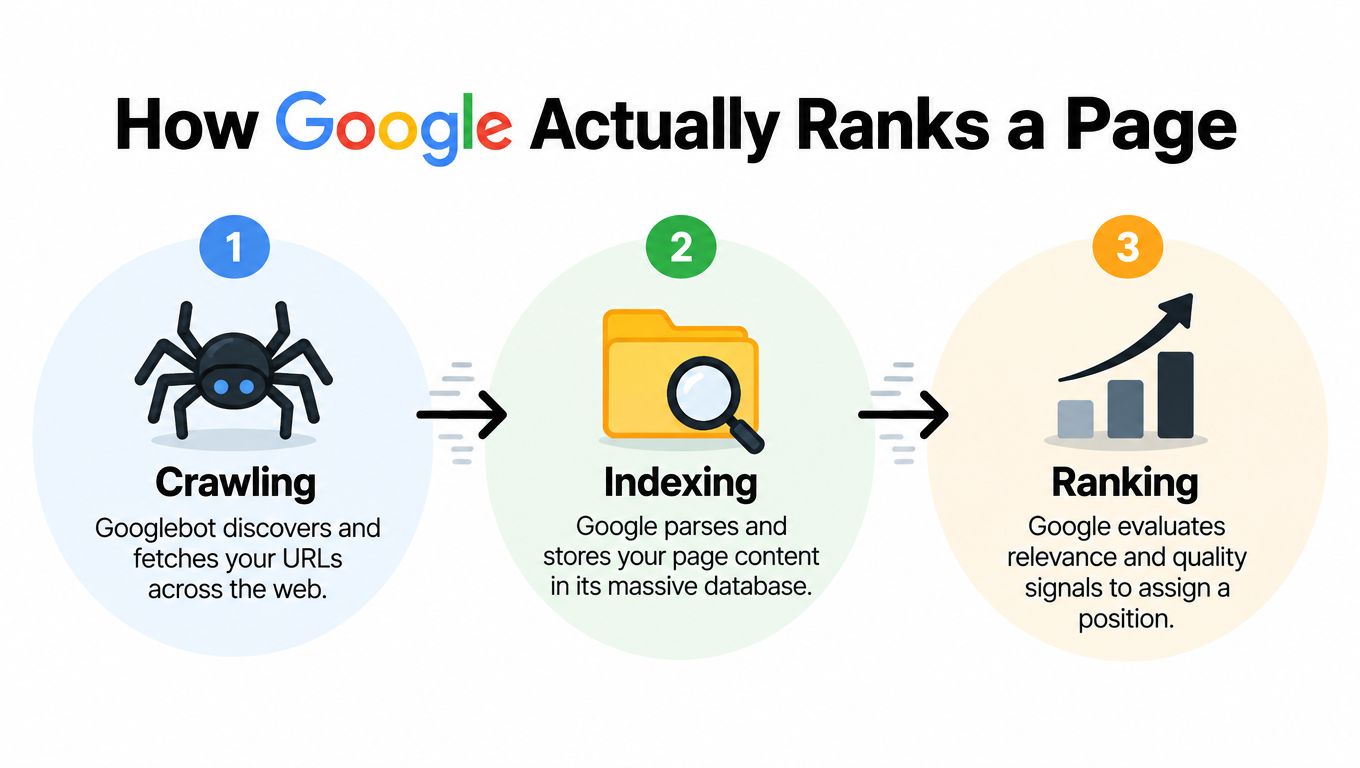
The simplified flow below illustrates those stages. Google's formal name for the final stage is serving search results, rather than ranking.
Publishing isn't the same as competing
Google's explanation of how Search works identifies crawling, indexing, and serving as distinct stages. Googlebot determines which sites to crawl, how often, and how many pages to fetch through an algorithmic process. Not every page completes every stage.
- Crawling: Googlebot discovers and downloads the page's resources.
- Indexing: Google analyzes its content, tags, and attributes and stores information about it.
- Serving: Google evaluates available pages for a particular search and presents results.
Google primarily discovers new pages through links from pages it already knows, according to its crawling and indexing documentation. That documentation also explains crawler controls and canonicalization, which can affect access and the preferred version of duplicated URLs.
For a founder, the diagnostic distinction is important. An undiscovered page needs a discovery investigation, not another paragraph of copy. A crawled page that isn't indexed needs a different investigation from an indexed page that ranks poorly.
Position also needs context. Treat the query, device, location, and search-result layout as part of the measurement, not incidental details. A page doesn't own a permanent ranking badge. It competes within a particular search situation.
The Ranking Factors That Move a Page
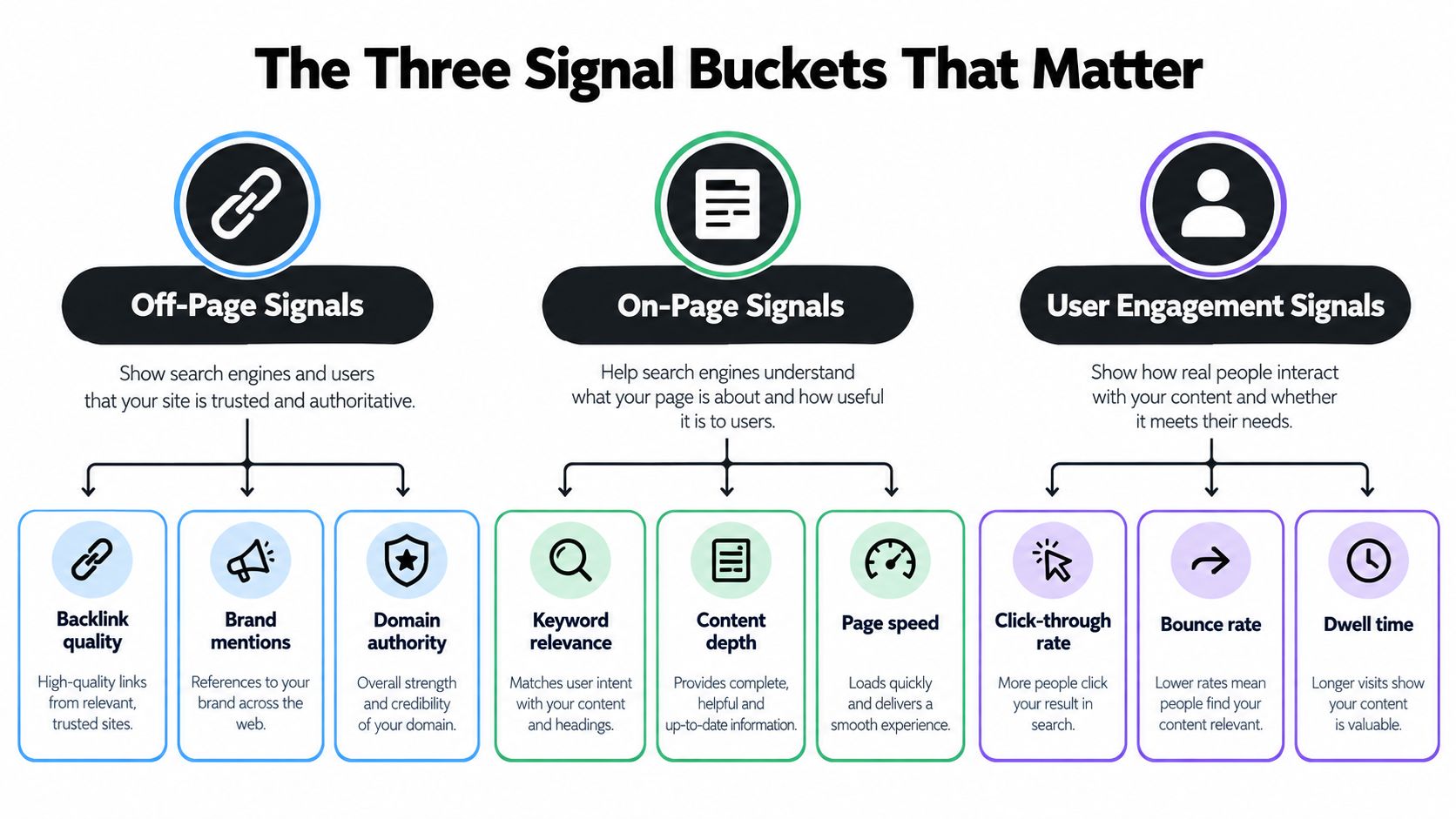
Don't begin with an enormous checklist of supposedly equal ranking factors. Begin with the page's most plausible constraint: relevance, relationships, or technical eligibility. These buckets are a diagnostic model, not a disclosed formula for Google's algorithm.
The visual offers a familiar overview, but its engagement labels need caution. Don't read bounce rate, dwell time, or a third-party domain-authority score as confirmed direct ranking inputs.
Relevance and relationships
On-page work starts with intent. A search for an invoicing tool comparison needs meaningful differences, limitations, and selection criteria. A generic explanation of invoicing doesn't answer the same request, however polished it is.
Google's ranking systems guide describes multiple automated systems operating at the page level, including passage ranking and link analysis/PageRank. Passage ranking helps Google understand the relevance of individual sections. It doesn't turn each paragraph into an independently indexed page.
Write descriptive headings and answer related subquestions clearly. Update material when the underlying answer changes, rather than changing the publication date for appearances.
Off-page work concerns how other pages connect to yours. PageRank's historical insight was that links convey relationships and importance, not merely navigation, as explained in this overview of search ranking factors. Relevant independent references and a coherent internal-link structure are more useful goals than collecting arbitrary links.
For a separate perspective on AI-answer visibility, MyMentions' AI search ranking framework is an additional resource to evaluate alongside your own observations, not a guarantee of inclusion.
Eligibility and common distractions
Technical work asks whether Google can access and interpret the intended page. Check the following before commissioning another rewrite:
- Access: Are important resources available to crawlers?
- URL preference: Are duplicate versions competing with the intended URL?
- Differentiation: Does this page serve a distinct purpose?
The ranking guide also describes duplicate-result systems. Publishing near-identical articles isn't a reliable way to occupy more results.
Another distraction is an indexing shortcut. Google's Indexing API isn't a general-purpose index-now button for ordinary articles. Technical eligibility and relevance can't be replaced by sending a notification.
The Post-AI-Overview Positioning Framework
Name the desired outcome before choosing the keyword. That's the classification rule I'd use with a lean team. Ask whether the user needs a fact, needs an experience available on your website, or is ready to take a commercial action.
These categories describe your intended outcome, not a promise about which search features Google will display. Don't assume commercial queries are immune to AI Overviews. Inspect the actual results and revisit the classification when they change.
Keyword Bucket Classifier for Search Engine Positioning
| Bucket | User Outcome | Best Content Format | Metric That Matters |
|---|---|---|---|
| Citation | Understand an answer and recognize a relevant provider | Clear definitions, original explanations, reference material | Accurate citations and subsequent brand interest |
| Click | Use something the search result can't fully provide | Calculator, detailed comparison, template, interactive demonstration | Qualified visits and meaningful on-site actions |
| Conversion | Choose, buy, subscribe, or contact | Product, pricing, service, or use-case page | Qualified leads, purchases, and customer fit |
Consider an invoicing startup. “What is a recurring invoice?” could belong in the citation bucket if your aim is accurate brand exposure. “Recurring invoice template” belongs in the click bucket when the page provides a usable download. “Invoicing software pricing” belongs in the conversion bucket when the visitor needs actual plans and purchasing details.
Decide what earns investment
A citation isn't automatically valuable. If your company is mentioned inaccurately, cited for an irrelevant topic, or never associated with later business interest, the exposure may not justify continued production.
Choose the format that fulfills the user's next action, not the format that's easiest to publish.
LLMrefs' search visibility factors for teams offers another resource for considering visibility beyond a conventional ranking report. To monitor the citation side, you can find AI overview tracking software, then define what counts as a relevant and accurate appearance.
Keep branded searches, assisted conversions, lead quality, and repeat visits alongside rankings. These are useful indicators, but they don't prove that an AI mention caused a sale. The practical trade-off is accepting that some informational content serves recognition rather than immediate traffic, while reserving production capacity for pages that earn visits and commercial actions.
Four Levers a Lean Team Can Actually Pull
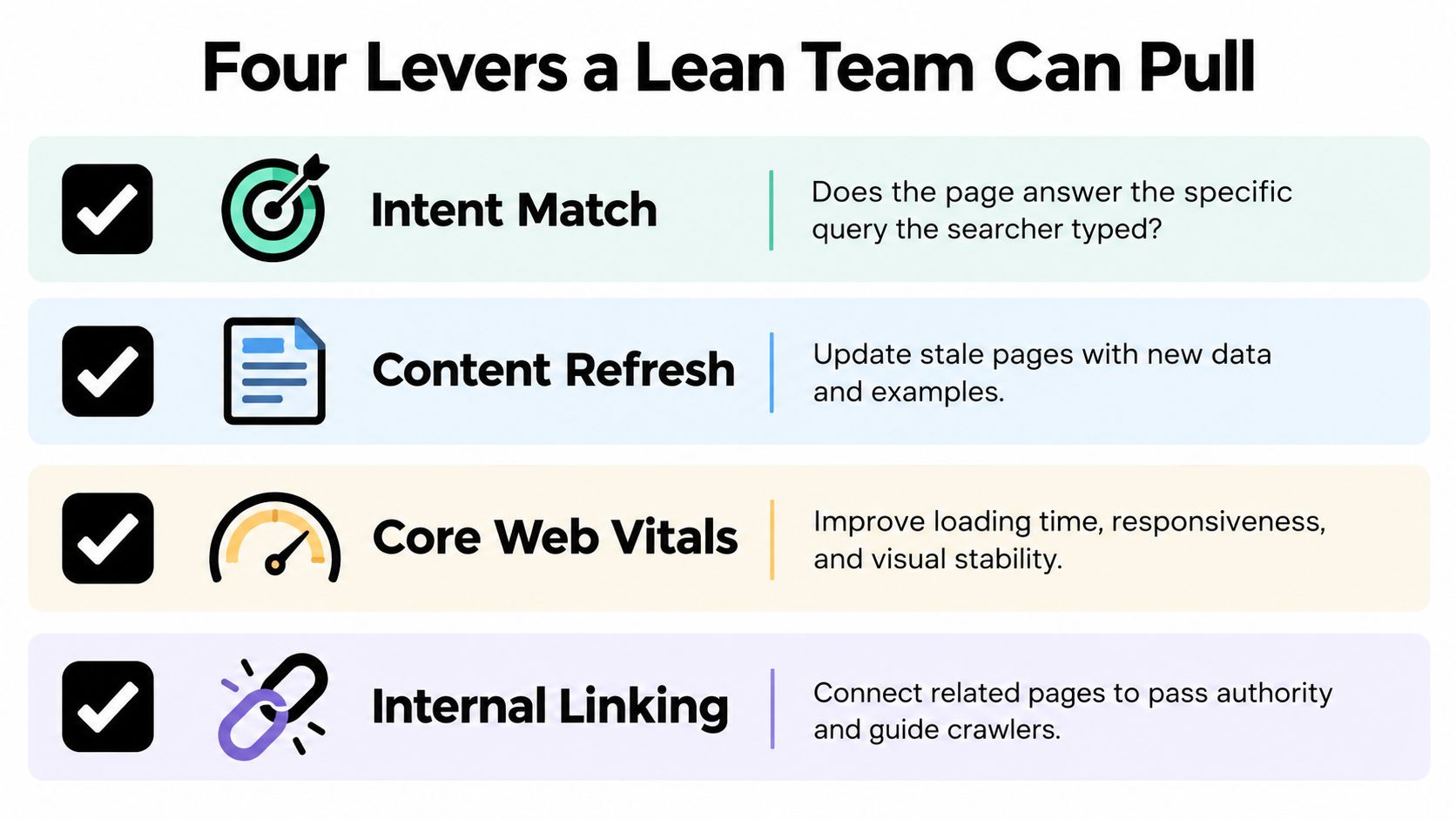
The right optimization depends on the symptom. A relevant indexed page with weak clicks needs different work from a product page whose important details aren't accessible. Run these levers in parallel where needed, but record changes so you can interpret the results.
The checklist visual includes content refresh as a useful supporting task. The working levers below also separate structured data from broader page experience.
Match the question and connect the answer
Intent match is the first lever to inspect when impressions come from queries your page barely answers. Compare the query modifiers with the page: “for freelancers,” “without accounting experience,” and “with recurring billing” represent different needs. Add the missing answer or retarget the page rather than inserting every phrase into the title.
Afterward, compare the intended query group in Search Console. Look for improved relevance in the queries generating impressions, not just a broader list of unrelated appearances.
For internal-link architecture, inspect how a reader reaches the page from related material. Link an invoicing guide to a recurring-billing feature page with concise, descriptive wording. After changing links, monitor whether the intended URL receives impressions for the relevant queries and whether competing URLs remain involved.
Make the page interpretable and usable
Google's SEO starter guide explains that dynamically injected JSON-LD can be read. Its structured-data guidance recommends placing Product markup in initial HTML for best results on ecommerce sites and ensuring sufficient server capacity when JavaScript generates markup.
- Structured data: Check that the markup accurately represents visible content before adding more types. Evaluate eligibility and any corresponding search appearance, rather than assuming markup produces a ranking lift.
- Page experience: Test loading, responsiveness, visual stability, and mobile usability. Compare performance by device afterward, while remembering that a technical improvement doesn't isolate the cause of a ranking change.
Search Console is useful for observing outcomes; browser testing and rendered-page inspection help diagnose the implementation. For the publishing portion, The SEO Agent is one option alongside a manual CMS workflow: it supports keyword research, cited drafting, internal linking, schema, and publishing. Automation doesn't remove the need to choose the right intent or verify that the live page works.
Technical Eligibility Is the Bottleneck
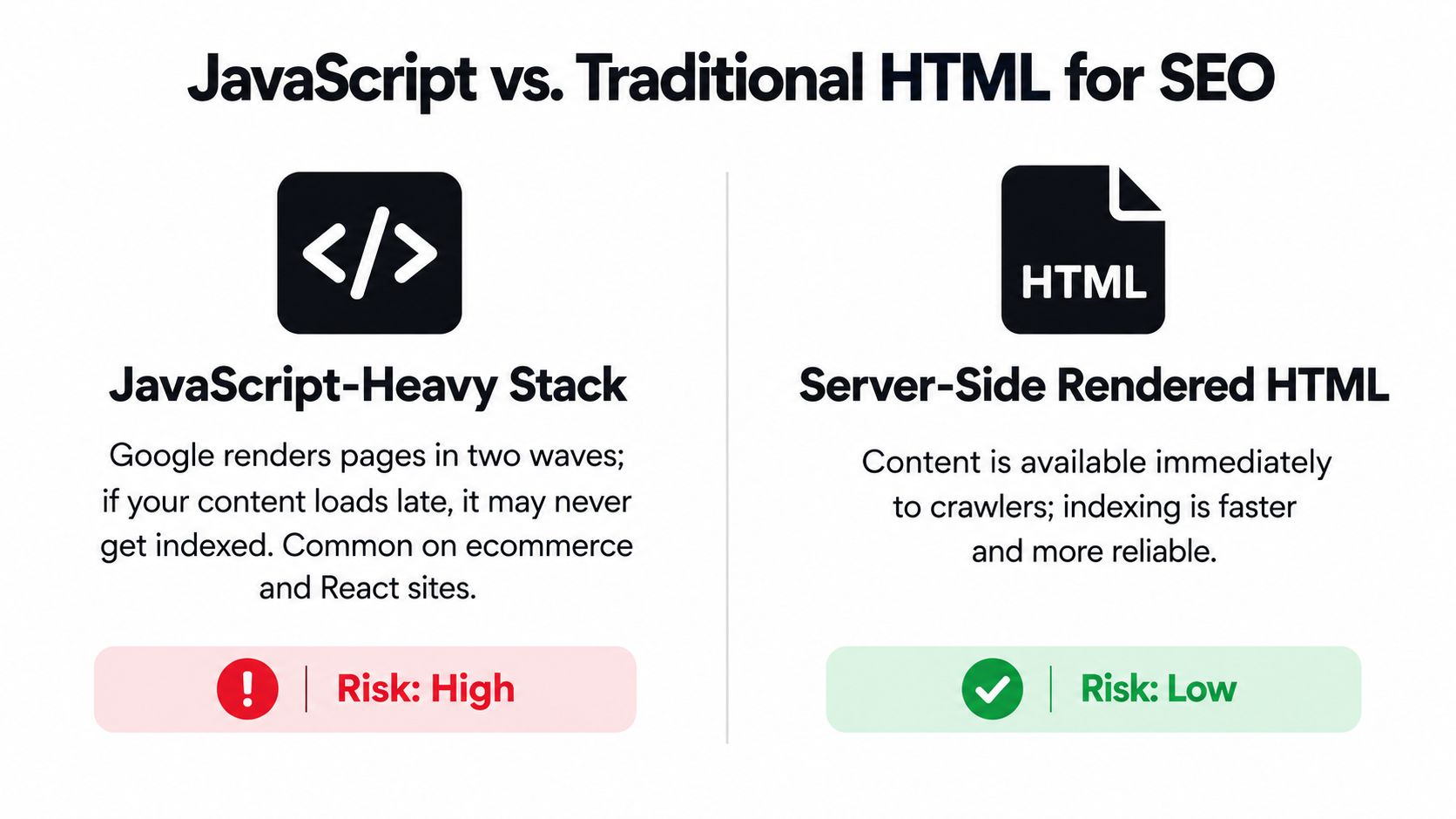
A product page can contain the right answer and still be hard for a search engine to process if that information depends on browser code that does not load reliably. “Google supports JavaScript” describes a capability, not a deployment strategy. The practical test is whether search engines can access the content they need to discover, understand, and evaluate the page.
The comparison below is a prompt to test your own setup. Its risk labels do not mean every JavaScript site fails or every server-rendered page gets indexed.
Put essential information on the reliable path
Where practical, deliver canonical text, product details, navigation, and critical schema in initial HTML. Client-side rendering can handle enhancements that are not needed for discovery or eligibility.
A product description that appears only after a delayed browser request adds a point of failure. Similarly, seeing a script in the source does not confirm that the intended structured data appears correctly in the rendered page.
| Page Type | Recommended Initial HTML | Suitable Client-Side Enhancements |
|---|---|---|
| Marketing landing page | Main proposition, use cases, navigation | Interactive demonstrations |
| Product page | Product details and critical Product markup | Optional recommendations |
| Blog post | Article text, headings, contextual links | Sharing controls |
| Faceted category page | Intended indexable category content and links | User-selected sorting and filters |
These are implementation recommendations, not indexing guarantees. For faceted pages, decide which combinations serve a distinct search purpose. Creating more rendered URL variations does not make those pages more useful.
Inspect what was delivered
Compare the server response, the browser-rendered page, and Google's inspected version. If text is missing, resources are unavailable, or markup conflicts with visible product information, investigate those gaps before rewriting the content.
For teams evaluating automated page comparisons, WebscrapingHQ offers a practical look at SEO scraping benefits. For a structured diagnostic checklist, use The SEO Agent for audits.
For a companion video, use the embedded player below.
Publishing through a CMS confirms that content was submitted, not that the live page renders as intended. After template changes, check representative pages, especially when product data or navigation relies on browser execution. A technically eligible page can earn visibility, but eligibility alone does not guarantee rankings or clicks.
Measuring Position Without Fooling Yourself
Start with a benchmark, then replace it with your own evidence. A 2024 academic study of organic click-through rates, using 31,648,226 impressions, 416,386 clicks, and 8,861,416 daily queries, estimated CTRs of 9.28% at position 1, 5.82% at position 2, and 3.11% at position 3. Device type materially changed the curve.
That dataset shows why position matters, not what your next improvement will deliver. Query mix and search features can make a borrowed CTR forecast misleading. Your own comparable Search Console history is the more defensible planning baseline.
Use a controlled comparison
- Segment the opportunity: Separate country, device, and branded versus nonbranded queries. Annotate the observed search-result format separately when necessary, rather than assuming every relevant feature is available as a reporting filter.
- Find realistic candidates: Prioritize high-impression pages in positions 4–10, following the practical workflow associated with the study above. Confirm that the query has a useful business outcome before investing.
- Make an interpretable change: Adjust intent coverage, title clarity, or internal prominence. Avoid bundling unrelated changes if you want to understand which intervention helped.
- Compare like with like: Use comparable periods and the same query-page segments. Record changes to the results layout, product offering, or demand that could affect interpretation.
A tracker can complement this work by observing a consistent query set. Compare options in this guide to top free rank tracking software, but don't treat a simulated search as the entire audience's experience.
Report outcomes without claiming causation
Reporting discipline: Say what changed, what you observed, and what remains uncertain.
For a click keyword, report qualified visits and on-site actions alongside position. For a citation keyword, report relevant appearances and corroborating brand signals. For a conversion keyword, prioritize qualified leads or purchases.
CTR is diagnostic, not proof that Google rewarded engagement or that ranking movement caused revenue. A stronger stakeholder report states that an intervention coincided with improvement, identifies the comparison used, and names plausible alternative explanations. That's more useful than declaring success from a single dashboard number.
A 90-Day Positioning Plan and Quick Answers
A 90-day plan is an operating schedule, not a promise that Google will deliver results within that window. Use it to replace scattered edits with a documented cycle.
Audit, improve, then allocate
- Days 1–30: Audit discovery, indexing, rendering, and the current query-page distribution. Assign each priority page a business outcome and record its baseline.
- Days 31–60: Apply the relevant levers to existing opportunities. Keep a change log and verify the published implementation.
- Days 61–90: Compare outcomes, reassess keyword buckets, and allocate effort toward the pages producing the strongest business value.
Use this practical SEO checklist to turn findings into assigned tasks rather than an unresolved audit document.
There's a sound historical reason to keep investing. BrightEdge's 2019 channel analysis found that organic search generated 53.3% of trackable website traffic, up from 51% in 2014. The analysis excluded direct traffic and isn't a current benchmark for every site, but it supports treating organic acquisition as a durable asset.
Quick answers
Why can a well-ranked page still feel invisible?
Inspect the whole results page and the keyword's intended outcome. The AI-summary evidence discussed earlier explains why position and visits can diverge.
Is buying links defensible?
I wouldn't buy links as a positioning shortcut. Evaluate any paid placement for its audience and advertising value, not a promised ranking benefit.
How long does movement take to appear?
There isn't a defensible universal timeline. Verify processing and indexing, then assess sustained movement across comparable reporting periods.
Can the Indexing API accelerate ordinary blog rankings?
No. Google's Indexing API eligibility documentation restricts it to pages containing JobPosting data or a BroadcastEvent embedded in a VideoObject.
On Monday, choose a priority page, name its intended outcome, and document the constraint you'll address. That's a manageable positioning decision, not another publishing quota.
The SEO Agent offers keyword research, source-checked article drafting, internal linking, and CMS publishing for founders and lean teams. Visit The SEO Agent to explore automating that production workflow, while keeping your positioning priorities focused on qualified visibility, useful visits, and commercial outcomes.