Marketing Content Planning Framework for 2026
Marketing content planning links audience, channels, calendars, and KPIs to a workflow that can refuse weak pages. A 2026 framework for lean teams.
Only 29% of respondents whose organizations had a documented content strategy rated it extremely or very effective in the Content Marketing Institute and MarketingProfs' 2025 B2B benchmark. That is the problem this guide solves. Writing a strategy down gives you a document. It doesn't give you a system that picks the right topics, staffs them responsibly, and refuses pages that shouldn't exist.
Table of Contents
- Why a Documented Strategy Still Misses
- The Five Parts of a Content Plan
- Map the Audience Before You Pick Topics
- Match Channels and Cadence to KPIs
- Run a Workflow That Can Refuse a Draft
- A One Quarter Plan for a Lean Team
- Approve One Cluster Before You Add Volume
Why a Documented Strategy Still Misses
The benchmark behind that figure surveyed 1,186 marketers globally between June and August 2024, and the rest of the split is just as telling. 58% called their documented strategy moderately effective, 12% called it not very effective, and 1% called it not effective at all. Documentation, on its own, changed very little.
What's Missing Between the Document and the Result
Among marketers whose strategy was moderately effective or worse, 42% identified unclear goals as at least part of the problem. Capacity sits right behind it. 54% named lack of resources as a challenge, 45% reported their organization lacked a scalable content-creation model, and another 20% weren't sure whether such a model existed.
Those numbers describe a familiar board. Topics get scheduled because a keyword tool found volume. Nobody owns the brief. Review time isn't counted. Success gets reported as posts shipped because nobody wrote down which business result each post was meant to move.
A topic list with no owner, no capacity cap, no audience job, and no metric is a schedule, not marketing content planning. It's a grocery list with no menu, no cook, and no check on whether dinner was edible. The list is real. The meal still fails.
The Framework in Reading Order
Work through five parts before you add a single keyword row. Score each topic to decide whether it deserves a URL, a section, an update, or nothing. Map every asset to one funnel stage and one measure. Run a weekly loop that can stop a weak draft. Then size one quarter to what a lean team can staff.
The bar to hold: Every scheduled asset needs a person, a purpose, and a way to be judged. If one of the three is missing, the asset isn't planned yet.
The Five Parts of a Content Plan
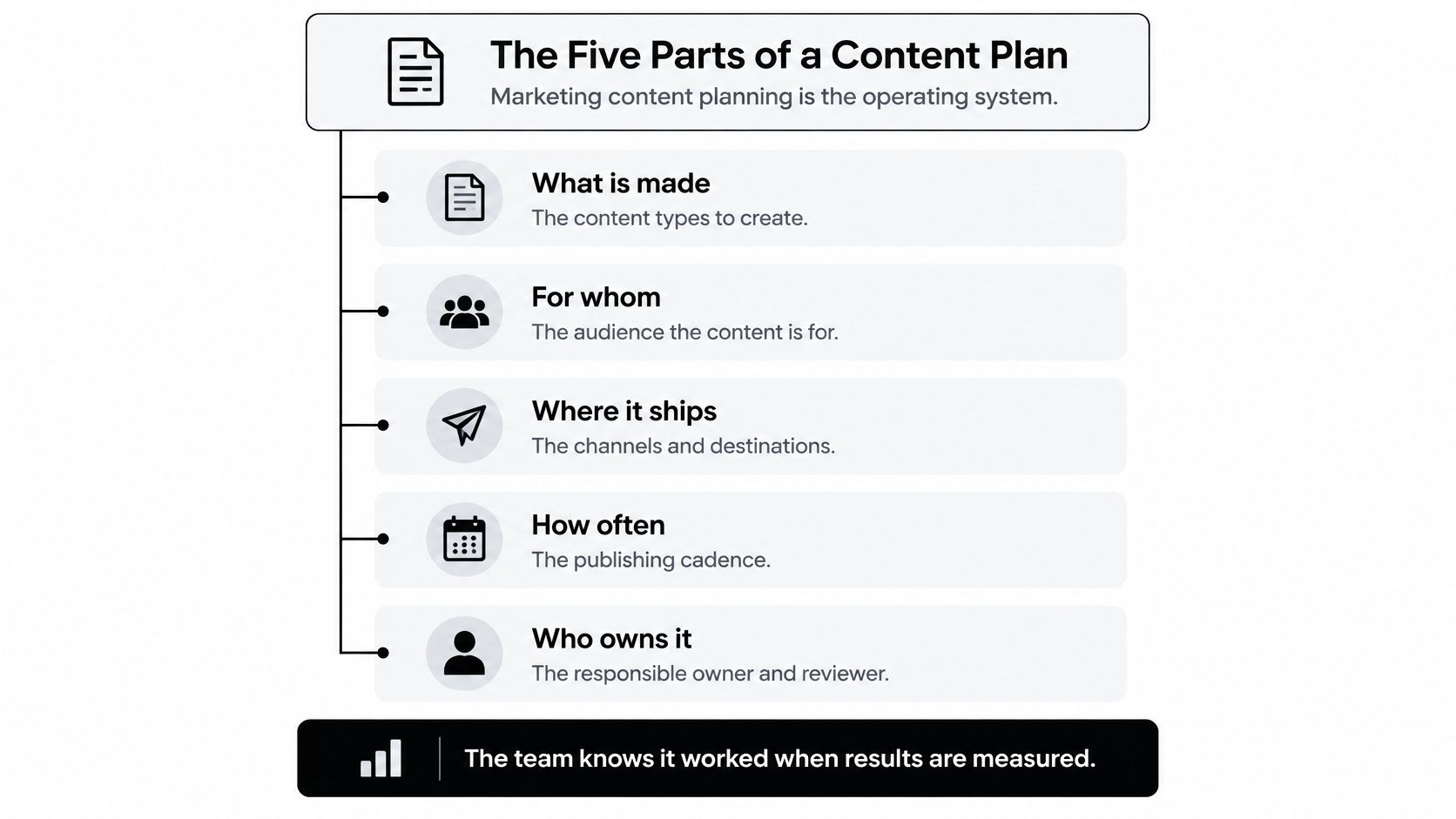
Marketing content planning is the operating system that decides what is made, for whom, where it ships, how often, who owns it, and how the team knows it worked.
| Part | Question it answers | Artifact | If you skip it |
|---|---|---|---|
| Audience map | Who is this for and what job are they doing | Persona card with one job-to-be-done | Topics that rank for people you do not sell to |
| Channel and format | Where will this buyer actually use the asset | One primary channel and format per asset | A blog calendar for an audience that decides in sales calls or video |
| Calendar | What can this team ship without dropping quality | Dated slots capped to weekly capacity | Aspirational dates and a backlog that never clears |
| KPI alignment | Which business result does this asset own | One primary metric and a review date per URL | Traffic reported as success while pipeline stays flat |
| Workflow and gate | Who drafts, checks, and may refuse publication | Weekly loop with a written score floor | Every idea ships, including thin pages that dilute the site |
Fill those parts in that order. Audience first, because every later decision inherits from it. Channel and format second, because a comparison buyer in a spreadsheet and a practitioner watching a walkthrough need different assets. The calendar comes third, capped by real hours rather than ambition. Then one primary KPI per asset, and finally a workflow with a quality floor someone is allowed to enforce.
Think of it as a transit map. Audience questions are the stops, channels are the lines, the calendar is the timetable, KPIs are the on-time record, and the workflow is the dispatcher who holds a train that isn't ready.
A Calendar Alone Only Answers When
Many teams own the third part and call it a plan. A calendar tells you Tuesday's slot. It tells you nothing about whether the person filling it matters, whether the format fits, or whether the result gets checked in a month.
Google's helpful content guidance sets the same constraint from the search side. A site needs an identifiable audience, a clear primary purpose, demonstrated first-hand expertise, and content that fully helps users accomplish their goal. Publishing large volumes across unrelated topics, summarizing existing material without adding value, and chasing subjects only because they're trendy all cut against that standard. So does targeting a prescribed word count.
That means volume across random topics isn't a strategy. It's a relevance risk with a publishing schedule attached. Complete the five artifacts left to right, and only then add keyword rows underneath them.
Map the Audience Before You Pick Topics
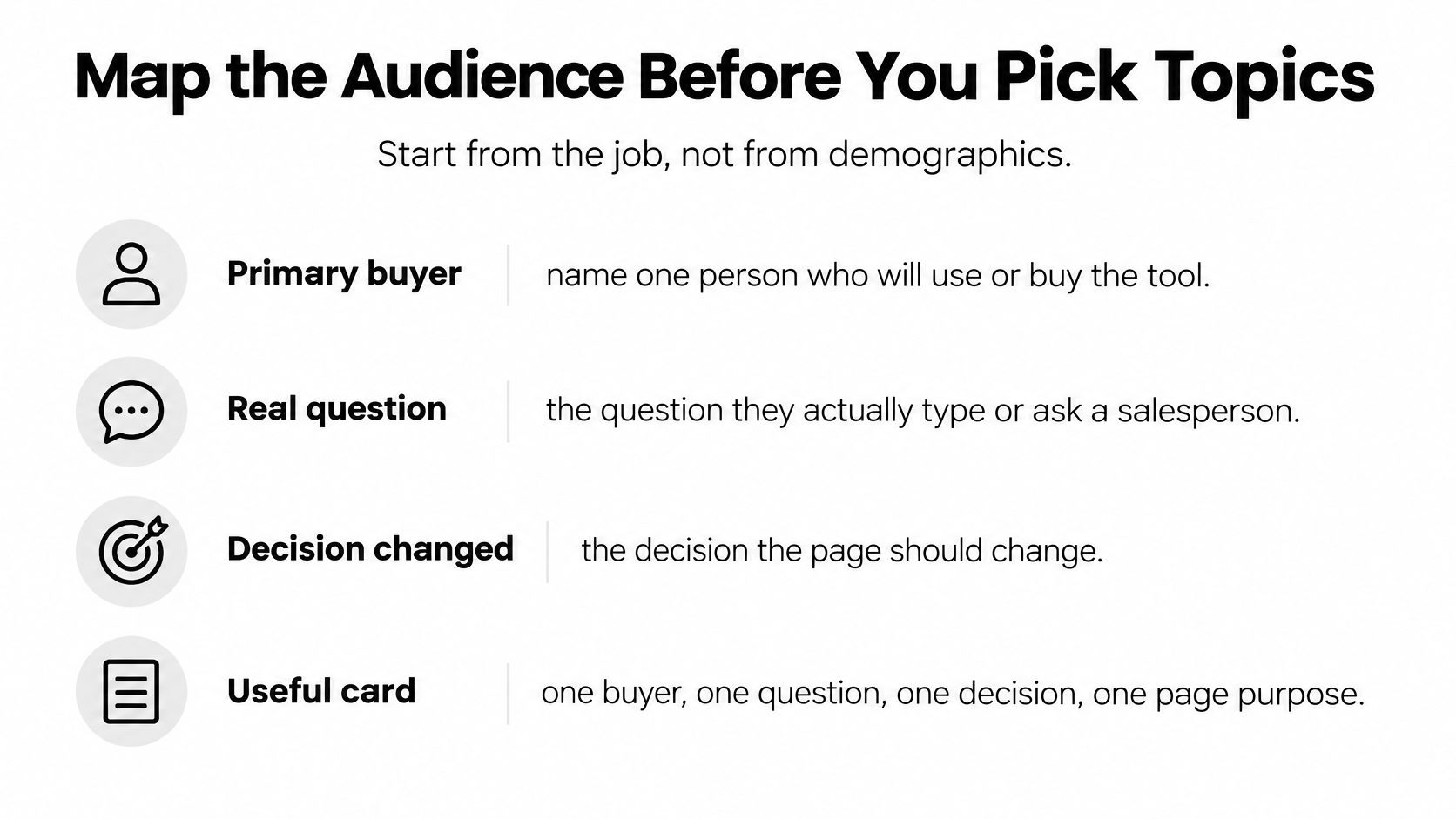
Start from the job, not from demographics. Age brackets and company size don't tell you what someone types at midnight before a purchase meeting. A job-to-be-done does.
Build one card per candidate topic with six fields filled in. Target persona, named as one person. Job-to-be-done, the key question they type or ask a salesperson. Search intent, what a satisfying result looks like. Unique evidence, the experience or data only you can add. Conversion path, the business action after reading. Qualification, the explicit reason your company is entitled to publish this. If you want help generating candidates to score, you can find topics with The SEO Agent, but the card still has to be completed by hand.
Score the Card and Enforce a Floor
Score each candidate 1 to 5 on audience fit, distinct intent, unresolved need versus pages that already rank, firsthand originality, and maintenance cost, where a higher maintenance score means cheaper to keep current. A card proceeds only if it scores at least 3 on audience fit and on firsthand originality and averages 3.5 or higher across all five. Anything below that is refused before drafting, and the refusal is logged with its reason.
Search data validates demand here. It doesn't choose the topic. A keyword with volume and no evidence you can add is a page your competitors have already written better.
Google's guidance on using generative AI content states that generating many pages without adding user value can violate its scaled-content-abuse policy, regardless of whether AI was used. That's why the plan needs a consolidation rule. If several proposed topics answer the same underlying question, plan one substantially better resource instead of several thin pages. Agencies managing large keyword lists hit this constantly, because semantic variations create cannibalization and maintenance costs rather than incremental demand.
| Outcome | Use when | Do not use when |
|---|---|---|
| New URL | Intent is distinct and you can add evidence the current results lack | The query is a paraphrase of a page you already have |
| Section on an existing page | The question is a sub-step of a pillar the buyer already needs | The pillar would become unfocused or too long to scan |
| Update the pillar | The answer is incomplete or the page has slipped against the query | You are only chasing a new keyword variant |
| No new content | There is no firsthand evidence and no business action | Sales calls show a real unresolved job you can document |
You should be able to reject a topic in one pass and answer, in writing, how the page adds unique value before it's approved. That answer is the audit trail.
Match Channels and Cadence to KPIs
Channel choice follows the audience job. It doesn't follow a trend list. A buyer who resolves objections on sales calls needs enablement material and strong nurture pages, not a daily blog grid. A buyer who compares tools through video needs walkthroughs, not another listicle.
In the Content Marketing Institute's 2025 B2B benchmark based on 980 marketers, 95% had a content strategy. Reported business contributions were strongest near the top of the funnel, with 87% saying content helped create brand awareness, 74% saying it generated demand or leads, 62% saying it nurtured audiences or leads, 52% saying it grew loyalty, and 49% saying it generated sales or revenue.
That gradient is exactly why publication can't be the success metric. Awareness is easy to claim and hard to bank. Every asset needs one funnel stage and one primary measure matched to that stage.
| Stage | Share citing this contribution | Primary measures | Review |
|---|---|---|---|
| Awareness | 87 percent | Qualified organic impressions, non-branded clicks, engaged visits | Monthly |
| Demand or leads | 74 percent | Assisted conversions, demo starts, lead quality | Monthly |
| Nurture | 62 percent | Return visits, sequence engagement, sales-assist notes | Monthly |
| Loyalty | 52 percent | Repeat engagement and use of product or customer education | Quarterly |
| Sales or revenue | 49 percent | Influenced pipeline or attributed transactions | Quarterly |
Review on the Cadence the Stage Can Prove
Review awareness, demand, and nurture monthly, because those signals arrive fast enough to act on. Review loyalty and revenue quarterly, because judging them monthly invites you to kill slow assets early. Then reallocate next quarter's slots by intent class, topic cluster, format, and channel toward downstream value rather than raw traffic. data-backed growth planning for lean teams earns its place, since the review only helps if it changes what gets scheduled next.
On distribution, one caution. Video investment is popular, but you should add a video channel only when your buyer uses it to decide. A channel your audience ignores is a second production line producing nothing.
Cap the Calendar Before Dates Go On It
Count the hours for briefing, drafting, review, and updates before you commit slots. Updates are the line item teams forget, and they grow with every URL you ship. Schedule fewer assets than enthusiasm suggests.
One staffed weekly asset plus one repurposed cut beats a daily grid nobody owns. The grid looks serious in a planning meeting. The staffed asset is what a buyer reads. By the end of this step, each planned URL carries one metric and one review date in writing.
Run a Workflow That Can Refuse a Draft
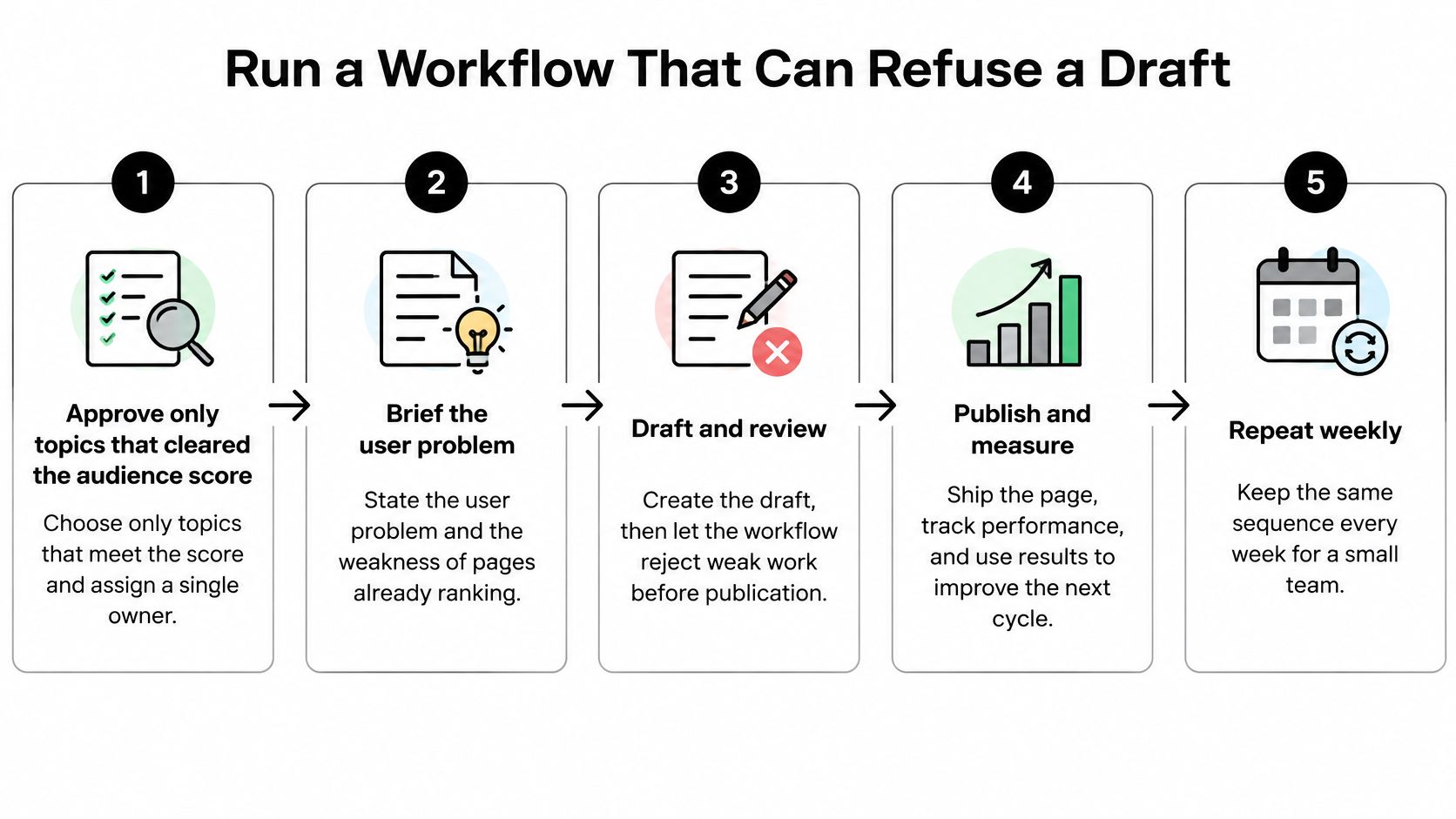
A small team needs one repeatable week, not a process document nobody opens. Run these seven steps in order.
- Approve: Take only topics that cleared the audience score, and name a single owner for each.
- Brief: State the user problem, the weakness of pages already ranking, the sources to use, and the business action expected.
- Draft: Answer the job with firsthand experience rather than a summary of what already ranks, and ignore any target word count.
- Fact-check: Verify every factual claim against its source and cut what can't be supported.
- Scan: Check originality, and check whether a visitor would find the page satisfying and complete.
- Link: Connect the page to its pillar and to the next step in the buyer's journey.
- Publish or return: Ship with title, meta description, images, and schema, or send the item back for another pass.
Below the score floor, the draft does not ship, even if the calendar slot stays empty.
Why the Refusal Rule Protects the Whole Site
Google's guidance on AI-generated content states that the production method itself isn't the deciding factor. Ranking systems are intended to reward original, high-quality content demonstrating experience, expertise, authoritativeness, and trustworthiness. Using AI in the pipeline doesn't lower that bar, and it doesn't raise it either. The page still needs originality and demonstrable expertise.
The downside of weak pages is site-wide. In Google's helpful content update documentation, its systems automatically identify content that appears to have little value, low added value, or poor usefulness. When a site contains relatively high amounts of such material, any content on that site may be less likely to perform well, assuming better alternatives exist elsewhere.
So an empty Tuesday costs nothing. A thin URL costs you maintenance, internal link dilution, and possibly performance on pages that deserved better. A content marketing automation roadmap for 2026 only helps if the gate sits inside it, because automating a loop with no refusal step just produces weak pages faster.
The next planning meeting starts from refused items and measured results. It doesn't start from a fresh keyword export.
A One Quarter Plan for a Lean Team
Say you're a 12-person B2B software company with one marketer and a founder who reviews. There's no content department. Your buyer is an operations lead comparing tools, and your cluster is one pillar plus four supporting pieces, not forty keyword variants.

Month 1 ships the pillar. The marketer owns it, the founder supplies two hours of product evidence, and it's measured on engaged non-branded visits. Nothing else competes for those hours.
Month 2 ships two demand pages aimed at demo-start quality. The founder's contribution here is proof points pulled directly from sales calls, including the objections prospects raise before booking. Those objections become sections, which is what makes the pages hard for competitors to copy.
Month 3 updates one comparison page the team already owns instead of opening a near-duplicate URL. The pillar also becomes one short video, but only if that operations lead watches vendor walkthroughs on YouTube. If the buyer decides in spreadsheets and calls, the video doesn't get made.
The video below walks through how a lean planning session like this runs in practice.
What the Board Shows and What It Leaves Off
Total capacity is four net-new or substantially updated URLs in the quarter, roughly one staffed production week each, with two weeks held as buffer for review and fixes. Every card on the board shows persona, intent, the evidence only this company has, the primary KPI, the owner, and the channel. A card missing any field doesn't get a date.
Left off entirely are trend posts, prescribed word counts, and how-to variants that answer the same question in different words. Refusing those is what frees the buffer weeks.
That restraint matches what marketers say they want from measurement. In HubSpot's 2025 survey of more than 1,700 B2B and B2C marketers, 31% viewed understanding which strategies work as a major advantage of data-driven marketing, 30% cited increasing marketing ROI, and 27% cited reaching the target audience more effectively. So this quarter gets judged on demo quality and engaged visits, not on posts shipped. Tools like The SEO Agent can run the production loop once a board this size is approved, but the board itself is the decision. It fits on one page, and a founder can approve it in a single meeting.
Approve One Cluster Before You Add Volume
Make one decision this week. Don't raise publishing volume until a single cluster has all five parts in place.
Run the checklist in order:
- Write the job: State the audience job in one sentence a salesperson would recognize.
- Gather candidates: List about ten questions drawn from sales calls and search data.
- Score and cut: Apply the five criteria and keep only cards that clear the floor.
- Consolidate: If three of the ten answer the same question, keep one URL.
- Staff clearly: Assign one KPI, one owner, and only the dates the team can cover.
A cluster is ready when each surviving card names the user problem, the weakness of current pages, the evidence you'll add, and the business action. That readiness test is also how you optimize SEO content with AI without letting tooling set the editorial standard, because the standard gets written before anything is drafted.
Once the plan is approved, production can run in-house or through a tool. For teams that want it handled, we built our pipeline around the same gate. The agent reads your site, maps what already ranks, and researches keyword targets, and you either approve the plan or let it run. You review the content plan, edit drafts, and choose when approved articles publish. Each approved finding becomes a queued article target that's drafted, checked against its sources, and published to your CMS with metadata, images, and schema attached, under the same score floor. To start, you provide the site and a few lines about what the business sells.
If you can't name the problem, the gap, your evidence, and the action for the next URL, it isn't ready to schedule.
Bring us one cluster you've scored and approved, and we'll run it through research, source-checked drafting, and native CMS publishing while you keep approval over the plan, the drafts, and the publish timing. Every article ships with metadata, images, internal links, and schema, and anything below your quality floor gets refused instead of posted. Visit The SEO Agent to put your next quarter on a board your team can staff.