How to Promote the Website: Tactics That Still Work in 2026
Learn how to promote the website with SEO, link building, content distribution and measurement that shows what is actually working in 2026.
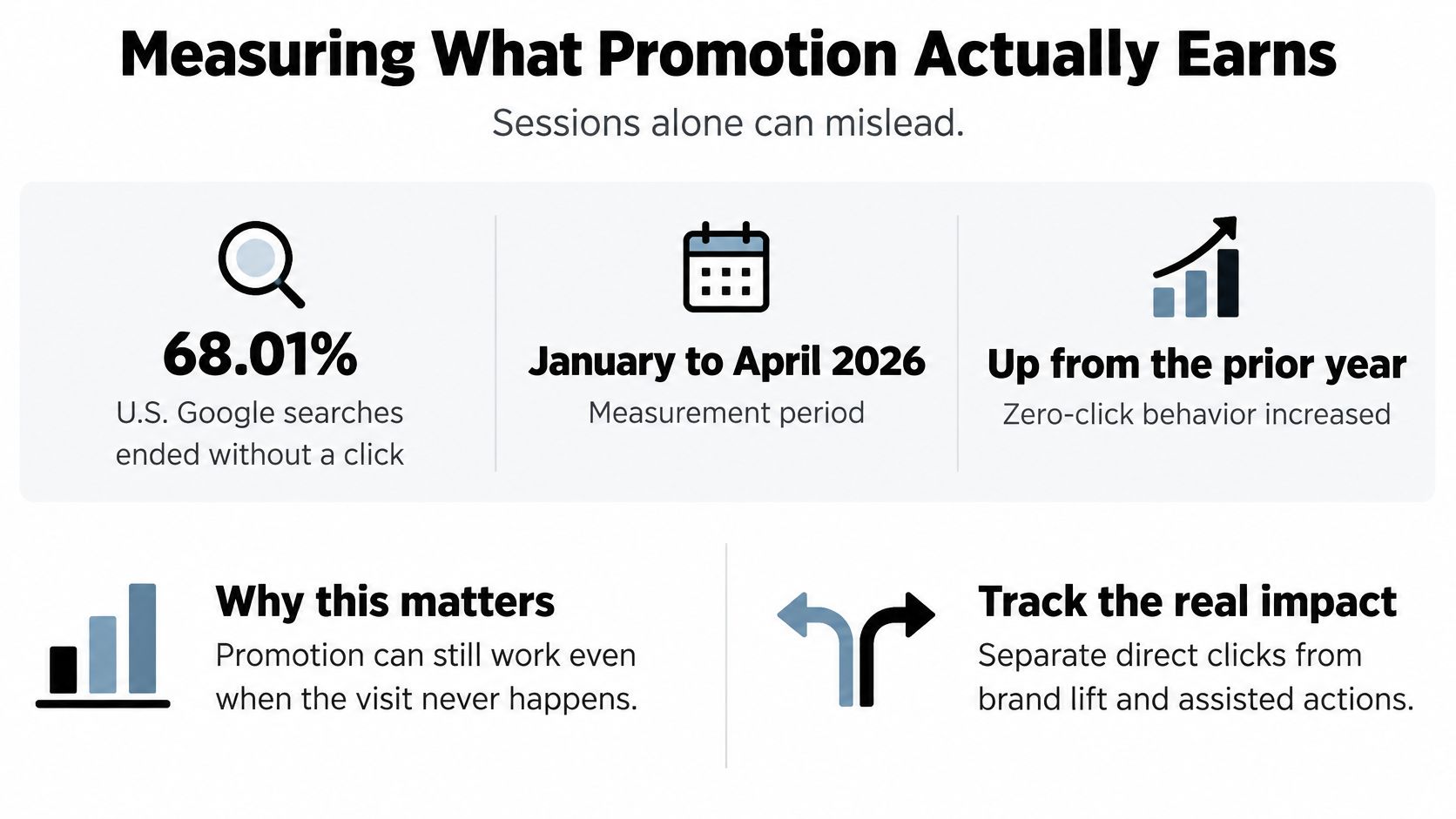
Between January and April 2026, 68.01% of U.S. Google searches ended without a click, according to the SparkToro analysis of Similarweb clickstream data. That's the uncomfortable starting point for anyone learning how to promote the website they've just built. You can rank, appear, and still get no visit.
But promotion hasn't stopped working. It's stopped reporting itself neatly in your sessions graph. People read an answer on the results page, remember your name, and come back later through a branded search, a direct visit, or an email click. If you judge every channel by last-click traffic, you'll kill the work that's creating demand and double down on whatever happens to sit closest to the conversion.
So the job now has three parts. Pick a small number of channels you can run well. Make every page findable and worth citing, whether the reader arrives from Google, an AI assistant, or another site. Then measure demand, branded search, and assisted conversions alongside sessions, so you can tell the difference between promotion that's failing and promotion that's working somewhere your default report doesn't look.
Table of Contents
- Which Promotion Channels Deserve Your Time
- How to Make Every Page Findable in Search
- How to Earn Links Without Breaking Spam Rules
- Measuring What Promotion Actually Earns
- How to Distribute Each Article Across Channels
- Adapting When Search Stops Sending Clicks
- Run the Two Channels for 90 Days
Which Promotion Channels Deserve Your Time
| Channel | Upfront effort | Time to first results | Best use |
|---|---|---|---|
| Organic search (SEO) | High | 3-6 months | Evergreen demand |
| Backlinks and digital PR | Medium to high | 2-4 months | Building authority |
| Email newsletter | Low to medium | Within weeks | Existing audience |
| Organic social | Medium, ongoing | 1-3 months | Reach and community |
| Guest posts and expert contributions | Medium | 1-3 months | Borrowed trust |
| Paid search | Low setup, ongoing spend | Days | Testing high-intent queries |
| Paid social | Low setup, ongoing spend | Days | Testing audiences |
These timings are working estimates, not guarantees. A narrow niche with weak competitors moves faster than a crowded market where every rival has years of content and links. Treat the table as a planning range and check your own baseline against it.
How to Pick Your First Two
Start with two channels where your readers already spend time, and let search build the long-term base underneath them. Spreading a lean team across seven channels produces seven half-finished efforts and no signal worth reading. This is the practical core of how to promote the website when you don't have a marketing department.
If you have no audience yet, I'd start with organic search plus one earned-links effort. Search captures people already asking for what you sell, and links give those pages the authority to compete. Tools like The SEO Agent can handle the publishing side, but the channel choice is still yours.
If you already have an email list, flip the order. Email goes first because it converts fastest, since you're writing to people who asked to hear from you. Search runs second and compounds over time.
Don't start with paid spend. Paying to amplify a message you haven't validated just teaches you, expensively, that the message doesn't work.
Paid channels earn their place later, once an organic post, email, or community thread proves a headline and offer can move someone to act. Until then, your budget is better spent on the two channels that build assets you keep.
How to Make Every Page Findable in Search
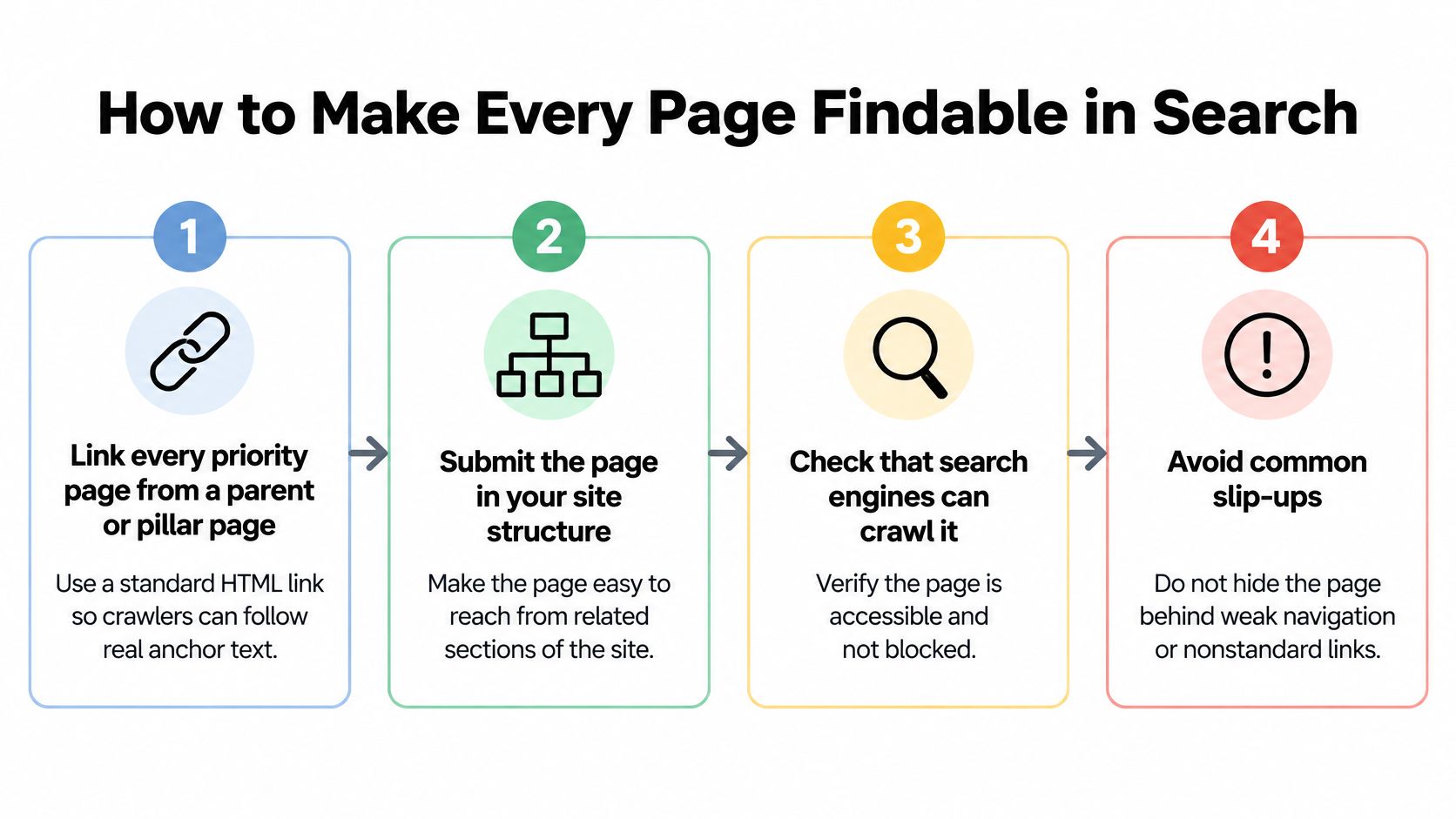
The most common reason a new page never gets found isn't weak writing. It's that nothing links to it. The page sits orphaned in your CMS, reachable only if someone types the URL, and crawlers have no path in. Fix discovery before you worry about rankings.
The Six-Step Routine
Link every priority page from a parent or pillar page. Use a standard HTML link, an anchor element with an href. The Google SEO Starter Guide states that links are a primary discovery mechanism and that crawlable links require that anchor format. Buttons wired to JavaScript click handlers often don't count, because crawlers may never follow them.
Create and submit an XML sitemap. List your important and recently updated pages so Google can prioritize what matters. Understand the limit, though. Sitemap inclusion helps prioritization, but it doesn't guarantee crawling or indexing, so a submitted URL that never gets indexed is still your problem to fix.
Use descriptive URLs and anchor text. A slug like /pricing-for-freelancers and anchor text that names the destination tell both readers and crawlers what sits behind the link. Generic text like "click here" wastes that signal.
Keep key claims in HTML text. Copy trapped inside images or client-side-only interfaces is effectively invisible to crawlers. If a statistic or headline matters, put it on the page as real text and give the supporting image proper alt text.
Validate after publishing. Check each URL in Google Search Console and confirm it has moved through discovered, crawled, and indexed. A page stuck at discovered usually needs a stronger internal link or a fix to whatever is blocking the crawl. The SEO Agent's optimization checklist works well as the template for this pass.
Refresh when pages change materially. Update the sitemap and the internal links pointing to the page whenever you substantially revise it, so the new version gets recrawled and older anchors still describe it accurately.
The Failures That Keep Recurring
Three slips account for most invisible pages. Orphan pages have no inbound links at all. Image-only copy hides your argument from crawlers. JavaScript click handlers replace real links with something a crawler can't reliably follow.
Measure promotion quality by discovered, crawled, indexed, and ranking URLs, not by how many articles you published this month.
Turn this into a pre-publish gate and you stop shipping invisible work. Reject any article with no linked parent page, no sitemap entry, a non-descriptive slug, missing alt text, or critical claims rendered only as graphics. That five-item check takes minutes and saves you from promoting a page search engines can't even store. It's unglamorous, but it's where how to promote the website begins.
How to Earn Links Without Breaking Spam Rules
Ask one question about every link you're offered. Would you still want this link if it sent no ranking benefit at all? If the answer is no, you're not earning a link. You're buying a signal, and that's exactly the behavior search engines punish.
Editorial links are the ones worth chasing because another site chose to point its readers at your resource. That choice is the endorsement. Anything you manufacture to imitate it carries risk out of proportion to the gain.
A Sequence That Stays Clean
- Find editors who already link out. List the pages that currently link to sources on your topic. Those editors have shown they're willing to cite external work, so your pitch lands somewhere receptive.
- Build something worth citing. Original data, a calculator, or a benchmark gives an editor a reason. Say a SaaS founder publishes a benchmark of 150 onboarding flows, then pitches the single most surprising finding to three industry newsletters. That's a citable asset, not a favor request.
- Pitch one specific angle. Give the journalist the exact number they can quote and the sentence around it. Vague pitches about your great content get deleted.
- Mark paid and untrusted links properly. Any paid placement, sponsored post, or login-gated link gets the nofollow attribute, and user-submitted links get the same treatment. That keeps promotional links from masquerading as editorial endorsements, which is the model link building for startup founders should follow.
- Refuse the shortcuts. Skip reciprocal link swaps, product-for-link exchanges, and automated link-building services entirely.
Where the Line Actually Sits
The rules aren't ambiguous. Google's link spam policy explicitly prohibits buying or selling links for ranking purposes, exchanging products or services for links, excessive reciprocal-link schemes, and using automated services to create backlinks. Paid articles, guest posts, or press releases carrying links that pass ranking credit can also violate the policy, especially with optimized anchor text.
That doesn't ban advertising or partnerships. It bans disguising them. A sponsored placement labeled as sponsored, with the right link attribute, is legitimate promotion. The same placement dressed up as an independent editorial recommendation is manipulation.
I would rather have five links from sites my buyers read than fifty from directories nobody visits. The first group sends customers today and authority over time. The second group sends a liability that surfaces whenever Google tightens enforcement, which is a poor trade for a lean team that can't afford to rebuild a domain.
Measuring What Promotion Actually Earns
Sessions alone will mislead you, because a growing share of searches now end on the results page itself. A campaign that builds real demand can show flat or falling traffic while branded searches and direct visits climb underneath. If sessions are your only scoreboard, you'll cancel the work that's working.
The Metrics Worth Checking
| Metric | Check at | What it tells you |
|---|---|---|
| Discovered and indexed URLs | 7 days after publishing | Whether search engines have found and stored the page |
| Qualified sessions | 28 days | Visits from the audience you are targeting |
| Branded search volume | 28 and 90 days | Demand that promotion has created |
| Assisted conversions | 90 days | Conversions where a promoted page appeared earlier in the path |
| Referring domains earned | 90 days | Editorial links from relevant sites, not directory listings |
| Pipeline or revenue | 90 days | The business result that promotion should support |
Read the table in order. Indexing tells you whether the page can compete at all. Qualified sessions and branded search tell you whether anyone cares. Assisted conversions, referring domains, and pipeline tell you whether that attention became money or authority.
How to Act on the Numbers
Judge different page types differently. Informational pages are the most exposed to zero-click behavior, so judge them by their assisted contribution to conversions and by whether branded search rises after they publish. Product, comparison, and pricing pages sit closer to a decision, so judge those by qualified actions like trial starts and demo requests.
Don't let impressions flatter you. An impression with no click, no branded lift, and no assisted conversion proves almost nothing beyond the fact that a results page rendered. It's a diagnostic, not a result.
Set the baseline first. Record indexed URLs, qualified sessions, branded search, assisted conversions, and pipeline before the campaign starts, or your 28-day and 90-day numbers have nothing to be compared against.
Use a model for reporting SEO results to keep those checkpoints consistent month to month, so you're comparing the same definitions rather than whatever metric looks best that week. Consistency matters more than sophistication here. A simple report you read beats a dashboard nobody opens.
Then apply a hard stopping rule. If qualified sessions, branded search, and assisted conversions are all flat after 90 days, that channel isn't earning its time. Move the effort to a channel showing movement instead of publishing harder into silence. Knowing when to stop is half of learning how to promote the website without burning a small team's hours. The other half is refusing to stop something early just because the click graph looks disappointing.
How to Distribute Each Article Across Channels
Publishing isn't distribution. An article that goes live and waits for Google is an article doing one job when it could do five. Run every substantial piece through the same sequence, in this order, because each step feeds the next.

The Six Steps in Order
Publish and link from a pillar page. The article needs a home inside your site structure before it needs an audience outside it. That internal link is what makes it findable and gives it context.
Send a segmented email with one call to action. Write to the segment the article serves and ask for one thing. A link dump of everything you published this month trains subscribers to ignore you.
Rewrite it for social. Turn the argument into short posts, a visual summary, or a webinar topic, and write fresh copy for each format. Pasting the same paragraph everywhere reads as lazy and performs that way too.
Pitch a useful excerpt, not yourself. Offer relevant publications, experts, or communities a specific data point or a quotable claim. You're giving them something their readers want, which is why they might run it.
Add paid only after organic proof. Paid spend should amplify a message that already earned replies, clicks, or signups for free. Before that proof exists, you're paying to test copy you could test at no cost.
Review at 7, 28, and 90 days. Check assisted conversions, qualified sessions, branded search, backlinks, and pipeline, then move effort toward whichever channels moved those numbers.
Why Third-Party Placement Deserves More Effort
Teams often overinvest in their own feeds and underinvest in other people's audiences. The Content Marketing Institute B2B research reports that top-performing B2B marketers are more likely than the overall sample to use guest posts or third-party articles, 63% versus 48%, and media or influencer relations, 46% versus 34%. Borrowed trust outperforms another post to your own small following.
That same benchmark shows how common the basics already are, with organic social, blogs, and email newsletters all widely used. Doing what everyone does gets you to the average. The gap lies in the outreach work often skipped because it's slower and involves rejection.
Run One Bounded Paid Test
When you do reach the paid step, keep it small enough to read. One high-intent query or one audience, one offer, one landing page. Start it only after the organic version of that message earned real engagement, then read the result at day 28 on qualified sessions and assisted conversions.
Stop the test when both are flat against your baseline. Don't raise spend because impressions look impressive, and don't keep retargeting the same unmoved audience hoping repetition will fix a weak offer. Counting impressions as success, distributing identical copy everywhere, buying low-quality links, and refusing to change targeting when performance stalls are the four pitfalls that eat a promotion budget. Changing course mid-stream isn't failure. It's the normal behavior of teams whose distribution works.
Adapting When Search Stops Sending Clicks
A search result can answer a query before anyone visits your site. When that happens, promotion still has a job: make your brand memorable and create demand that shows up in other ways.

Run Two Tracks at Once
Protect conventional search visibility. Keep pages crawlable, use clear titles, and link related pages together. Those basics still affect whether your content can appear in search results.
Make useful information easy to quote. Publish original data, clear definitions, expert evidence, distinctive comparisons, and facts readers can attribute to your brand. These formats give search engines and AI systems material they can reuse. Vector search and content architecture are one way to think about how information can be organized and retrieved.
Keep expectations grounded. A 2026 analysis of 150 B2B SaaS websites found that identifiable AI referrals accounted for 0.88% of total sessions, though 96% of the sites received some AI referral traffic. AI referrals grew 223% during the study period, from 5,760 monthly sessions in October 2025 to 18,609 in September 2026. That growth is worth monitoring, but it does not justify dropping Google, partnerships, email, communities, or review sites.
What Success Looks Like Without the Click
Suppose organic clicks fall after an AI overview begins summarizing a topic, while branded searches and direct visits rise. The page may still be building recognition, even if fewer searchers click through. Keep the report current and link to it from relevant product pages rather than judging it on clicks alone.
Track AI assistant referrals separately from later direct visits and branded searches. Referral reports show visits that can be attributed to an AI source; branded search and direct traffic can indicate demand that surfaced later, but do not prove what caused it.
Promote for Queries That Never Click
- Answer in the first paragraph. State the main answer clearly so readers and search systems can find it quickly.
- Include a distinctive fact. Original data, a precise definition, or a useful comparison gives people something specific to associate with your brand.
- Use your brand name in the title when it fits. Searchers may remember the name even if they do not visit the page.
- Distribute the page elsewhere. Share it with your email list, a relevant community, or a review site profile to reach people beyond search.
Before promoting an informational page, check three things: Does the first paragraph answer the core question? Does the page include a fact or insight distinctive to your company? Can readers verify its claims on the page? If any answer is no, improve the content before spending time distributing it.
Run the Two Channels for 90 Days
Decide the quarter before you publish anything else, using the two channels you picked from the opening table. Ninety days is long enough for search and outreach to show real movement and short enough that a dead channel doesn't eat your year.
Your Checkpoints
This week, record the baseline. Note indexed URLs, qualified sessions, branded search, assisted conversions, and pipeline. Nothing later means anything without these numbers.
Publish one pillar page. Link every new article from it with a standard HTML anchor so the whole cluster is discoverable from day one.
Each week, publish one substantial article and distribute it. Rewrite the email, the social posts, and the pitch for each channel instead of pasting the same text into three boxes.
On day 7, confirm indexing. Check that every new URL is discovered and indexed, and fix orphan pages before you write the next piece. Publishing on top of broken discovery just stacks invisible pages.
On day 28, compare against baseline. Look at qualified sessions and branded search, and pause any paid test whose message never earned organic engagement.
On day 90, make the keep or cut call. Keep a channel only when qualified sessions, branded search, or assisted conversions have moved. If all three are flat, shift that time to the other channel in your pair.
Put the day-28 review on the calendar the day the pillar page goes live. Reviews that depend on someone remembering don't happen, and unreviewed promotion drifts into habit.
Keep the work in-house while your team can hold the weekly cadence. If it can't, our service handles content SEO end to end, covering keyword targeting, articles, internal links between the posts it writes, and native publishing. The $99 plan includes site analysis, keyword research against live search data, article planning approved by the customer, drafting with a fact-check pass and citations, images, metadata, internal links, schema, and native publishing. That's the mechanical half of how to promote the website handled for you, while the channel decisions above stay yours.
If publishing every week is the part your team keeps dropping, The SEO Agent takes it off your plate by researching keywords, drafting and fact-checking articles, wiring internal links to your pillar pages, and publishing natively to your CMS. You keep the channel strategy and the 90-day checkpoints, and we keep the pages coming so there's always something worth distributing. Visit us to start your first pillar page this week.