How to Improve Domain Authority: A Practical 2026 Playbook
Learn how to improve domain authority with a step-by-step plan covering audits, fixes, link building, measurement and realistic 2026 timelines.
The usual advice on how to improve domain authority is to publish more content and collect more backlinks. That's an expensive way to stay busy if your pages don't answer the right questions or your new links come from sites your buyers would never read.
A better approach is to identify the competitive gap, fix the pages that should attract qualified traffic, and earn references that help those pages compete. Treat authority as a diagnostic, not the deliverable. Rankings, relevant visits, and conversions are the outcomes worth funding.
Table of Contents
- What Domain Authority Measures and Where It Stops
- Baseline Audit Metrics to Record Before You Change Anything
- Technical Fixes in the Order to Tackle Them
- Content and Internal Links That Earn References
- Scalable Link Building That Avoids Spam Penalties
- Common Pitfalls That Waste Authority Work
- Measuring Progress and Your First 30 Days
What Domain Authority Measures and Where It Stops
Domain Authority is a predictive score from 0 to 100, created by Moz and built mainly from backlink data. It isn't a Google ranking factor, and a higher score doesn't guarantee higher rankings, as Moz's Domain Authority documentation explains.
Moz uses a machine-learning model that considers linking root domains, link quality, and other signals associated with search performance. You're looking at a tool's estimate of competitive strength, not a score Google assigns to your business.
Compare competitors, not arbitrary targets
The scale is logarithmic: moving from DA 10 to 20 is generally easier than moving from 80 to 90, according to Moz's link-building reporting guide. Equal point increases don't represent equal work, so a fixed monthly DA target is a poor operating goal.
Use the score to ask better questions. Do competing sites have more relevant referring domains? Have they earned links to useful resources, or does their apparent strength sit elsewhere on the site?
Practical rule: Compare yourself with sites competing for the same searches, not with the largest brand in your industry.
Say a software company submits its site to a batch of generic directories. Its DA rises, but its product-comparison queries stay flat and demo requests don't change. That's a hypothetical example of metric movement without business progress, not evidence that the company needs another directory campaign.
The useful sequence is straightforward:
- Record the baseline before changing pages or commissioning links.
- Remove technical blockers that prevent important URLs from competing.
- Earn relevant references to pages with a defensible reason to be cited.
- Evaluate cohorts of results over realistic review windows.
A lower-scoring competitor can still deserve the click because its page better answers the query. Don't use DA to excuse weak content or to rule out a useful topic before inspecting the actual results.
Baseline Audit Metrics to Record Before You Change Anything
Baseline metrics to record and where to pull them
| Metric | What it tells you | Where to check | Benchmark |
|---|---|---|---|
| Domain Authority | Predictive comparison score, 0 to 100 | Moz Link Explorer | Compare against your three closest query competitors |
| Referring root domains | Count of unique linking domains | Ahrefs, Moz, Search Console Links report | Flag competitor-to-site gaps above 3 to 1 for investigation |
| Linking page strength | Authority of the pages linking to you | Moz Page Authority or Ahrefs UR | Compare relevant referring pages, not domain averages |
| Referring page organic traffic | Whether linking pages get search visits | Ahrefs | Prioritize relevant pages with evidence of search visibility |
| Indexed pages with organic traffic | Share of indexed pages earning search visits | Search Console Performance and Page indexing reports | Improve the share among commercially useful pages |
| Target-query rankings | Visibility for searches that matter | Search Console or a rank tracker | Use the top 10 as a working target for priority queries |
| Unlinked brand mentions | References to your business without a link | Ahrefs, Google Alerts | Verify relevance and whether a citation would help readers |
The numerical comparison rules in this table are working audit thresholds, not ranking requirements. Choose the three closest competitors for your target query, then use the same tools and reporting periods for every site.
Read the gaps together
Export your backlinks, search performance, and crawl results. Group referring domains by topic and classify the linking pages as editorial articles, resource lists, directories, associations, or other meaningful categories.
Page-level inspection matters. In its 2019 analysis, Ahrefs' study of links with traffic found that referring-page organic traffic correlated more strongly with ranking ability than just counting referring pages, while URL Rating was the strongest correlating factor examined.
Don't confuse estimated search traffic with actual referral visits. Ahrefs or Semrush can help evaluate a linking page's search visibility; your analytics show whether people clicked through and did anything useful.
For a hypothetical 40-page B2B site with 12 referring domains against competitors with 60, the referring-domain gap is five to one. Inspect the competitors' relevant links before deciding that publishing more articles is the priority.
Keep the audit affordable
Use Search Console for your own indexing and query data, Moz Link Explorer for DA, and a backlink platform for competitor analysis. Screaming Frog can supply crawl data; check its current free allowance before assuming your entire site fits.
Save a dated workbook and turn findings into assigned tasks. The SEO Agent's SEO checklist can help organize that work.
Our audit walks the sitemap, fetches the pages carrying traffic, and scores titles, descriptions, headings, schema, thin or duplicated content, and stock phrasing associated with machine-written pages. Automated scoring identifies candidates for review, but a person still needs to decide whether a page serves a distinct purpose.
Technical Fixes in the Order to Tackle Them
Technical cleanup won't manufacture editorial authority. It makes your existing pages and backlinks more useful by removing avoidable obstacles.
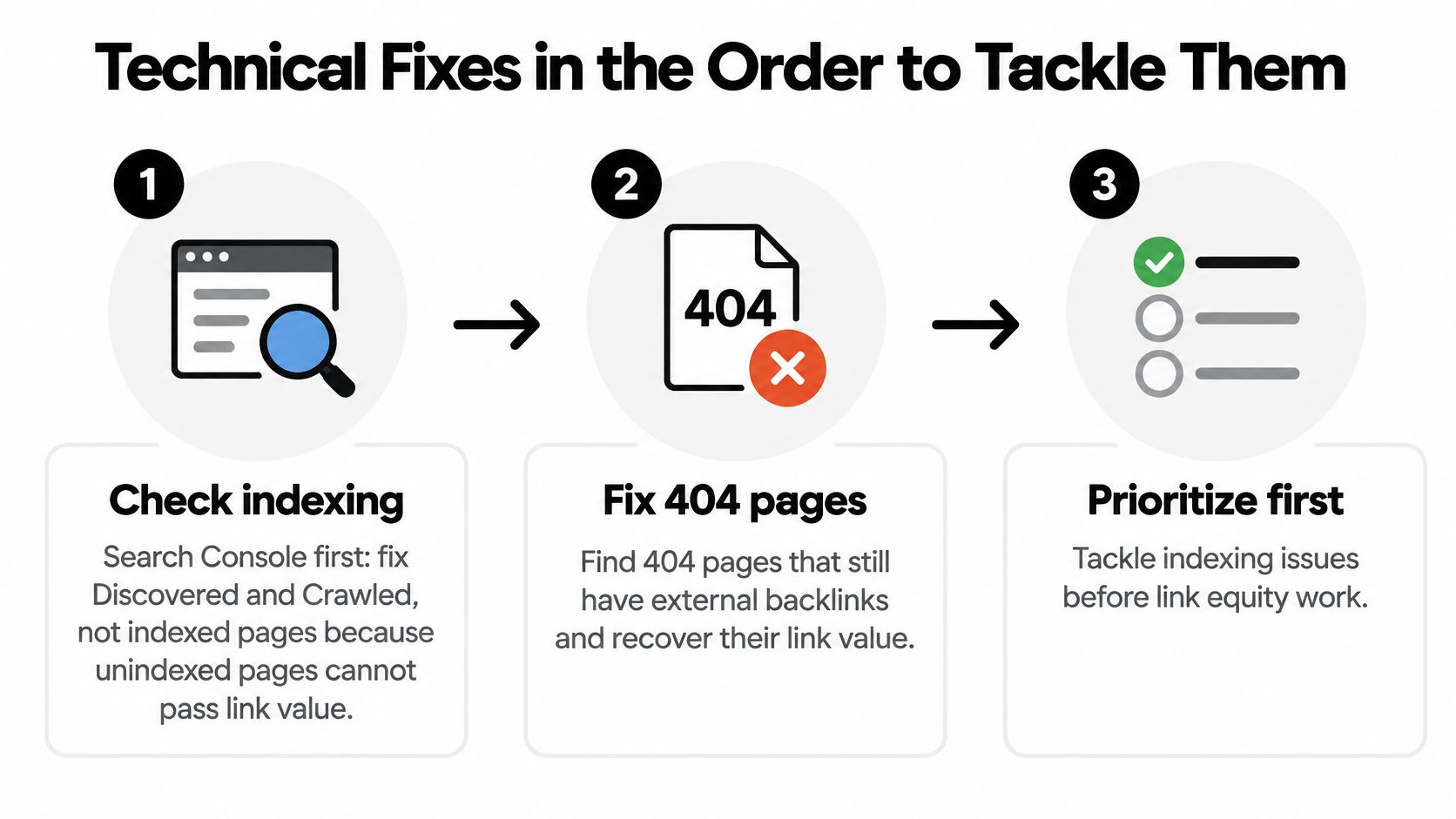
Use this sequence to prioritize the cleanup.
Restore access and recover useful destinations
Investigate indexing exclusions. Inspect important URLs marked Discovered or Crawled, not indexed in Search Console, checking access, canonical selection, internal discovery, and content usefulness. Don't assume every excluded page should be indexed, or that repeatedly requesting indexing fixes the underlying problem.
Recover externally linked 404 pages. Find broken destinations in Ahrefs or Moz, then restore valuable content or use a permanent redirect to the closest relevant live page. Sending every dead URL to the homepage can prevent you from preserving the original link's usefulness and relevance.
Flatten redirect chains. Update redirects and internal references so visitors and crawlers reach the final destination directly wherever possible. Extra hops add avoidable work and failure points, but don't assume every redirect automatically loses ranking value.
Repair broken internal links. Replace links to missing URLs with relevant live destinations, including links inside templates and older articles. A redirect may rescue the visit, but updating the original link is cleaner than relying on that rescue indefinitely.
Clarify the preferred pages
Resolve genuine duplicates. Choose the preferred URL for duplicate versions and align canonical tags, sitemap entries, and internal links with that choice. Don't canonicalize distinct pages merely because they discuss related topics; canonical tags aren't a substitute for a clear content strategy.
Connect orphan pages. Add useful links from a relevant hub or established article to important pages that have no internal route. Putting an orphan URL in the sitemap doesn't give readers a meaningful way to find it.
Confirm a consistent HTTPS host. Check that the site's preferred secure version is used consistently in redirects, canonicals, navigation, and sitemap entries. Watch for old templates that continue generating links to alternate versions.
Prioritize Core Web Vitals work by exposure. Start with the pages bringing the most traffic, inspect their field performance where available, and address oversized images, unstable layouts, and heavy scripts. Don't spend your whole maintenance window polishing an obscure page while a slow shared template affects your main acquisition pages.
For a manageable first pass, choose your twenty highest-traffic pages as the working speed-audit sample. That's a prioritization choice, not a technical threshold.
The SEO Agent's technical audit guide provides a checklist for organizing the fixes and their validation.
A completed ticket isn't proof of a completed fix. Test the live URL, its final response, and the internal links pointing to it.
Set a two-week review checkpoint. Re-crawl the site, verify that targeted redirect chains are gone, and check whether intended pages are becoming indexed, without assuming the total indexed-page count must rise if you also removed duplicates.
Content and Internal Links That Earn References
Fewer, stronger pages are a better investment than a large inventory of thin articles. A page needs a reason to exist beyond targeting another variation of a keyword.
Google's people-first content guidance emphasizes reliable information created for people, including clear sourcing, demonstrable expertise, and a satisfying experience. Give readers something they can use and other writers something they can cite.
Choose an asset you can maintain
Link-earning asset types and their effort
The effort windows below are suggested planning allowances, not measured production averages. Narrow scope, access to evidence, and review requirements determine your actual schedule.
| Asset type | Why sites link to it | Typical effort | Example |
|---|---|---|---|
| Original survey or data study | Journalists and blogs need a citable number | High, requires collection and methodology review | Hypothetical survey of 200 practitioners on a specific budget |
| Free calculator or template | Resource pages link to tools that save work | Medium, allow 1 to 3 weeks | ROI or cost calculator for your niche |
| Definitive guide with sources | Reference pages and course lists need complete explainers | Medium, allow 2 to 4 weeks | Full guide with cited statistics |
| Expert teardown or benchmark | Comparison writers need fair, measured reviews | Low to medium, allow 1 to 2 weeks | Hypothetical benchmark of five tools on the same test |
| Glossary or data page | Writers need a stable, maintained reference | Low, scope an initial version under 1 week | Definitions page with dated figures |
Choose based on what you can substantiate. A calculator needs transparent assumptions and testing; a survey needs an honest methodology, not a dramatic headline built on an unsuitable sample.
For a small team, a narrow expert guide may be more defensible than an ambitious industry report. Publish the answer, explain the limitations, identify the author, and maintain the page when facts change.
Make internal links support the reader's next task
Build a hub-and-spoke structure around durable topics. The hub should lead readers to specific guides, while each guide links back when the broader overview is useful.
Use descriptive anchors in relevant body copy rather than relying on a footer list. Context helps readers understand why the destination matters; don't attach an invented numerical weighting advantage to contextual links.
A hypothetical 2,000-word guide linked from three established, related posts gives you a useful test. Monitor its long-tail queries over the following weeks, but don't promise a ranking deadline based on length or link count.
The SEO Agent's internal linking tool fits into this workflow alongside manual review of relevance and anchor wording.
When overlapping posts answer the same query without distinct value, consolidate their strongest material and redirect the retired URL appropriately. Become a citable specialist through original numbers, precise definitions, and explanations that make difficult decisions easier.
Scalable Link Building That Avoids Spam Penalties
Scale the prospecting and recordkeeping, not the pretense that every website needs your link. Editors need a reason to change their page.
An outreach email should make that reason easy to evaluate.

In Ahrefs' published outreach case study, 473 emails were delivered, 42 bounced, 83 recipients replied, and 27 sites linked, producing a 17.55% reply rate and 5.71% link-acquisition conversion rate. Using that case's conversion rate, 1,000 valid prospects would imply roughly 57 links before quality filtering, not a guaranteed campaign result.
Build a controlled outreach funnel
Define the audience and asset. Choose a specific readership and a resource that solves a problem for it. Broad business relevance isn't enough.
Build the prospect list. Use competitor-link reports, specialist publications, associations, and maintained resource pages. Record the exact page where your asset would help.
Qualify before contacting. Check topical fit, indexability, evidence of real search visibility, and editorial maintenance. Reject pages whose only apparent purpose is selling placements.
Personalize the reason. Point to a missing citation, outdated figure, broken resource, or unanswered question. Explain the improvement instead of praising the website generically.
Follow up respectfully. Plan one or two follow-ups, then stop if there's no interest. Keep suppression records so another teammate doesn't restart the same pitch.
Separate outcomes. Track delivered, bounced, replied, linked, and qualified links in distinct fields. A friendly response isn't a placement, and a placement isn't automatically useful.
Use a simple sheet before buying outreach software. If you can't explain why a prospect belongs in the sheet, automation will only make the campaign noisier.
For a complementary explanation of the process, use this video.
Keep the spam boundary explicit
Google's link-spam policy identifies manipulative practices including:
- Buying ranking credit, including exchanges of money, goods, or services.
- Requiring contractual links without allowing the publisher to qualify them.
- Excessive reciprocal linking arranged to manipulate rankings.
- Automated link services that manufacture placements.
- Paid guest posts or press releases with ranking-credit links or optimized anchors.
Paid or sponsored placements should carry rel="sponsored" or rel="nofollow" rather than be sold as ranking endorsements.
A legitimate guest contribution might explain inventory forecasting for a specialist retail publication, with a plain citation to a useful methodology page. The editor should control whether the reference belongs and how it's qualified.
If you're evaluating backlink support from The SEO Agent, apply the same relevance and outcome checks. Outsourcing execution doesn't remove the need to judge the destinations.
Common Pitfalls That Waste Authority Work
The costly mistakes usually start with the wrong acceptance criteria. A team buys a deliverable that's easy to count, then discovers it has little connection to the searches or customers that matter.
Replace activity targets with quality checks
- Chasing the score. An unrelated placement can satisfy a reporting target without helping your intended audience; require a clear topical reason before approving it.
- Using blanket homepage redirects. A convenient redirect map can send visitors somewhere unhelpful; match the retired page's purpose to the nearest useful destination.
- Publishing interchangeable pages. Separate URLs don't create separate value; consolidate overlapping answers and retain distinct use cases.
- Counting replies as wins. Positive correspondence isn't an acquired reference; keep communication outcomes separate from verified placements.
- Reporting only total backlinks. Repeated links from the same sources can obscure limited reach; review distinct referring domains, linking-page strength, and audience fit.
- Prescribing identical anchors. A campaign-wide keyword formula removes editorial judgment; let wording reflect the sentence and destination naturally.
- Paying for ranking credit. A placement invoice doesn't establish editorial merit; treat paid exposure as advertising and qualify its links appropriately.
Stop buying duplicate capabilities
Choose a primary tool for each job. You need search performance reporting, a crawl view, backlink analysis, and an outreach log, not every suite that includes those features.
Moz's Link Explorer overview describes a model that evaluates link characteristics and linking-domain quality rather than treating all backlinks as interchangeable. Your review process should be equally selective.
Budget test: If a task can't be connected to a useful destination, a relevant audience, or a measurable acquisition outcome, defer it.
Keep the operational distinction clear: technical repairs protect access, content improves the answer, and outreach introduces that answer to potential references. Don't let a vendor package blur those jobs into an unexplained promise of authority.
Measuring Progress and Your First 30 Days
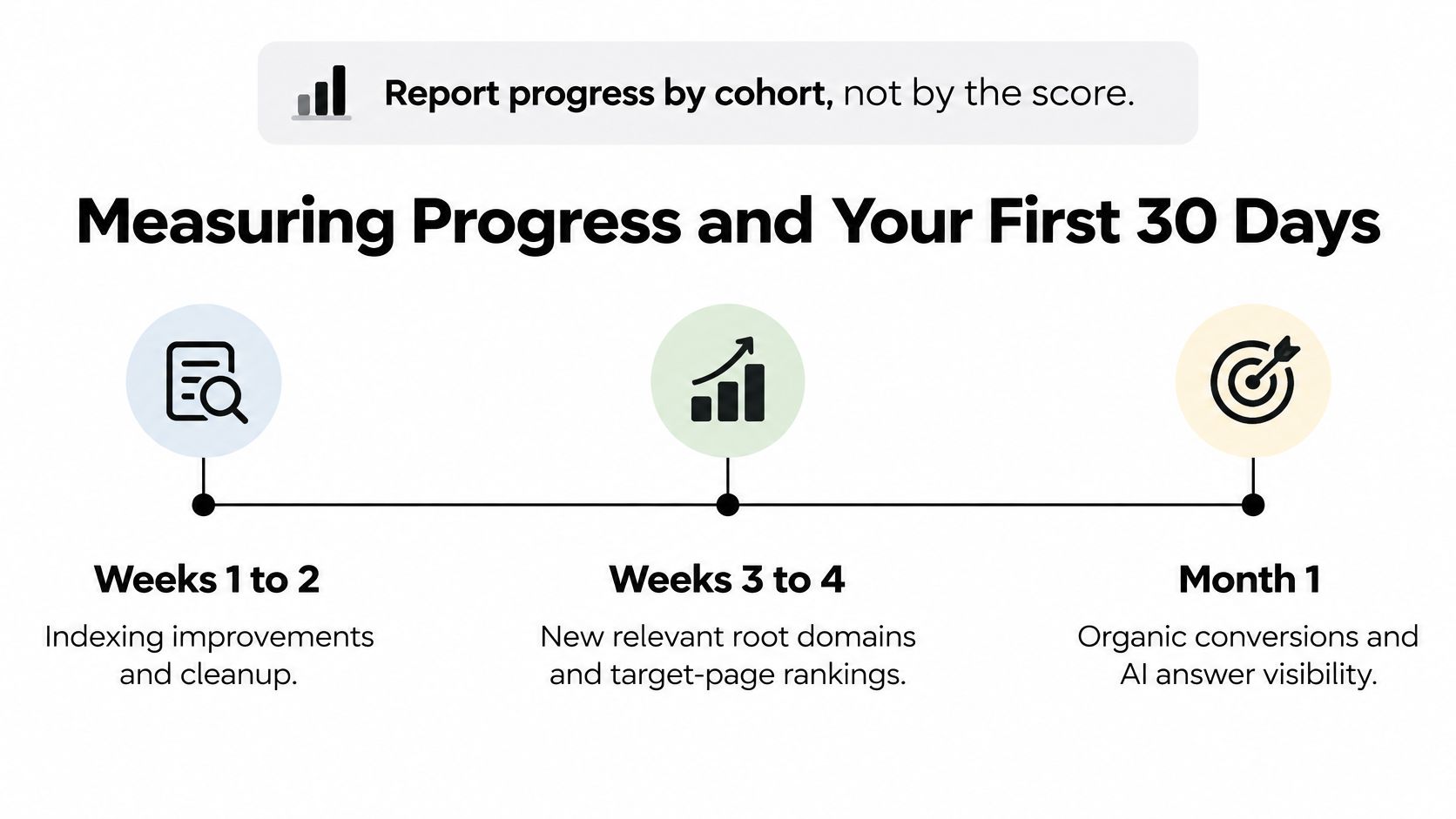
Report progress by cohort, not by the score. Group acquired references by the period they went live and the target pages they support, then track relevant root domains, rankings, qualified organic visits, conversions, and assisted revenue.
In its 2025 analysis, Ahrefs reported a correlation with ranking position of 0.131 for Domain Rating, compared with 0.255 for referring domains and 0.248 for backlinks. Those are correlations, not expected lifts, and Domain Rating is a different proprietary metric from Moz's DA.
Use timelines as review windows
Expected timeline for authority gains
| Window | What usually changes | What to check |
|---|---|---|
| Weeks 1 to 2 | Fixed pages get crawled; new pages are usually indexed within days | Indexed-page status and crawl errors |
| Months 1 to 3 | First referring domains may appear; DA may move only slightly | New relevant root domains and referral traffic |
| Months 3 to 6 | Meaningful movement on competitive terms becomes more plausible | Target-query positions and organic clicks |
| Months 6 to 12 | Maintained assets can attract further references | Cohort conversions, retained links, and brand mentions |
These are planning windows, not service-level commitments. New pages are usually indexed within days, while meaningful ranking movement on competitive terms takes three to six months; neither happens automatically because a calendar window has passed.
Answer-engine citations follow indexing and usually take weeks rather than days, depending on the domain's existing authority. Track AI answer visibility as an observation, not as proof that a particular backlink caused a citation.
Use the graphic as a schedule for beginning measurement, not as a promise that every outcome will appear in the opening month.
Maintain a monthly cohort sheet and refresh competitors quarterly. Count a link in the qualified acquisition cohort only after verifying that it's live, on an indexed and topically relevant page; record link qualification and actual referral visits separately.
For forecasting, SEO projections with The SEO Agent can help structure assumptions without turning them into guarantees.
Your dated first-month checklist
Enter a real start date and assign an owner to each action. The schedule below is a practical work plan, not a prediction of results.
- Week 1, baseline. Record your metrics and those of three query competitors. Save dated exports and select the pages whose traffic could produce qualified inquiries or sales.
- Week 2, repairs. Resolve important indexing issues and recover externally linked broken URLs through restoration or relevant redirects. Verify the live implementation.
- Week 3, assets. Produce a narrowly scoped, link-worthy resource and consolidate two thin pages competing for the same query. Add useful internal routes to the retained page.
- Week 4, outreach. Build a 100-prospect working list, verify fit, and send the first personalized batch. Log delivery, replies, placements, and qualified outcomes separately.
If rankings and qualified traffic improve, continue while checking conversion quality. If only the authority score improves, inspect topical relevance, search intent, page quality, internal linking, and query difficulty before acquiring more links.
No specific SEO outcome is guaranteed. Judge the work against your recorded baseline, not against the most optimistic campaign example.
The SEO Agent combines site analysis, source-checked content, internal linking, and CMS publishing with optional done-for-you backlink support. Connect your domain and CMS, the only onboarding step that requires you, to start building a plan around competitive gaps rather than an arbitrary authority score.