How to Find Low Competition Keywords That Actually Rank
Learn how to find low competition keywords with proven workflows, SERP signals, and validation tactics that turn research into real rankings.
The most popular advice on how to find low competition keywords is also the easiest to misuse: filter a keyword tool by a low difficulty score, then write. That score can help you build a shortlist, but it can't tell you whether the results match the search, whether Google's AI features answer it without a click, or whether your site can create something better than what already ranks.
The decision that matters happens on the search results page. Check what ranks, why it ranks, and whether the query can still earn a useful visit. A keyword is only an opportunity when you can realistically win attention, not just appear somewhere on page one.
Table of Contents
- Why Difficulty Scores Get This Wrong
- Building a Candidate Pool From Real Search Language
- What Keyword Difficulty Measures
- Reading the SERP for Real Competition Signals
- Zero-Volume Keywords and AI Overview Survivability
- Validating Performance Before You Double Down
- Pitfalls and a One-Screen Checklist
Why Difficulty Scores Get This Wrong
A low keyword difficulty score isn't a competition diagnosis. It's a tool's estimate, often weighted toward the backlink profiles of pages already ranking. That can miss the details that determine whether your page has a credible chance: how well the current results satisfy the query, whether their information is fresh, whether they offer first-hand evidence, and how much space search features take from conventional listings.
That's why “find a KD below 20” is a weak strategy. Two keywords with similar scores can have very different prospects. One may have an outdated page and several results that answer the wrong question. Another may be dominated by highly relevant, well-linked pages, even if the score looks inviting.
Use a SERP-first process
Generate candidates from customer language and existing site data. Then inspect the search results for intent, content quality, freshness, and link strength. Finally, validate promising topics against actual performance and business value. This order keeps a tool score in its proper role: a screening signal, not a verdict.
AI Overviews add another check. A query may be easy to rank for in the traditional results, but still have little value if Google answers it directly above them. The useful question isn't just “Can we rank?” It's “Can we earn attention if we do?”
For another practical approach to uncover low-competition search terms, start with the language people use and treat difficulty scores as one input. The SERP, not the number in a dashboard, decides whether the opportunity is real.
Building a Candidate Pool From Real Search Language
A keyword list built from tool exports is a list of what competitors already chase. Start somewhere harder to copy: the words customers use. Sales calls, support tickets, onboarding questions, and product usage all contain the exact phrasing people bring to Google. Capture that wording before anyone polishes it into marketing language.
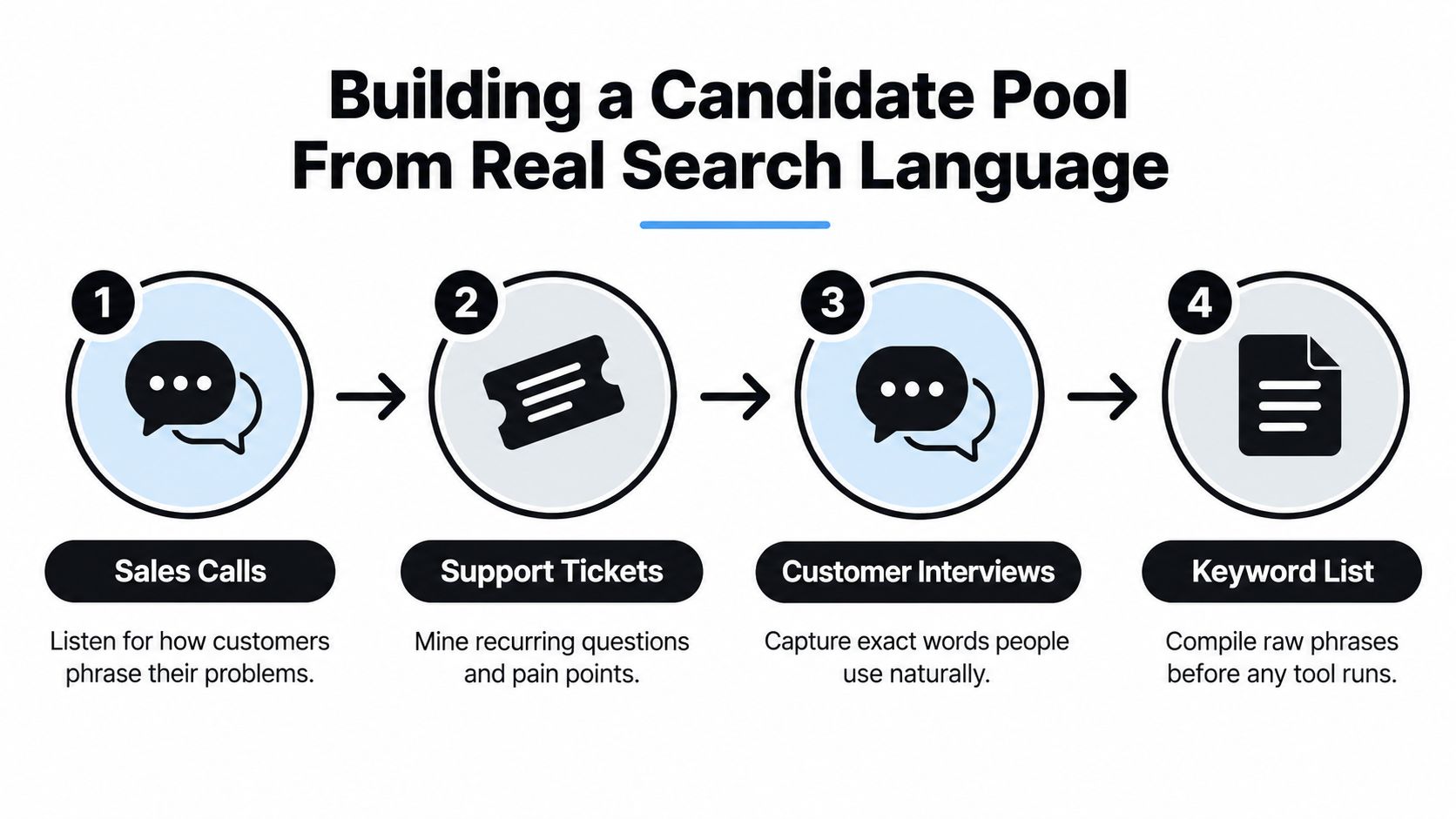
Then widen the pool with Google autocomplete, People Also Ask, and competitor topic gaps. Pull your Search Console queries too, and flag the questions your current pages only partially answer. These are not guaranteed wins. They are queries where Google has already associated your site with the topic, which shortens the credibility gap a new page has to cross.
Keep related phrases together
Group candidates by the job the searcher wants done. An informational "how does X work" should not automatically share a page with a "best X vendors" comparison. If the top results differ in format or purpose, treat the phrases as separate intent clusters and inspect each on its own. This is the step that turns a pile of terms into a set of SERPs you can judge for survivability.
Do not drop a phrase because a tool reports zero volume. Most tools estimate demand from historical data, so emerging questions and low-frequency B2B searches can show "0" before enough observations accumulate. Treat a zero as a prompt to look at the SERP, not as a verdict.
Before a candidate advances, log four things: the natural wording, the intended audience, the likely page type, and the related questions it could share a page with. If you are turning customer language into future briefs, keyword research for content repurposing can help connect research to existing content. For a running list of topic prompts, blog post ideas from The SEO Agent keeps the pool stocked between research sessions.
What Keyword Difficulty Measures
Keyword difficulty is a comparative estimate produced by an SEO tool. Google publishes no such metric. Use it to sort a candidate list, nothing more. It cannot tell you whether your page will satisfy intent or beat what already ranks.
Semrush expresses its score as a percentage and builds it mainly from the backlink profiles of pages in the top results, with smaller inputs from query-level factors like search volume and SERP features. Ahrefs weights link-related signals too, and its own guidance pushes users toward manual review of relevance, depth, freshness, and authority. Both vendors tell you the same thing in their documentation: the number is a first-pass filter, never a verdict.
Here is what the score misses. A keyword can look easy because the ranking pages have weak link profiles, while those same pages match intent perfectly and show genuine expertise. The reverse happens just as often: an intimidating score can hide a results page full of stale, thin content answering a slightly different question. The bigger blind spot is newer. When an AI Overview absorbs the informational intent on a query, a top ranking delivers a fraction of the clicks the old model assumed. These scores were calibrated for a SERP of blue links. Survivability is a different question entirely.
Google's systems rely on many signals, including link analysis and PageRank, to assess how pages connect and what they cover (Google's ranking systems guide). Its documentation reinforces that no single factor decides placement (Google's spam policies and search essentials). No tool compresses that into one number.
My rule: let the score break ties between candidates you have already judged on the results page. If you want to connect keyword research with content planning, The SEO Agent is one platform that researches topics and helps route opportunities into a publishing workflow. Whatever tool you use, the manual check stays.
Reading the SERP for Real Competition Signals
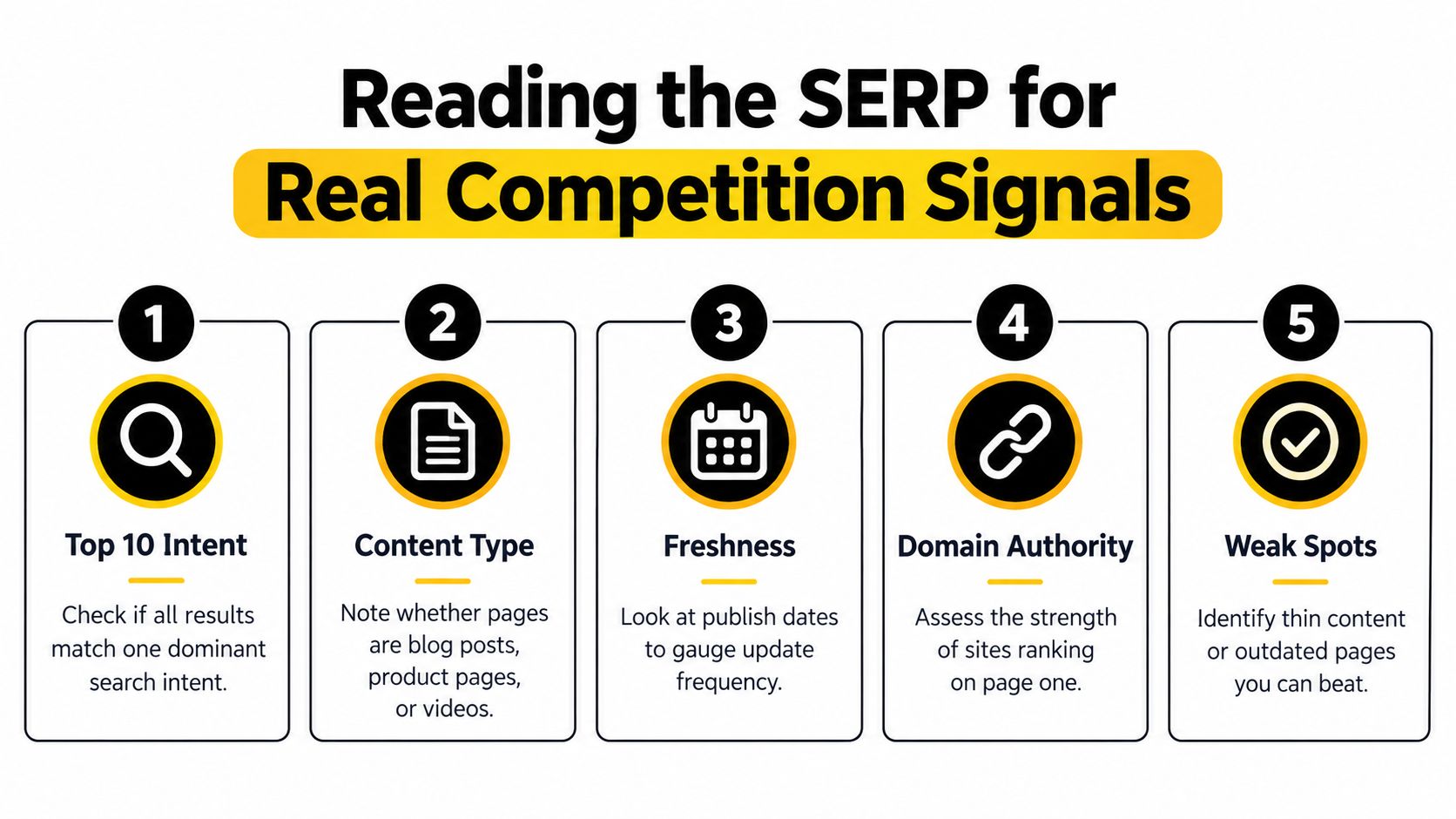
The top results are the evidence. Search each candidate in its target country and on the device your audience uses, then study the pages that rank. Don't stop at the titles or a keyword score. Open the pages and judge whether they meet the searcher's need.
A five-point audit
Intent: Do the results answer one dominant kind of question, or are informational and commercial pages mixed together? If the search results mostly show product pages, a general blog article is probably the wrong format.
Content type: Note whether the leaders are guides, product pages, comparisons, videos, or local listings. Match the format that serves the query, then look for a more useful angle within it.
Freshness and depth: Check whether the pages are current and whether they cover the necessary subtopics. An old page isn't automatically beatable, and a long page isn't automatically good. Look for gaps that would leave a searcher needing another result.
First-hand evidence: See whether pages show original experience, examples, or practical detail. If every result repeats generic advice, a page with specific expertise may have a defensible advantage.
Referring domains: Review the link profiles of the top pages. A weak link profile can help, but it doesn't override a strong intent match or authoritative content. Record the evidence rather than relying on a vague impression.
Google Trends can help you assess direction and seasonality. Google describes it as a random sample of aggregated, anonymized, categorized Google and YouTube searches. Compare a broad topic with specific variants, check country or city demand, and inspect both shorter and longer trend lines. Trends' “Rising” related terms can reveal queries that are less known and potentially less competitive, but Trends doesn't provide absolute monthly search volume, so use it for discovery and direction, not as a standalone difficulty measure (Google Trends guidance).
Write your findings into a simple sheet: intent, page type, freshness, coverage gaps, first-hand evidence, and referring-domain strength. If you can't name a real weakness in the current results, don't call the keyword low competition just because a tool says so.
Watch this walkthrough as you practice reading the results page:
Zero-Volume Keywords and AI Overview Survivability
A zero-volume label usually means the tool hasn't observed enough historical demand, which happens constantly with emerging questions and specialized B2B phrasing. It does not mean you've found a hidden traffic vein. In Ahrefs' testing, the overwhelming majority of low- and zero-volume keywords produced almost no impressions, so treat the upside as modest until the cluster proves itself.
The smarter play is to validate a cluster rather than bet on a single phrase. Ask whether the topic fits your audience, whether real searchers would find the current results relevant, and whether one page can answer the cluster's questions well. A small cluster with product-use or commercial intent can outperform a high-volume term where you have nothing distinctive to add.

Ask whether the query still earns a click
AI Overviews have changed what "easy to rank for" means. If a query can be resolved by a short factual summary, Google will often answer it before the organic results get a chance. Ranking first on a query nobody clicks through is a vanity position.
Classify each candidate: factual question, procedure, diagnosis, or evidence-dependent decision. Prioritize queries where your comparisons, calculations, implementation details, or industry context change what the searcher does next. Those are the pages that still earn the visit.
Google confirms that AI Overviews and AI Mode run on foundational SEO practices: crawlability, indexability, internal links, page experience, and helpful, reliable content, with no special optimization required for these features (Google's guidance on AI features). For the tactical side of structuring pages for AI surfaces, see The SEO Agent's AI overview guide.
Validating Performance Before You Double Down
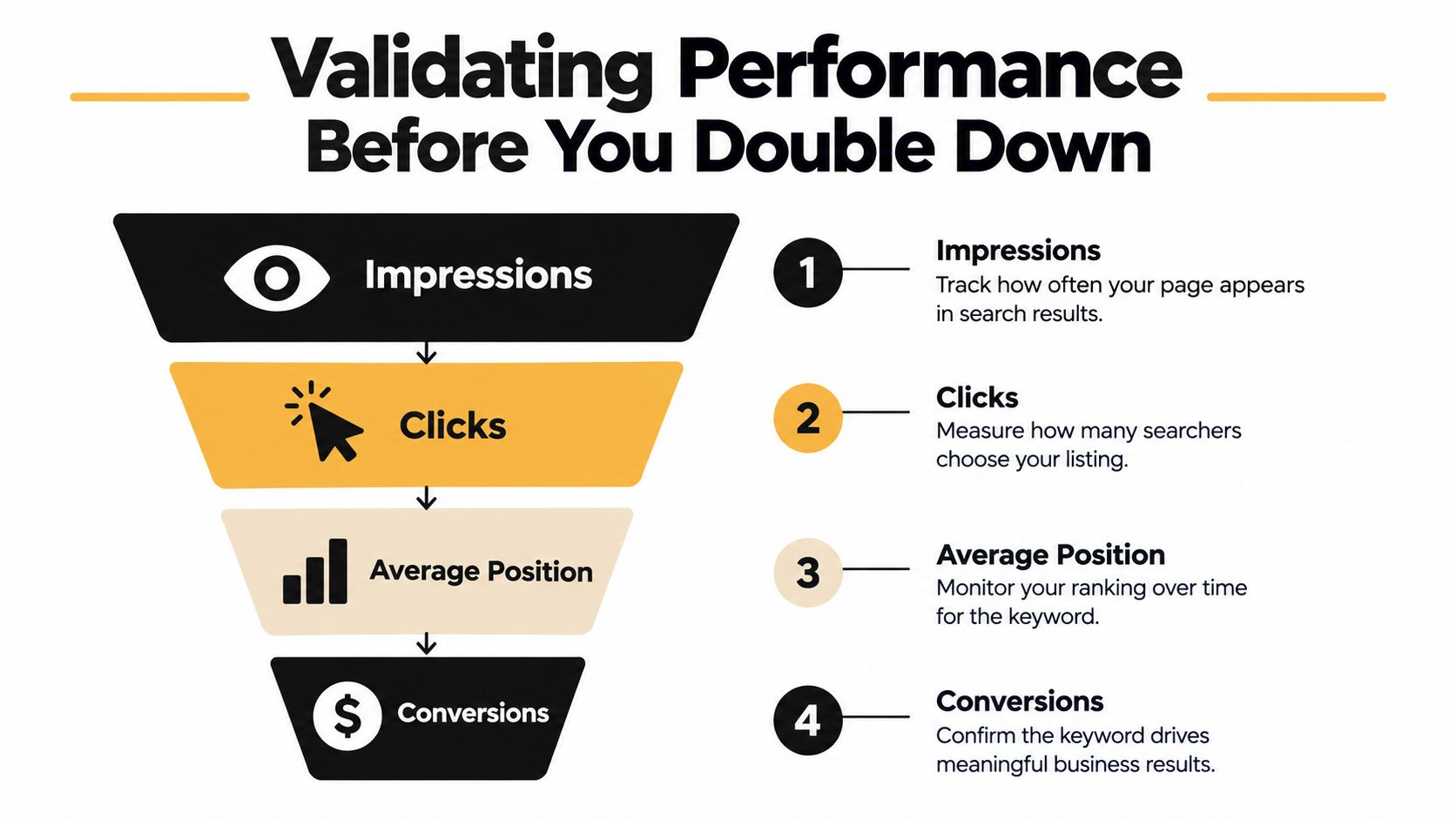
Before publishing, record a baseline for the relevant page or topic in Search Console and your analytics platform. Track impressions, clicks, average position, and conversions. Without that starting point, you can't distinguish a real improvement from a change in demand or a shift in the search results.
Map one page to one dominant intent. Before creating anything new, check whether an existing URL already targets the same query cluster. Two overlapping pages can compete with each other instead of strengthening your coverage.
Make the page useful first. Google recommends helpful, reliable, people-first content, and its spam policies prohibit keyword stuffing. Use the searcher's natural wording in prominent places, such as the title and main heading, then link the page from relevant existing content. Don't repeat the exact phrase mechanically or create near-duplicate pages for minor wording variations.
Read the signals, then act
A large-scale analysis of roughly 4 million Google results found that the first organic result receives an average 27.6% of clicks, while positions eight through ten have nearly identical click-through rates. Reaching the bottom of page one may bring limited incremental traffic, so judge progress by qualified visits and business outcomes, not a ranking screenshot alone (the CTR analysis).
If impressions rise but clicks or conversions don't, check the title, SERP alignment, and whether the query is being answered above the organic listings. If a page gets impressions but fails to meet the searcher's need, improve or consolidate it rather than producing another page for a near-identical term. For a broader framework to track content performance effectively, connect visibility measures to outcomes that matter to the business. You can also compare free rank trackers when choosing how to monitor rankings.
Pitfalls and a One-Screen Checklist
Low difficulty can still be a bad target. Before you approve a page, run through the failure modes that waste lean teams' time:
- Cannibalization: Check whether an existing page already serves the same intent. Update or consolidate before creating another URL.
- Mixed intent: Don't combine an informational explainer and a buying comparison into one unfocused page. Match the dominant intent.
- Missing modifiers: Check country, language, location, audience, and product context. A broad query may hide a more relevant local or industry-specific need.
- Low volume mistaken for low competition: Review the SERP and adjacent questions. A small estimate doesn't prove the results are weak.
- Mechanical repetition: Write naturally. Google identifies unnatural keyword or number repetition as keyword stuffing in its Search Essentials guidance.
- No internal path: Link the new page from relevant, crawlable pages so both readers and crawlers can discover it.
Before publishing, confirm that you know the searcher's intent, have chosen the right page type, can name a genuine weakness in the current results, and can offer useful evidence or detail the ranking pages lack. Then define what you'll measure and what would prompt an update. A practical automated SEO checklist can help teams make those checks repeatable.
Candidate generation beats guessing. SERP inspection beats tool labels. Measurement beats opinions. Use that standard for every page, and you'll spend less time chasing attractive scores and more time building content that can earn qualified attention.
The SEO Agent researches keyword opportunities using search-demand data and SERP audits, then helps lean teams turn selected topics into cited articles, internal links, and scheduled publishing. If you want to move from keyword shortlist to publishable content in one workflow, visit The SEO Agent.