HARO Help a Reporter: How to Get Quoted in 2026
Learn how HARO Help a Reporter works for sources and journalists, with sign-up steps, pitch templates, timing tips and alternatives for 2026.
You've found a journalist's request that sounds made for your business. You could answer it between meetings, but you're wondering whether anyone will read your reply, whether a quote will include a link, and whether HARO is even the same service you remember. Those are sensible questions. The useful approach isn't to send more pitches, it's to understand the current service and make each response worth a reporter's time.
Table of Contents
- What HARO Is and Where It Stands in 2026
- How Reporters Choose Which Replies to Use
- Digest Times, Deadlines and Follow-Up
- How to Sign Up and Answer Your First Query
- Pitch Templates That Earn a Reply
- Mistakes That Get Sources Ignored
- Measure Results and Decide If HARO Fits Your Team
What HARO Is and Where It Stands in 2026
HARO, or Help a Reporter Out, matches journalists seeking expert commentary with sources who can provide it. A journalist gets potential answers for a story; a founder, specialist, or business owner gets a chance at media coverage. A response is an opportunity, not a guarantee of publication or a link.
In 2026, Featured's company overview reported more than 150,000 registered sources and 75,000 journalists and bloggers. Those figures describe the platform's reported scale, not the odds of being quoted in any particular story.
HARO ownership timeline
| Year | Event |
|---|---|
| 2008 | HARO launches on its own website, HelpAReporter.com, on March 20, as documented by Mediabistro. |
| 2010 | Vocus, Inc. acquires HARO in June. |
| 2014 | Vocus merges with Cision. |
| 2024 | HARO is retired from Cision, and Connectively shuts down in December. |
| 2025 | The HARO brand returns under Featured, with an email service. |
The shutdown of Connectively and the return of HARO refer to different products and periods. Advice based on Connectively's closure does not establish that HARO remains unavailable. The revived brand also does not guarantee that account access, moderation, or commercial terms match earlier versions.
Check the current registration process and pricing before assuming access is free or an old subscription still applies. Verify sender details and current rules before replying. For a separate approach to earning visibility in AI search, The SEO Agent's AI search framework explains how articles can be formatted for AI Overviews, ChatGPT, and Perplexity. A media quote and search visibility are separate outcomes.
How Reporters Choose Which Replies to Use
A journalist isn't opening your reply to learn your company's story. They're trying to finish theirs.
HARO's description of its workflow explains that journalists submit a topic, required expertise, questions, and deadline; approved requests reach sources through weekday digests. Sources respond, and reporters evaluate those replies or request follow-up interviews. That process turns a broad search for specialists into a manageable, deadline-driven inbox.
Your pitch has to survive a quick editorial assessment:
- Expertise match: Does your actual work qualify you to answer this particular question?
- Immediate usefulness: Do the opening lines address what the reporter asked?
- Quotability: Is there a clear observation they can incorporate without untangling promotional language?
- Verification: Can they check your title, company, professional profile, or relevant published work?
Say a reporter wants an employment lawyer's interpretation of a contract clause. Being a founder who has signed employment contracts doesn't satisfy that request. But if the query asks how founders explain compensation to candidates, your operating experience could be directly relevant.
Practical rule: Write for the reporter's missing paragraph, not for your company's positioning document.
A specific answer with a limitation is often more usable than a sweeping claim. Explain what you'd do, why, and when that advice wouldn't apply. Don't spend the opening establishing how passionate you are.
Qualification also works in the other direction. HARO's submission guidelines prohibit guest-blogging requests, link exchanges, and backlink solicitation. Skip requests that resemble those arrangements rather than treating every apparent publishing opportunity as legitimate.
Relevance under time pressure beats submission volume. Send the answer you're qualified to give, not a lightly rewritten response to every adjacent topic.
Digest Times, Deadlines and Follow-Up
| Digest | Days | Scheduled time (Eastern Standard Time) | Best use |
|---|---|---|---|
| Morning digest | Monday to Friday | 5:35 a.m. | Scan first and flag queries that match your expertise |
| Midday digest | Monday to Friday | 12:35 p.m. | Draft replies while there is still time before deadlines |
| Evening digest | Monday to Friday | 5:35 p.m. | Send replies for next-day deadlines and queue follow-ups |
HARO's published source terms specify these three weekday delivery times, potentially 15 scheduled digests per standard working week, and direct sources to the anonymous @helpareporter.net address attached to each request.
Treat that as the published schedule, not a substitute for your current welcome email. Confirm delivery times after registration, and check the stated time zone rather than assuming Eastern Standard Time always means your local offset.
Turn delivery times into working slots
Scan the morning delivery first for newly arrived matches. Use a midday work slot to finish answers you can substantiate, and inspect evening requests for deadlines you can realistically meet the following day. Always read the individual deadline; an evening arrival doesn't automatically mean tomorrow.
A quiet digest isn't evidence that your account is broken. The number and relevance of requests can differ between deliveries.
Send a complete reply early enough to be useful. If follow-up is permitted and the story remains open, send a short note after a few days only when you have something new, such as a supporting document or clarification. Don't chase a closed deadline or contact the journalist elsewhere.
Use a fixed scan slot, a separate reply slot, and a Friday review of missed deadlines. SEO automation tools can support surrounding content work, but editorial responses still need a person who can verify the answer.
How to Sign Up and Answer Your First Query
Prepare your profile and evidence before trying to answer a live request. You don't want to spend the available response window searching for your own credentials.
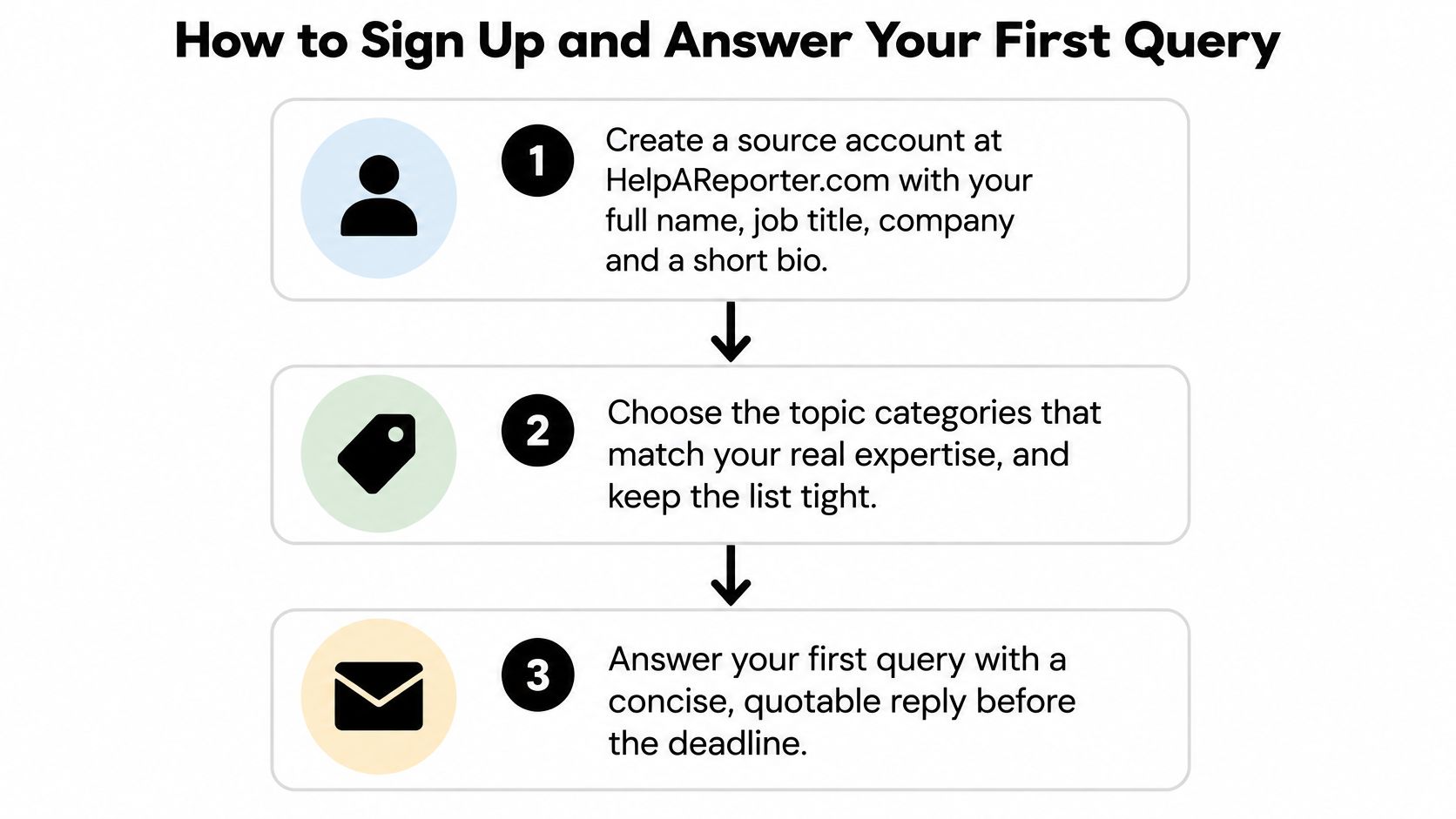
Set up, qualify, and send
Start at HelpAReporter.com. Follow the current source-registration process and supply your full name, job title, company, and a short professional biography. Use details a journalist can verify, not a list of aspirational specialties.
Choose relevant topics where category selection is offered. Keep your choices close to work you perform. Broad selections create more screening work without making you qualified for more stories.
Confirm your delivery address. Complete any email verification and check spam for the welcome message. Use an inbox you monitor during working hours rather than an account nobody owns.
Scan for expertise fit. Read request headings before opening every opportunity. A recognizable publication isn't a reason to answer a question outside your experience.
Read the complete request. Identify the outlet, deadline, requested credentials, and every question before drafting. Check whether you can obtain internal approval in time if you're speaking for an employer.
Write the answer before the biography. Address the first question immediately, then add a concrete example or a documented finding you're authorized to share. Finish with the credential that explains why your answer deserves consideration.
Use the request's designated reply address. Don't substitute a journalist's social account or personal inbox. Keep the response in the channel specified by the request and current platform rules.
Record what you sent. In Google Sheets or Notion, log the query identifier, outlet, deadline, angle, and response status. Save the actual reply so a colleague can handle a follow-up without reconstructing it.
Keep link acquisition separate from source participation. The SEO Agent's free backlink offers belong in a different evaluation from an editorial request; neither a pitch nor a quote entitles you to a backlink.
Before sending, apply a simple test: could the journalist paste your opening paragraph into a draft today? If it needs your biography to make sense, move the answer forward and cut the introduction.
Pitch Templates That Earn a Reply
A useful template controls the order of information. It shouldn't make every expert sound identical.
Use this sequence: topic and angle, direct answer, relevant credential, checkable evidence, availability, signature. Follow any subject-line or formatting instructions in the request before applying your preferred structure.
A fictional founder's hiring response
The following example illustrates wording, not a real founder's results or credentials:
Subject: Startup hiring, define ownership before choosing a title
Opening answer: An early-stage founder should define the decisions a new hire will own before writing the job title. Otherwise, candidates can agree to the title while imagining different responsibilities.
Credential: I'm Alex, founder of a software startup, and I lead our hiring process.
Evidence: For an operations role, I'd separate vendor approval, customer escalations, and process documentation in the job brief, then ask candidates which responsibilities they've owned directly.
Availability: I'm available for a follow-up conversation and can provide a bio or headshot on request.
Sign-off: Alex, founder, company name, professional profile.
The opening supplies the quote. The credential explains fit without dominating the response. The example makes the advice concrete without inventing a hiring metric. In a real pitch, replace every fictional detail and attach supporting material only when it's relevant and shareable.
Keep the substance human
In 2026, 35% of HARO journalists opted out of receiving pitches identified as fully AI-generated, according to Featured's analysis of more than 2,500 journalists, published by the Kemmerer Gazette. Editing assistance isn't a replacement for an expert's actual judgment, and you should respect any journalist's stated restrictions.
For an additional walkthrough, watch the accompanying video.
Could the reporter quote your answer without changing its meaning or removing sales language? If not, rewrite the opening sentences.
Mistakes That Get Sources Ignored
Fully generated pitches are a substantial part of the inbox problem. In 2026, 21% of approximately 1.4 million pitches evaluated through HARO were classified as fully AI-generated, according to data discussed by Brett Farmiloe in a HARO interview about media pitching and AI. That finding doesn't establish the most common reason for rejection, but it does show why interchangeable wording is a poor competitive strategy.
Check for these avoidable failures:
- Generic replies: Open with the answer to the query's first question.
- Off-topic pitches: Respond only when your credentials meet the requested expertise.
- Inflated credentials: Supply an accurate title, company, and checkable professional reference.
- Sales-led openings: Remove product promotion unless the journalist explicitly requests product information.
- Late submissions: Record the deadline before drafting and leave time for review.
- Machine-like filler: Cut sentences that could appear unchanged in another expert's pitch.
- Recycled answers: Rewrite the opening around the particular question rather than swapping topic words.
Don't confuse editorial work with link buying
A reporter may use your insight without linking to your site. Don't turn the response into a negotiation about anchor text or publication conditions.
If you separately browse done-for-you link building packages, evaluate that as a distinct activity. A journalist's request isn't permission to introduce a commercial placement arrangement.
Read the reply aloud. Remove anything that doesn't help the reporter understand, verify, or quote your answer.
Keep necessary caveats. Cutting fluff should make your answer clearer, not more absolute than the evidence allows.
Measure Results and Decide If HARO Fits Your Team
| Service | Share of respondents |
|---|---|
| Help a B2B Writer | 22% |
| Featured | 18% |
| Qwoted | 18% |
An Ahrefs poll of 101 respondents in May 2024, summarized in GavelGrow's HARO guide, found Help a B2B Writer used by 22% of respondents, with Featured and Qwoted each used by 18%. The poll offers a snapshot of channel use, not current market share or a measure of service quality.
Treat revived HARO, Qwoted, SourceBottle, Source of Sources, and regional services as potential channels in a broader outreach mix. Choose based on your expertise, the outlet's audience, geography, and deadlines. A locally relevant story may matter more to your business than coverage in a larger publication whose readers are unlikely to buy from you.
Track editorial outcomes
Use a spreadsheet to record the query, service, outlet, deadline, time spent, outcome, and published URL. Separate results into four categories:
- Qualified mentions: A published quote or citation relevant to your expertise.
- Linked citations: Coverage that includes a working link to your site.
- Referral activity: Visits and useful actions you can identify in analytics.
- Conversion efficiency: Replies submitted, quotes published, and staff time spent.
A quote without a link can still support your reputation. A link gives readers a path to your site, but it does not guarantee rankings. Silence is inconclusive: the reporter may have changed direction, chosen another source, or dropped the story.
For a separate view of search performance, see this SEO reporting sample from The SEO Agent. Keep search reporting distinct from pitch activity. A content workflow can support your site, but it cannot show whether HARO is producing editorial results.
Set a bounded test
Start with a few relevant categories, scan a manageable digest each working day, and reply only to strong matches. That keeps the time commitment under control while giving you a basis for comparison.
At a monthly review, keep channels producing qualified mentions or promising editorial conversations. Pause those that consume time without relevant outcomes. Allow for stories that have not yet published, but do not keep a channel because you have sent many replies.
HARO suits founders and specialists who can make clear, defensible observations quickly. It is a weaker fit when every answer needs lengthy approval or the spokesperson lacks distinct expertise.
Before relying on advice written during HARO's shutdown, check the current ownership, sender address, account terms, and delivery schedule. This week, choose one practical next step: complete your source profile, create a tracker, or answer a request you can improve.
The SEO Agent automates keyword research, source-checked drafting, internal linking, and native publishing, helping lean teams maintain their content while pursuing earned media. Visit The SEO Agent to explore its free trial and build a publishing workflow alongside your HARO outreach.