8 Examples of a Brief for Creative, SEO, and Content Work
See 8 real examples of a brief for creative, SEO, and content work, with templates, annotated notes, and tips to make each one ship-ready in 2026.
Poor briefs are a leading obstacle to effective campaigns. They list deliverables without settling the decision the work needs to support, leaving writers and designers to fill gaps once production has started.
The word itself gives you a clue. A legal brief is a formal written argument submitted to a court. The term comes from the Latin brevis, meaning “short,” according to the overview of a brief in law). Modern briefs still connect facts to an outcome, but the format now spans creative, SEO, content, and project work.
A brief is a low-cost place to resolve a content problem before production begins. The eight examples below are dissected field by field: each annotation explains why the field exists, what breaks when it is missing, and how a lean team can adapt it under deadline pressure. Borrow the strongest fields from each type. One repeatable system can align the work without requiring eight separate templates.
Table of Contents
- 1. SEO Content Brief
- 2. Creative Brief
- 3. Project Brief
- 4. Marketing Campaign Brief
- 5. Design Brief
- 6. Client Brief for Agencies
- 7. Product Brief
- 8. Video Production Brief
- How the eight brief types compare by purpose, standout field, and main risk
- Turn Your Next Brief Into a Repeatable System
1. SEO Content Brief
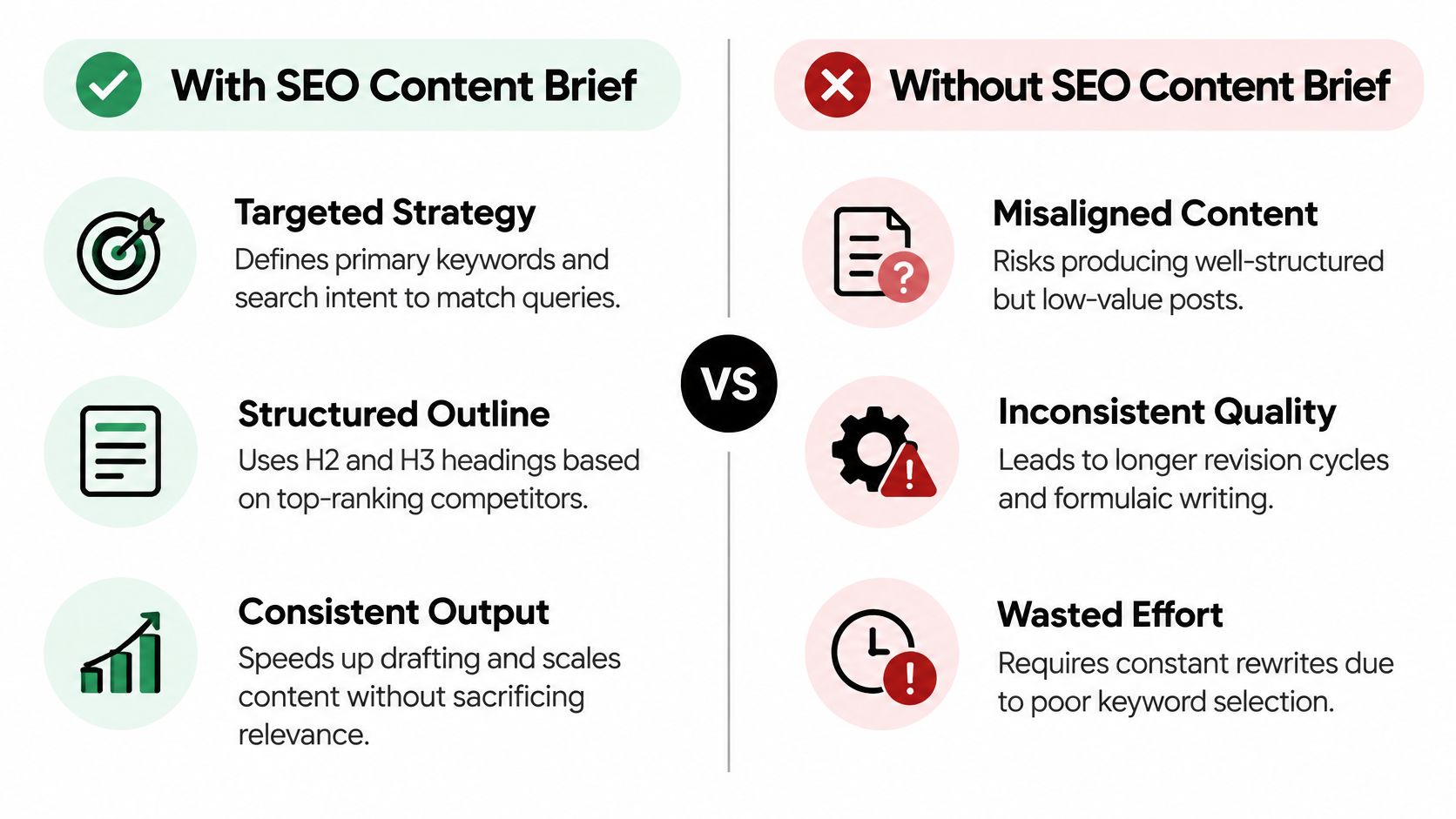
A useful SEO brief makes the writer's decisions explicit before drafting starts. Begin with one primary keyword, the search intent, and the task the reader needs to complete. Then shape the outline around that task, rather than choosing a format by habit.
For best project management tools for small teams, the brief might set comparison criteria, recommend H2s, and identify an internal link to a software category page. For how to write a product update email, it might call for a how-to structure and sourced guidance. The brief should name what each page needs to deliver, not prescribe the same outline for every keyword.
Fields That Do the Real Work
- Primary intent: Say whether the page should compare, instruct, or define. Without this, the writer may choose a format that misses the searcher's goal.
- Sourced outline: Use relevant subtopics from pages ranking for the query, then remove headings that do not help the reader complete their task.
- Evidence required: Flag claims that need citations, firsthand examples, or original data. Otherwise, writers may discover evidence gaps after the draft is complete.
- Internal links: Identify relevant pillar and conversion pages before writing. Adding links late can leave important pages disconnected.
- Quality threshold: Set a minimum originality or readability score. A clear threshold gives the team a reason to hold a weak draft instead of publishing it.
Google's guidance on AI optimization calls for content that is valuable, accurate, relevant, and not generic. The Google AI optimization guide also warns against creating separate pages for every query variation. Give each proposed page a distinct reason to exist, and cut sections that add no value.
For lean teams, The SEO Agent builds briefs from live keyword data as part of its research-to-publish pipeline, so these fields can be set before drafting starts. Apply the same discipline to partner work, including AI affiliate content with Riff Analytics. A focused brief gives the writer decisions to follow, not a generic prompt to interpret.
2. Creative Brief
A sneaker launch brief that says "make it exciting" isn't a brief. It's a wish. A usable creative brief gives the team one audience, one message, and the constraints that make ideas judgeable. Designers and copywriters can't prioritise if every stakeholder's message gets equal weight.
Take an advertising brief for a sneaker launch targeting urban runners aged 18 to 30. The single message is built for the city, and the required format is social-first video. A brand refresh brief for financial software would look different. Its message centres on trust and simplicity, with mandatory logo rules that can't be reinterpreted by the design team.

What Breaks Without Specifics
Canva's guidance recommends documenting audience demographics including age range, gender, location, socioeconomic status, and interests, and the Canva creative brief guidance also calls for the required assets and technical specifications. Skip that, and you get beautiful work in the wrong dimensions for the wrong people. Add the human insight behind the demographic, too, because data alone doesn't explain why anyone should care.
Adobe identifies timeline and budget as core components alongside audience, deliverables, and specifications in its Adobe creative brief guidance. Name the approvers and their roles. State the budget teams must observe. If approval authority stays implicit, revisions multiply and nobody can close a decision.
Practical rule: One primary message, one target audience, one accountable approver. If a field doesn't change a decision, cut it.
Define how success will be measured before creative begins, whether that's demo requests, qualified leads, or store visits. When you find AI tools for marketing copy, the brief still does the strategic work. Tools generate options. The brief decides which option wins.
3. Project Brief
A project brief is an early decision document, not a detailed plan. The UK government's project guidance defines it as an initial view of what the project must achieve, and the UK government guidelines for managing projects describe it as the basis for agreement before detailed planning. It authorises work to move forward. That's a higher bar than a summary.
Say you're briefing a website redesign for a Shopify store. The conversion goal, the six-week timeline, the fixed budget, and what won't be redesigned are all specified. An internal tooling example for automating weekly SEO reporting names the marketing lead as owner and lists the data sources involved. Both fit on one or two pages, so stakeholders read them.

The Fields Stakeholders Argue About Later
NHS Wales describes the brief as a concise tool explaining why and how a project will be conducted, and its NHS Wales project management tool lists objectives, scope, main deliverables, milestones, and schedule. Separate those fields. An outcome isn't a deliverable, and a deliverable without a dated milestone has no checkpoint.
Borrow from military writing when time is short. NATO's guide defines a brief as a report to share information or obtain direction, and the NATO Military English Guide recommends placing the main point and recommendations at the beginning. Put the decision first. Supporting detail follows.
List what's out of scope in plain language. Name a single decision owner for approvals. For content operations, that clarity helps when you build automated content workflows and new requests keep arriving. A lean team should add a change rule: anything outside scope needs owner approval and a revised date before work starts.
4. Marketing Campaign Brief
A campaign brief fails when it counts engagement and calls it impact. The brief must connect audience, channel, creative format, and the nearest credible business outcome. Every channel needs its own KPI, because a webinar, an ad, and a blog post don't do the same job.
Consider a B2B SaaS product launch. The brief combines LinkedIn ads, a webinar, and a nurture email sequence, with each tactic tied to demo sign-ups or a clear step toward them. A seasonal e-commerce brief for a Shopify store pairs email promotions and paid social retargeting with a blog post targeting gift-guide keywords. The content calendar is checked first, so messaging isn't duplicated across channels.

Build the Measurement Into the Brief
A documented agency framework recommends agreeing on measurable outcomes, recording starting metrics, and attaching a timeframe to every result, as set out in the PitchSite agency case study guide. Reject a brief that omits a baseline, owner, source of truth, or numerical success condition. Otherwise you'll report articles shipped and views earned without proving anything changed.
McDonald's Halloween influencer campaign shows why attribution matters. It generated 82,400 engagements and was associated with 540,000 incremental visits, a 23% increase in store traffic, according to Marketing Dive's campaign report. The decisive metric was offline visitation, not likes. Define the conversion event and reporting period before launch.
Set a midway review checkpoint to reallocate budget while it still matters. I recommend one optimisation loop in writing: which signal earns more spend, which signal triggers a rewrite, and who decides. Teams comparing SEO automation tools still need that human decision rule. Automation reports faster. It doesn't choose your KPI for you.
5. Design Brief
Designers don't need more adjectives. They need criteria they can make decisions against. A design brief translates a business goal into layout, typography, colour, imagery, and constraints, then gives reviewers a fair basis for judging the finished work. Without it, feedback becomes personal taste dressed up as strategy.
A landing page brief for a fintech startup might specify mobile-first layouts, WCAG AA contrast compliance, and a single primary call to action. A packaging brief for an e-commerce brand lists required dimensions, print specifications, and three competitor references to avoid. Notice the difference. One brief governs interaction and accessibility. The other governs physical production and shelf differentiation.
Learning From a Working Design Example
Watch how precise requirements narrow choices early and save revision rounds later.
Include at least three examples of designs you like, and annotate what works about each one. Say whether you're borrowing the hierarchy, the density, the type scale, or the restraint. "Clean like this site" forces the designer to guess which quality you mean.
- Accessibility requirements: State contrast, keyboard navigation, and text size needs up front, not during QA.
- Performance limits: Name image weight and loading expectations before layouts are approved.
- Revision rounds: Specify how many rounds are in scope and what counts as a new direction.
- Approval owner: Give one person authority to settle conflicting feedback.
A strong design brief protects the designer's freedom inside clear boundaries. Vague briefs don't create freedom. They create rework.
For a lean team, keep a must solve, must not change, and open for exploration section. That structure gives contractors permission to explore without reopening settled brand decisions.
6. Client Brief for Agencies
An agency client brief has a different enemy: inconsistent intake. One client sends a deck, another sends three bullet points, and the team prices both on guesswork. A standard client brief captures business goals, brand context, target customers, competitors, and expectations in comparable form. That's what makes scoping and pricing defensible.
An SEO agency brief for a Webflow client would capture current organic traffic, top converting pages, and three competitors to benchmark against. A content agency brief for a Shopify brand defines publishing frequency, approved topics, and the review process for each article. Both briefs answer the same underlying questions. What exists now? What outcome matters? Who approves?
The Alignment Protocol Most Templates Skip
Headings like objective, audience, timeline, budget, and deliverables aren't enough. Add the single measurable outcome, the one accountable decision-maker, explicit non-goals, and a sign-off checkpoint before production. Then state what wins when stakeholders disagree. If the KPI conflicts with a brand constraint, the brief should say which one governs.
Use a standard intake form so every client provides comparable information. Confirm the brief in writing before estimating timelines or costs. Review it at quarterly intervals because goals, audiences, and offers move, and an old brief becomes wrong.
When you streamline client blog publishing, keep the intake fields stable across accounts so performance can be compared fairly. The same discipline helps when you review business proposal formats compared before sending a proposal. A proposal built on a weak client brief just formalises the misunderstanding.
Change-control rule: Any request added after sign-off names an owner, a cost or timing impact, and what it replaces. Otherwise it's a suggestion, not scope.
7. Product Brief
Start a product brief with the problem, not the feature. A feature-first brief lets engineering, design, and marketing build three different products from the same document. A problem-first brief gives them a shared test: does this choice reduce the user's friction in a measurable way?
Say a lean publishing team keeps missing deadlines because draft approvals sit in inboxes. The brief identifies publishing delays as the core problem and proposes a one-click draft approval flow for an AI-assisted content feature. A mobile checkout brief works the same way. It starts with drop-off evidence at the payment step, then defines the improvement and the success threshold.
Fields That Keep Teams Honest
- User problem: Describe the friction in the user's words, validated through real customer conversations.
- Target user: Name who's affected first and who isn't in scope for this release.
- Proposed solution: Keep it short enough that trade-offs stay visible.
- Success criteria: Define the measurable change before writing detailed requirements.
- Open questions: List unresolved decisions where everyone can see them.
The trade-off is speed versus certainty. A startup shouldn't wait for perfect evidence, but it also shouldn't hide unknowns under confident solution language. Mark assumptions clearly. Assign an owner and a date to test each one.
I recommend a blunt quality gate here. If the brief can't state the user, the problem, and the success metric in three sentences, the idea isn't ready for development. Send it back for customer conversations, not more feature detail. More pages won't fix a weak problem definition.
8. Video Production Brief
Video briefs break on logistics, not ideas. A strong concept filmed in the wrong aspect ratio for the wrong platform still fails. The brief must cover purpose, audience, message, format, length, style, and distribution before anyone writes a script or books a shoot.
A 60-second product explainer for a SaaS landing page might require a vertical version for social and a horizontal version for the website. A testimonial brief for a Wix-based service business lists three customer questions and a 90-second maximum length. Those limits aren't bureaucracy. They tell the editor what a finished asset looks like.
Specify Distribution Before Production
Name the platform and aspect ratio first. Then define the funnel stage, because an awareness clip and a product demo shouldn't share the same script structure. Provide an example video that matches the desired pacing and style, and say exactly what you're borrowing from it.
- Format and length: State runtime, orientation, and any cut-down versions required.
- Message: Limit the video to one claim the viewer should remember.
- Accessibility: Include captions and alt text requirements to support accessibility and search.
- Talent and approvals: Name who's on camera, who reviews the script, and who approves the final edit.
- Distribution: List each channel and the conversion action attached to it.
Borrow the measurement discipline from campaign briefs. Define the baseline, the publishing window, and the action that counts as success, whether that's demo starts, qualified leads, or completed views that lead to a click. For broader planning, Up North Media's video strategy guide is a useful companion on distribution decisions. Don't judge a testimonial by views alone. Judge it by whether the right viewer takes the next step.
How the eight brief types compare by purpose, standout field, and main risk
| Item | Best For | Standout Field | Main Risk |
|---|---|---|---|
| SEO Content Brief | Planning search-focused articles | SERP-based outline and keyword targeting | Can become formulaic or outdated |
| Creative Brief | Aligning teams on campaign or brand creative | Single key message with creative constraints | Vague goals can lead to unfocused work |
| Project Brief | Agreeing on project scope and goals before planning | High-level timeline, budget, and stakeholders | Gaps in scope may emerge later |
| Marketing Campaign Brief | Coordinating multichannel campaigns | KPIs tied to business outcomes | Teams may optimize for vanity metrics |
| Design Brief | Guiding visual design work | User goals paired with visual and technical requirements | Missing technical details can cause rework |
| Client Brief for Agencies | Onboarding clients and scoping agency work | Client goals, deliverables, budget, and approvals | Incomplete client information can delay work |
| Product Brief | Evaluating and aligning teams around a product idea | User problem and measurable success criteria | Unvalidated assumptions can misdirect development |
| Video Production Brief | Planning videos for specific audiences and platforms | Format, length, aspect ratio, and distribution guidance | Changing platform requirements can make details outdated |
Turn Your Next Brief Into a Repeatable System
Pick the one example above that matches your most frequent deliverable. Copy its fields into a template. Then add the three fields often omitted: a baseline, a numerical success condition, and a single owner for approvals. Those fields turn a creative request into an auditable production specification.
Keep the measurement definitions stable before and after publication. For SEO work, compare average position, impressions, clicks, click-through rate, assisted conversions, and qualified leads across equivalent windows. If revenue data isn't available, use directly observable proxy metrics such as sessions, leads, engagement, or branded-search volume. What matters is that the brief names the metric before the work ships, not after the results arrive.
Borrow Across Brief Types
- From legal and policy briefs: Put the recommended outcome first and support it with authoritative evidence.
- From project briefs: Separate outcome, scope, deliverables, milestones, and out-of-scope items.
- From creative briefs: Protect one message and one audience with a named approver and a real budget.
- From campaign briefs: Define the optimisation loop, attribution method, and midway decision checkpoint.
- From product briefs: State the user problem and success criteria before debating the solution.
That borrowing is the advantage of studying different examples of a brief side by side. An SEO brief gets stronger when it inherits a product brief's success criteria. A design brief gets stronger when it inherits a project brief's out-of-scope list. A client brief gets stronger when it inherits a policy brief's bottom-line-up-front structure.
Add an Alignment Gate
Before production, require one short sign-off. The accountable decision-maker confirms the measurable outcome, the prioritised audience insight, explicit non-goals, and the rule for resolving disagreement. I recommend writing that rule in the template itself. When the KPI, the audience, and a brand constraint conflict, the brief should already say which one wins. Adding more detail won't help if priorities stay hidden. Ruthless prioritisation beats a longer template every time.
Once the brief is fixed, the draft gets easier to check. Reviewers can test whether the work targets the agreed intent, cites the required claims, links to the right pages, and stays inside scope. For teams publishing SEO articles, The SEO Agent can support that workflow by building briefs from live keyword data, drafting with citations, checking claims, adding internal links, and publishing to your CMS. The process runs in five steps: research, plan, write, fact-check, and publish.
Start small this week. Take your next assignment, name one measurable outcome, record the baseline, list three non-goals, and set a quality threshold that can block publication. You'll spend a little more time before the first draft. You'll spend far less time rewriting work that was never aligned in the first place.
Turn your next brief from a loose request into a publishable plan with keyword research, source-checked drafting, internal linking, and native CMS publishing handled in one pipeline. Visit The SEO Agent to see how one keyword becomes a researched article built from a structured brief.