Buyer Persona Research: A Step-by-Step Guide for 2026
Buyer persona research step by step: set hypotheses, pull CRM data, run interviews, build segments, validate them and apply them to SEO content.

The most repeated advice on this topic is still to invent a named character, drop in a stock photo, and fill in age, hobbies, and a job title. That produces a poster, not a model you can be wrong about. Buyer persona research only pays off when each segment is a hypothesis you can falsify: a trigger, an objection, a proof need, and a metric that says the segment is still real.
Table of Contents
- Buyer Persona Research at a Glance
- Set Goals and Testable Hypotheses Before You Collect Data
- Pull Behavioral Data From Systems You Already Own
- Interview and Survey Buyers the Right Way
- Synthesize Interviews Into Segments and Persona Cards
- How to Validate Personas and Avoid Common Pitfalls
- Turn Personas Into Your Next Content and SEO Plan
Buyer Persona Research at a Glance
Buyer persona research is a documented, evidence-based model of who buys, what triggers the purchase, what they compare, and what makes them hesitate. It is not a biography and it is not a demographic summary.
The method started in software design, which is why interviews come before job titles. In the mid-1980s, Alan Cooper interviewed prospective users about goals, frustrations, and how they worked, rather than designing around features alone. The first documented persona, "Kathy," was created in 1985 as a representative archetype from those interviews, not as a real person, as the Persona Institut history of buyer personas records. Cooper later built "Cooper Chuck," "Cynthia," and "Rob" for Sagent Technologies in 1995, organized around tasks, goals, and skill. Marketing picked up related ideas in the early 1990s through Angus Jenkinson's "Customer Prints," then through jobs to be done (Tony Ulwick in 1991, later popularized by Clay Christensen in 2003). "Data-driven personas" entered the literature in doctoral work at Georgia Tech in 2006, and automatic generation systems arrived around 2016–2017. The through-line is observed needs and behavior, not fiction.
A lean team can run the cycle in six to eight weeks the first time. Validation then sends you back to goals.
| Phase | Output you keep | Typical time | Lead owner |
|---|---|---|---|
| Goals and hypotheses | Ranked decisions and testable hypotheses | 2-3 days | Marketing lead |
| Data audit | Map of CRM, analytics and support sources | 3-5 days | Ops or RevOps |
| Interviews | 12-15 coded interviews per segment | 3-4 weeks | Researcher or founder |
| Survey | Measured trigger and objection rates | 1-2 weeks | Marketing |
| Synthesis | 3-5 segments with persona cards | 1 week | Whole team |
| Validation | Pass or fail on each segment with a review date | Ongoing, quarterly | Marketing and sales |
Hold three to five evidence-backed segments, each with triggers, objections, proof needs, a validation metric, and a dated review. If a segment cannot fail, it is not research.
Set Goals and Testable Hypotheses Before You Collect Data
Quotes without a decision become a folder nobody opens. Start from the choices the persona has to change, then write a hypothesis you could kill.

Say a project management SaaS gets about 40 trial signups a week. The team wants better homepage copy, blog topics, onboarding, the pricing page, and sales qualification. Walk one hypothesis through the same five steps you will use for the rest.
- Name three to five decisions. Homepage messaging, which blog topics get a sprint, the first onboarding email, pricing-page proof, and who sales should qualify out. If a finding cannot change one of those, drop it.
- Write one hypothesis per decision. Form: we believe this segment buys because of a specific trigger and hesitates over a specific objection. For onboarding and the homepage: we believe operations leads start a trial after a missed launch date and hesitate because migration looks heavy.
- Add a disqualifier and a falsifier. Disqualifier: no launch calendar and no shared deadline with another team. Falsifier: most won deals in the sample name a tool switch with no deadline trigger. If that pattern shows up, the missed-launch story is wrong, even if it sounds sharp in a workshop.
- Rank by impact and by how cheap the test is. Homepage and qualification move revenue this quarter. Blog topics can wait. A falsifier you can check in closed-won notes beats one that needs a six-month brand study. The same ranking logic sits behind The SEO Agent's forecasting approach: bet on the claim you can measure soon.
- Set the sample frame before anyone is contacted. Deals from the last 12 to 18 months, the regions and roles in scope, and which stages count (closed-won, closed-lost, and churned, kept separate). Active trial users alone will flatter you.
Hypothesis register: Ops lead | trigger: missed launch | objection: migration effort | falsifier: won deals with no deadline | metric: share of won deals naming a date, reviewed quarterly.
Keep that one line in a shared doc. Update the status, not the prose.
Pull Behavioral Data From Systems You Already Own
The cheapest useful source is already in the CRM: lost-deal reason fields and the notes next to them. They are the buyer's words, or a close paraphrase, and they cost a filter, not a recruiting fee. Support tickets are the second pass for the same reason. Analytics and Search Console come after you know which phrases repeat. Product usage comes last among internal sources, because it only exists after signup.
| Source | What it tells you | Main blind spot | Effort |
|---|---|---|---|
| Web analytics (GA4) | Which pages and topics bring visitors who convert | Does not explain why visitors leave | Low: 1-2 days |
| CRM (HubSpot, Salesforce) | Won, lost and stalled deals with stated reasons | Reason fields are often left blank | Low to medium: 2-3 days |
| Search Console | Queries that show problems buyers are trying to solve | Shows the search, not the motive | Low: half a day |
| Support tickets and chat logs | Recurring objections in the buyer's own words | Skews toward existing customers | Medium: 3-5 days |
| Product usage data | Features adopted first and accounts that stall | Cannot explain intent before signup | Medium: needs a data team |
| Sales call notes and recordings | Triggers, budget and competing options | Filtered through the rep's view | Medium: about 1 week |
| Social listening (Reddit, LinkedIn, G2 reviews) | Unprompted language about pain points | Loud minority, hard to tie to segments | Low to medium: 2-4 days |
| Win-loss interviews | Full reconstruction of decisions | Slow and costly to recruit | High: 2-4 weeks |
Export routine and the privacy check
Before any export, run a consent and minimization check. Collect only attributes that would change a decision, drop any field you cannot justify, and record the source and consent basis for each one. In 2024, 68% of surveyed customer-data professionals increased spending on first-party-data strategies, according to Tealium's future of customer data briefing, so this audit is a standard step, not a nice extra.
Then pull twelve months of won, lost, and churned accounts. Tag each row with company size, role, the trigger mentioned, and the first feature used. Check fill rate on reason fields before you trust a segment. A column that is blank on most lost deals is not a pattern.
Behavioral rows show what people did. They do not show why. Every cluster should become an interview question, not a slide. When systems disagree, a CRM industry code against a survey answer, log the conflict and prefer the buyer's own words. Score each source for coverage and freshness before you book a single call. A keyword research and audit tool roundup helps with the query side, but it will not fill a blank loss reason.
Interview and Survey Buyers the Right Way
Talk to people who just made a choice, including the choice to do nothing. Then rebuild that choice in sequence. Your brand enters last, if at all.
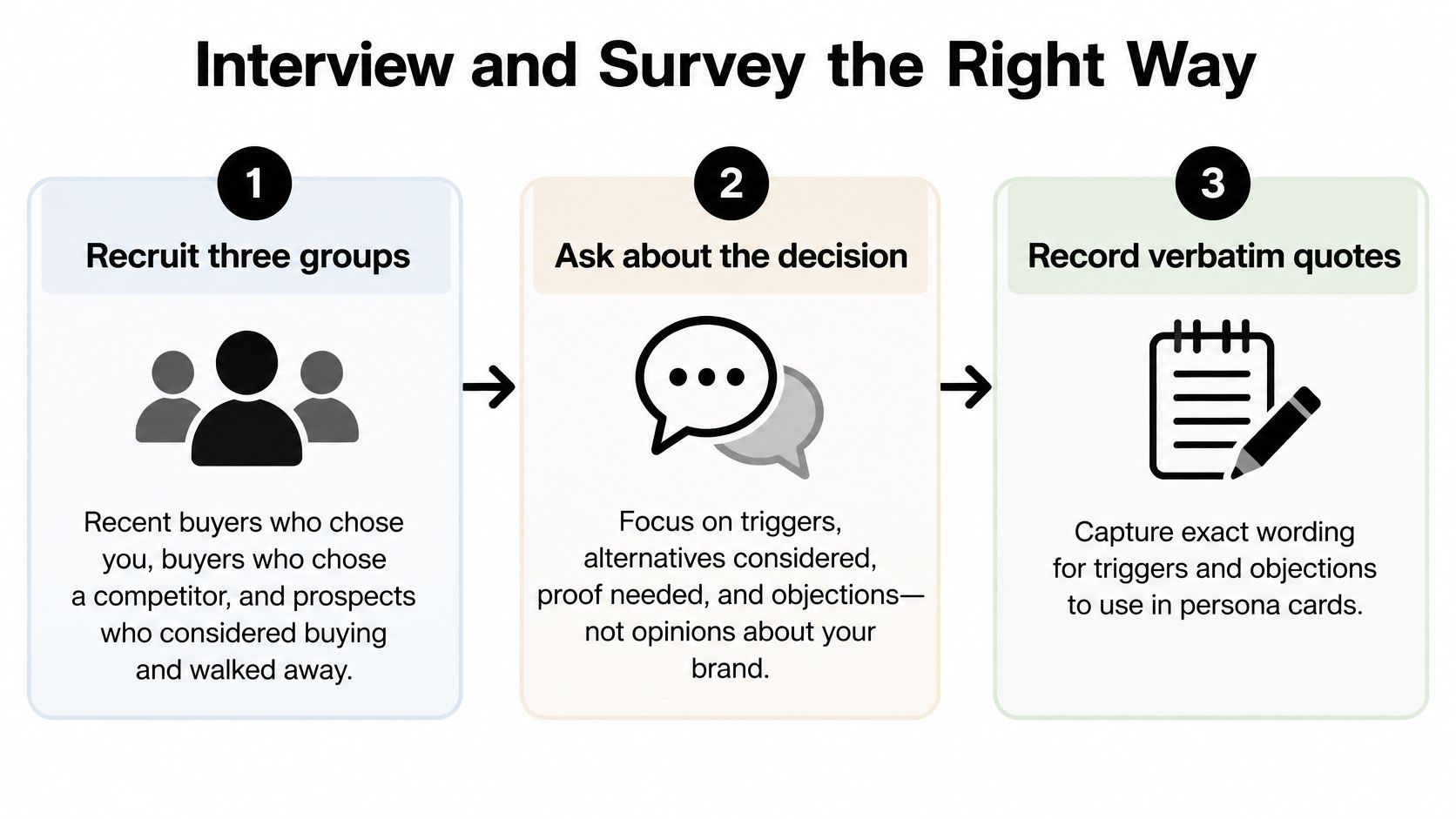
The costly error is modeling one decision-maker. Adweek's look at B2B's people problem notes that buying groups commonly include roughly 6–10 or more stakeholders, with another industry read closer to 10–12. A champion-only interview misses the economic buyer, the technical evaluator, the end user, and the blocker, and each of them can falsify a different part of your segment hypothesis.
- Recruit three groups from recent decisions. Buyers who chose you, buyers who chose a competitor, and prospects who considered the purchase and kept the status quo. Wins alone teach you your own pitch. The third group is the one teams skip, and it produces the cleanest falsifiers: people who had the trigger you predicted and still did nothing.
- Cover the buying group where you can. Aim for an economic buyer, a technical evaluator, an end user, and a blocker on the same deal, or across similar deals if one account will not open up.
- Rebuild the decision in time. When it became a priority, what triggered it, who joined, what got compared, and what finally tipped the choice. Fixed questionnaires flatten that sequence.
- Use questions that force a story. Ask, in these words: What was happening that made this a priority? What did you try before us? Who said no, and what were they worried about? What almost stopped you from signing? How did you make the case internally?
- Stop recruiting when themes repeat rather than when the calendar says so. Plan 12 to 15 coded interviews per segment, and add more only when roles or industries inside the segment clearly split. An answer that appears once is an anecdote, not evidence for a segment.
- Measure what the interviews found with a short survey. One published framework used stratified probabilistic sampling and collected 378 responses, 117 existing customers and 261 prospective customers, at a 95% confidence level and a 5% margin of error, after expert and managerial review of the questionnaire, as described in this MDPI study on persona measurement. The survey's job is measurement: it puts a frequency on patterns the interviews surfaced, and it can falsify a segment the calls seemed to support. Keep wording neutral. A leading scale will "confirm" the story you already like.
Code each answer into trigger, desired outcome, perceived risk, proof requirement, decision criteria, and disqualifier, then compare frequency by role. A persona built on one champion's memory is a hypothesis with a sample of one. The interviews widen the sample, and the survey is the validation metric that tells you whether the pattern holds beyond the people you could get on a call.
Watch this walkthrough of the same recruiting logic before you write the screener.
Synthesize Interviews Into Segments and Persona Cards
Raw notes stay raw until the same codes show up on won deals, lost deals, and churns. Count first. Name a segment second.
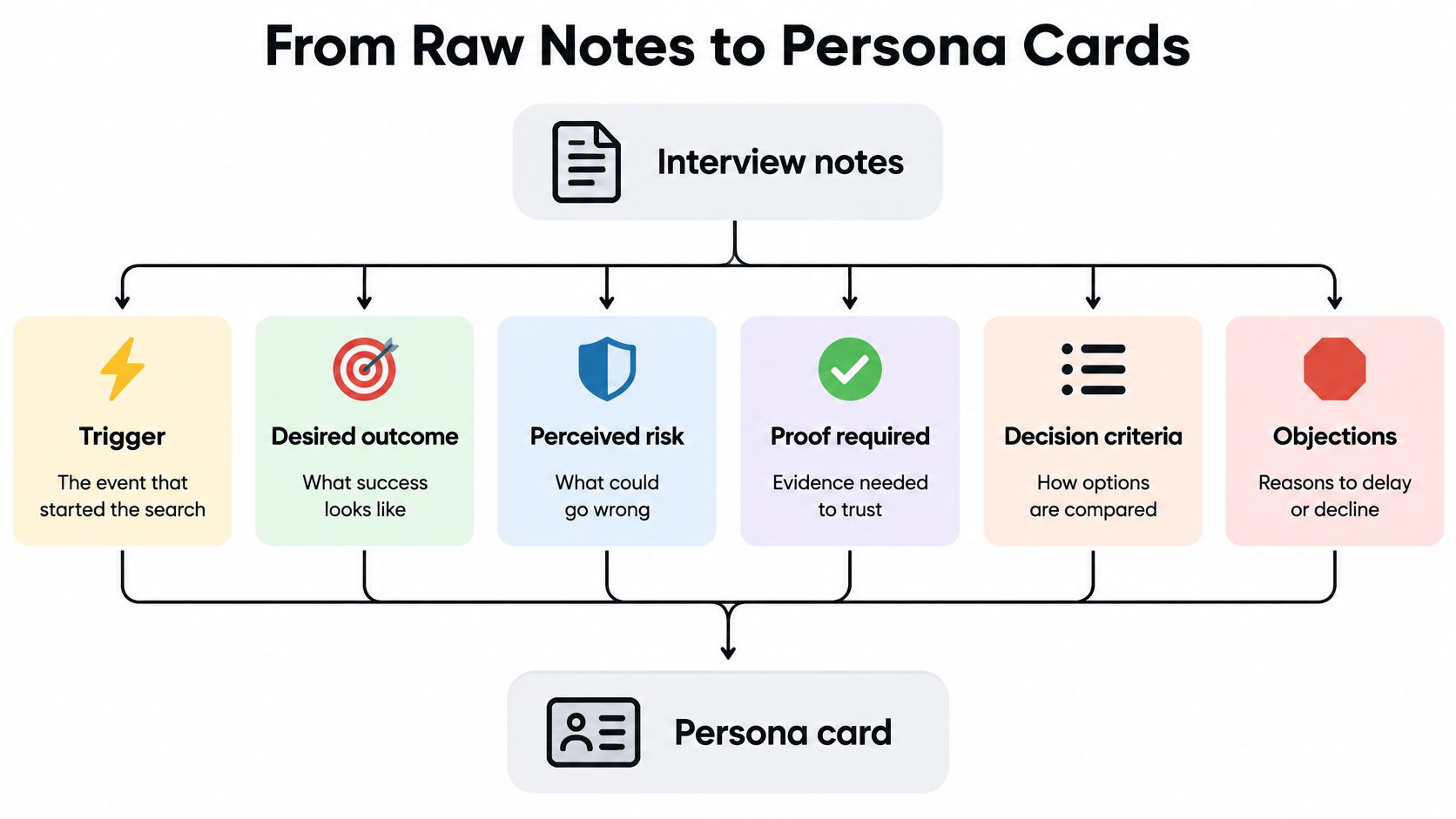
Take one operations lead, closed-won, mid-market. The notes say the launch slipped by eleven days, the team had already tried a shared spreadsheet, finance asked for a migration plan before signing, and the deal would have died if cutover needed a weekend freeze. Coded, that is trigger = missed launch, desired outcome = a dated cutover, perceived risk = downtime, proof required = a written migration plan, decision criteria = calendar fit, disqualifier = no shared deadline. The card line is not "Ops Olivia, 38, likes hiking." It is: buys after a missed launch, closes on a migration plan, walks if there is no deadline.
From codes to a card
- Code every interview into six fields: trigger, desired outcome, perceived risk, proof required, decision criteria, and disqualifier.
- Count codes by role and by outcome (won, lost, churned). A story that appears once is an anecdote.
- Keep codes that travel together. A missed deadline paired with a demand for a migration plan is a segment clue. A one-off complaint about font size is not, unless the counts say otherwise.
- Segment on more than one dimension. As the Sogolytics guide to market segmentation lays out, demographic data says who the buyer is, geographic data says where, psychographic data covers values and motivations, and behavioral data records purchase history, usage, loyalty, channel, and support. Behavior shows what people do. Interviews and psychographics are what explain why.
- Write the card around the job. Trigger, top three objections, the proof that closes, the channels they use, and a line on when they will not buy. Skip the face.
- Keep three to five segments. Merge any two that share triggers and objections. If you cannot name the one objection that separates them, they are the same segment.
A persona card that cannot state when this buyer will not buy is a brochure.
Founders who publish from these cards, rather than from a content calendar of trends, can use the same job language in how founders source daily article topics. The card is the brief. The name on the card is optional.
How to Validate Personas and Avoid Common Pitfalls
Many teams refresh the poster and call it research. A 2025 survey of 351 marketing leaders found that 63% update personas annually, yet only 40% believe the personas reflect customers, and 80% say maintaining them consumes too many resources, according to Solsten's buyer persona guidance. The gap is predictive validity, not another template.
Run a loop each quarter. Compare the hypothesis with CRM and product-usage data. Test the message against conversion and retention. Include lost deals and non-buyers. Retire or revise a segment when the falsifier hits, not when the offsite feels stale. Survey links between documented personas and revenue are correlations, not proof: a 2015 Cintell survey of 137 companies found 71% of organizations exceeding revenue and lead goals had formally documented personas, versus 37% of those merely meeting goals and 26% of those missing them, as summarized by MarketSplash's buyer persona statistics. Treat that as a signal to document and validate, not as a guaranteed lift.
| Metric | How to measure | Healthy sign | Warning sign |
|---|---|---|---|
| Lead-to-opportunity rate by segment | Opportunities divided by qualified leads, split by persona | Stable or rising across two quarters | A drop of 20% or more for one segment |
| Sales cycle length by segment | Median days from first meeting to close | Shorter for personas with a clear trigger | Wide gaps between segments with no product change |
| Content engagement by topic cluster | Scroll depth, return visits and assisted conversions per cluster | Top clusters match stated objections | High traffic with no assisted conversions |
| Win rate against named objections | Won deals where the objection came up and was resolved | Rising after messaging changes | Flat after you address the objection |
| Persona refresh interval | Days since the last check against new deals | Reviewed every 6 to 12 months | Older than 12 months or unchanged after market shifts |
Narrow "ideal" profiles create false precision. If groups overlap, targeting only the perfect buyer drops light buyers, adjacent use cases, and other people in the buying group. For a lean team, a ranked list of jobs, objections, and triggers beats a fictional name. Search behavior is one cheap check on whether the stated need shows up as demand, which is also the point of how lean teams optimize SEO content.
Pitfalls and the test that catches each one
- Demographic theater: Age and hobbies with no decision value. Test: delete them. Does any message, page, or qualification rule change? If not, they were decoration.
- Sales opinion as evidence: The segment matches what reps already believe. Test: the same codes must appear in buyer interviews, not only in call notes.
- Collapsed roles: Founder, marketer, and technical publisher share one card. Test: name the objection unique to each. If you cannot, you merged too far, or you never split them.
- Champion-only model: Every quote comes from the person who liked you. Test: at least one economic buyer or blocker per segment in the last round.
- Over-narrow ideal: Light buyers and adjacent jobs never appear in wins. Test: compare win mix to the card. A large off-card share means the card is a filter, not a model.
- Calendar refresh: Updated because a year passed, with no new deals. Test: list what changed in triggers or objections. "We tweaked the photo" fails.
Forrester's Buyer Insights draws on more than 17,500 buyers worldwide and is refreshed annually with a consistent method. Use an external benchmark like that to see whether your segment is drifting, instead of treating last year's card as permanent.
Turn Personas Into Your Next Content and SEO Plan
Pick one persona this month and plan a three-page sprint around its top trigger and its top objections. A full library can wait. One segment with a metric will teach you more than five unnamed clusters.
Awareness queries come from the trigger ("missed launch date," "project slipped"). Consideration queries come from comparisons and alternatives. Decision queries come from pricing, integrations, and implementation. That split keeps you from writing three guides that all say the same thing.

- Turn each objection into the question a buyer would type. "Migration will take a weekend" becomes a query about cutover time, not a slogan about ease.
- Assign a page type. A guide for the trigger, a comparison for the alternative, a FAQ block on the product page for the objection that should not need its own URL.
- Check live demand and the current results before anyone drafts. If the results are all vendor homepages, a long essay will not match the intent.
- Set one success metric per persona, such as assisted conversions from that topic cluster, and put a 90-day review on the calendar tied to the warning signs above.
The SEO Agent can take the mapping step off a founder's plate. It reads the site, maps buyer questions you already answer, and researches questions you do not cover yet with real search-demand data from the DataForSEO Labs feed, not an internal guess. You approve the question map or let the plan run, and the drafts are buyer-question articles rather than another collection-page checklist. The startup guide to automated content pipelines shows where that handoff sits. The persona still has to be true. Automation only scales the questions you already earned in interviews.
The SEO Agent turns a validated persona into articles aimed at the questions that segment searches, using live search demand and a question map you can approve before anything is published. If your next sprint is one persona and three pages, that is the workflow it is built for. Start with your site at The SEO Agent.