SEO for Small Business: What to Fix First and Why
A practical SEO for small business plan: fix the foundation first, pick low-cost local tactics, and measure calls and sales, not just rankings.
The most popular advice on SEO for small business is to start a blog, chase keywords, and publish until traffic shows up. That advice skips the businesses that need search the most. A site nobody can use, a listing nobody claimed, and a phone number that never gets recorded will not be rescued by another article.
Search pays when a buyer can find you, see what you sell, and reach you. Rankings are a means. Calls, bookings, and sales are the result. If those paths are missing, content volume is a distraction, not a strategy.
Fix the door before you decorate the window. Claim the profile if nearby customers look for you. Put one clear page in front of every offer you sell. Record whether people call or buy. Only then does a publishing calendar earn its hours.
Table of Contents
- Which SEO Foundation a Small Business Builds First
- How Search Finds Your Pages and Which Content to Prioritize
- Core Web Vitals Targets for Revenue Pages
- How to Win Local Search Step by Step
- Measuring SEO When Clicks Are Not the Whole Story
- Low-Cost SEO Tactics and What They Cost in Time
- Choose Your First Three SEO Actions This Month
Which SEO Foundation a Small Business Builds First
More content is rarely the first fix. A small business without a reliable website or a claimed Google Business Profile has a more urgent problem than any editorial plan. BrightLocal's 2025 SMB research found that only 40% of surveyed SMBs had a dedicated website and only 35% had a Google Business Profile, even though 72% said SEO had a medium-to-high business impact. The same research found that 89% of SMBs reported investing in local SEO, yet only 29% of that group rated it as having a high impact. Plenty of owners are spending on the channel while the shopfront is still missing.
Think of the foundation as the shopfront. People cannot find a door that does not exist. The core list is short: a working site that describes each service clearly, an accurate business name, address, and phone number, a claimed and completed profile where maps matter, conversion tracking that records calls and form submissions, and a minimal set of pages for each offer. Daily articles come after that list, not before it. A guide to consistent, search-focused blog publishing is useful once those pages can take an inquiry.
| Business type | Build first | Defer for now |
|---|---|---|
| Local storefront | Claimed profile with exact hours and address, one page per main service | Blog archive |
| Service-area business | Profile with listed service areas, one page per service and area | Storefront-specific settings |
| E-commerce store | Crawlable category navigation, unique product and category titles, speed fixes on key pages | Daily blog posts |
| Consultant or professional | Clear service pages with a visible contact path | Broad informational articles |
A storefront needs a precise address and hours because customers show up. A service-area business should list the towns it covers and should not pretend it has a public counter. A consultant who sells advice nationwide can skip map work and put the hours into service pages with a phone number or form above the fold. An online store should make categories crawlable before it funds a magazine.
If a searcher can find the business, call it, and understand what it sells within one minute, the foundation is ready for content.
How Search Finds Your Pages and Which Content to Prioritize
A strong service page still fails if nothing points to it. Google's SEO starter guide says the search engine uses automated crawlers and primarily finds new pages through links from pages it has already crawled. A page with no path from the rest of the site is harder to discover. The same documentation recommends structured data when a page needs extra guidance, because that markup can help Google understand the content and may enable rich results.

Treat the page as a shop window and the internal links as the signposts on the street. The window can be well dressed. If no sign points to it, visitors walk past. Put those signposts in the main menu, in related service pages, and in any article that mentions the offer.
Intent that deserves a page
Commercial pages come before any blog archive. Name what you sell and where you serve.
- Buy-now terms: "plumber near me" or "emergency roof repair." These visitors want a business, a phone number, and proof you cover their area.
- Comparison terms: "kitchen remodel cost." These visitors are choosing. Give ranges, what changes the price, and a path to a quote.
- Questions: "how long grout lasts." Answer the question, then link to the service that solves the next problem.
Say a dental practice has three treatment pages, one location page, and two question articles. Each question article links to one relevant treatment page. Each treatment page links back to a short hub that lists the treatments and the location. That is enough architecture for a lean site. Publishing ten broad articles with no page that can take a booking is the common mistake. Those articles can earn impressions and still produce zero appointments.
Scalable search content for startups only pays off after the pages that take money are linked and indexable.
Build order and crawl checks
Build revenue pages first, location pages second, and question content third. Then confirm the mechanics.
- Service pages are not blocked in robots.txt and do not carry a noindex tag.
- Key pages sit in the main menu, reachable within a few clicks.
- A sitemap is submitted in Search Console so new service pages are requested quickly.
The short video below walks through how those crawl paths and page priorities fit a small site.
Core Web Vitals Targets for Revenue Pages
Core Web Vitals are engineering work, not a writing task. Set a performance budget for the pages that take money. Google's Core Web Vitals guidance sets the current good thresholds at an LCP of 2.5 seconds or less, an INP below 200 milliseconds, and a CLS below 0.1. Search Console classifies pages above 4 seconds LCP, 500 milliseconds INP, or 0.25 CLS as poor.
| Metric | What it measures | Good | Poor |
|---|---|---|---|
| Largest Contentful Paint (LCP) | Loading speed of the main content | 2.5 seconds or less | Above 4 seconds |
| Interaction to Next Paint (INP) | Responsiveness to taps and clicks | Below 200 milliseconds | Above 500 milliseconds |
| Cumulative Layout Shift (CLS) | Visual stability while loading | Below 0.1 | Above 0.25 |
On a small site the causes are familiar. A heavy hero image delays LCP. An image or embed without reserved space jumps the layout and raises CLS. A chat widget or bulky script delays the next tap and raises INP.
- List the highest-value landing pages from analytics.
- Check field data in Search Console, not only a lab score.
- Size and prioritize the largest above-the-fold image and the critical font.
- Set fixed width and height for images and embeds.
- Defer scripts that are not needed on the first screen.
- Retest after one week.
Meeting the thresholds does not rescue a thin or irrelevant page. Start with revenue templates, and audit your site before scaling content.
How to Win Local Search Step by Step
Local visibility is a sequence. Each step feeds the next, and skipping the early ones wastes the later ones.
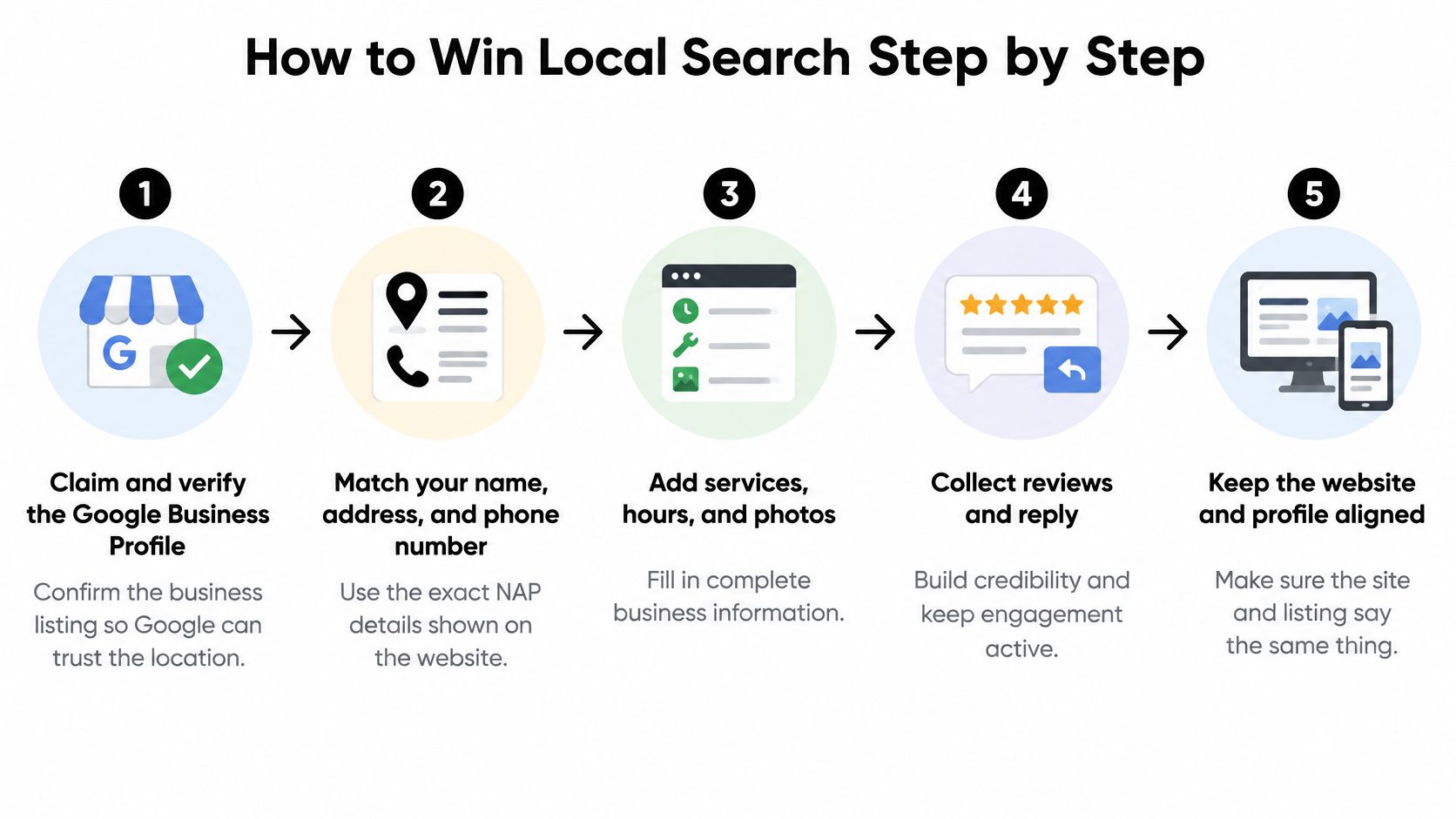
- Claim and verify the Google Business Profile, using the exact name, address, and phone number shown on the website. Google needs one identity it can trust, and a mismatched phone number splits that trust.
- Choose the most specific primary category, and add secondary categories only where they describe services you perform. A vague category pulls the wrong searches and hides the right ones.
- Complete services, service areas, hours, and a description that names the towns or neighborhoods you serve. Detail is how the profile matches real queries instead of generic ones.
- Add photos of the storefront, the team, and completed work. Buyers use those images to decide whether to call, and an empty profile looks unfinished.
- Give each location its own page with a unique address block and one LocalBusiness structured-data entity, using the most specific subtype available, plus telephone, URL, and opening hours. Google's local business structured data documentation treats that markup as explicit clues about the business, its address, and its schedule, not as a ranking promise.
- Validate the page with Google's Rich Results Test, confirm it is crawlable, then inspect the URL in Search Console. A markup error or a blocked page means the clues never get read.
- Ask customers for a review after each completed job, with a direct link, and reply to every review. Reviews are an ongoing process, not a setup task you finish once.
What you can move
Google's local ranking explanation says local results rest on relevance, distance, and prominence. Relevance is how closely the profile matches the query, which is why complete services and categories matter. Distance is how far the business is from the place in the search, or from the searcher's estimated location, and you cannot move the customer. Prominence is how well known the business is, drawn from links, articles, directories, review quantity, and review scores.
You cannot shorten the distance. You can make the profile complete and make the business easier to mention and review.
We write the content side of local SEO, including service pages, comparison pages, and informational questions. We do not manage a Google Business Profile, chase local citations, or reply to reviews. Profile management, directory cleanup, and review replies stay with the owner, because those actions need the actual business identity and the actual customer relationship.
The setup is working when calls and direction requests rise in the profile insights panel, not when a rank tracker shows a prettier position for a week.
Measuring SEO When Clicks Are Not the Whole Story
Clicks alone mislead once answers appear on the results page. Google's 2025 statements on AI in marketing reported in May 2025 that AI Overviews increased Google usage by more than 10% for query types where they appear in the U.S. and India. In August 2025, Google said overall organic click volume remained relatively stable year over year while the average quality of clicks increased. Traffic can hold steady while its mix changes. A business can lose casual reading clicks and still gain people who are ready to call.
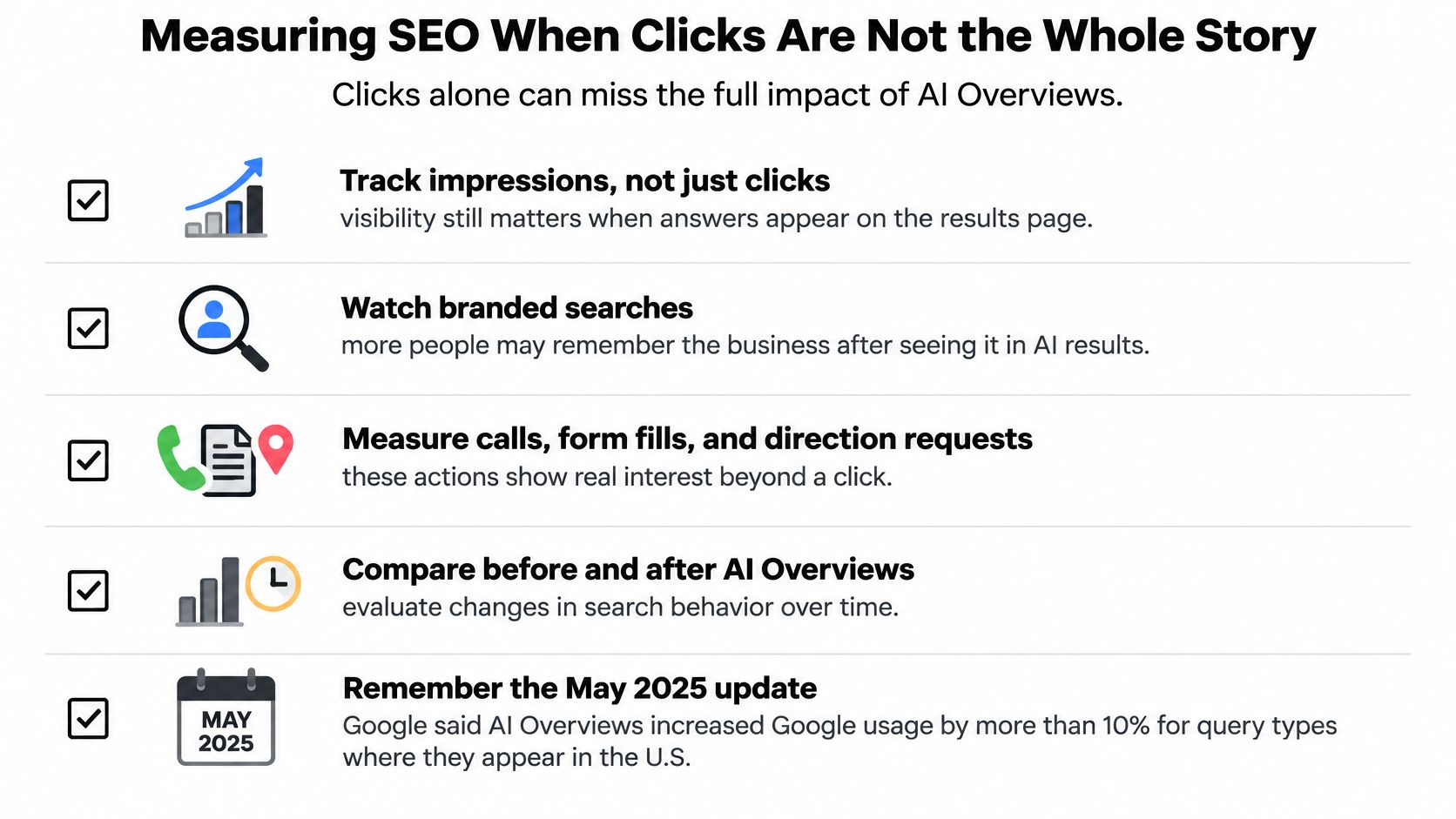
Split the picture before you judge a month. Separate branded queries from non-branded ones. Separate informational intent from commercial intent. Then look at conversions by page, not at a single sessions chart. A visibility you cannot see in a rank tracker still shows up as impressions, branded searches, map actions, or assisted calls.
| Business goal | Primary metric | Secondary check | Review cadence |
|---|---|---|---|
| Get calls or bookings | Calls and form submissions from organic search | Branded search trend | Monthly |
| Sell products online | Organic purchases and revenue per session | Non-branded clicks by page | Monthly |
| Win local customers | Map views, direction requests and calls from the profile | Review count and average rating | Monthly |
| Build awareness with articles | Impressions and click-through rate in Search Console | Changes in visibility for informational queries | Quarterly |
The monthly pass
The numbers live in three places: Search Console, analytics events for calls and forms, and the profile insights panel. The SEO Agent's reporting example shows how those outcomes can sit in one review instead of a rankings screenshot.
- Calls and forms by page: which URLs produce inquiries.
- Branded search trend: whether more people look for the business by name.
- Local map actions: views, direction requests, and calls from the profile.
- Conversion rate on the top ten commercial pages: whether the pages that should sell are doing it.
If a traffic article brings visits but no inquiries for two review cycles, stop funding it. Move that effort to a service page or to a review request. Qualified outcomes beat a higher session count that never reaches the phone.
Low-Cost SEO Tactics and What They Cost in Time
Most small-business budgets run out of hours before they run out of ideas. In 2024, 49% of small businesses said organic search delivered the best marketing return on investment, according to data summarized by Electro IQ. That is a survey result, not a promise that the next article will pay for itself. The cheap wins are the ones you can finish in an afternoon and measure a month later.
| Tactic | Time per month | Cash cost | Best for |
|---|---|---|---|
| Rewrite title tags and meta descriptions on top pages | About 2-3 hours | None | Pages with impressions but few clicks |
| Add internal links from guides to service pages | About 1-2 hours | None | Service pages with few inbound links |
| Answer repeated customer questions on one page each | About 3-4 hours | None | Questions asked on every sales call |
| Update an out-of-date page with current details | About 2 hours | None | Pages whose impressions have dropped |
| Outsourced content production | Under 1 hour of review | Monthly service fee | Owners without time to write |
Say a plumber's bathroom remodel page gets impressions and few clicks. Rewrite the title and meta description so they name the town and the service. Add two internal links from related guides. Check clicks four weeks later. That is a complete test, and it does not require a new 2,000-word post.
Three checks before you spend the hours
Run these before any tactic on the list.
- Conversion page: the change helps a URL where customers already call, book, or buy.
- Time cap: the work takes less than three hours in a normal month, or you have named someone else to do it.
- Measurement: analytics or Search Console can show whether clicks, calls, or sales moved.
Profile replies and speed fixes belong in their own routines, so they are not repeated here. Owners who cannot write can hand drafts to The SEO Agent and keep the review hour for facts and links. Publishing another long article is rarely the cheapest first move when a title, a link, or a stale page is the actual leak.
Choose Your First Three SEO Actions This Month
Use the next thirty days as a sequence, not a pile of ideas.
Week one. Confirm the site loads, the profile is claimed and accurate where you rely on maps, and conversion tracking records calls and form submissions.
Week two. List the top five commercial pages. Check their titles, the internal links pointing at them, and their speed against the thresholds for revenue pages.
Week three. Pick one local gap, such as a missing location page or a profile with no service areas, and fix that gap only.
Week four. Run the monthly review on calls, branded search, map actions, and conversion rate. Decide which single page to fund or stop.
SEO compounds over months. No provider can guarantee rankings, traffic, or a specific outcome, and The SEO Agent does not guarantee that published articles will rank, attract traffic, or produce any specific SEO result. If time is the bottleneck, hand off answer pages and location pages, and keep the profile and the reviews in-house. A free trial is available if you want to test that handoff before you commit hours.
Before next month, answer one question: which page earns calls or sales, and what will strengthen it?
The SEO Agent handles the content side of SEO for a small business, from keyword research through a drafted, fact-checked article published to your CMS, while you keep the profile and the reviews. It is built for founders who need service pages and answer pages without staffing a writing desk, and it does not promise rankings or a set amount of traffic. Visit The SEO Agent to start with your site and a short description of what you sell.