How to Write Meta Description Copy That Earns the Click
Learn how to write meta description copy that earns clicks with intent-matched formulas, length rules, and examples that survive mobile truncation.
Most meta description advice gets this wrong from the start. The tag isn't a fixed blurb Google promises to print, and it's not a place to stuff keywords until a counter turns green. It's a query-response guess, a short preview you write for a search result that may be shown, shortened, or replaced entirely.
Table of Contents
- Why the Character-Count Rule Is Wrong
- Where Google Actually Gets the Snippet
- The Intent-Matched Writing Workflow
- Rewrites for Three Real Intents
- Length, Truncation, and Front-Loading
- The Pre-Publish Checklist
- HTML Implementation and CMS Practicalities
Why the Character-Count Rule Is Wrong
The usual “write 155 to 160 characters” advice sounds tidy, but it breaks the moment you look at how search results behave. Google's guidance has never treated the meta description as a rigid display contract, and current snippet behavior still varies by query, device, and the text Google thinks is most useful. A universal character rule gives writers false confidence, then fails them when the snippet gets rewritten from visible page content.
In practice, the better mental model is simple, write a truthful search preview that can survive truncation. Google's older guidance already treated descriptions as one possible source for snippets, not the only source, and it documented practical ways to create them, including page-specific descriptions and programmatic generation for predictable templates. That's the right mindset for modern SEO too, because the tag is a suggestion, not a guarantee. For a deeper look at how description copy affects clicks and conversion behavior, the website conversion optimisation guide is a useful companion read.
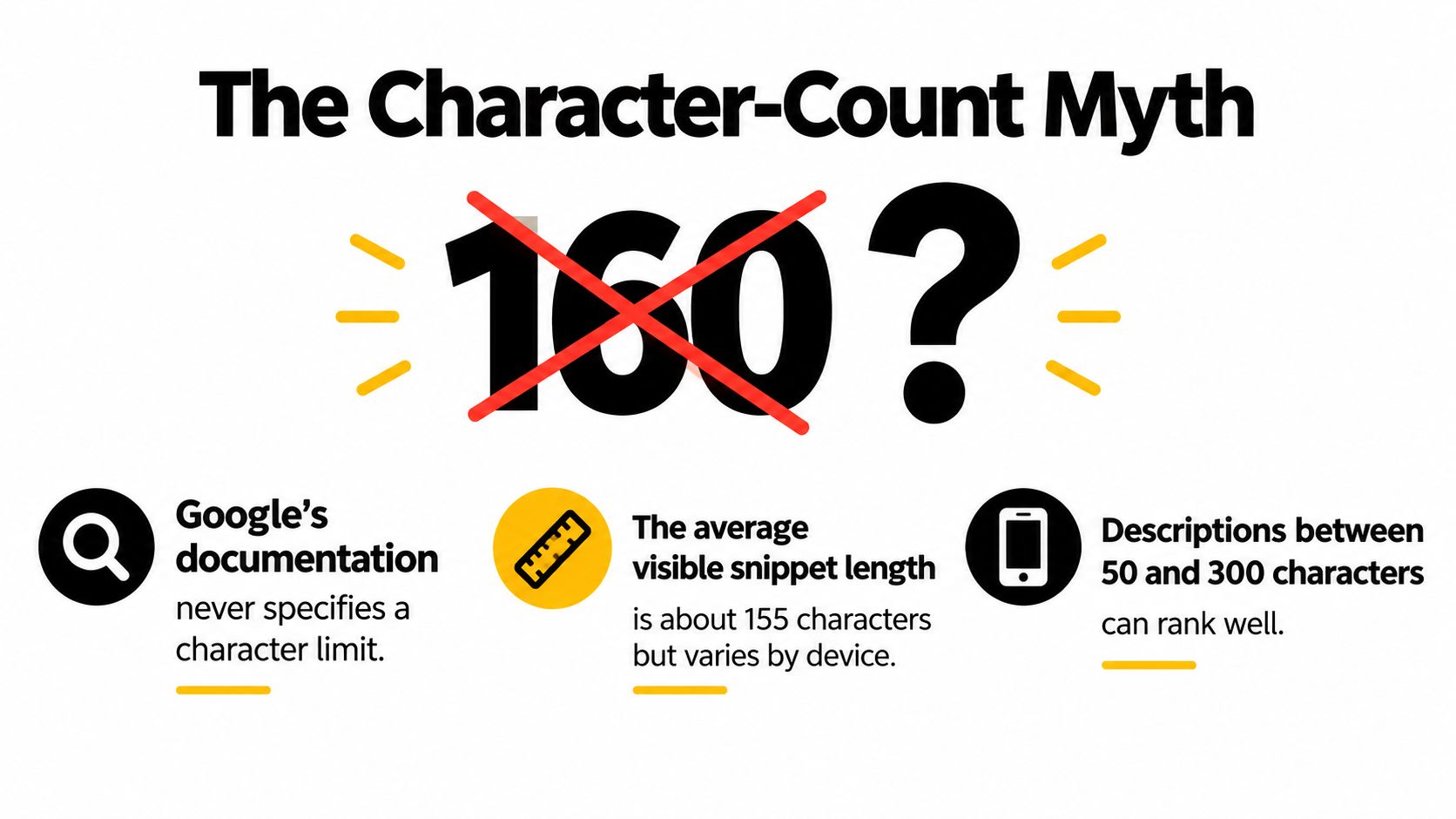
Moz's December 2017 dataset of 89,909 page-one organic results found that the average displayed snippet was 215 characters while the median was 186 characters, which is exactly why a single target number is misleading. The average gets pulled upward by a smaller set of long snippets, so chasing one magic length produces bad writing decisions. Moz's dataset is a good reminder that meaning beats counting.
The best meta description is the one that still makes sense after Google trims it.
Where Google Actually Gets the Snippet
Google has historically used three sources for snippets, the page content, the meta description, and DMOZ listings. DMOZ is gone as a source now, which leaves page content and the meta tag as the mechanisms that matter in current snippet selection. That shift matters because it means your description competes with the page body, and sometimes the body wins if it offers a cleaner answer to the query. Google's snippet guidance still describes the meta description as the fallback that can help when the page has little text or when your summary is more accurate than an auto-extracted line.
That's why the tag works best on pages where the visible copy doesn't already supply a perfect preview. Product pages, thin landing pages, and pages with structured facts often benefit because the description can surface the exact detail a searcher needs before clicking. On a content-heavy article, Google may prefer a sentence from the body if that sentence better matches the search phrase, which is why a strong description should complement the page rather than compete with it.
For a related perspective on how Google surfaces short answer-style content, the featured snippet tactics for SEO specialists guide is worth comparing with your own snippet strategy. The lesson is the same in both places, write for the searcher's question, not for a decorative field. And if your site's editorial structure depends on repeatable template logic, the same thinking that informs blog SEO strategies applies here too.
The Intent-Matched Writing Workflow
Start with the query, not the tag
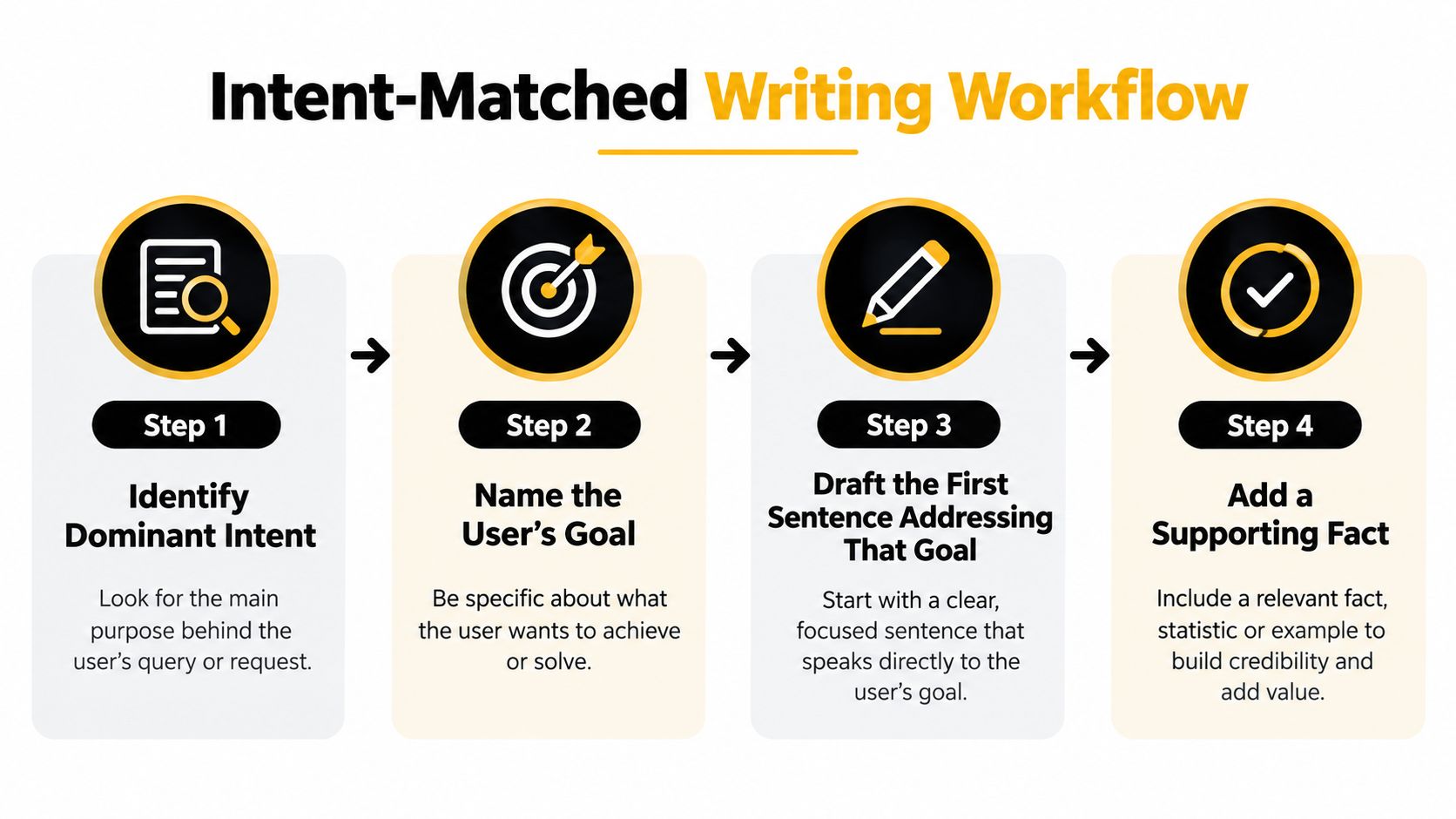
Start with the searcher's intent. An informational page needs to answer, a commercial page needs to help someone compare, and a product page needs to remove purchase doubt. Once that purpose is clear, write the meta description around the single strongest benefit the page delivers.
A blog post about keyword clustering does not need a slogan. It needs a preview that says what the page teaches and why the reader should open it. A commercial comparison page should say what is being compared and what decision help the reader gets. A product page should surface the detail that makes the item easy to evaluate, such as a manufacturer or price, when that detail matters.
Draft one sentence that does the job
Write a truthful one- or two-sentence summary that puts the benefit, the differentiator, and any useful qualifier near the start. Google's documentation recommends unique descriptions for individual pages and points to useful details like an article's author, publication date, or byline, and a product's price, age, or manufacturer when relevant. That guidance matters because it helps the searcher judge whether the page matches the query.
A simple draft process looks like this, with the strongest information first:
- Informational page: “Learn how to write meta descriptions that survive truncation, with examples for blog posts, product pages, and comparison pages.”
- Commercial page: “Compare the main approaches to meta description writing, including when to use custom copy and when templated text is enough.”
- Product page: “A compact description that highlights the product's main use, manufacturer, and the detail buyers care about most.”
Put it into the tag last
Once the sentence is solid, move it into the HTML tag, not the headline, the body copy, or a keyword list. The SEO Agent attaches the finished description automatically when an approved article is pushed to a supported CMS, so the tag ships with the content instead of being typed separately. The SEO Agent handles that handoff after the copy is approved.
Rewrites for Three Real Intents
A weak description usually sounds like a title repeat or a marketing slogan. A strong one names the page's purpose, gives the reader a reason to click, and leaves enough information intact if Google trims the tail. That difference shows up fast when you compare real page types.
Informational page
Weak draft: “How to write meta descriptions for SEO.”
Stronger rewrite: “Learn how to write meta descriptions that survive mobile truncation, summarize the page accurately, and help Google match the right query to the right page.”
The second version works because it tells the searcher what the page covers and what outcome they get from reading it. The opening clause is the part most likely to survive if the result gets cut short, because it carries the subject and the promise immediately.
Commercial comparison page
Weak draft: “Best tools for meta descriptions.”
Stronger rewrite: “Compare meta description tools by workflow, snippet control, and CMS support, so you can choose the option that fits your publishing process.”
This version does more than repeat a category name. It frames the page as a decision aid and names the criteria the reader is likely using. It also avoids fluff, which matters because commercial queries usually reward copy that sounds like a clear filter, not an ad slogan.
Product page
Weak draft: “Premium SEO platform for teams.”
Stronger rewrite: “Automate meta descriptions, titles, and publishing steps for approved articles across supported CMS platforms.”
The strongest sentence is the one that names the action first. If the page is about a product, the description should make the product's function obvious before the searcher scrolls away. On mobile, that front-loaded clause is what you want to preserve, since the visible snippet often cuts before the last words.
For teams refining page templates, the AI SEO title generator features page is a useful example of how a tool can present a precise job-to-be-done without burying the lead. That same discipline is what makes meta descriptions clickable.
Length, Truncation, and Front-Loading
Moz's 89,909-result dataset is useful not because it gives you a rule, but because it proves there isn't one. The median of 186 characters is more honest than the average, because a few long snippets can distort the picture. Google's own documentation also avoids a fixed limit and notes that snippets may be shortened to fit the interface, which means your copy needs to work under truncation, not just in a content editor.
The practical move is to front-load the subject, differentiator, and useful outcome. If the search result cuts off after the first clause, the reader should still know what the page is and why it matters. That's especially important on mobile, where display space is tighter and the visible snippet can shrink depending on the query and layout.
| Context | Approx. visible characters | What to put first |
|---|---|---|
| Mobile snippet without a date | About 118 | Subject, main benefit, qualifier |
| Mobile snippet with a date | About 95 to 105 | Subject, date or byline, key takeaway |
| Longer desktop display | Varies by query and layout | Benefit first, supporting detail second |
For practical testing, the best meta description checker options article can help you review how your copy behaves in different preview tools. Still, the preview is only a proxy. If the first sentence doesn't carry the message by itself, the description is too dependent on the tail.
Write as if the last clause might disappear. If the opening still works, the snippet still works.
The Pre-Publish Checklist
A meta description earns its place only if it helps a searcher choose the result. It should state the page's real benefit, still read cleanly if Google trims the tail, and include one concrete detail that separates it from the title. If it only repeats the headline, it wastes the slot.
Priority matters on bigger sites. Write by hand for the homepage, top-traffic URLs, and money pages first. Lower-value index pages can use templates or be left alone if they will not move traffic, because careful writing belongs where searchers will see it.
- Names the page's actual benefit. The reader should know why the page exists.
- First sentence works alone. If truncation cuts early, the point still lands.
- Adds at least one fact. A date, author, product detail, or other qualifier helps relevance.
- Matches search intent. The snippet should fit the query the page is meant to win.
A checklist for automating content publishing can save time on large sites, especially when descriptions are generated with drafts and routed for approval. That setup cuts missed pages without turning every description into the same template.
Treat the meta description as a preview you are proposing to Google, one it can accept, trim, or replace.
HTML Implementation and CMS Practicalities
The actual tag is straightforward. HTML5.1 defines the description metadata as free-form text that describes the page, and it specifies that a document must not contain more than one meta element whose name is description. In plain terms, the canonical implementation is a single page-level tag like <meta name="description" content="...">, not two competing descriptions hidden in different template layers.
That one-tag rule matters because CMS setups often create duplicate fields. A theme, a plugin, or a page builder can inject its own description after you've already written one, and then the final rendered HTML contains a conflict. When that happens, the fix is usually to find the override source and keep only one description field active.
When a CMS doesn't expose the field, template logic becomes the fallback. Predictable page types like product pages, category pages, and recipe pages are good candidates for programmatic generation, as long as the placeholders pull in the facts that matter to the searcher. That's where the rule from Google's guidance still helps, because the description should reflect the document, not the whole site's slogan.
If you're managing this at scale, the automatic SEO plugin for WordPress workflow is a useful model for how descriptions can be attached during publishing without adding manual friction. The principle stays the same across platforms, keep the tag unique, keep it truthful, and make sure only one version ships.
If you want a faster way to generate descriptions that match intent, survive truncation, and publish cleanly inside your CMS, try The SEO Agent. It builds meta descriptions into an automated SEO workflow, so your team can move from draft to published page without losing control of the snippet.