What Is an All-in-One SEO Platform in 2026?
Discover what is an all-in-one SEO platform and how it simplifies your SEO workflow. Boost traffic and improve efficiency today!

Managing SEO across separate tools for keywords, audits, backlinks, and rank tracking creates friction that adds up fast. An all-in-one SEO platform solves this by consolidating those functions into a single dashboard, eliminating the context-switching that fragments your workflow. Whether you’re a founder trying to grow organic traffic or a marketer managing multiple client sites, understanding what these platforms offer, and where they fall short, directly shapes how efficiently you execute your SEO strategy.
Table of Contents
- Key Takeaways
- What an all-in-one SEO platform actually includes
- Who benefits most from all-in-one SEO software
- Pricing structures in 2026
- AI features transforming SEO platforms
- How to choose the right SEO platform
- My take on all-in-one SEO platforms
- How Theseoagent fits into your SEO workflow
- FAQ
Key Takeaways
| Point | Details |
|---|---|
| Single dashboard advantage | All-in-one SEO platforms combine keyword research, audits, backlinks, and rank tracking in one place. |
| Pricing varies significantly | Entry-level plans start near $24/month while enterprise suites exceed $140/month depending on scale. |
| AI is reshaping platforms | Modern platforms now use AI agents to detect issues and generate content, not just surface data. |
| User type shapes the best fit | Small businesses, agencies, and enterprises need different feature sets from their SEO platform. |
| Supplement when necessary | Experienced marketers often pair all-in-one tools with specialized software for deep audits or content scoring. |
What an all-in-one SEO platform actually includes
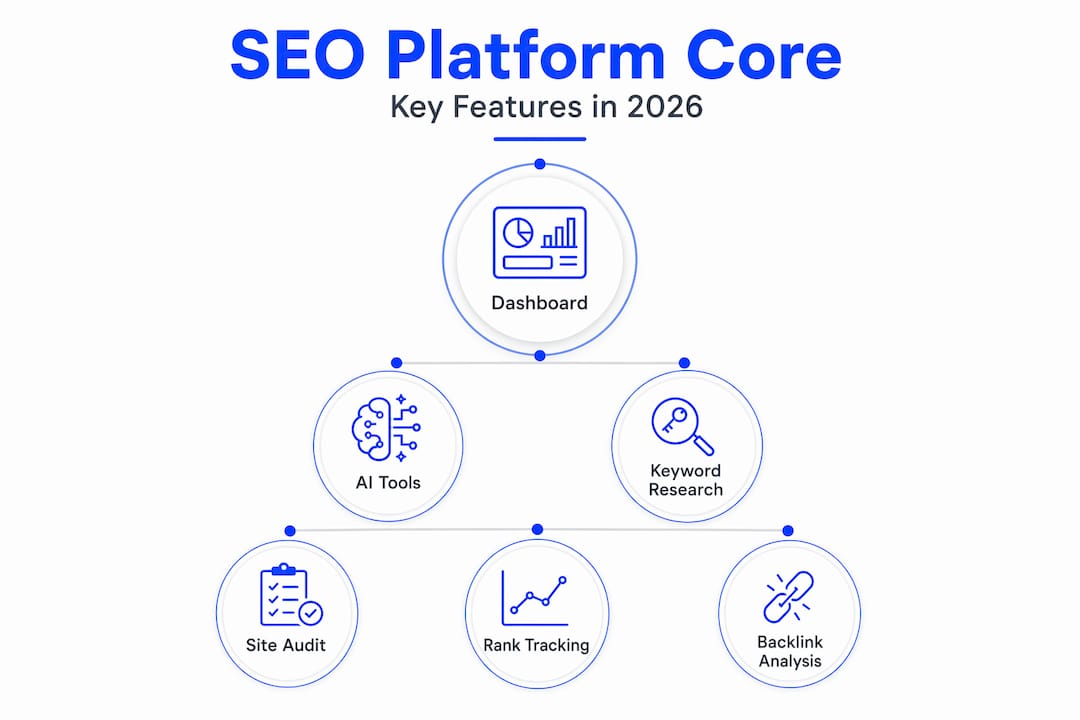
An all-in-one SEO platform integrates multiple critical SEO functions into a single dashboard to reduce the need for multiple tools. At minimum, a platform earns that label by covering keyword research, rank tracking, site audits, backlink analysis, and competitor insights inside one subscription. The value is not just convenience. It is also data continuity: when your keyword research tool, rank tracker, and site auditor share the same underlying data source, you get a more consistent picture of why your traffic is moving the way it is.
Here is what the core feature set typically looks like across the best all-in-one SEO tools:
- Keyword research: Search volume, keyword difficulty, SERP feature data, and related query suggestions
- Rank tracking: Daily or weekly position monitoring across Google and Bing, often with local and mobile segmentation
- Technical site audits: Crawl-based checks for broken links, slow pages, missing metadata, and indexability issues
- Backlink analysis: Link profile monitoring, referring domain counts, and toxic link identification
- Competitor intelligence: Side-by-side keyword gap analysis and traffic estimates for competing domains
- Content tools: On-page optimization scoring, content briefs, or AI-generated drafts depending on the platform tier
The following table shows how these features map across tool categories at a high level:
| Feature | Entry-level tools | Mid-market suites | Enterprise platforms |
|---|---|---|---|
| Keyword research | Basic volume data | Full SERP analysis | Advanced segmentation |
| Rank tracking | Weekly updates | Daily tracking | Real-time monitoring |
| Site audits | Surface-level checks | Deep crawls | Custom rules + API access |
| Backlink analysis | Limited index | Full backlink index | Historical + alerts |
| AI content features | None or minimal | Draft generation | Autonomous SEO agents |
For example, WordPress users often encounter AIOSEO, which embeds technical SEO and schema tools directly inside the CMS dashboard. With over 3 million active users, it represents the CMS-native side of the all-in-one category. Broader standalone platforms operate outside your CMS and offer cross-domain functionality suited to agencies and multi-site operators.
Who benefits most from all-in-one SEO software
The best fit between platform and user depends heavily on how your business operates and who is running your SEO. The feature priorities are genuinely different across user types.
Small business owners gain the most from simplicity and cost. Running keyword research in one tab, tracking rankings in another, and running audits in a third adds cognitive overhead that reduces execution speed. All-in-one SEO software consolidates this into a single login. Cost savings are also real: three mid-tier tools at $50/month each becomes one platform at $65 to $100/month.

Marketing agencies have a different set of priorities. Client reporting, white-label dashboards, and the ability to manage dozens of projects from a single account matter more than raw data depth. Automated reporting can save agencies 5 to 10 hours weekly when client deliverables would otherwise require manual export and formatting. Agency-grade all-in-one platforms often focus less on tool depth and more on client management features that scale with headcount.
Enterprise teams need platforms that support multiple users, large keyword sets, frequent crawls, and API access for custom integrations. Scalability and automation become the primary criteria rather than cost per seat.
Pro Tip: Before evaluating platforms, map out where your actual bottlenecks are. If rank tracking is current and audits are your weak point, prioritize platforms with deeper crawl capabilities. Buying a platform with a great rank tracker you already have elsewhere wastes budget.
Pricing structures in 2026
Pricing across all-in-one SEO platforms spans a wide range, and the differences are not just about feature count. They reflect scaling factors: how many keywords you track, how many domains you manage, and how often the platform refreshes its data.
Entry-level packages start around $24 to $65 per month, targeting solo operators and small teams that need the basics without enterprise complexity. Enterprise suites exceed $140 per month and unlock higher keyword limits, faster crawl frequency, and dedicated support.
| Tier | Monthly price range | Typical limits | Best for |
|---|---|---|---|
| Entry-level | $24 to $65 | 500 to 2,000 keywords | Solopreneurs, small blogs |
| Mid-market | $65 to $140 | 2,000 to 10,000 keywords | Growing businesses, small agencies |
| Enterprise | $140 and above | 10,000+ keywords, API access | Agencies, large marketing teams |
One concrete mid-market example: SE Ranking starts at about $65/month and includes flexible rank tracking frequency alongside strong auditing and backlink monitoring. That positions it well for businesses growing past the basics but not yet needing full enterprise tooling.
When comparing pricing, factor in what you would otherwise spend across individual tools. A keyword research tool, a rank tracker, and a backlink checker each running at $30 to $50 per month independently can easily justify a mid-market all-in-one subscription. You can review Theseoagent’s pricing model as one benchmark for how AI-integrated platforms structure their value at each tier.
AI features transforming SEO platforms
The most significant shift in all-in-one SEO software over the past two years is not about adding more data. It is about shifting from passive data delivery to active SEO execution. Modern platforms now include autonomous AI agents that perform analysis, apply technical fixes, and generate optimized content without requiring a human to interpret a report first.
This is a material change in what “all-in-one” means. Previously, the category meant: here is all your SEO data in one place. Now, leading platforms are pushing toward: here is your SEO data, and here is software that acts on it.
Specific AI capabilities now appearing across top-tier platforms include:
- Content generation: AI drafts that incorporate target keywords, semantic variants, and internal link suggestions based on live SERP data
- Automated issue resolution: Technical fixes like missing alt text or redirect chains flagged and sometimes patched automatically
- Intent-based keyword clustering: AI groups keywords by search intent rather than requiring manual categorization
- SERP gap identification: Platforms scan competitor content and surface topics your site is not covering that correlate with ranking opportunities
- Predictive rank tracking: Some platforms model likely ranking changes based on content improvements before publishing
Pro Tip: When evaluating AI features, ask vendors to demonstrate the output, not just the capability list. AI content quality varies significantly across platforms. A live test on a real keyword in your niche will reveal more than a feature comparison page.
For a direct comparison of how AI-powered SEO tools differ in content output quality, the Theseoagent vs Outrank analysis covers the key distinctions in how different platforms handle content generation at scale.
How to choose the right SEO platform
Choosing from the available SEO platforms comes down to matching your actual workflow needs against what each tool does well. Here is a structured approach:
-
Define your primary use case. Are you creating content, fixing technical issues, building links, or managing client reports? Platforms are rarely equal across all of these, so your primary use case should drive the shortlist.
-
Assess your SEO skill level. Beginner-friendly platforms like those built directly into a CMS prioritize guided setup and plain-language recommendations. Advanced users can extract more value from raw data exports and API access.
-
Map required integrations. If your site runs on WordPress, Shopify, or Webflow, confirm the platform integrates natively. A platform that requires manual data exports to connect with your CMS creates new friction instead of removing it.
-
Compare feature depth against your non-negotiables. List five features you cannot operate without, then score each platform candidate on those five specifically, not on total feature count.
-
Consider supplementing, not replacing. Experienced marketers often supplement all-in-one platforms with specialized tools for deep audits or advanced content scoring. An all-in-one covers 80% of the workflow well; niche tools cover the remaining 20% when it matters.
-
Use free trials with real data. Load your actual domain, your actual competitors, and your actual target keywords during a trial period. Performance on generic demo data tells you nothing useful.
A quick starting point: run a technical site audit on your own domain to identify what your current SEO gaps are before committing to any platform. Knowing your gaps in advance makes platform evaluation considerably more focused.
My take on all-in-one SEO platforms
In my experience, the gap between what all-in-one platforms promise and what they actually deliver is narrowing, but it has not closed. I have worked with dozens of business owners who paid for a comprehensive SEO suite and used 30% of it. The platform was not the problem. Their workflow was not set up to absorb the data those tools were generating.
What I have learned is that the real value of an all-in-one platform is not the feature count. It is the reduction in decision fatigue. When your audit findings, keyword opportunities, and rank changes all live in one place, you make faster decisions. That speed compounds over months.
The AI angle is genuinely exciting, but I would temper expectations for 2026. AI-generated content inside SEO platforms ranges from surprisingly useful to barely publishable depending on the vendor. The honest test is not whether the platform has AI features. It is whether the output actually ranks. That requires live testing, not vendor demos.
My broader advice: treat your all-in-one platform as the operational core of your SEO program, not the whole program. Use it to set direction and track progress. Bring in specialized tools for content scoring or link prospecting when the stakes are high enough to justify them. That combination consistently outperforms relying on a single suite to do everything at full depth.
— Seo
How Theseoagent fits into your SEO workflow
If you’ve worked through what an all-in-one SEO platform should do, Theseoagent is built to handle the piece that most platforms still leave to you: consistent, publication-quality content that actually gets indexed and ranks.
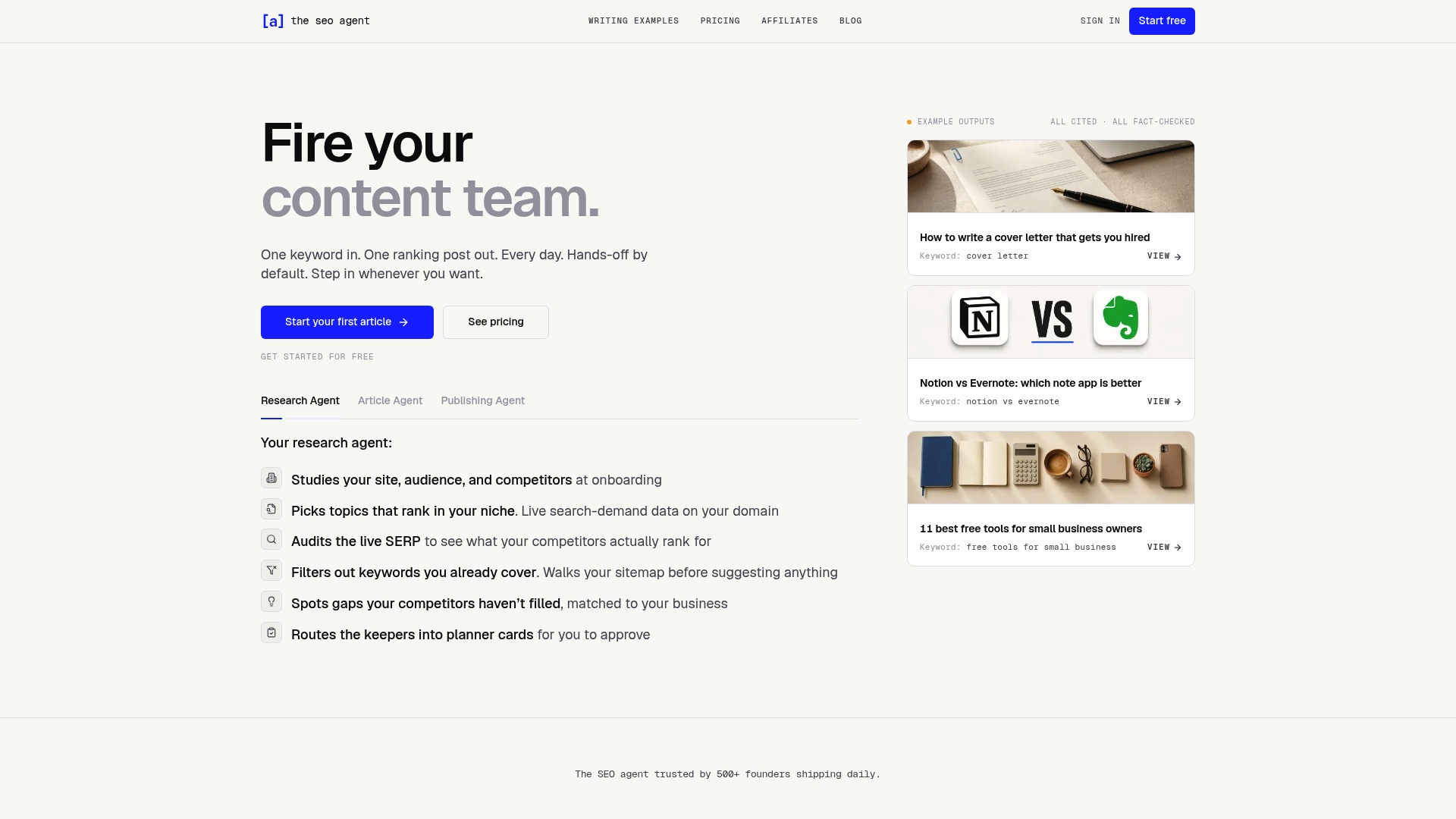
Theseoagent automates the full content pipeline, from live keyword research and SERP gap analysis through to drafting, fact-checking, and publishing one optimized article per day. It integrates directly with WordPress, Shopify, Webflow, Ghost, and other major CMS platforms, making it a direct complement to any audit or tracking suite you already use. For Shopify operators specifically, the Theseoagent Shopify app handles SEO content management without requiring a separate content team. You can also explore the full SEO automation feature set to see how daily content production fits into a broader organic growth strategy.
FAQ
What is an all-in-one SEO platform?
An all-in-one SEO platform is a software suite that combines keyword research, rank tracking, site audits, backlink analysis, and competitor intelligence into a single dashboard, reducing the need to manage multiple separate tools.
How much do all-in-one SEO platforms cost?
Pricing typically ranges from $24 to $65 per month for entry-level plans and exceeds $140 per month for enterprise tiers, with cost driven by tracked keyword volume, managed domains, and data refresh frequency.
Are all-in-one SEO tools good for small businesses?
Yes, provided the platform matches the business’s actual workflow. Small businesses benefit most from platforms that simplify reporting and consolidate costs, rather than those optimized for agency-scale client management.
What AI features should I look for in an SEO platform?
Look for platforms that use AI to generate content briefs or drafts, cluster keywords by intent, and identify SERP gaps based on live competitor data. The quality of AI output varies significantly, so test on real keywords before committing.
Do I need specialized tools alongside an all-in-one SEO platform?
Often yes. Experienced marketers supplement all-in-one platforms with specialized tools for tasks like deep technical audits or advanced content scoring, since general-purpose modules rarely match the depth of purpose-built alternatives.