What Is a Managed SEO Service for Your Business?
Discover what a managed SEO service is and how it can drive growth for your business by handling all aspects of SEO expertly.

Understanding what is a managed SEO service separates businesses that grow organically from those that spin their wheels publishing content with no results. Most small business owners treat SEO like a one-time project: set up a few keywords, write some blog posts, and wait. The reality is that SEO is an ongoing operational discipline requiring technical expertise, content strategy, link acquisition, and consistent measurement. A managed SEO service handles all of that for you, so your team focuses on running the business instead of decoding algorithm updates.
Table of Contents
- Key takeaways
- What a managed SEO service actually includes
- How managed SEO services work
- Managed SEO versus in-house and freelancers
- Is managed SEO worth it for your business
- How to work effectively with your SEO provider
- My perspective on managed SEO: what most businesses miss
- How Theseoagent handles managed SEO differently
- FAQ
Key takeaways
| Point | Details |
|---|---|
| Managed SEO is ongoing, not one-time | It covers keyword research, technical SEO, content, and link building on a continuous basis. |
| Scope excludes paid ads and social | Managed SEO typically does not cover paid advertising or social media unless explicitly contracted. |
| ROI takes time to materialize | Most businesses see measurable organic growth within 5 to 6 months of starting a managed program. |
| Contract terms carry real risk | Without explicit ownership clauses, you can lose access to analytics data and content when you switch providers. |
| Automation changes the economics | AI-driven platforms now make managed-level SEO accessible at price points previously reserved for enterprise budgets. |
What a managed SEO service actually includes
A managed SEO service is an ongoing engagement where an external provider takes full responsibility for your search engine optimization program. Rather than hiring a single freelancer for one piece of the puzzle, you get a coordinated service that covers the full SEO management scope: keyword and topic research, on-page optimization, technical SEO, content creation, link building, and performance reporting.
The core deliverables you should expect each month typically include:
- Keyword and topic research: Identifying high-value, achievable ranking targets based on search volume, competition, and your business context
- On-page optimization: Title tags, meta descriptions, header structures, internal linking, and content updates on existing pages
- Technical SEO: Crawl error resolution, page speed issues, schema markup, XML sitemaps, and mobile usability fixes
- Content creation or optimization: New articles, landing pages, or refreshes of underperforming content
- Link acquisition: Outreach for authoritative backlinks or digital PR campaigns
- Reporting: Monthly summaries covering organic traffic, keyword ranking movements, and conversion trends
One thing many providers are transparent about excluding from a standard managed SEO engagement: paid advertising, social media management, and large-scale website redesigns. Those fall under separate service lines with different pricing and skills.
Pro Tip: Ask any prospective provider for a sample monthly deliverables schedule before signing. Vague statements like “ongoing optimization” should be replaced with specific line items: how many pieces of content, how many technical issues addressed, and how many link-building outreach attempts.
The benefit of a fully managed model is the elimination of vendor coordination overhead. Without it, you would be managing a separate content writer, a technical SEO consultant, a link-building agency, and a reporting analyst. Managed SEO consolidates that into a single accountable relationship.
How managed SEO services work
Understanding how managed SEO works starts at the setup phase. Before any optimization begins, your provider should configure your measurement infrastructure: Google Search Console, GA4, rank tracking software, and conversion event tracking. These create the baseline your results will be measured against, which matters enormously for proving ROI later.
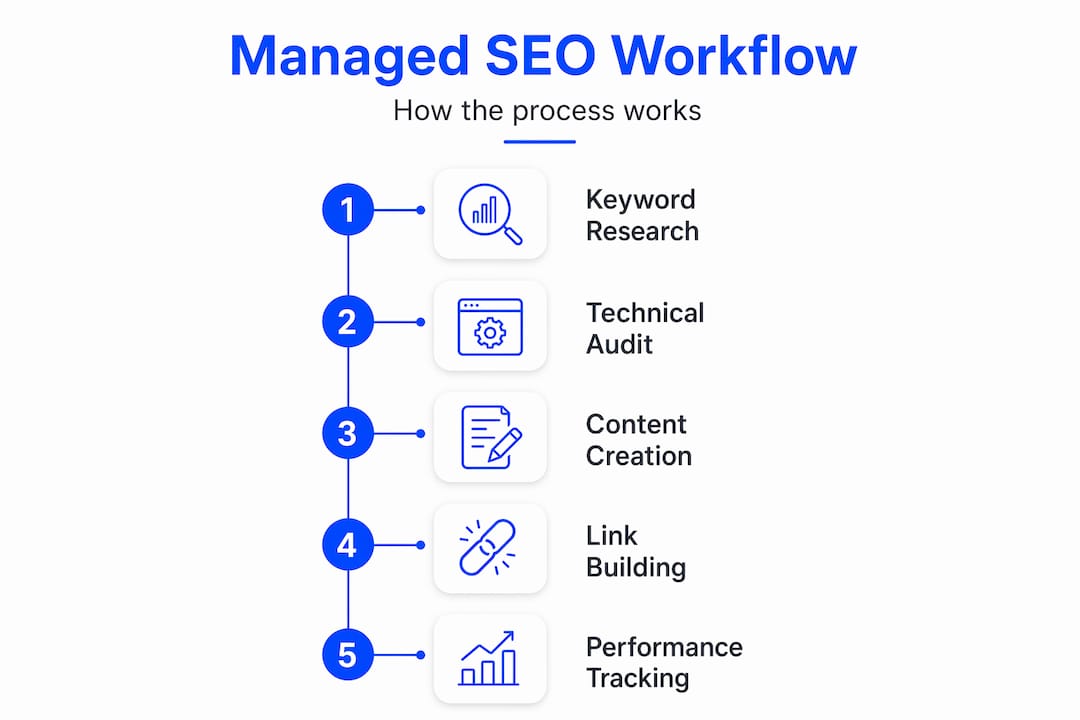
From there, the operational cycle typically follows this sequence:
- Technical audit: A crawl of your site identifies structural issues blocking rankings, such as broken internal links, duplicate content, or slow core web vitals scores.
- Keyword prioritization: Based on your audit and competitive SERP analysis, the provider identifies a ranked list of topics to target in the current month.
- Content execution: Writers or AI tools produce new content or optimize existing pages based on the keyword plan.
- Link acquisition: Outreach campaigns attempt to earn backlinks from relevant, authoritative domains in your industry.
- Performance review: At the end of the month, you receive a report covering organic rankings, traffic, and conversions with plain-language commentary on what changed and why.
The client’s responsibilities in this model are narrower but still real. You provide brand context, approve content before it publishes, and flag any business changes that affect your keyword strategy. The provider does the execution.
Pro Tip: Set up a shared dashboard with your provider from day one. Real-time access to your rank tracking and analytics data means you can spot issues before the monthly report arrives, rather than discovering a traffic drop after 30 days.

Communication cadence matters here. Weekly check-ins for the first 90 days tend to produce better results than monthly-only calls, because the provider has more context about your business and you catch strategic misalignments early.
Managed SEO versus in-house and freelancers
When evaluating SEO management solutions, most businesses consider three options: building an in-house team, hiring freelancers, or purchasing a managed SEO service. Each has genuine trade-offs.
| Option | Strengths | Weaknesses |
|---|---|---|
| In-house SEO team | Deep brand knowledge, direct control, tight integration | High cost, limited specialist coverage, slow hiring cycles |
| Freelancers | Flexible, cost-effective for single tasks | Inconsistent output, no coordination, gaps in technical depth |
| Managed SEO service | Expert team access, established tools, faster starts | Less day-to-day control, requires trust in provider |
The in-house route gives you the most control, but it demands hiring a strategist, a content writer, a technical SEO specialist, and potentially a link-building outreach person. For most small businesses, that payroll does not make sense until organic revenue justifies it.
Freelancers solve specific problems effectively but create coordination gaps. A freelance content writer will not flag a technical crawl issue. A freelance link builder will not optimize your page titles. Without someone connecting the pieces, you get siloed work with limited compound impact.
Managed SEO closes that coordination gap. The benefits of managed SEO include access to an expert team, professional-grade tools such as enterprise crawlers and rank trackers that cost thousands per year independently, and a consistent monthly workflow with defined deliverables.
Hybrid models are worth considering when you have one strong in-house SEO generalist but need specialist support for technical audits or link building. In those cases, a managed provider handles execution while your internal person owns strategy. This structure keeps costs lower than a full-service retainer while maintaining quality.
Is managed SEO worth it for your business
The honest answer depends on three factors: your current organic traffic baseline, your monthly budget, and your patience for long-cycle investments.
On budget, small businesses typically spend between $1,000 and $3,000 per month on managed SEO, with ROI usually realized around the five- to six-month mark. That timeline is not a flaw. It reflects how search engines work: authority and relevance build incrementally, not overnight.
Signs your business is ready for managed SEO:
- Your website receives fewer than 1,000 organic visits per month despite having a substantial product or service catalog
- You have tried publishing content inconsistently and seen little ranking movement
- Your competitors rank for terms you know your customers are searching
- Your internal team lacks time or technical expertise to run SEO consistently
- You have budget for at least a six-month commitment without expecting immediate returns
Contract terms deserve serious scrutiny before you sign. Two pitfalls appear frequently. First, providers that retain ownership of the content they write for your site, meaning you lose that content if you cancel. Client ownership of content and analytics accounts should be explicitly stated in any contract. Second, guaranteed ranking promises. No credible provider can guarantee specific positions on Google. Anyone who does is either misleading you or using risky tactics that can trigger penalties.
Affordable managed SEO is achievable, but low price points usually come with trade-offs in content volume or link-building activity. Understand exactly what you are buying at each price tier before comparing providers on cost alone.
How to work effectively with your SEO provider
Getting full value from a managed SEO service requires active participation on your end, even though the execution happens externally. Several practices consistently separate clients who see strong results from those who do not.
- Own your data accounts outright. Your GA4 property, Google Search Console, and any rank-tracking accounts should be registered under your business email. Providers get access, not ownership. This is what to expect from SEO services that operate with integrity.
- Require specific monthly deliverables in writing. A detailed deliverables schedule stating content volume, technical fixes, and link-building activity protects you from vague commitments and gives you a clear basis for evaluating performance.
- Stay involved in content approvals. Your provider cannot fully replicate your brand voice or industry-specific knowledge. Review and approve content before it goes live rather than rubber-stamping everything.
- Monitor progress between reports. Use tools like Google Search Console directly to track impressions and clicks. You should not need to wait for a monthly PDF to know whether your organic presence is growing.
- Set measurable goals from the start. Organic traffic volume, keyword ranking improvements, and lead generation from organic sources give you concrete targets to evaluate against. Vague goals produce vague accountability.
Pro Tip: Run a baseline SEO audit before you engage any provider. Knowing your current technical health score, indexed page count, and ranking distribution gives you a factual starting point and prevents providers from taking credit for improvements that existed before they started.
My perspective on managed SEO: what most businesses miss
I have seen many small business owners approach managed SEO with one of two flawed assumptions. Either they expect results in 60 days and cancel before the investment has time to compound, or they sign a contract, go completely hands-off, and blame the provider 12 months later when results are thin.
The truth I have learned from watching both scenarios play out: managed SEO is not a vending machine, and it is not a set-and-forget subscription. It is a collaborative operational program. The businesses that get the strongest results treat their SEO provider like an extended team member, not a vendor. They provide brand context, respond quickly to content approval requests, and stay curious about what the data shows each month.
The other thing most businesses overlook is the contract structure. I have seen clients lose months of published content because they did not ensure ownership of SEO assets was written into the contract. Getting that right from the start costs nothing and protects everything you build.
— Seo
How Theseoagent handles managed SEO differently
If the coordination overhead of a traditional managed SEO agency sounds heavy, there is a more direct path to consistent organic growth.
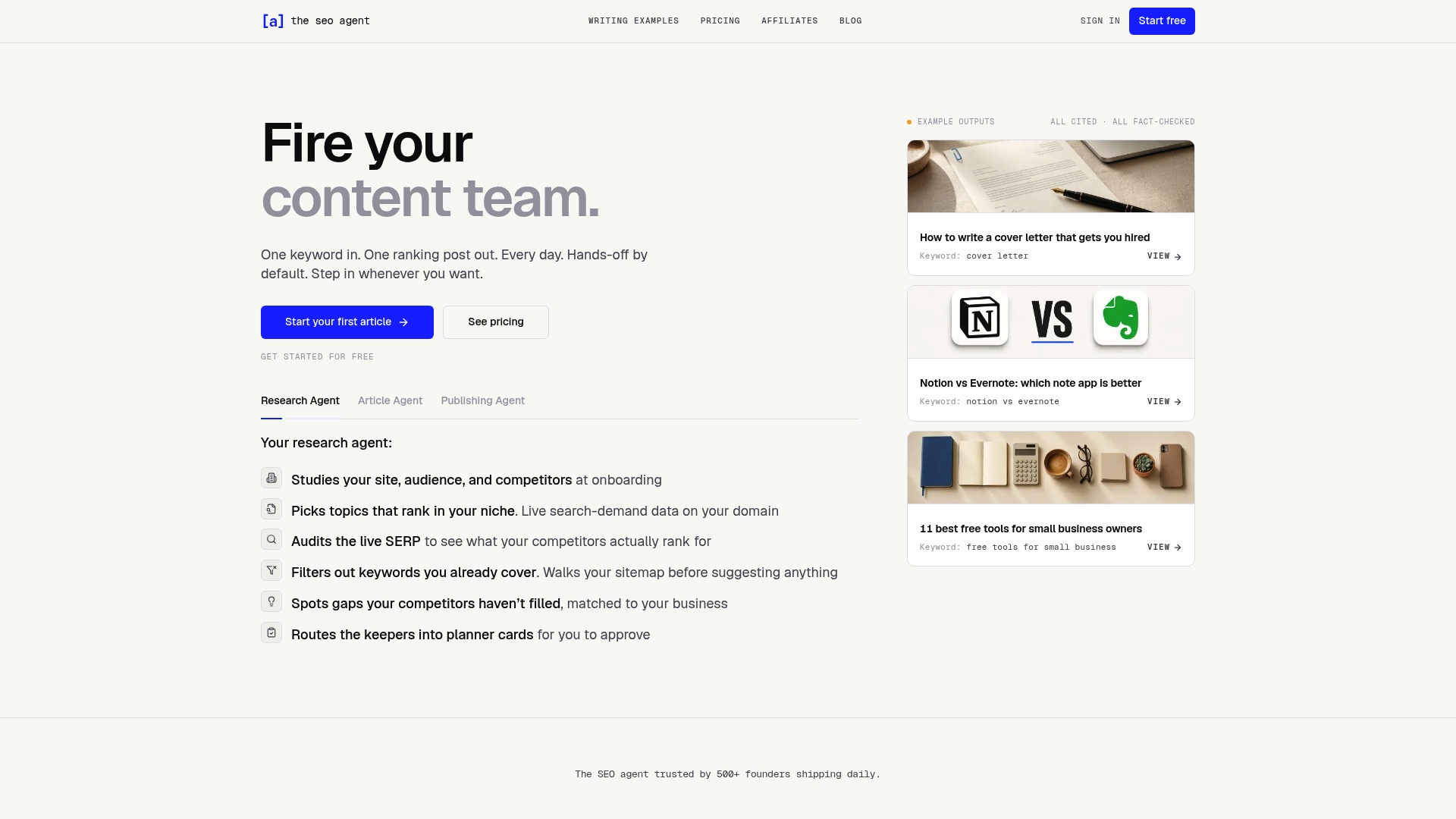
Theseoagent is built for founders and small business operators who need the output of a managed SEO service without the account management friction. The platform handles keyword research, content drafting, fact-checking, and publishing automatically, delivering one optimized article per day using live search demand data and competitive SERP analysis. It integrates directly with WordPress, Shopify, Webflow, and other major CMS platforms, so published content goes live without manual steps. You can start with a free SEO audit to see exactly where your organic opportunity sits, then let the platform’s SEO automation close those gaps systematically. Transparent pricing, no lock-in contracts, and daily content delivery make it one of the most accessible managed-level solutions available.
FAQ
What does a managed SEO service include?
A managed SEO service typically covers keyword research, on-page optimization, technical SEO, content creation, link building, and monthly performance reporting. Some providers also include local SEO and Google Business Profile management when relevant.
How long does managed SEO take to show results?
Most businesses start seeing measurable organic growth within five to six months of starting a managed program, though competitive industries may take longer. SEO builds authority incrementally, which is why a minimum six-month commitment is standard.
What should I watch out for in a managed SEO contract?
Verify that the contract grants you full ownership of all content produced, your analytics accounts, and your Google Search Console property. Avoid contracts that promise guaranteed rankings or retain content ownership after cancellation.
Is managed SEO different from hiring a freelancer?
Yes. A freelancer typically handles one aspect of SEO, while a managed service coordinates keyword strategy, content, technical fixes, and link building as a single integrated program. The result is more consistent progress and fewer coordination gaps.
How much does managed SEO cost for a small business?
Small businesses typically spend between $1,000 and $3,000 per month on managed SEO services. AI-driven platforms can deliver comparable scope at lower price points by automating content production and keyword research.