How to Find Keywords for Your Small Business Blog
Unlock your blog's potential! Learn how to find keywords for your small business blog and attract the right audience today.

Most small business owners publish blog posts that almost no one finds. Not because the writing is poor, but because the keyword choices are wrong. Learning to find keywords for small business blog content is the difference between a post that ranks on page one and one that collects digital dust. This guide walks you through every step: from defining your audience and seed keywords, to validating search volumes, prioritizing long-tail terms, organizing your content, and measuring what actually works.
Table of Contents
- Key takeaways
- What you need before you start keyword research
- Expanding and validating your keyword list
- Prioritizing long-tail and local keywords
- Organizing keywords and mapping them to posts
- Monitoring and refining your keyword strategy
- My honest take on keyword research for small businesses
- Let Theseoagent handle the heavy lifting
- FAQ
Key takeaways
| Point | Details |
|---|---|
| Start with seed keywords | Define your business goals and customer language before opening any keyword tool. |
| Target long-tail terms | Long-tail keywords offer lower competition and better search intent alignment for small blogs. |
| Match intent to content | Use informational keywords for blog posts and commercial keywords for product or service pages. |
| Map one keyword per post | Assign a single primary keyword per page to prevent keyword cannibalization and sharpen SEO signals. |
| Monitor with Search Console | Review Google Search Console data regularly to find quick wins and refine underperforming content. |
What you need before you start keyword research
Keyword research without a clear foundation is guesswork. Before you open a single tool, you need three things clearly defined: your business goals, your ideal customer, and your initial seed keyword ideas.
Start with your conversion goals. Are you trying to drive phone calls, appointment bookings, or direct product sales? The answer shapes which keywords you target. A plumber focused on emergency calls needs different terms than a plumber building a DIY tips blog to generate brand awareness.
Understand how your customers actually talk. Your customers do not search using industry jargon. A dental office might describe a procedure as “dental prophylaxis,” but patients search for “teeth cleaning near me.” List the words and phrases your customers use in conversation, in reviews, and in the questions they ask at the point of sale.
From there, build your initial seed keyword list. Seed keywords are the broad foundation you expand from. Good examples include:
- Your core service or product category (“wedding photography,” “tax preparation”)
- The problems your business solves (“leaky faucet repair,” “lower back pain relief”)
- Your customer’s desired outcome (“grow my small business,” “lose weight fast”)
- Location-modified basics (“Austin plumber,” “Chicago tax accountant”)
These seed keywords are not your final targets. They are the starting point for discovery. Aim for 10 to 15 seeds that span your main offerings and customer needs.
Pro Tip: Check your own Google Business Profile reviews and any customer emails or support tickets. The exact phrases customers use there are often your strongest seed keywords because they reflect real search language.
Expanding and validating your keyword list
Once your seed list is ready, the next step is expansion and validation. Google Keyword Planner offers a two-step workflow that works well for this: use “Discover New Keywords” first to generate related ideas, then use “Get Search Volume and Forecasts” to validate the candidates you want to target.
Here is a practical process to follow:
- Enter your seed keywords into the “Discover New Keywords” tab. Google will return hundreds of related terms grouped by theme.
- Apply location and language filters. For a local business, restrict results to your city or region. This removes irrelevant national data that inflates perceived competition.
- Review the competition column. In Keyword Planner, competition refers to Google Ads bidding density. High competition typically signals strong commercial intent, which is useful context even for organic SEO planning.
- Copy your shortlist into the “Get Search Volume and Forecasts” tab for precise monthly volume data.
- Prioritize terms with 50 to 1,000 monthly local searches. As a general benchmark, local keyword volumes in that range are realistic targets for small business blogs without massive authority.
If you prefer free alternatives, Google Trends shows whether interest in a keyword is growing or declining. AnswerThePublic visualizes question-based searches around your seed terms. Both tools complement Keyword Planner without requiring an ad spend. For a deeper view of competition and search volume data, the Theseoagent blog covers practical guidance on evaluating keyword metrics for small business contexts.
Pro Tip: Google Ads Keyword Planner is fully usable for free even without running ads. You only need a Google account and a basic Ads setup with no live campaigns to access all the data you need.
| Tool | Cost | Best for |
|---|---|---|
| Google Keyword Planner | Free | Volume data, competition signals |
| Google Trends | Free | Seasonality and rising topics |
| AnswerThePublic | Free/Paid | Question-based keyword discovery |
| Ubersuggest | Free/Paid | Long-tail suggestions and difficulty scores |
Prioritizing long-tail and local keywords
Here is where most small business blogs make their biggest mistake. They target broad, high-volume head terms like “best pizza” or “home insurance” and rank nowhere because the competition is dominated by national brands and major publishers.

Long-tail keywords face less competition and align better with search intent than broad head terms. A three-word-plus phrase like “best gluten-free pizza delivery in Denver” will convert at a far higher rate than “best pizza,” even though the search volume is lower.
Local modifiers are equally important. Most guides tell you to add city names. That advice is correct but incomplete. Neighborhood-level keyword targeting uncovers gaps competitors miss and produces measurable improvements in local leads. Consider using:
- Neighborhood names (“Wicker Park plumber” vs. “Chicago plumber”)
- Nearby landmarks (“dentist near Wrigley Field”)
- Urgency terms (“emergency AC repair same day”)
- Service-specific modifiers (“affordable,” “licensed,” “certified”)
Beyond location, every keyword carries a search intent. Understanding that intent determines where to use the keyword.
| Intent type | What searchers want | Best content match |
|---|---|---|
| Informational | Learning and research | Blog posts, how-to guides |
| Commercial | Comparing options | Blog posts, comparison pages |
| Transactional | Ready to buy or book | Service pages, product pages |
| Navigational | Finding a specific brand | Homepage, brand pages |
Matching keyword intent to your content format is one of the highest-leverage moves in SEO. A blog post targeting “how to choose a tax accountant” (informational) will outperform a blog post targeting “hire tax accountant Austin” (transactional) because the transactional keyword belongs on a service page where the visitor can take direct action. For additional local SEO strategies that complement your keyword selection, pairing location modifiers with well-defined intent narrows your audience precisely.
Organizing keywords and mapping them to posts
Finding the right keywords is only half the work. If you assign them carelessly across your blog, you create keyword cannibalization, where multiple posts compete for the same term and dilute each other’s ranking potential.
The solution is a keyword map: a simple document that assigns one primary keyword to each blog post and supports it with three to five secondary terms.
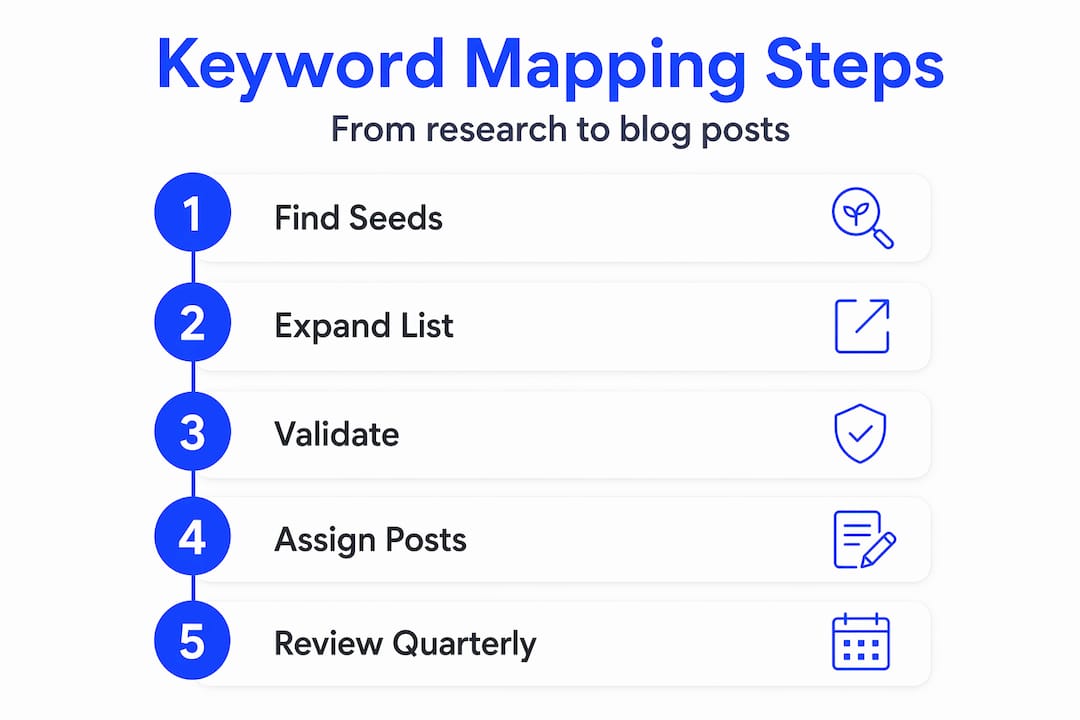
Pro Tip: Per blog post, select three primary keywords and three to five supporting long-tail keywords to maintain topical focus. This prevents dilution and gives search engines a clear signal about what each page covers.
Your primary keyword should appear in the post title, the first paragraph, at least one subheading, the meta description, and naturally throughout the body. Secondary keywords reinforce topical depth without competing directly. For a post about “how to choose a wedding photographer in Austin,” your secondary keywords might include “wedding photography checklist,” “questions to ask a wedding photographer,” and “Austin wedding photographer prices.”
Effective keyword grouping also speeds up content planning. Group related keywords by theme and assign each cluster to a blog post. For example:
- Cluster: Home cleaning tips covers “how to clean hardwood floors,” “best natural cleaning products,” “weekly cleaning schedule”
- Cluster: Pricing and hiring covers “how much does house cleaning cost,” “what to look for in a cleaning service,” “house cleaning near me prices”
Each cluster becomes one blog post. This approach, sometimes called topical authority, signals to Google that your site covers a subject with depth rather than producing scattered, disconnected content.
Revisit your keyword map every quarter. Search trends shift, your business evolves, and new topics emerge. Keyword research for blogs is not a one-time task. Treating your map as a living document keeps your blog strategy aligned with real demand.
Monitoring and refining your keyword strategy
Writing and publishing posts is not the finish line. The blogs that consistently gain traffic are the ones backed by ongoing monitoring and deliberate refinement.
Google Search Console is your primary tool here. The Performance report shows clicks, impressions, CTR, and average position by query, giving you a direct view of what your blog already ranks for and where the gaps are. Many small businesses skip validating keyword candidates against their Search Console data, which means they miss realistic wins where they already hold positions 8 through 20. Pushing a page from position 15 to position 5 requires far less effort than building a new page from scratch.
When reviewing your Search Console data, focus on these signals:
- Posts ranking on page two (positions 11 to 20) are strong optimization candidates. Updating the content, adding internal links, or improving title tags can push them onto page one.
- Queries with high impressions but low CTR suggest your title or meta description is not compelling enough for your keyword.
- Queries you did not intentionally target sometimes reveal genuine content gaps worth addressing.
Competitor keyword gap analysis adds another layer. Use an effective keyword research strategy to identify terms your competitors rank for that you do not. If a competing business in your area publishes a post on “how to winterize your sprinkler system” and that post ranks well, that is a signal worth acting on.
Pro Tip: Avoid stuffing multiple unrelated keywords onto a single page. Diluting keyword focus confuses search engines and reduces ranking potential across all the terms you are targeting.
Set a monthly or quarterly review cycle. Check which posts moved up or down in rankings, which queries are gaining impressions, and whether any existing content needs a keyword or structural update. Consistent iteration compounds over time.
My honest take on keyword research for small businesses
I’ve worked with enough small business owners to know that most of them approach keyword research the same way: they pick the terms that sound best to them and then wonder why the traffic never comes.
The biggest mindset shift I’ve seen work is treating keywords as customer questions, not labels for your services. When you search for “how to find blog keywords” yourself, you’re not looking for a service. You want a process. The businesses that understand this produce content that actually matches what searchers need at each stage of their decision.
I’ve also learned that patience is genuinely hard to maintain in SEO. A well-optimized blog post can take three to six months to gain meaningful traction. The tendency is to assume something is wrong and start changing things before the content has had time to rank. In my experience, the blogs that win are the ones where the owner commits to a consistent publishing schedule, keeps the keyword map updated, and resists the urge to rewrite posts after two weeks.
Finally, the obsession with high-volume keywords is a trap for small businesses. A keyword with 100 monthly searches in your local market, where you can realistically rank in the top three, will deliver more qualified customers than a keyword with 10,000 monthly searches where you have no realistic path to page one. Local and long-tail targeting is not settling for less. It is choosing fights you can win.
— Seo
Let Theseoagent handle the heavy lifting
Keyword research, content planning, and ongoing monitoring add up to a substantial time investment, especially when you are running a business at the same time.
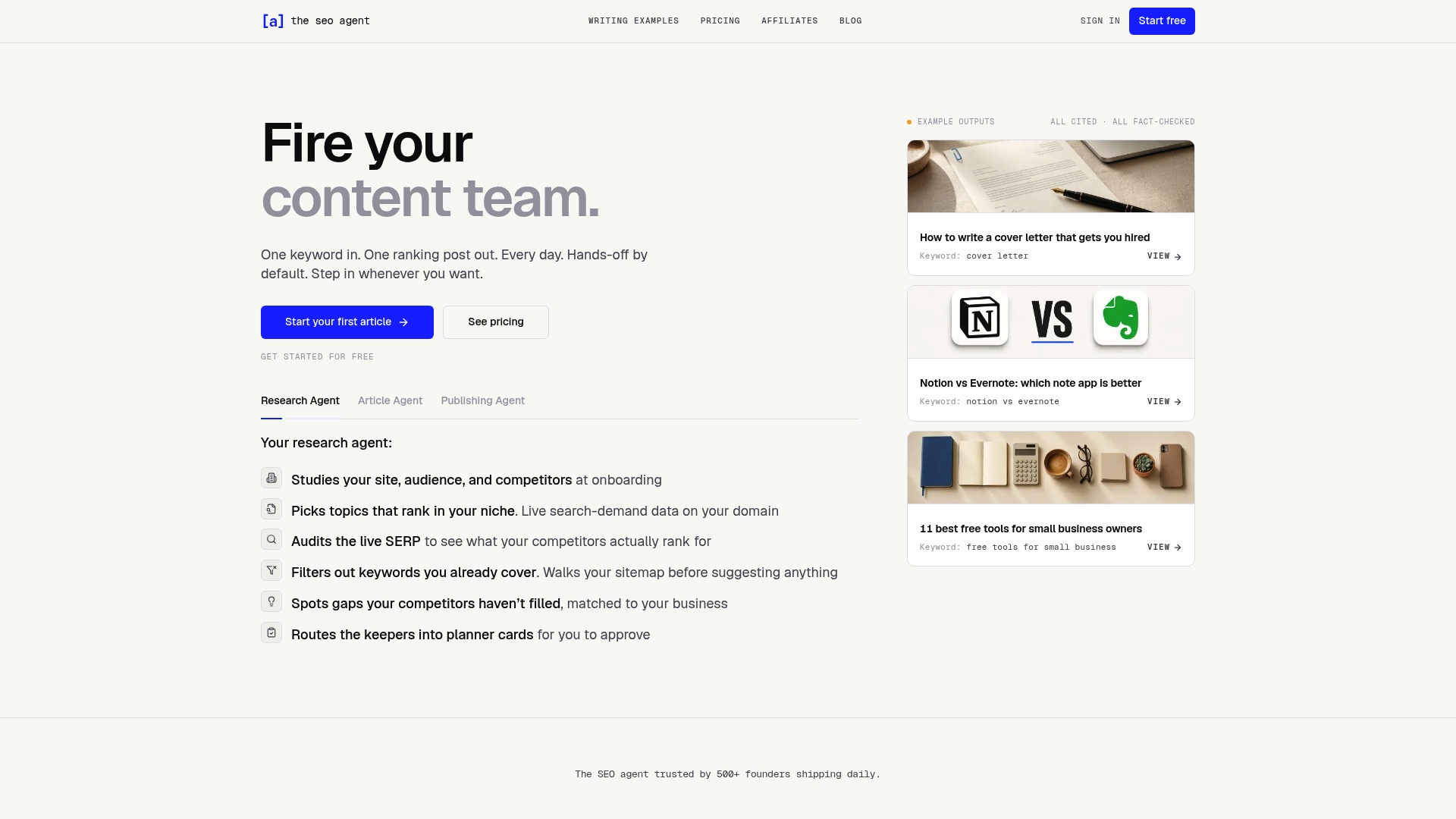
Theseoagent is built specifically for this problem. The platform automates the entire content pipeline: keyword discovery using live search demand data, content drafting, fact-checking, and publishing, all delivering one optimized blog post per day with minimal involvement from you. For Shopify store owners, the Theseoagent Shopify app integrates directly into your store and aligns keyword targeting with your product catalog. If you want to start with a clear picture of where your current content stands, a free SEO audit surfaces real keyword gaps and opportunity lists within minutes. For fully hands-off content production, SEO automation keeps your blog publishing on schedule without requiring you to manage every step.
FAQ
What are the best keywords for a small business blog?
The best keywords balance achievable search volume (typically 50 to 1,000 local monthly searches), low to medium competition, and clear intent alignment with your blog content. Long-tail and locally modified terms consistently outperform broad head terms for small business blogs.
How do I find keywords for my small business blog for free?
Google Keyword Planner, Google Trends, and AnswerThePublic are all free tools that support keyword discovery. Google Keyword Planner alone provides volume data, competition signals, and related keyword suggestions with no ad spend required.
How many keywords should I target per blog post?
Focus on one primary keyword per post, supported by three to five related secondary keywords. This prevents keyword cannibalization and gives search engines a clear understanding of each page’s core topic.
What is keyword cannibalization and why does it matter?
Keyword cannibalization happens when multiple pages on your site target the same keyword, causing them to compete against each other in search results. It weakens the ranking potential of both pages and dilutes your SEO signals.
How long does it take for blog keywords to drive traffic?
Most well-optimized blog posts take three to six months to gain meaningful organic traffic. Competitive keywords may take longer, while low-competition local terms can rank within weeks when the content is well-structured and properly indexed.