How AI Replaces SEO Freelancers: 2026 Guide
Discover how AI replaces SEO freelancers in 2026. Learn the shift in roles, the rise of strategy experts, and how to adapt effectively.

The question of how AI replaces SEO freelancers is generating real anxiety across the industry. Senior practitioners are watching AI tools draft keyword briefs in seconds, generate meta descriptions at scale, and surface content gaps that once took hours to identify manually. But the picture is more nuanced than the headline suggests. AI is not simply deleting freelancer roles from the org chart. It is restructuring them, compressing some positions out of existence while expanding others into higher-value territory. This guide breaks down exactly what is changing, what is not, and how both SEO professionals and small business owners should respond.
Table of Contents
- Key Takeaways
- How AI replaces SEO freelancers through task automation
- What AI still cannot do in SEO
- Adapting your SEO practice to work with AI
- Emerging SEO practices driven by AI search engines
- My take on the AI and SEO freelancer debate
- Put AI-powered SEO to work for your site
- FAQ
Key Takeaways
| Point | Details |
|---|---|
| Junior roles are shrinking fast | AI now handles repetitive SEO tasks, reducing demand for entry-level manual execution work. |
| Strategy is now the primary product | Senior SEO professionals who direct AI execution are in growing demand as human judgment becomes more valuable. |
| AI-driven search changes keyword priorities | Informational queries are losing organic traffic; commercial and transactional keywords now offer better ROI. |
| Freelancers must become AI orchestrators | Developing prompt engineering and output evaluation skills is the most direct path to staying competitive. |
| Over-reliance on AI carries real risk | Factual inaccuracies and thin content from unchecked AI outputs can damage rankings and brand authority. |
How AI replaces SEO freelancers through task automation
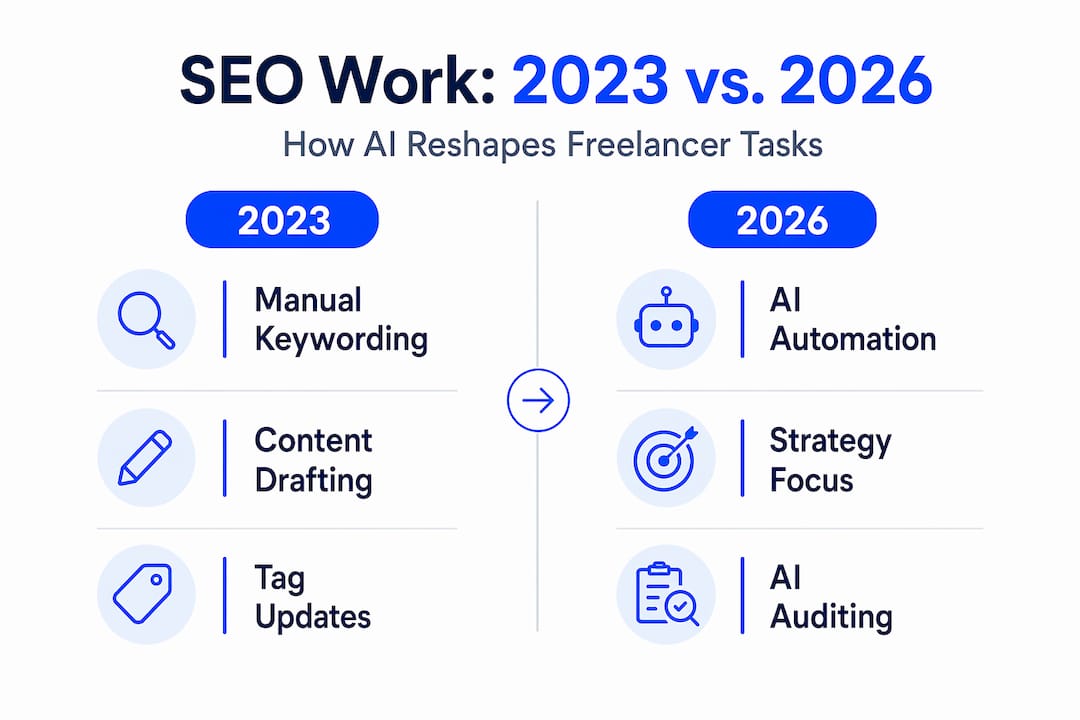
The clearest evidence of AI’s impact on SEO freelancing shows up in the task list. Work that once required dedicated hours from a junior specialist now runs in the background.
AI handles a growing portion of the traditional SEO workflow:
- Keyword research. Tools now pull live search demand data, map intent clusters, and surface low-competition opportunities without a human sitting in a spreadsheet.
- Meta description and title tag generation. AI produces dozens of character-count-compliant variants in one pass, far faster than manual writing.
- Content brief creation. Competitive SERP analysis, topic clustering, and outline generation all run automatically based on target queries.
- Technical site audits. Crawling, broken link detection, and indexing issue identification happen continuously rather than in scheduled batches.
- First-draft content. Full article drafts, including headers, internal link suggestions, and schema markup, are produced by AI agents in minutes.
The productivity shift is significant. AI-integrated teams now publish 15 to 20 quality articles monthly compared to 4 to 6 just three years ago, and 77% of organizations report talent scarcity as the primary driver pushing them toward AI-powered scale. The math is unavoidable for small business owners: why pay a junior freelancer to spend eight hours on keyword research when a purpose-built AI tool completes that same task in under five minutes?
The impact on junior roles is direct. Demand for entry-level SEO positions focused on repetitive, manual tasks has dropped sharply, while demand for senior strategists who can direct AI systems is rising. Gartner projects a 25% drop in traditional search volume by 2026, and 89% of senior HR leaders expect AI to reshape job structures across marketing functions. Junior freelancers who built their value around execution speed are the most exposed.

Pro Tip: If you currently offer keyword research or meta tag writing as standalone services, reframe your offer around strategic interpretation. Deliver the analysis and recommended action plan, not just the data dump.
AI agents now consolidate the entire SEO stack into conversational workflows, allowing solo operators to execute processes that previously required a team. This is not a future state. It is operational in 2026.
What AI still cannot do in SEO
Understanding the limitations of AI is as important as recognizing its capabilities. The impact of AI on SEO jobs is real, but AI does not operate well without structured human guidance.
The areas where human expertise remains irreplaceable include:
- Contextual judgment. AI generates content based on patterns. It cannot assess whether a piece of advice is appropriate for a specific client’s brand voice, compliance requirements, or audience sensitivity.
- Strategic integration. Connecting SEO goals to a broader business plan, a product launch timeline, or a repositioning effort requires understanding the client’s commercial reality. AI does not have access to that context unless you provide it explicitly.
- Fact verification. SEO practitioners warn that over-reliance on AI leads directly to factual inaccuracies. E-E-A-T signals matter more than ever, and generative content that lacks verified sourcing can be penalized.
- Client communication. Translating performance data into business decisions, managing expectations during traffic dips, and advising on budget allocation are not tasks AI handles.
- AI output evaluation. The technical knowledge required to assess whether an AI-generated outline, brief, or article actually meets quality standards is itself a specialized skill.
“The most successful SEO professionals in 2026 treat AI as a teammate, not a replacement. Their job is to direct, evaluate, and refine — not to prompt and publish without review.” — AI SEO insight
The shift is from manual executor to AI orchestrator. Freelancers who make this transition retain significant value. Those who do not will find their services undercut by platforms that automate the same outputs at a fraction of the cost. Clients now have direct access to granular performance data through Google Search Console, which means information asymmetry no longer protects freelancers who cannot demonstrate measurable business outcomes.
The skills that matter in this environment: prompt engineering, AI output auditing, strategic planning, data interpretation, and client-facing communication. These are not soft skills. They are technical competencies that require deliberate development.
Adapting your SEO practice to work with AI
The future of SEO with AI is not about resistance. It is about repositioning. Freelancers and small business owners who adopt an AI teammate model early have a measurable advantage over those still operating on manual-only workflows.
Here is a practical sequence for making the transition:
- Audit your current task list. Separate what you do into two categories: tasks that are primarily execution-based (writing meta tags, pulling keyword lists, formatting reports) and tasks that require judgment (strategy, client advising, content direction). AI should handle the first category.
- Build prompt engineering fluency. The quality of AI output is directly proportional to the quality of the input. Learning how to write structured, detailed prompts that incorporate SEO context, brand tone, and content goals is now a core professional skill.
- Develop an AI review protocol. Fact-check AI-generated content systematically. Full automation of complex SEO tasks requires ongoing technical infrastructure and expert maintenance. Treating AI output as publish-ready without review is the most common and most damaging mistake.
- Reposition your offer around outcomes. Clients are less interested in deliverables (a report, a batch of articles) and more interested in results (ranking improvements, organic traffic growth, lead generation). Frame your services around measurable outcomes, with AI handling the production pipeline.
- Invest in strategic SEO knowledge. Competitive intelligence, link acquisition strategy, content gap analysis at the domain level, and brand authority building are all areas where human expertise still commands premium rates.
Pro Tip: When pitching to clients, describe your AI tools explicitly. Saying “I use AI to handle production so I can focus entirely on strategy and analysis” positions you as more capable, not less valuable.
The pitfall to avoid is substituting AI tools for strategy entirely. A freelancer who simply forwards AI-generated content to clients without any review, refinement, or strategic framing is not operating as an AI orchestrator. That person is operating as a middleman, and they are one automation layer away from being replaced. Explore AI SEO alternatives to identify which tools best complement your workflow before committing to any single platform.
Emerging SEO practices driven by AI search engines
The will AI take over SEO debate often focuses on content creation. The more consequential shift is happening at the search engine level itself, where AI is changing how users find and consume information.
| Search Behavior | Pre-AI SEO | AI-Driven SEO |
|---|---|---|
| Informational queries | High organic click-through rates | Synthesized answers reduce clicks by 20 to 40% |
| Commercial queries | Moderate competition | Higher priority for SEO investment |
| Transactional queries | Product and service pages | Stronger conversion focus with AI-optimized intent matching |
| Brand authority queries | Secondary concern | Primary signal for AI citation and visibility |
Organic traffic for informational queries has dropped 20 to 40% as AI Overviews deliver synthesized answers directly in the SERP, eliminating the click. This fundamentally changes where SEO investment creates return.
The practical adjustments for 2026 include:
- Prioritize commercial and transactional content. These query types are less likely to be satisfied by AI-generated summaries, making them more valuable for organic traffic.
- Optimize for AI citation. AI search engines pull from authoritative sources. Publishing content with clear authorship, verifiable facts, and proper citations increases the likelihood your content is referenced in AI-generated answers.
- Expand beyond Google. SEO must now encompass visibility on AI platforms including ChatGPT and Gemini, not just traditional search engines. This “Search Everywhere Optimization” approach is a structural shift in how strategy is built.
- Build E-E-A-T signals deliberately. Author credentials, citations, original data, and editorial standards are the signals that AI search engines use to determine trustworthiness. These cannot be faked at scale.
My take on the AI and SEO freelancer debate
I have watched this conversation circle for two years now, and most of what gets written misses the actual dynamic. The framing of “will AI take over SEO” is the wrong question. The right question is: which version of an SEO freelancer survives this shift?
In my experience, the practitioners who are thriving are not the ones with the most impressive AI tool stack. They are the ones who understand what AI cannot yet do, and they have built their positioning around exactly those gaps. Strategic judgment, client trust, and the ability to connect SEO data to business outcomes are not features you can prompt your way into. They require experience, domain knowledge, and the kind of contextual understanding that only comes from working across real clients with real constraints.
What concerns me more than AI replacing SEO freelancers is the number of practitioners who are using AI as a shortcut rather than a multiplier. Publishing AI-generated content without review, substituting automation for analysis, and treating prompt engineering as a replacement for strategic thinking are all paths toward devaluing your own services. The AI tools for SEO optimization that actually create competitive advantage are the ones used by people who understand the strategy well enough to evaluate the output critically.
The freelancers I would be most concerned about are those who have not updated their skill set since 2022. Not because AI will replace them outright, but because clients who understand the new environment will stop paying for services that AI can produce at one-tenth the cost. Continuous learning is not optional in this cycle. It is the baseline requirement for staying relevant.
— Seo
Put AI-powered SEO to work for your site
Understanding the shift in how AI changes SEO work is one thing. Having the infrastructure to act on it is another.
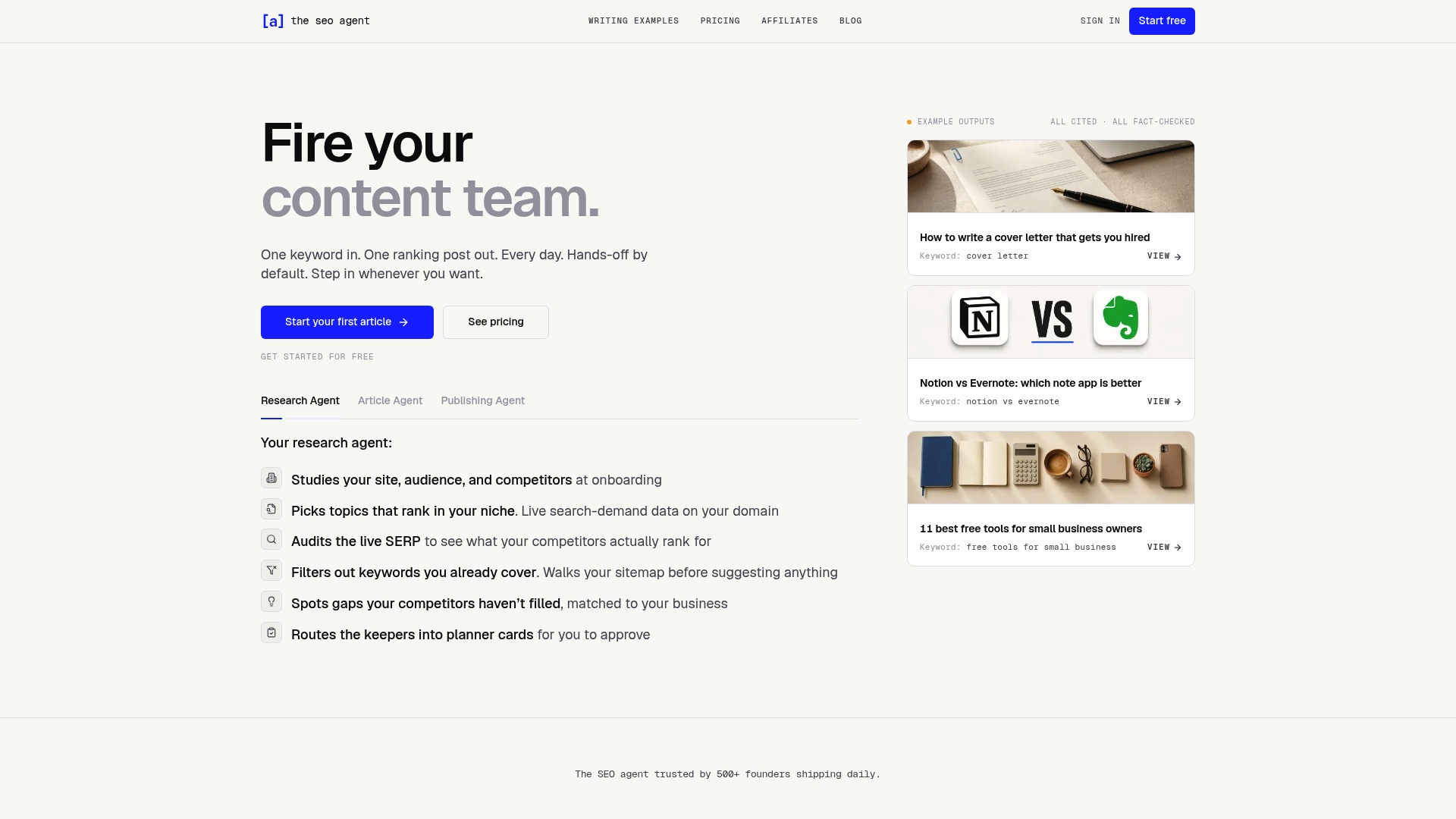
Theseoagent is built specifically for founders and small business owners who want the output of a professional SEO content operation without managing the production pipeline manually. The platform handles keyword research, content drafting, fact-checking, schema markup, and CMS publishing, delivering one optimized article per day based on live SERP data and content gap analysis. For businesses evaluating how to scale organic traffic without adding headcount, the SEO automation features replace the manual workflow that junior freelancers used to handle. E-commerce operators can explore the Shopify SEO app for a direct integration that connects AI content production to your product catalog. Review the pricing options to find the tier that fits your publishing volume and growth stage.
FAQ
How AI replaces SEO freelancers in practice
AI replaces the execution layer of SEO freelancing, handling tasks like keyword research, meta tag generation, and content drafting automatically. Human expertise remains necessary for strategy, client communication, and output quality control.
Will AI take over SEO completely?
AI will not take over SEO completely because contextual judgment, brand strategy, and accurate fact verification still require human oversight. The role shifts from manual execution to AI orchestration and strategic direction.
What SEO tasks are most vulnerable to AI automation?
Repetitive, data-driven tasks like keyword clustering, SERP analysis, and first-draft content generation are most exposed. These were the primary responsibilities of junior-level SEO freelancers and are now handled by AI tools at a fraction of the cost.
What skills do SEO freelancers need to stay competitive with AI?
Prompt engineering, AI output auditing, strategic planning, and client-facing communication are the skills that carry the highest value in an AI-integrated SEO environment. Technical execution skills alone are no longer sufficient.
How does AI search affect organic traffic for SEO clients?
AI-generated search summaries have caused a 20 to 40% decline in organic clicks for informational queries. This pushes SEO strategy toward commercial and transactional content, where AI Overviews are less likely to eliminate the click entirely.