Compare AI content tools for small businesses: 2026
Discover how to effectively compare AI content tools 2026 for your small business. Maximize your marketing spend with the right choices!

When you’re running a small business and every dollar of marketing spend needs to work, choosing the wrong AI content tool is a real budget problem. The market to compare AI content tools 2026 has expanded dramatically, with dozens of platforms promising SEO gains, faster publishing, and automated workflows. Some deliver. Many don’t for your specific situation. This guide cuts through the noise, categorizes the tools by how they actually function, breaks down true total costs, and gives you a clear framework to match the right tool to your content workflow before you commit to a subscription.
Table of Contents
- Compare AI content tools 2026 by tier
- Compare pricing and features for SEO content optimization
- Evaluate WordPress-native AI writers and integration considerations
- Explore multi-format AI content tools for diverse small business needs
- How to verify your AI content tool fits your SEO workflow and budget
- Why choosing the right AI content tool tier transforms small business SEO success
- Boost your AI content strategy with The SEO Agent’s automation tools
- Frequently asked questions
Key Takeaways
| Point | Details |
|---|---|
| AI tools split into tiers | Choosing the right AI content tool tier based on drafting, marketing copy, or editing needs prevents wasted budget. |
| Total cost matters | Consider combined costs of AI writing and SEO optimization tools to avoid hidden high monthly expenses. |
| WordPress SEO advantage | GetGenie AI integrates AI writing and SEO in WordPress for efficient content optimization and lower overall cost. |
| Test before buying | Use free trials to cover 80% of your needs before committing to paid AI content tools. |
| Automation complements AI | SEO automation tools like The SEO Agent enhance and streamline AI content workflows for better results. |
Compare AI content tools 2026 by tier
Not all AI writing tools are built for the same job. The single biggest mistake small business founders make is buying a tool because it ranked well in a roundup, without first asking: what stage of my content process is actually broken?
AI content tool categories break cleanly into three tiers, and matching your bottleneck to the right tier is the most cost-effective decision you can make. As tested rankings confirm, small-business-friendly AI content tools split into three tiers, and choosing the wrong tier is a costly mistake.
Tier 1: General LLM writers These tools, which include broadly capable large language model platforms, are best for drafting raw content at volume. They’re flexible, fast, and handle most topics. The tradeoff is that they have no native SEO awareness. You get words, not rankings.
Tier 2: Marketing and copy optimization tools These platforms specialize in conversion-focused copy, brand voice consistency, and marketing content at scale. They’re well suited to ad copy, landing pages, and email sequences where tone and audience targeting matter more than raw word count.
Tier 3: Editing and refinement tools Grammar checkers, style editors, and readability improvers sit in this tier. They don’t generate content from scratch. They polish what you already have.
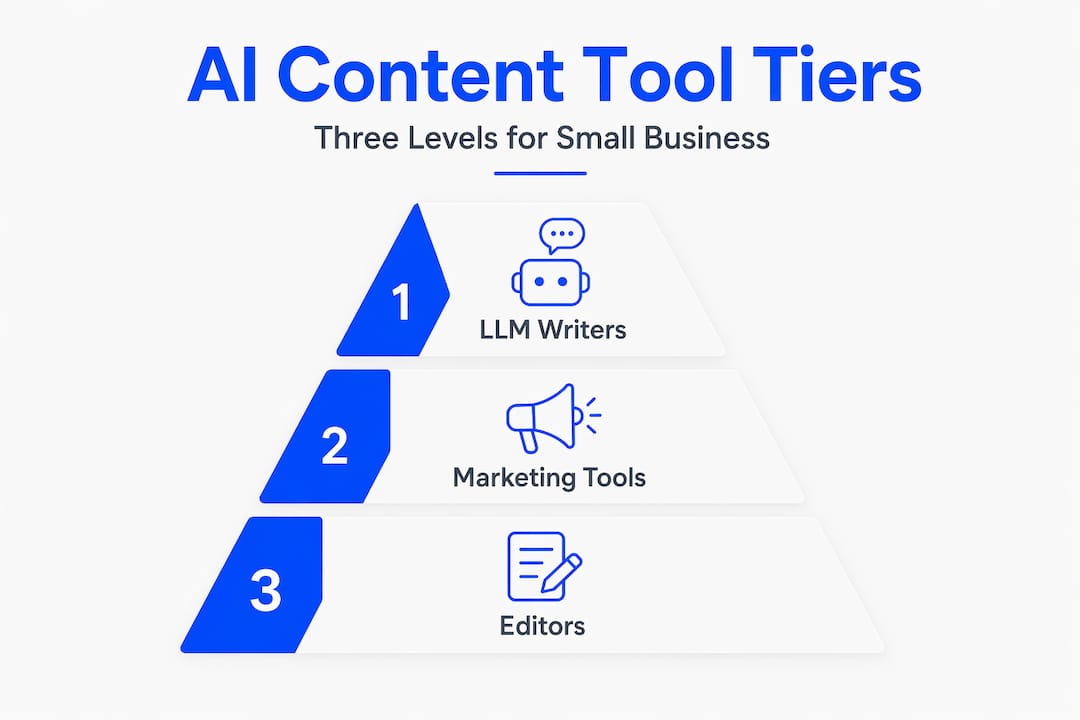
| Tier | Primary function | Best for | Typical monthly cost |
|---|---|---|---|
| 1 | General drafting | Blog posts, outlines, research | $20–$40 |
| 2 | Marketing copy and brand voice | Ads, landing pages, emails | $49–$125 |
| 3 | Editing and polish | Grammar, readability, style | $12–$30 |
A founder whose blog posts take too long to write has a Tier 1 problem. A founder whose ads aren’t converting has a Tier 2 problem. Paying for Tier 2 features when your bottleneck is Tier 1 drafting speed wastes both money and time. Use strategies for mapping AI content tools to your process stage before purchasing.
Pro Tip: Before signing up for any tool, write down the one content task that costs you the most time this week. That task points directly to the tier you need.
With a clear understanding of AI content tool categories, let’s examine pricing and workflow implications for small businesses.
Compare pricing and features for SEO content optimization
Sticker price tells only part of the story. For founders building organic search visibility, the real question is what the tool costs when you configure it to actually handle SEO, not just generate text.
Surfer SEO leads the SEO optimization category at $89 to $129 per month, while Clearscope is the superior enterprise option at a minimum of $170 per month. Clearscope’s quality is genuinely high, but at that price, it’s designed for teams producing 20 or more optimized pieces per month. Most small business founders don’t need that scale.
Here’s where the pricing math gets important. Some popular AI writers have attractive base prices but require a separate SEO tool to be genuinely useful for ranking content. Total cost rises sharply when you pair a writing tool with a separate SEO optimizer like Surfer SEO, pushing combined spend to $75 to $186 per month compared to an all-in-one option at around $49.
| Tool | Base price/month | SEO features included | Estimated total workflow cost |
|---|---|---|---|
| Surfer SEO | $89 | Yes (native) | $89 |
| Clearscope | $170 | Yes (native) | $170 |
| Writesonic + Surfer SEO | $16 + $59 | Only when combined | $75–$186 |
| GetGenie AI | ~$49 | Yes (native in WordPress) | $49 |
For small teams, the all-in-one pricing of tools with native SEO scoring is a significant advantage. Paying two separate subscriptions also introduces friction: you’re switching between platforms, manually copying content, and doing double QA checks.
- Factor in time cost, not just subscription fees
- Prioritize tools where SEO scoring is native, not bolted on
- Check whether the base plan limits the number of articles per month
Pro Tip: Add up 90 days of your current tool stack costs. If your AI writing bill plus SEO tool bill exceeds $150 per month, you’re likely a candidate for an all-in-one SEO content tool that handles both functions.
Now that you understand pricing impact, let’s explore specialized options for WordPress SEO content creators.
Evaluate WordPress-native AI writers and integration considerations
If your website runs on WordPress, the tool ecosystem question changes meaningfully. Working inside a single interface, without exporting to a separate SEO scorer, copying optimized content back, and then republishing, saves real time every single week.

GetGenie AI is purpose-built for WordPress SEO with built-in SERP analysis, NLP keyword suggestions, and real-time content scoring, giving it a clear advantage over tools that require separate SEO add-ons. That native integration is worth more than its price difference when you’re publishing weekly.
Compare this to tools like Writesonic or Copy.ai that produce capable content but have no native WordPress SEO scoring. To match GetGenie’s on-page optimization quality, you’d need to layer in Surfer SEO or a comparable tool, which adds cost and workflow complexity.
Key considerations when evaluating WordPress-native tools:
- Does the tool install as a native WordPress plugin, or does it require a browser extension or external tab?
- Does it pull live SERP data for your target keyword, or does it rely on static templates?
- Does content scoring update in real time as you write, or only after a manual request?
- Will it suggest internal links from your existing post library?
A WordPress AI SEO tools comparison is worth running if you publish primarily through WordPress, since the integration quality gap between tools in this space is substantial. A tool that reduces publishing from 90 minutes to 30 minutes per post compounds significantly over a year.
Pro Tip: Run a timed test on your next post. Track minutes from brief to publish using your current tool. Then trial a WordPress-native option on the following post. The time difference will make the ROI case for you.
Moving to a broader content creation perspective, consider AI tools that support multi-format marketing content.
Explore multi-format AI content tools for diverse small business needs
SEO blog content is often the priority, but most small businesses also need social graphics, short-form video, email campaigns, and voice content. The honest reality is that no single tool handles all formats at a professional level.
In 2026, most content teams need two to three specialist AI tools for best output quality, despite the all-in-one promises some platforms make. That’s not a failure of the market. It reflects the genuine complexity of producing multiple content formats at the quality bar audiences now expect.
| Tool category | Primary format | Starting price/month | Best use case |
|---|---|---|---|
| Design and social platform | Graphics, video, social posts | ~$15 | SMB visual content |
| Brand-governed copy platform | Marketing copy at scale | ~$49 | Team-based content |
| Video editing with AI | Video transcription, editing | ~$24 | Podcast and video repurposing |
| AI voice generation | Voice overs, audio content | ~$11 | Explainer and ad audio |
| AI avatar video platform | Talking head video | ~$22 | Product and training videos |
For small businesses, the most cost-effective starting stack is typically a general LLM writer for drafting combined with a design tool for social and visual assets. SEO content then becomes the third priority, addressed either by a native SEO writer or an overview of AI content solutions that bundles multiple functions.
- Identify your top two content formats by traffic and conversion value
- Choose specialist tools for those formats before building toward a broader stack
- Audit your stack every 90 days to retire tools you’re using less than twice per week
Having surveyed popular tools, it’s crucial to verify your choice by understanding workflow integration and cost efficiency.
How to verify your AI content tool fits your SEO workflow and budget
Before committing to any subscription beyond a free trial, run through this five-step verification process. It surfaces hidden costs and workflow gaps before they become expensive problems.
-
Map your bottleneck. Identify whether your content problem is primarily drafting speed, conversion performance, or editorial quality. Each maps to a different AI tool tier, and buying outside your tier is the most common budget mistake.
-
Calculate total monthly cost. List every tool the AI writer requires to deliver SEO-ready content, including the AI writer itself, any SEO scoring platforms, grammar checkers, and image tools. Pairing an AI writer with a separate SEO optimizer creates a hidden cost pattern that dramatically increases monthly spend.
-
Test free tiers for 80% coverage. Most quality tools offer free plans or trial periods. Run three real-world tasks on the free tier before upgrading. If the free tier handles 80% of your needs, evaluate whether the paid upgrade is worth the delta.
-
Build a review checklist. AI hallucinations are a genuine SEO risk. Structured briefs and iterative editing are standard practice in effective AI writing workflows. Your checklist should verify facts, check citations, and assess E-E-A-T (Experience, Expertise, Authoritativeness, and Trustworthiness) signals before publishing.
-
Confirm CMS and collaboration integration. A tool that doesn’t connect to your CMS, or that lacks team seat options if you work with contractors, will create friction that erodes time savings.
- Avoid tool sprawl by capping your AI tool stack at three active subscriptions
- Review alternative SEO tool options if your current setup exceeds your budget threshold
- Set a 60-day performance review to evaluate whether rankings or content output have improved
Pro Tip: Create a simple monthly cost log with three columns: tool name, monthly fee, and hours saved. If the hours-saved column can’t justify the fee, that tool should be on your cut list.
Why choosing the right AI content tool tier transforms small business SEO success
We’ve reviewed hundreds of AI content tool setups used by small business founders, and the pattern that consistently separates effective stacks from expensive ones is deceptively simple: clarity about the bottleneck.
The market hype cycle pushes you toward the most-discussed tool of the moment. In practice, buying the most popular product rather than the one that solves your specific bottleneck is the most expensive mistake in AI content budgeting. A founder who needs faster first drafts doesn’t benefit from a sophisticated brand voice optimizer with a $125 per month price tag. The feature count doesn’t solve the actual problem.
Integration and workflow efficiency consistently outperform raw feature counts. A tool that fits cleanly into your publishing process, reduces context switching, and produces output you can use with minimal rework is worth more than a feature-rich platform that adds three extra steps to every post. This is especially true for teams of one or two people where each hour has a high opportunity cost.
The mindset we recommend is cautious incrementalism: start with the lowest tier that addresses your bottleneck, test it against real output goals for 60 days, and upgrade only when you hit a clear workflow ceiling. This approach treats AI tools as workflow infrastructure rather than silver bullets, which is exactly what they are. Read our AI tool tier strategy breakdown for a more detailed framework.
Founders who apply this discipline consistently report two things: lower monthly tool spend and better content output quality, because they’re using each tool for what it actually does well.
Boost your AI content strategy with The SEO Agent’s automation tools
Selecting the right AI writing tool is only half the equation. The other half is what happens after the content is written: keyword tracking, publishing schedules, internal linking, and daily SEO updates that keep your site competitive.
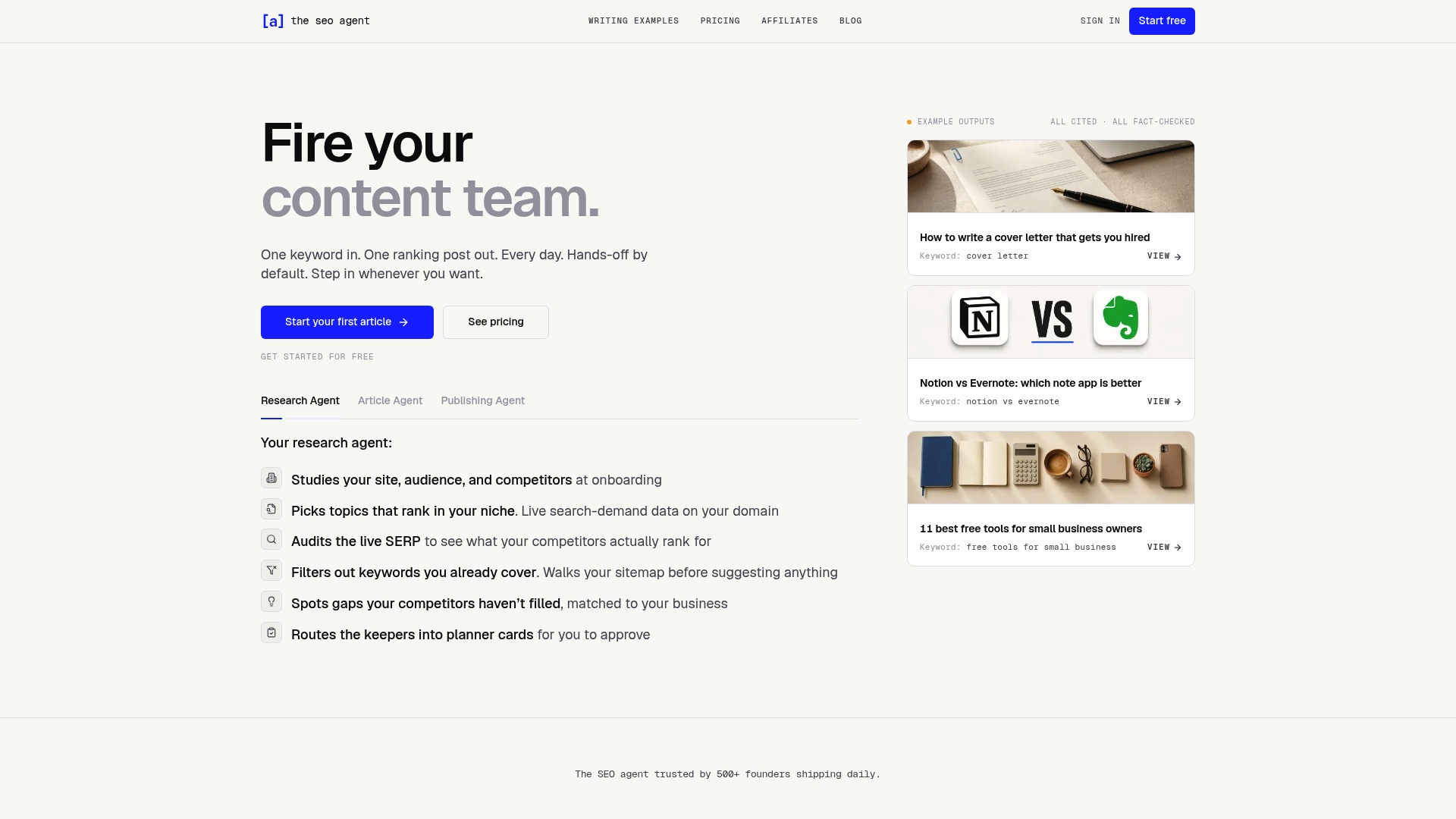
The SEO Agent handles the parts of SEO content production that most AI writers leave unfinished. From automated SEO title and meta description generation to daily optimized blog posts built from live SERP data, the platform reduces hands-on time for founders who need consistent output without a full content team. The SEO automation features cover keyword research, content briefs, fact-checking, schema markup, and CMS publishing in a single pipeline. For Shopify merchants, the dedicated Shopify SEO automation app brings the same automation directly into your store’s content workflow, covering product and category page optimization without manual effort.
Frequently asked questions
What are the main types of AI content tools for SEO in 2026?
AI content tools in 2026 fall into three types: general-purpose LLM writers for drafting, marketing and copy optimizing tools for brand-consistent content, and editing and refinement tools for polishing. Choosing the right type depends on where your workflow actually slows down.
Why should I consider total workflow cost when choosing AI content tools?
Many AI writing tools lack built-in SEO features, so you end up paying for a separate SEO optimizer on top of the base price. Total spend can jump from $16 to $75 or more per month once you add the tools required to produce genuinely rankable content.
What makes GetGenie AI stand out for WordPress users?
GetGenie AI integrates AI writing, SERP competitor analysis, NLP keyword suggestions, and real-time content scoring directly inside the WordPress editor. Unlike other AI writing platforms, it doesn’t require a separate SEO tool to deliver on-page optimization quality.
How can I avoid paying for unnecessary AI tools?
Identify your specific content workflow bottleneck first, whether that’s drafting speed, conversion copy, or editing quality, then test free versions before upgrading. Buying a tool because it’s popular, rather than because it addresses your specific gap, is where most small business budgets leak.
Can AI content tools replace human editors?
AI tools assist with drafting and polishing, but human editing remains essential for verifying facts, maintaining brand voice, and catching hallucinations. Expert review checklists are a standard safeguard in professional AI-assisted content workflows to protect SEO credibility and accuracy.